The TALOSBO C1 Is the Best Budget Robotic Pool Cleaner for a Simple Pool
Price rule: Every price used for this page was a recorded snapshot rather than a live offer, so a cleaner qualifies only while its checkout price remains within the stated budget.
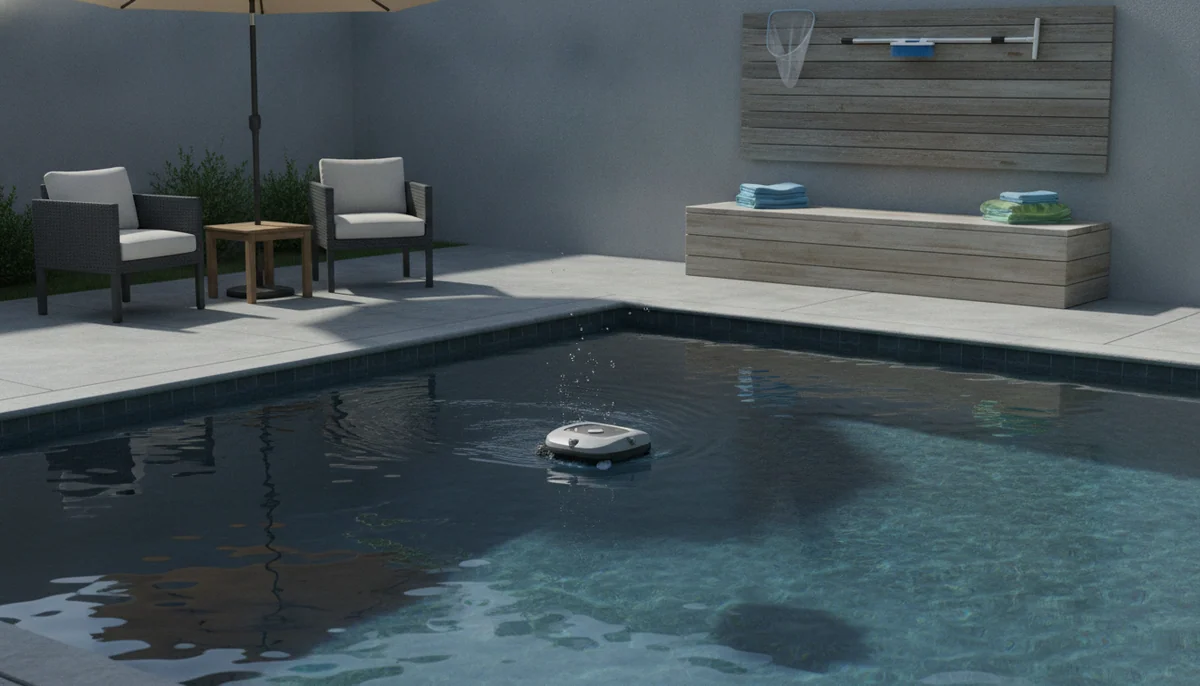
The TALOSBO C1 wins because it makes the most convincing case for cleaning the whole pool without spending the entire budget. Its tracked chassis can climb suitable walls, its basket and foam layer address both ordinary debris and finer material, and its owner record supports useful pickup of sand, silt, leaves, pollen, and dirt. The recommendation is deliberately narrower than the marketing: it is a good value for a rectangle, round pool, or another predictable shape, not a robot that understands every pool it enters.
Navigation is the catch. The C1 follows preset behavior rather than building a persistent map, so an oval, freeform deep end, raised ladder pad, bowed wall, or awkward transition can consume the battery while part of the pool remains untouched. Its advertised 180-minute ceiling also belongs to Eco mode; a full-pool cycle is much shorter.
Buy the TALOSBO C1 if
Your pool has an open floor and conventional walls, routine debris is the main problem, and you accept that retrieval, filter rinsing, drying, and charging remain manual chores.
Choose something else if
Your pool has broad steps, a tanning ledge, several depth transitions, heavy leaf fall, or a strong need for proven replacement parts and long-term service.
A small, flat above-ground pool does not need the winner’s wall hardware. The PoolMr is the smarter floor-only value there, while the cheaper AIPER Scuba 2025 is a narrower option for a taut liner and scattered loose debris. The updated Aiper Scuba S1 has the strongest fine filter in this group, but it spends the whole budget and still struggles with complicated geometry. The BUBLUE F10 belongs in another category entirely because it skims floating debris and never cleans the pool floor.
At a Glance: All Robotic Pool cleaners under 500 Compared
| Feature | Editor's Pick TALOSBO C1 | ZYERCH Robotic Pool vacuum | Aiper Scuba 2025 | BOTLUXE PC10 | IGarden K36 | IGarden KN35 | Lodoba SAT25 | WYBOT B1 | WYBOT A1 | BUBLUE F10 | Nepturox SAT25 | PoolMr cordless Robotic Pool cleaner | BUBLUE Bubot 300P | WYBOT C1 | Aiper Scuba N1 renewed | (2026 Upgrade) Aiper Scuba S1 |
|---|---|---|---|---|---|---|---|---|---|---|---|---|---|---|---|---|
| Price Range | $200–$500 | Under $200 | Under $200 | $200–$500 | Under $200 | $200–$500 | $200–$500 | Under $200 | $200–$500 | Under $200 | $200–$500 | Under $200 | Under $200 | $200–$500 | $200–$500 | $200–$500 |
| Claimed runtime | Up to 180 minutes in Eco mode; approximately 90–100 minutes in Full Pool mode | Up to 150 minutes | Up to 95 minutes | Up to 120 minutes | Up to 220 minutes for the floor, with materially less time in full-coverage mode | Up to 210 minutes | Up to 190 minutes | Up to about 120 minutes in eco floor mode | — | — | Up to 150 minutes | Up to 120 minutes per charge | Up to 90 minutes | Up to 160 minutes | Up to 150 minutes | — |
| Check Price on Amazon | Check Price on Amazon | Check Price on Amazon | Check Price on Amazon | Check Price on Amazon | Check Price on Amazon | Check Price on Amazon | Check Price on Amazon | Check Price on Amazon | Check Price on Amazon | Check Price on Amazon | Check Price on Amazon | Check Price on Amazon | Check Price on Amazon | Check Price on Amazon | Check Price on Amazon |
The complete ranking
The first five positions offer a defensible use case, although only the winner covers a broad full-pool assignment at a strong recorded value. The lower ranks are not consolation prizes: several are products Smart Pool Bots would actively skip.
1. TALOSBO C1 — The TALOSBO C1 is the best overall value for a conventional pool.
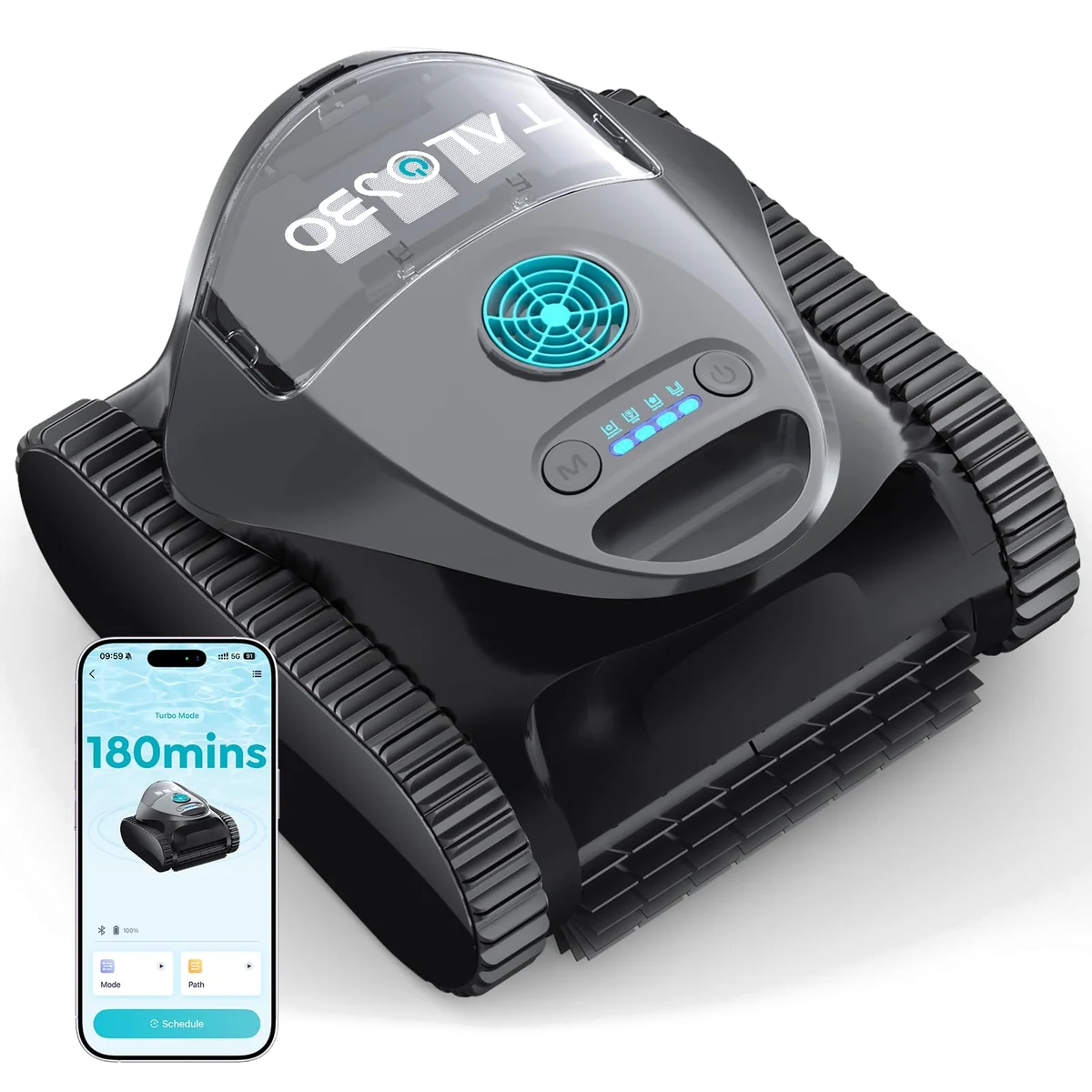
Its two-stage filtration, credible routine-debris pickup, tracked wall climbing, and recorded midrange price make it the most balanced full-pool cleaner here.
It does not build a persistent map, so ovals, freeform deep ends, raised fixtures, bowed walls, and narrow steps can turn a long cycle into incomplete coverage.
The 180-minute headline belongs to Eco mode, while Full Pool operation is closer to 90 to 100 minutes. The basket handles larger material and the foam layer helps with fines, although a loaded or restrictive filter can reduce wall traction. Treat the app as an above-water setup and firmware panel rather than an underwater remote, and test the route through every awkward transition before the return window closes.
Strengths
- It has credible pickup for leaves, sand, silt, insects, dirt, grass, pet hair, and other settled debris.
- Its tracks usually provide useful wall climbing on conventional vinyl and plaster surfaces.
- Eco mode can approach three hours, giving the robot time to compensate for some repeated movement.
- The top-load basket and secondary foam are easy to reach without turning the robot over.
Limitations
- Preset routes can repeat cleaned areas, miss patches, and perform poorly in oval or irregular pools.
- The app does not maintain an underwater connection and feels unfinished to some owners.
- The thin basket and secondary foam can require careful alignment and two-part cleaning after every run.
- Long-term battery health, replacement-part access, and even the stated warranty term remain unclear.
2. ZYERCH Robotic Pool vacuum — The ZYERCH SAT20 is a cheap full-pool experiment rather than a dependable primary cleaner.
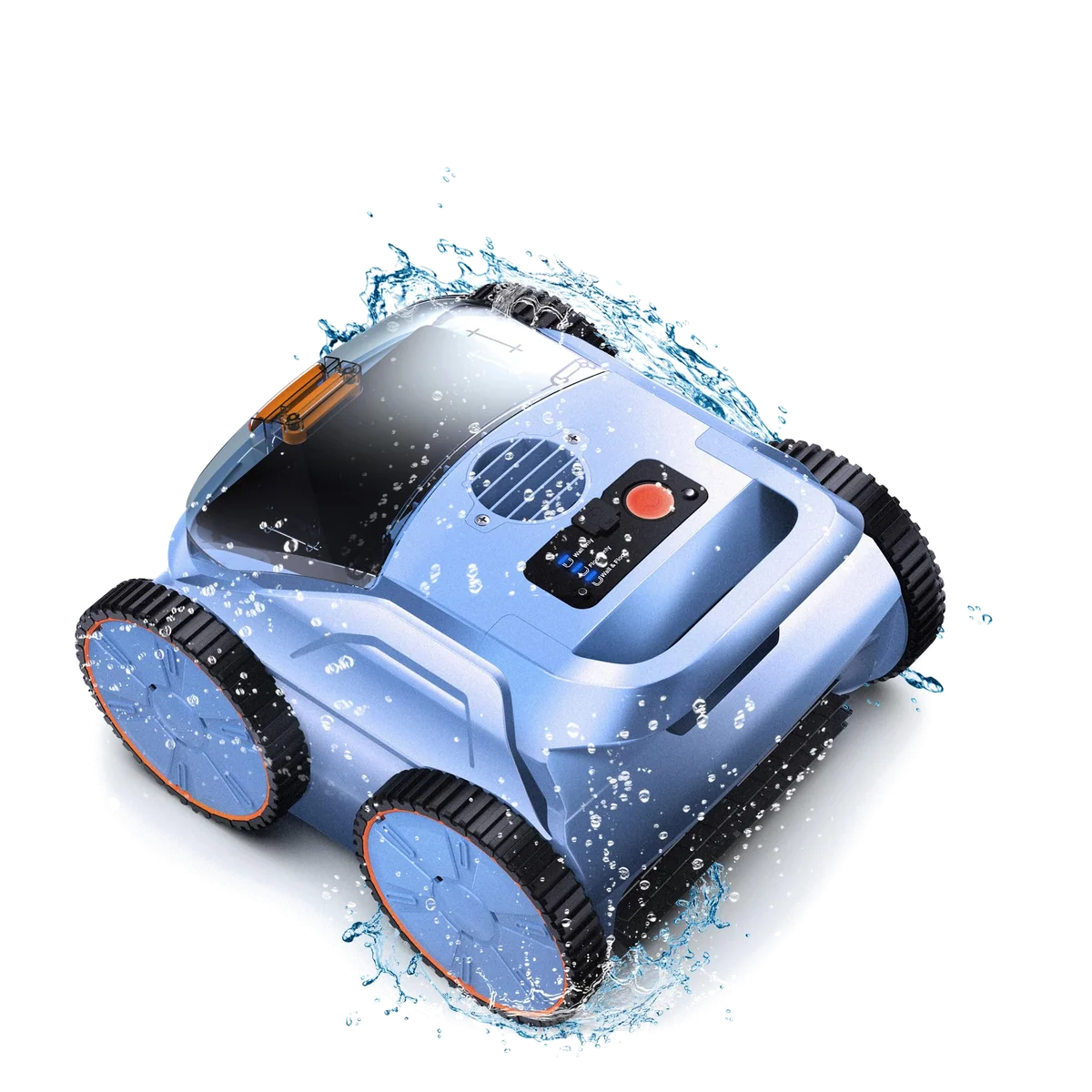
Healthy units can collect substantial dirt and climb walls, but a good first season is not enough to overcome the concentrated breakdown record.
Charging failures, severe runtime loss, repeated lanes, drain hang-ups, and second-season deterioration make the low recorded price poor protection against replacement hassle.
The listing gives conflicting pool-size descriptions, and the ordinary 300-micron basket is not a persuasive answer for pollen or fine silt. Consider it only if the seller supplies unusually strong written warranty terms and an easy return route, because owner reports disagree on whether coverage lasts one year, three years, or longer.
Strengths
- Healthy units can climb walls and reach the waterline area.
- Some owners report strong routine dirt pickup on pebble and coarse gunite finishes.
- Onboard floor, wall, and combined modes avoid dependence on Wi-Fi.
- Cordless operation removes the hose and keeps debris in a separate basket.
- Two owners received complete replacement robots after charging failures.
Limitations
- Breakdowns and serious deterioration cluster around the transition to a second season.
- Reported navigation failures include repeated lanes, wall stalls, missed areas, and drain hang-ups.
- One exact owner measured only 45 to 50 minutes from a full charge.
- Leaf pickup is inconsistent even when debris remains visible on the floor.
- Reported warranty terms conflict, and post-window support access is not assured.
- The listing contradicts itself about the maximum pool size.
3. Aiper Scuba 2025 — The AIPER Scuba 2025 is the cheapest acceptable helper for a small, flat pool.
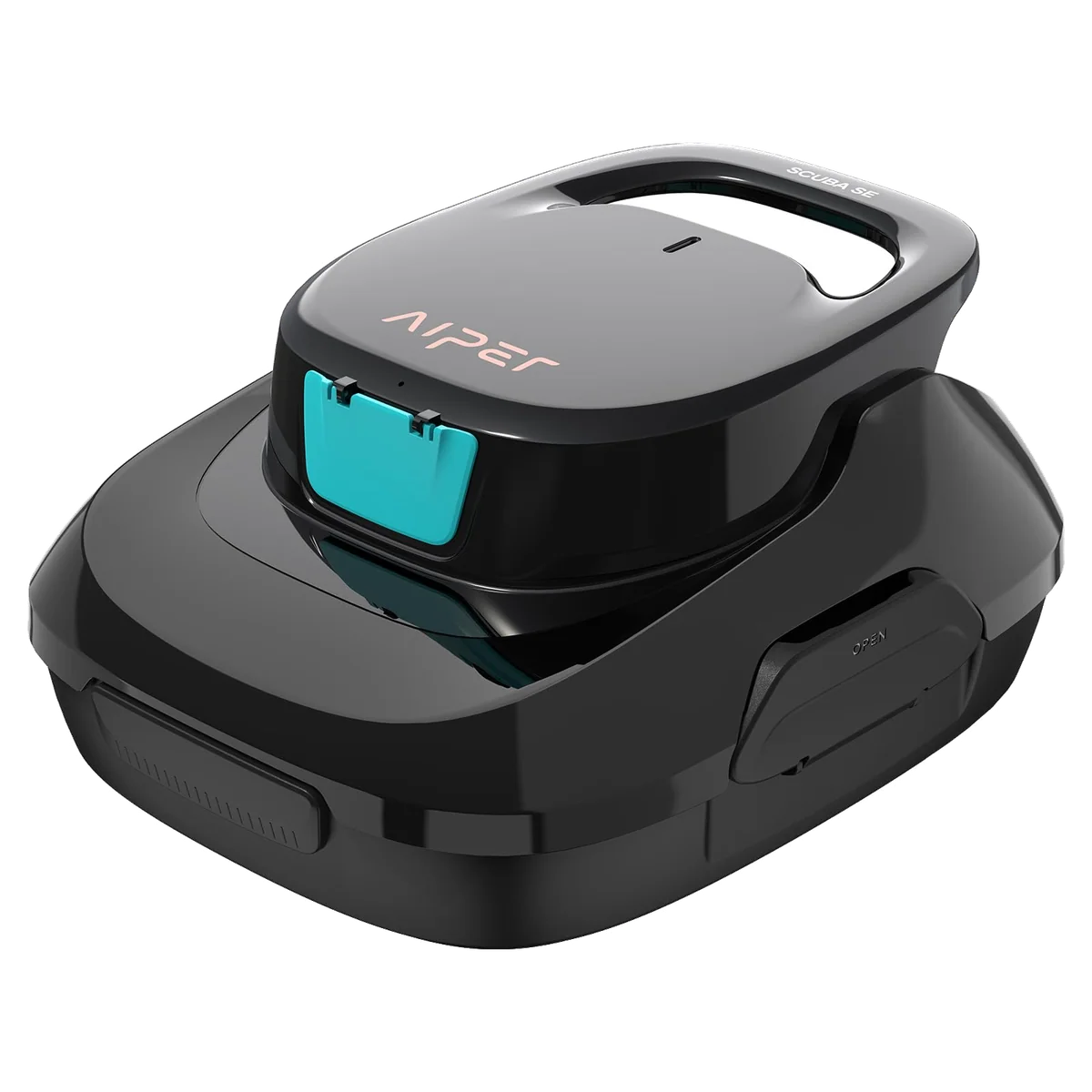
It is a sensible charge-and-drop floor cleaner for scattered leaves and ordinary loose debris in a smooth, taut-lined above-ground pool.
Random movement, no wall cleaning, weak fine-particle retention, liner-wrinkle stalls, and exact reports of early battery trouble keep the assignment narrow.
This is the 95-minute Scuba 2025, not a Scuba S1, N1, Scuba 800, or Seagull. One owner reported runtime close to the stated ceiling, while another unit died in the middle of a round pool and battery replacements created repeated inconvenience. Auto-parking means an attempt to stop near an edge, not a dock or guaranteed retrieval point.
Strengths
- The cordless routine removes suction-hose and operating-cable setup.
- It can collect leaves and ordinary loose bottom debris on a suitable smooth floor.
- Exact-product owners describe the cleaner and its filter as easy to remove and rinse.
- Aiper sent no-cost replacements in two retained owner cases.
Limitations
- It is a floor cleaner with no supported wall, stair or waterline mode.
- Random movement can miss sections or leave the cleaner discharged in the middle.
- Wrinkles and uneven liner areas can strand its small chassis.
- Fine material may remain on the floor or be stirred back into the water.
- Exact-product reviews include early battery failure and a replacement that would not turn on.
4. BOTLUXE PC10 — The BOTLUXE PC10 cleans capably but asks buyers to trust too many unresolved ownership terms.
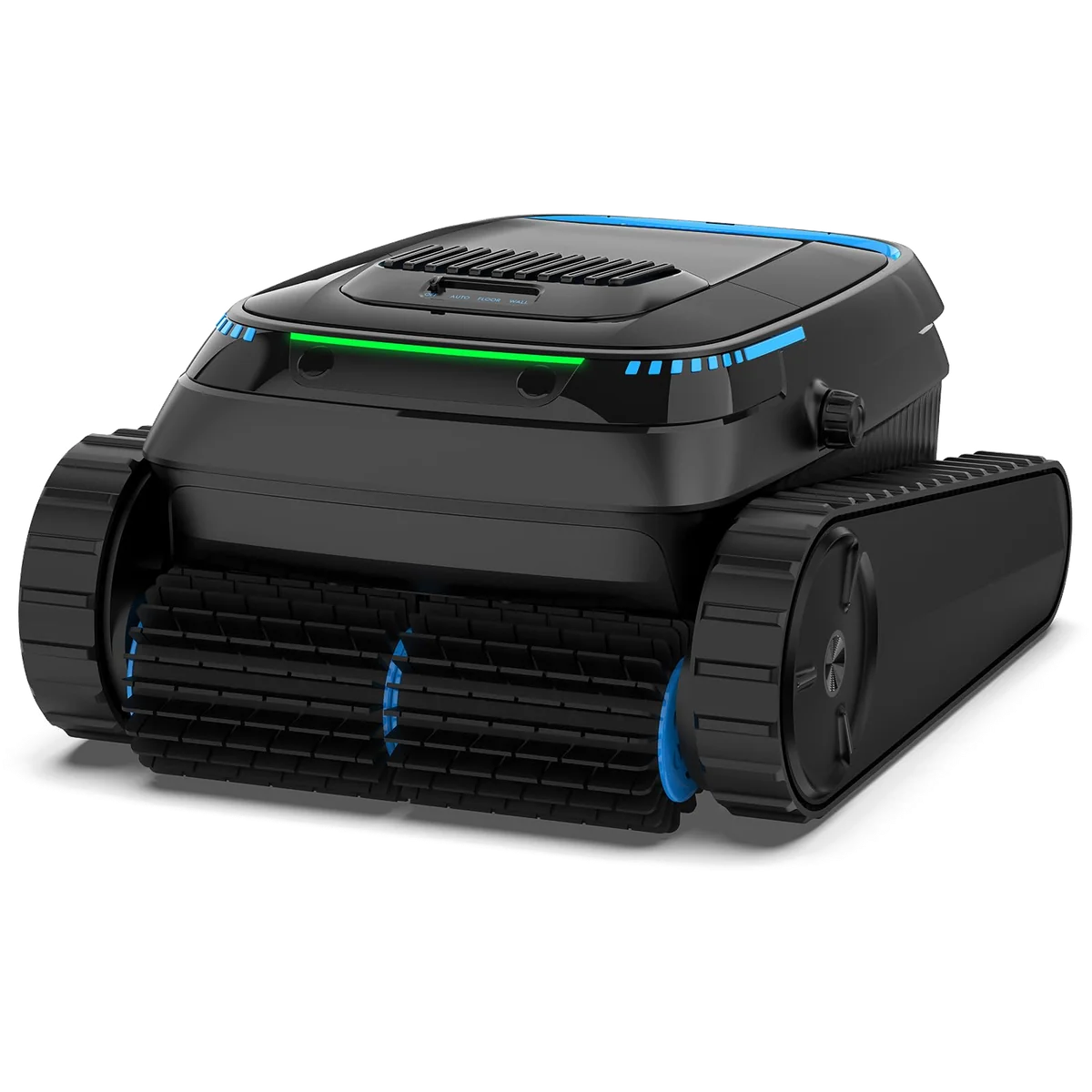
Its large top basket, simple physical modes, and credible floor, wall, stair, and waterline cleaning show that the machine can perform in a suitable pool.
An early total failure, inconsistent runtime, unreliable deep-end parking, unclear support, and an owner-reported nonreplaceable battery make it a weak long-term purchase.
The 150-micron basket looks good on paper, but filtration cannot rescue a cleaner when the battery or drive system lacks a clear service path. The PC10 is worth considering only if warranty responsibility, replacement parts, battery terms, and return shipping are supplied in writing.
Strengths
- The physical mode selector makes setup unusually simple.
- The cordless body avoids hoses and a floating power cable.
- Several exact owners report strong floor, wall, stair, and waterline cleaning.
- The 4 L top-access basket is repeatedly described as easy to rinse.
- Auto, Floor, and Wall modes give useful control without requiring an account or app.
Limitations
- Exact-owner runtime ranges from about one hour to more than two hours.
- Parking near an edge can still leave the cleaner inaccessible in a deep end.
- Fine sand and dead-algae pickup are inconsistent.
- One exact unit stopped moving in under three months, while another behaved badly from its first cycle.
- Warranty responsibility, parts availability, and battery replacement remain insufficiently clear.
5. IGarden K36 — The iGarden K36 is the endurance pick that needs an acceptance test.
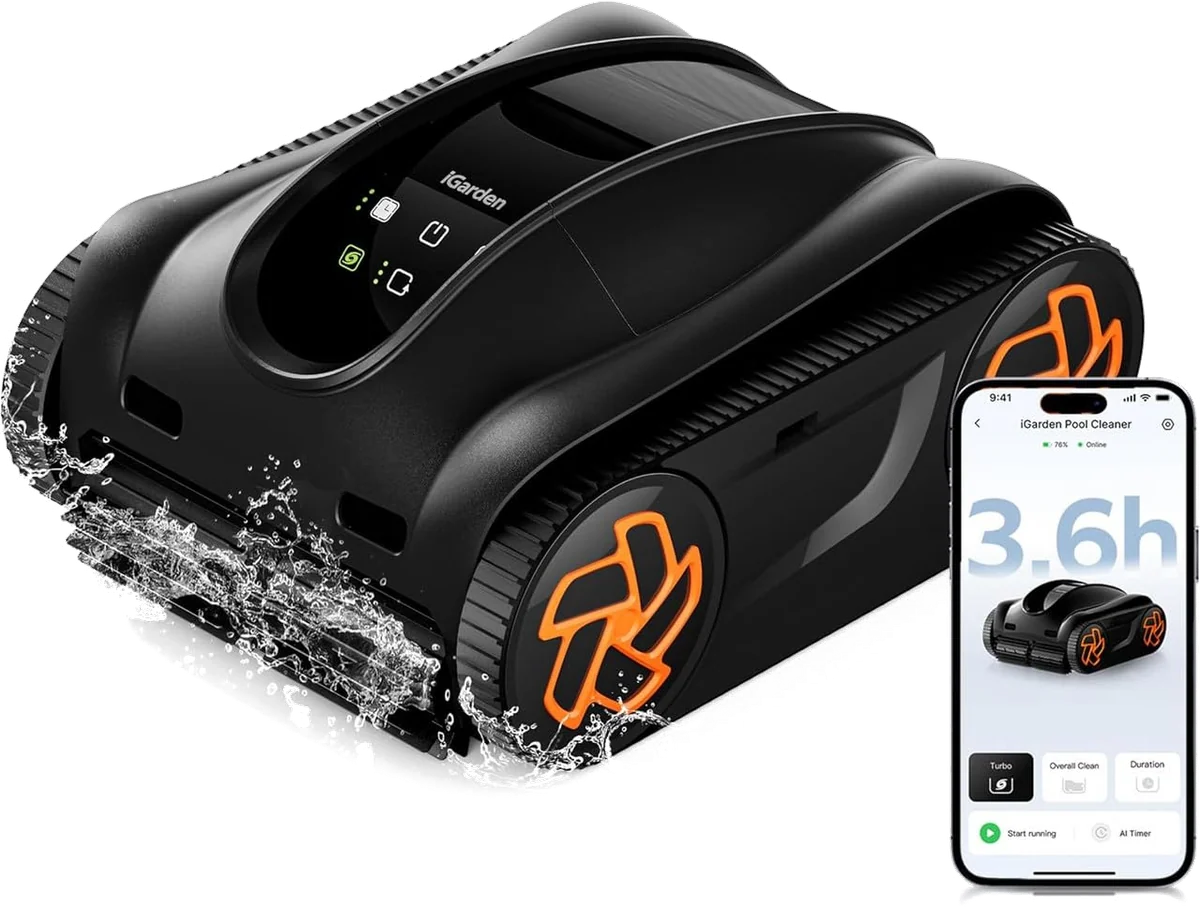
Healthy units provide unusually long floor cycles, useful ordinary-debris pickup, credible wall access, physical controls, and a large top-loading basket.
Inconsistent exact-unit behavior, awkward wet retrieval, missed strips, app limitations, and a hot charging-brick report prevent a confident recommendation without a competitive checkout price.
The advertised maximum applies to floor-only operation, while full-pool runtime is shorter and inconsistently stated. Its approximately 21.6-pound dry body becomes more demanding before it drains, and the dark shell can be difficult to locate in deep water. Charge it on a heat-safe, ventilated surface and dry the charging area thoroughly.
Strengths
- Healthy units provide unusually long floor-only endurance for a cordless cleaner.
- The 4-liter top-loading basket handles routine leaves, insects, hair, sand and settled dirt well.
- Physical controls keep normal cleaning available without an app account.
- The robot can climb suitable walls and reach the waterline when traction and flow are favorable.
- Cordless operation removes the floating cable and external power supply from the cleaning cycle.
- Customer support has a documented pattern of responding with troubleshooting, refunds and replacements.
Limitations
- Direct owners report serious first-unit faults, including flipping, wheelies, short runtime and an Error 3 failure.
- Its organized navigation can still leave wide strips, corners, steps and ledges untouched.
- Full-coverage runtime is much shorter than the headline floor-only maximum, and iGarden publishes conflicting figures.
- The app cannot steer, recall or meaningfully monitor the robot underwater.
- Retrieval is awkward because the cleaner is heavy, dark underwater and easy to catch in the wrong place.
- The charging port requires careful drying, and one tested power brick became hot enough to damage a table finish.
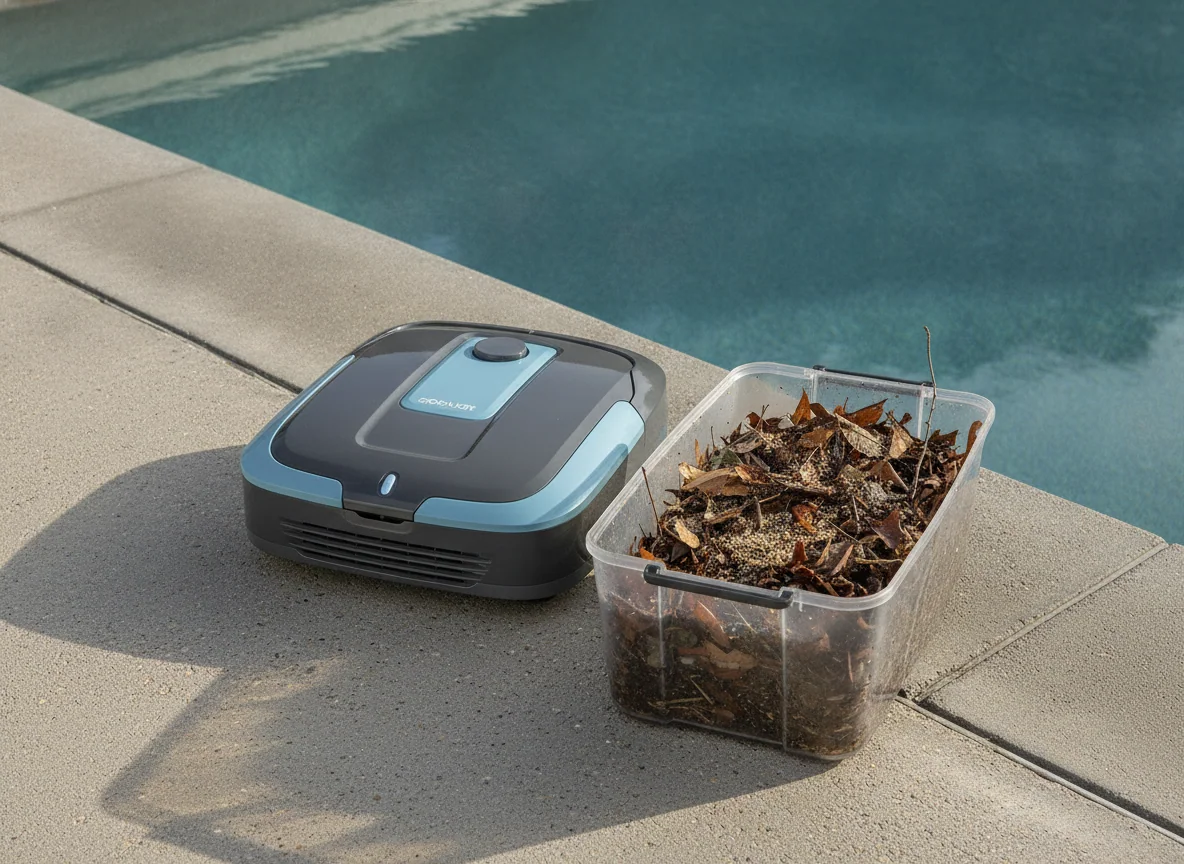
6. IGarden KN35 — The iGarden KN35 is the better long-runtime choice for a simple open pool.
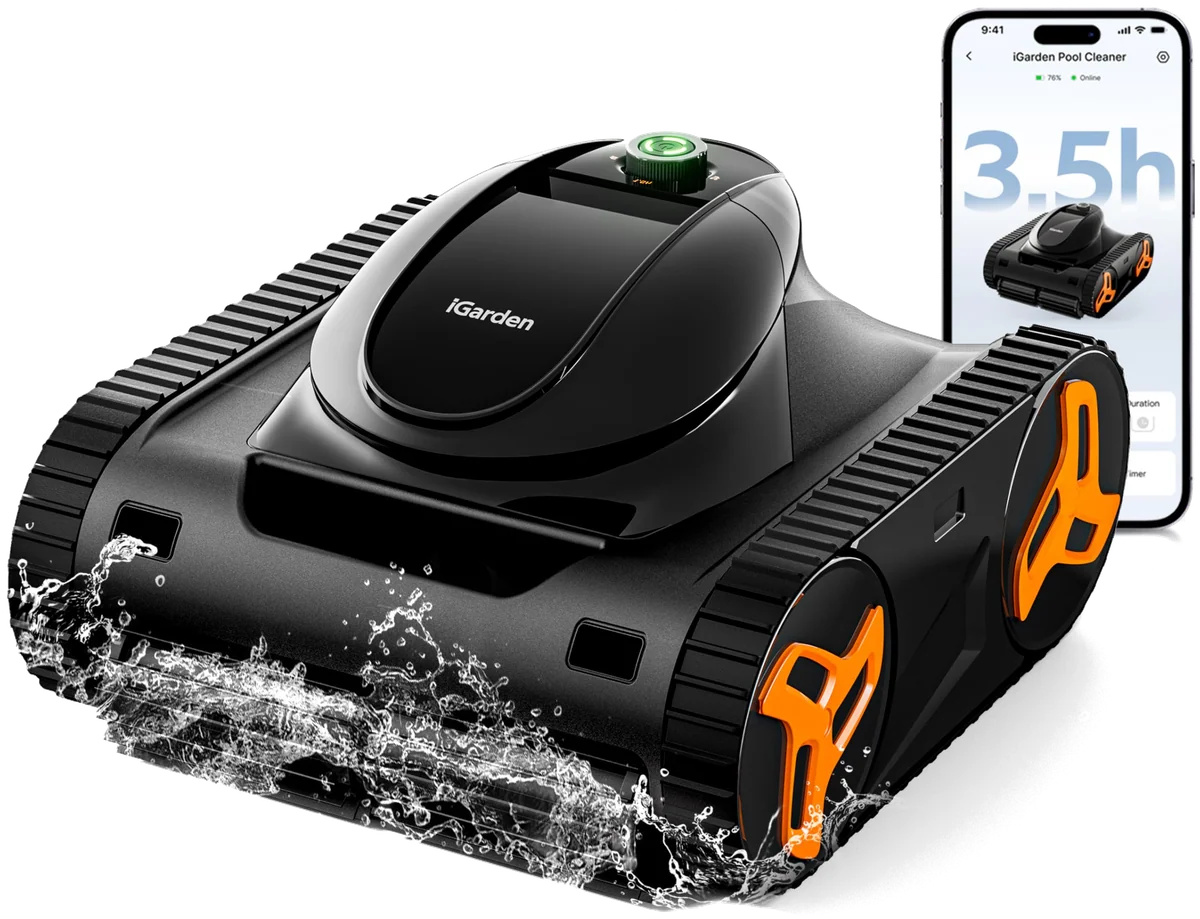
Selectable cycle lengths, a 210-minute stated ceiling, routine sand and small-leaf pickup, and a listing that states two-year replacement protection make it a credible alternative to the winner.
Steps, tight corners, ladder gaps, raised drains, large leaves, and a review population contaminated by other iGarden configurations weaken the apparent certainty.
The KN35 can clean floors, conventional walls, and the waterline, but its side parking is a random reachable position rather than a return to the launch point. The app disconnects underwater by design, so use it for setup rather than live steering. Its stronger aggregate rating is encouraging, not proof of multi-season battery or parts durability.
Strengths
- Cordless deployment eliminates the hose and floating power cable from routine cleaning.
- The selectable cycle lengths make the large advertised battery capacity useful for both quick and extended maintenance.
- Owner reports support capable floor, wall and waterline cleaning in pools without troublesome geometry.
- The 3.2-liter top basket is large enough for ordinary maintenance loads and easy to rinse.
- Floor-only and broader coverage modes let the owner match energy use to the actual chore.
Limitations
- Steps, tight corners, ladder gaps and raised floor fixtures can remain dirty or trap the robot.
- Large leaves and adhered fine silt are less dependable targets than loose dirt and smaller debris.
- The app disconnects underwater, so it cannot steer, recall or reconfigure the robot during a cycle.
- Wet retrieval can demand real effort, and a little collected material may fall back during draining.
- The exact KN35 lacks a convincing long-term record for battery life, repairability and replacement-part access.
7. Lodoba SAT25 — The Lodoba SAT25 is a plausible full-pool cleaner with too many blank spaces.
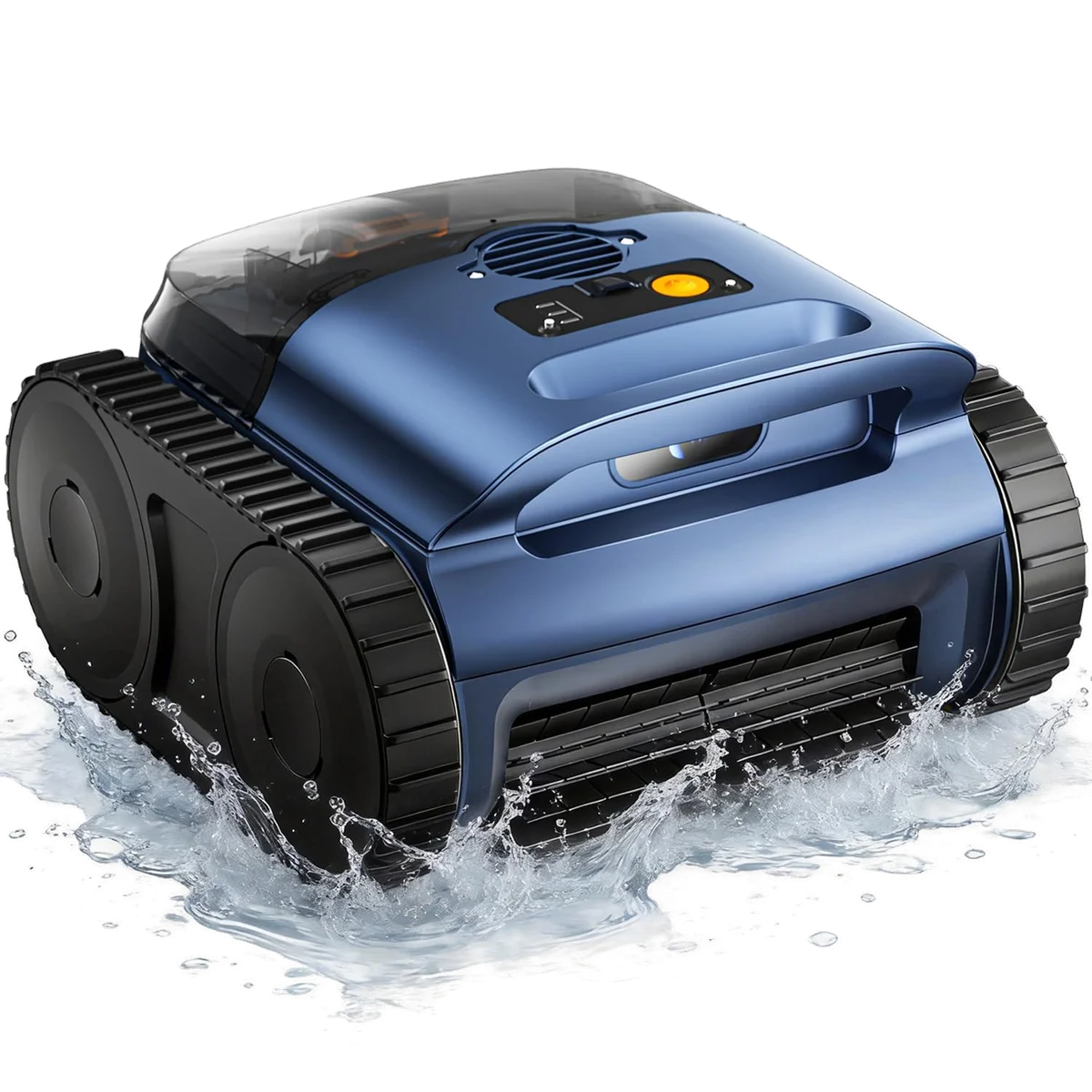
Its ordinary leaf and dirt pickup, wall climbing, waterline contact, tracked drive, and targeted modes make it a conditional experiment for a simple rectangle or oval.
Fine filtration, exact coverage, battery service, parts, warranty responsibility, and long-term support remain too thinly documented for a top recommendation.
The listing’s drain and skimmer language should not be read as proof that the robot cleans inside a skimmer, deliberately services a main drain, or removes floating debris. Its sonar wording also does not establish a stored map. The TALOSBO C1 has the stronger direct cleaning record and a lower recorded price.
Strengths
- Cordless setup avoids hoses, floating cables, and cable tangles.
- Exact-model reporting supports useful pickup of ordinary leaves, dirt, bugs, and some sand.
- Tracked wall climbing and waterline contact appear credible on conventional straight walls.
- Separate floor, wall, and full-coverage modes make routine cleaning easier to target.
- The top-access cleaning routine appears simple enough for frequent use.
Limitations
- Fine silt, pollen, and powdery debris may escape or resettle.
- No controlled SAT25 test establishes runtime, coverage, filtration, stair performance, or wet lifting weight.
- Warranty terms, battery replacement, spare parts, and repair support remain unresolved.
- A depleted battery prevents an immediate full second cycle during heavy debris events.
- The drain and skimmer language is broader than the demonstrated cleaning behavior.
- Curved steps, ledges, and freeform transitions may still require manual touch-up.
8. WYBOT B1 — The WYBOT B1 is lightweight full-pool hardware with heavyweight uncertainty.
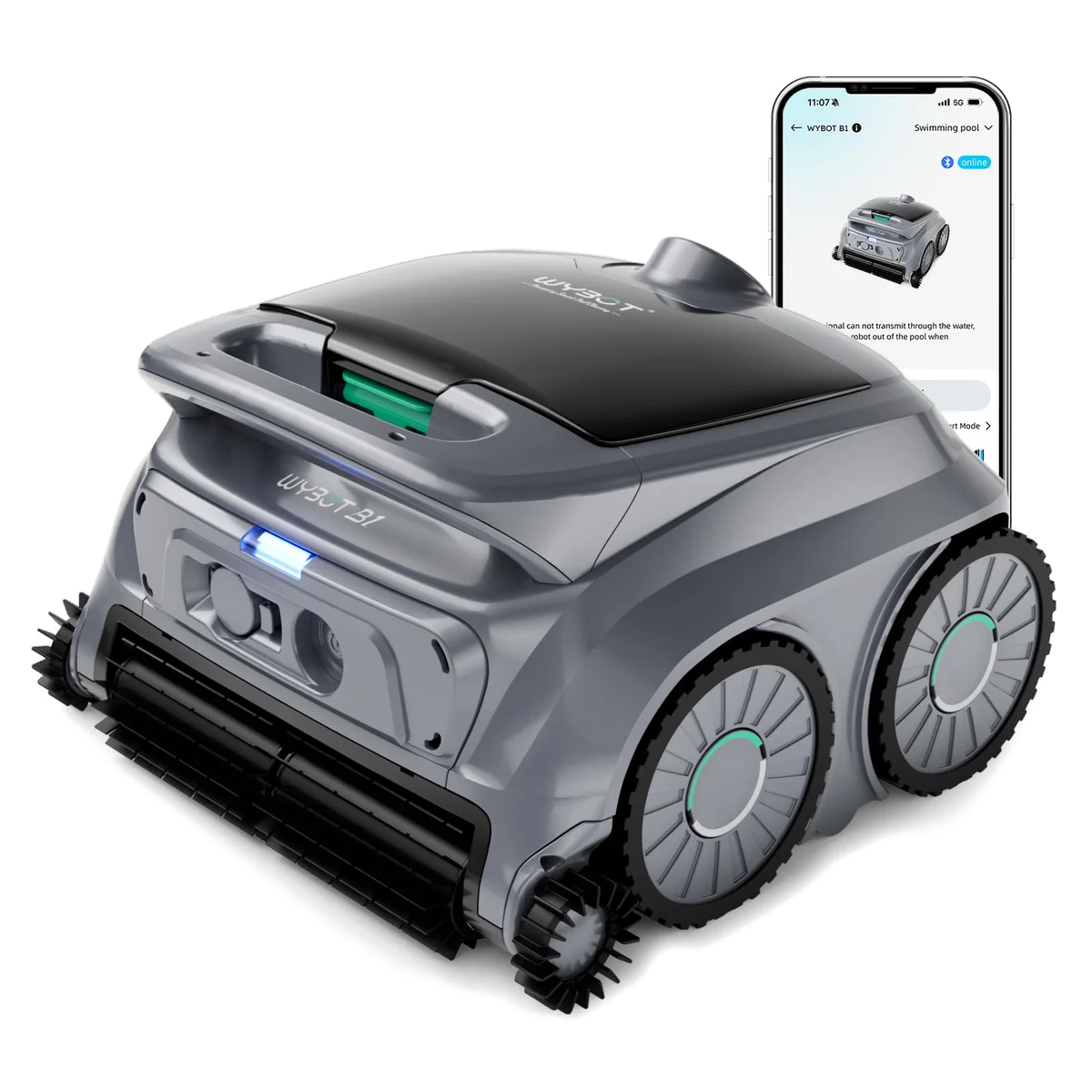
Its approximately 14-pound dry body, credible ordinary-debris pickup, obstacle crossing, wall climbing, and waterline reach suit a small uncomplicated pool.
Coverage splits sharply by pool, the hood can be awkward to open, debris may spill during retrieval, and one exact unit failed after two months with no useful support.
The B1’s low weight is its clearest advantage over larger tracked robots. That benefit does not settle missed areas, inconsistent wall behavior, limited fine filtration, or unknown value because no usable recorded price was established. Consider it only when easy lifting matters more than complete coverage and the retailer, rather than the manufacturer alone, protects the purchase.
Strengths
- At roughly 14 pounds dry, the B1 is relatively easy to carry for a robot that attempts full-pool cleaning.
- Cordless operation removes cable drag, tangles, and the need to position a transformer near the pool.
- Direct evidence supports useful pickup of leaves, bugs, sand, pebbles, and ordinary settled dirt.
- It can climb vertical walls, reach the waterline, cross a raised drain, and park near an edge.
Limitations
- Coverage can become repetitive or incomplete in pools with slopes, steps, shelves, or awkward corners.
- The 180-micron basket lacks the ultra-fine secondary filtration needed for serious silt or water-polishing work.
- The app-dependent mode selection, unlabeled controls, and absence of a weekly timer limit the “smart” claim.
- The hood latch is awkward enough to turn routine basket cleaning into a daily annoyance.
- A direct two-month failure and recurring WYBOT support complaints make the easy-return policy part of the product.
9. WYBOT A1 — The WYBOT A1 charges nearly full-pool money for a floor-only assignment.
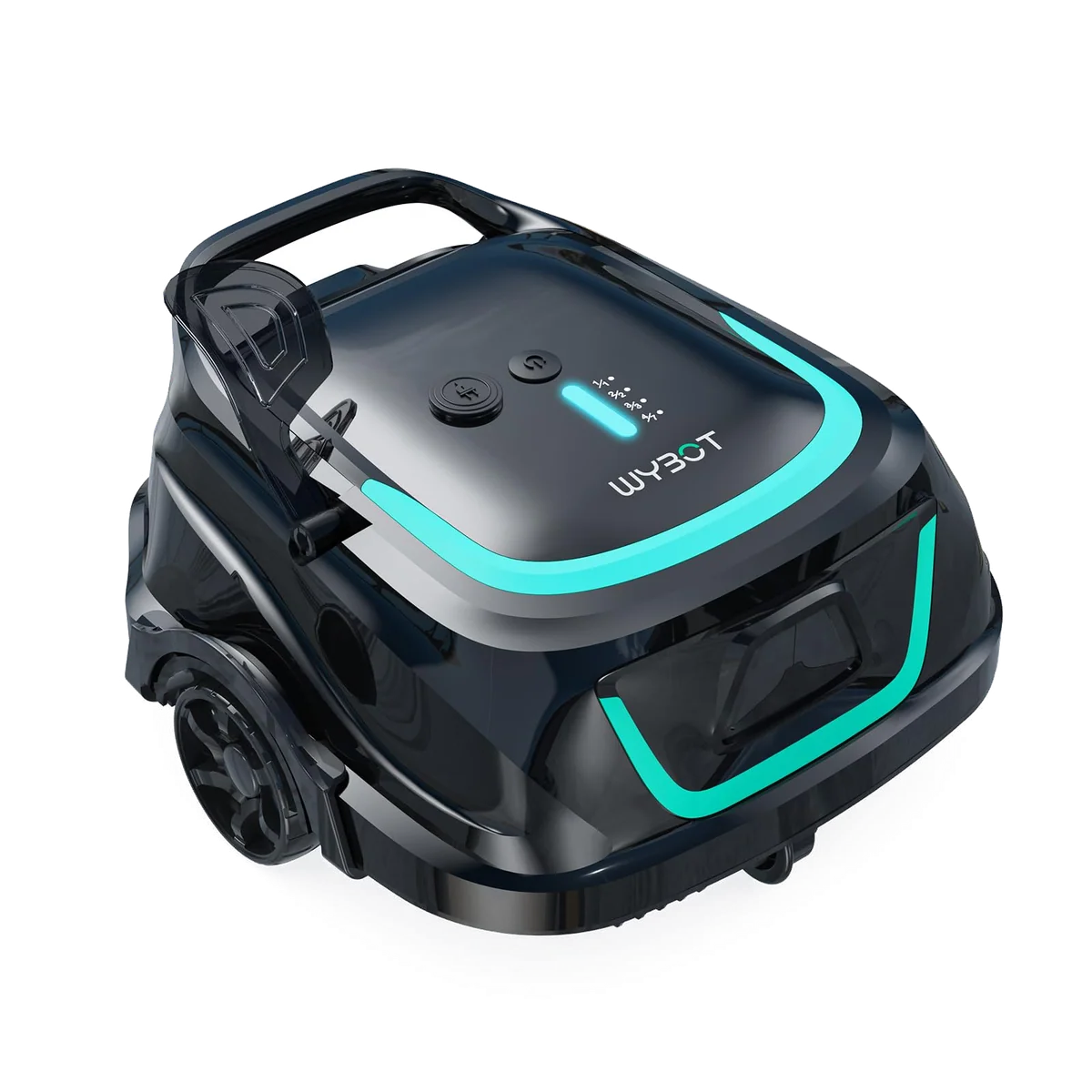
Its mesh-and-foam filter can collect loose sand, silt, insects, and small debris on a smooth, flat, obstacle-light floor.
No active brush, no walls, random routing, wrinkle and drain traps, inconsistent large-leaf pickup, and a recorded price close to better wall climbers make it poor value.
The exact revision is the WY26A1-PRO, so older A1 runtimes and warranties should not be transferred automatically. Its foam layer is useful, but the PoolMr performs the same broad floor-helper role for far less in the recorded data. Unless the actual checkout price is dramatically lower than the snapshot, the A1 has no persuasive place in this ranking.
Strengths
- The cordless body avoids a floating power cable, hose setup, and tangles.
- The dual-layer filter is useful for loose fine sediment that reaches the inlet.
- The light body is easier to lower and retrieve than many full-size corded robots.
- Filter rinsing is straightforward once the housing is aligned correctly.
Limitations
- Random travel can repeat routes while leaving other parts of the floor untouched.
- The lack of an active brush leaves attached algae and grime behind.
- Wrinkles, slopes, drains, ladders, and floor transitions can stop or trap it.
- Owners report early shutdowns, charging failures, broken clips, and other durability problems.
- It cannot clean walls or the waterline.
10. BUBLUE F10 — The BUBLUE F10 is a useful surface skimmer, not a pool vacuum.
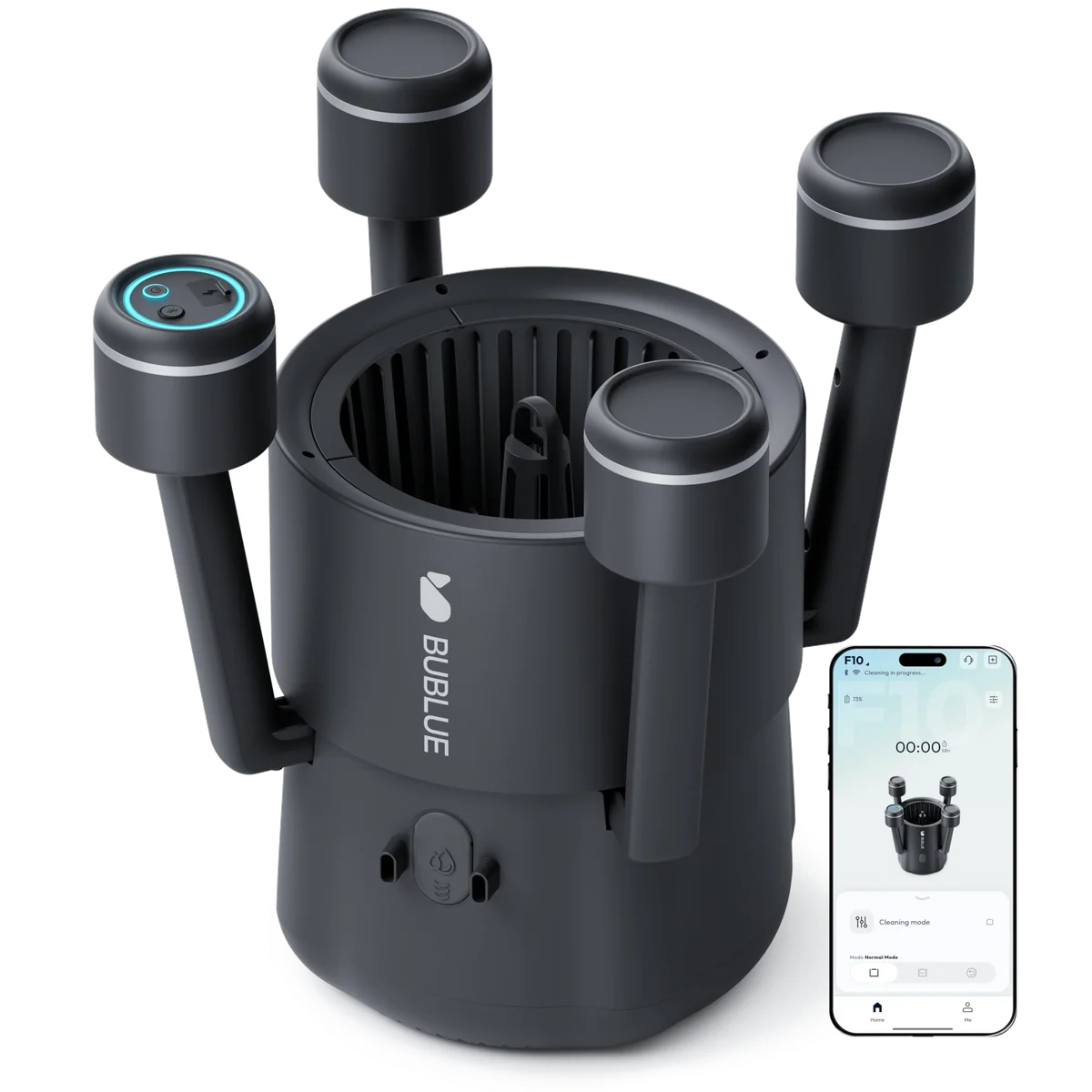
Its large basket and continuous surface collection make it a strong specialist for leaves, insects, flowers, and needles arriving throughout the day.
It does nothing for settled sand, walls, or the floor, and manual charging plus exact runtimes near an hour weaken the promise of all-day autonomy.
Buy the F10 only after deciding that floating material is the dominant problem and that a separate submerged cleaner will handle everything below. The app’s return-to-side command is not a charging dock, and sloping walls, steps, shelves, cords, and strings can still interfere. For direct category alternatives, see the site’s guide to the best robotic pool skimmers.
11. Nepturox SAT25 — The Nepturox SAT25 can clean well, but the purchase proposition is the failure.
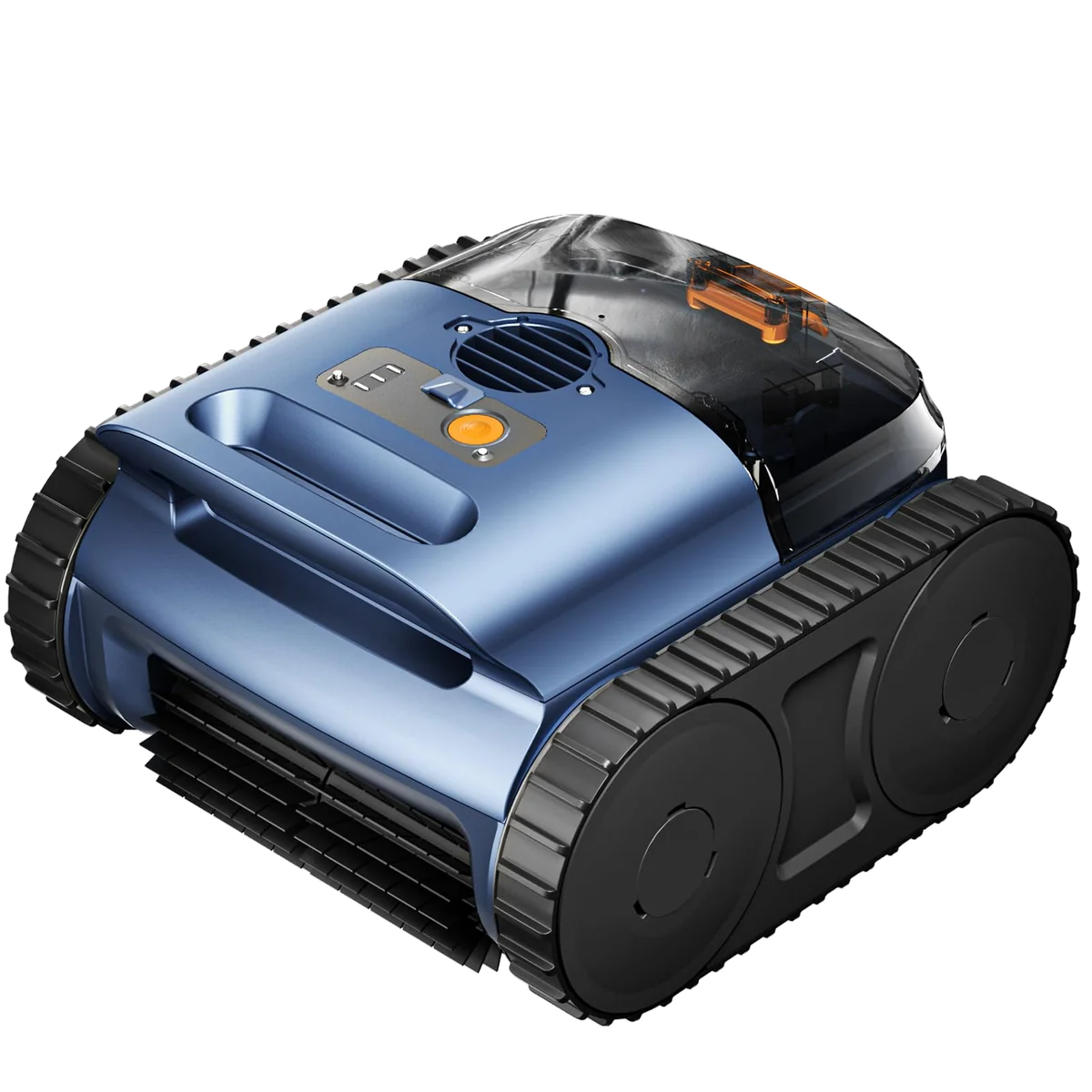
Working units can collect leaves, grit, sand, small particles, and ordinary debris while climbing suitable walls to the waterline.
Severe charging and electrical failures, unresolved support, route repetition, drain hang-ups, sediment resuspension, and unclear warranty terms make it a gamble at its recorded price.
Two retained owners received first units with serious electrical or charging problems, including one report of loud sparking at the connection. A replacement may solve an individual case without making the original purchase dependable. At the same recorded price, the iGarden KN35 presents a more defensible ownership case.
Strengths
- Cordless operation removes the hose or floating power cable from the cleaning cycle.
- Functional units show credible pickup of leaves, grit and routine settled debris.
- Track-driven wall climbing has stronger support than most of the listing’s other premium claims.
- Three physical cleaning modes keep operation simple for buyers who do not want an app.
Limitations
- Two retained owners received first units with severe charging or electrical failures.
- The warranty, replacement-parts supply and battery-service path remain unclear.
- Navigation can repeat areas or struggle around drains, stairs and skimmers.
- Fine-sediment performance is unsettled because pickup reports conflict with a resuspension complaint.
- Retrieval still requires lifting, draining, basket cleaning, dry-port charging and redeployment.
12. PoolMr cordless Robotic Pool cleaner — The PoolMr is the best inexpensive floor cleaner in this field.
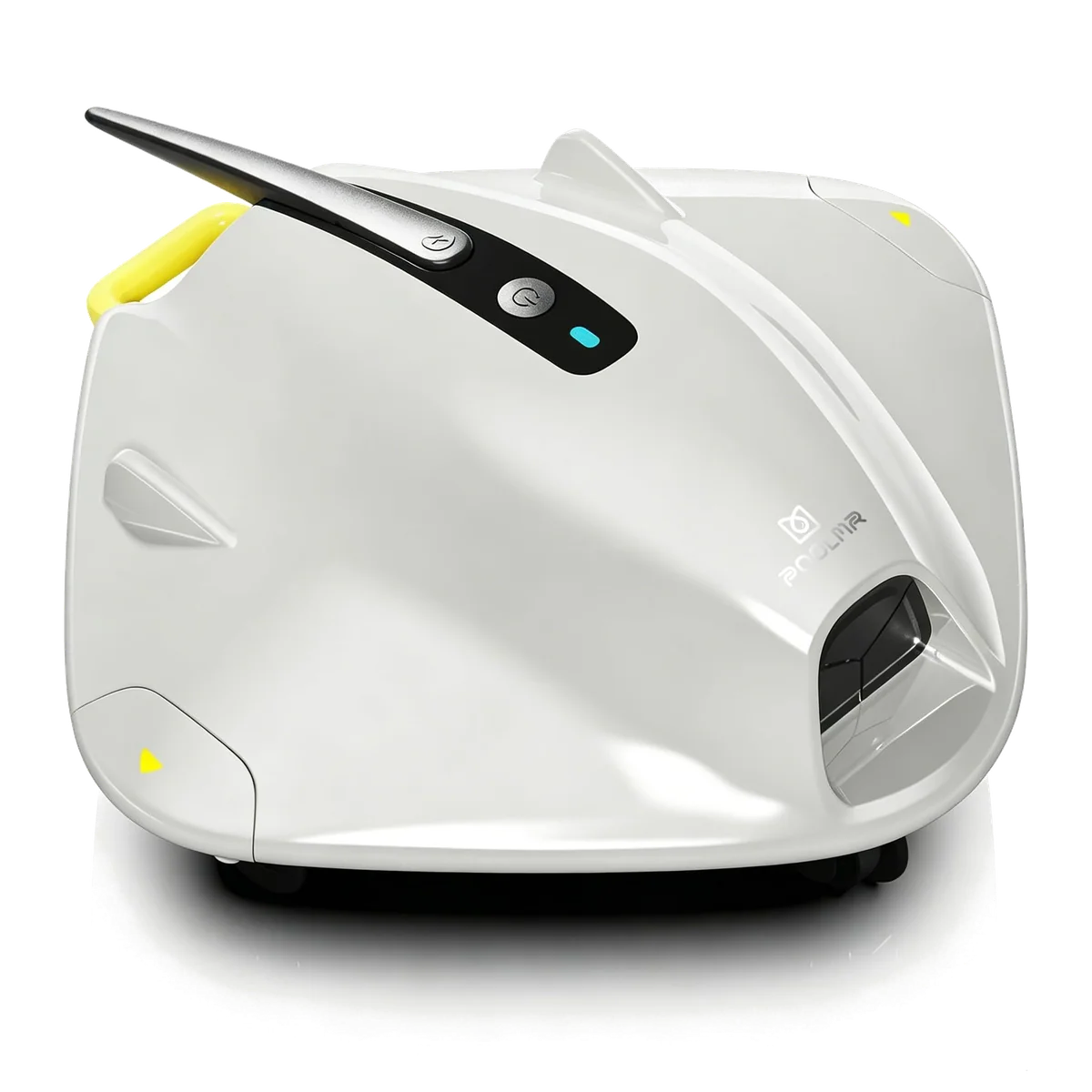
Its roughly two-hour supported use, mesh-and-sponge filtration, and credible pickup of dirt, sand, silt, twigs, and ordinary leaves make it valuable routine help for a simple above-ground pool.
It cannot deliberately clean walls, steps, or the waterline, and large leaves, ladder traps, one-run silt, and unverified replacement parts remain real limits.
The PoolMr costs more than the AIPER Scuba 2025 in the recorded data, but the extra runtime and secondary sponge make the case easier to defend. Keep a leaf net or manual vacuum for storms and precise cleanup. Its advertised maximum area is a compatibility claim, not proof of complete one-cycle coverage at that size.
Strengths
- The roughly two-hour runtime is supported by the most detailed exact-model owner account.
- The mesh-and-sponge filter gives fine dirt a better chance of staying captured than a coarse basket alone.
- Cordless operation removes cable management from routine floor cleaning.
- Owners report useful pickup of dirt, sand, silt, twigs and ordinary leaves.
- Edge stopping can place the robot within reach of the supplied retrieval hook.
Limitations
- Large leaves, heavy post-storm debris and algae-laden cleanup can overwhelm its fast single-speed approach.
- It does not claim wall, step or waterline cleaning.
- A ladder can trap it, and repeated passes are not the same as systematic mapped coverage.
- The advertised maximum area is not independently demonstrated by an exact-model owner.
- Replacement-charger, filter, battery, warranty and service details remain unverified.
13. BUBLUE Bubot 300P — The BUBLUE Bubot 300P loses its recommendation every time it stops moving.
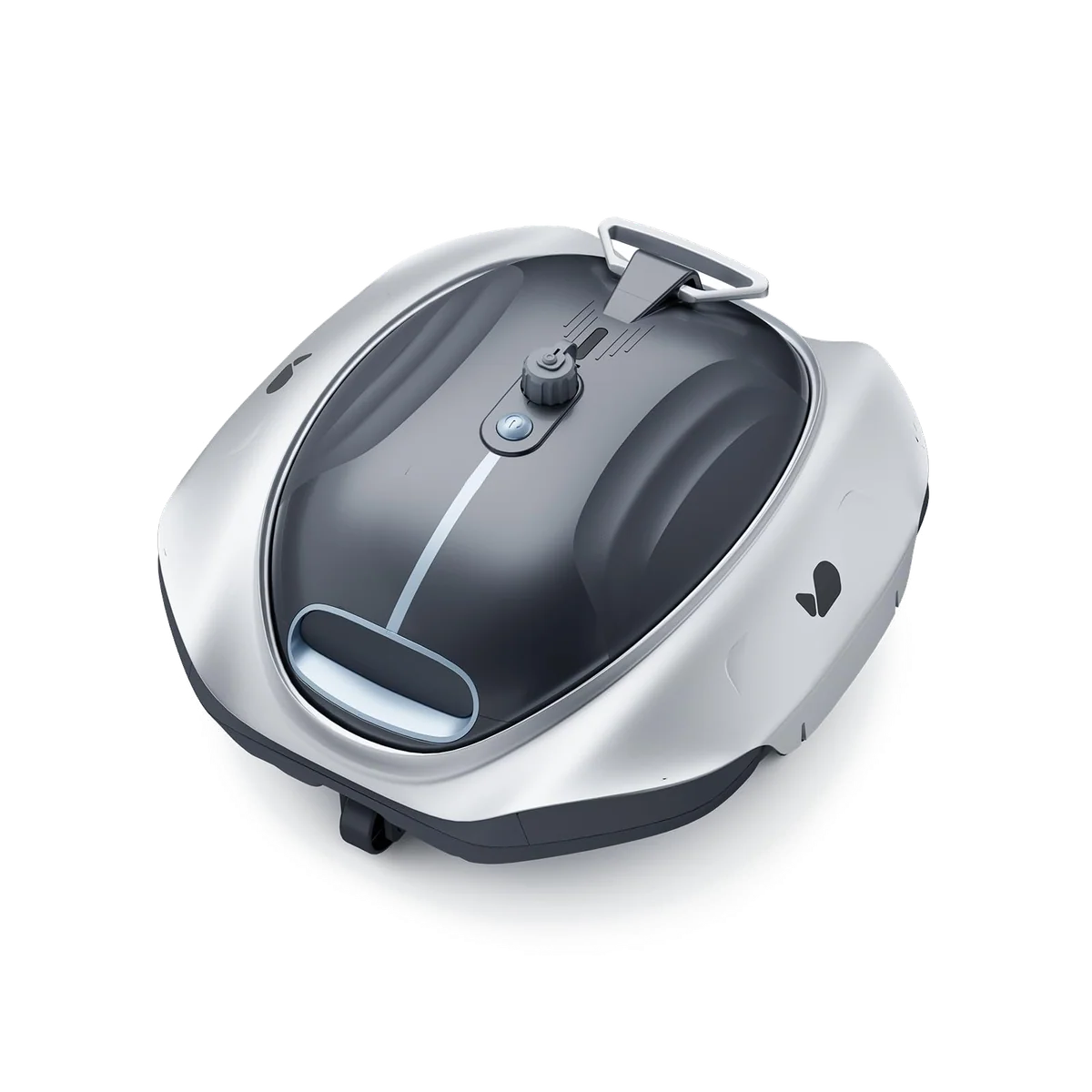
It is light, easy to rinse, and capable of collecting sand, fine dirt, insects, hair, and leaves while it is running.
Repeated reports of stopping at walls, wrinkles, seams, low spots, and even clean flat areas attack the labor-saving reason to buy it.
This is a floor-only robot for genuinely flat above-ground pools, not a wall or transition cleaner. Its reactive route can leave perimeter debris, and fine material may escape if the body is lifted carelessly. The PoolMr has the stronger exact-owner record and a longer useful cycle in the evidence retained for this page.
Strengths
- It collects sand, fine dirt, insects and leaves effectively when it remains in motion.
- Its cordless design avoids a power cable or vacuum hose in the pool during cleaning.
- The 7.72-pound dry body is relatively easy to carry and handle.
- The filter compartment opens for rinsing, and the body drains water quickly during retrieval.
Limitations
- Repeated owner reports describe premature stopping at walls or after only a short distance.
- Liner wrinkles, bumps and low spots can turn an unattended run into a babysitting job.
- It cleans only the floor and cannot handle walls, the waterline or sloped transitions.
- Random routing can revisit clean patches while leaving perimeter debris behind.
- Fine sediment may seep from the body seam if the cleaner is lifted vertically.
- Official materials conflict on charging time and warranty length.
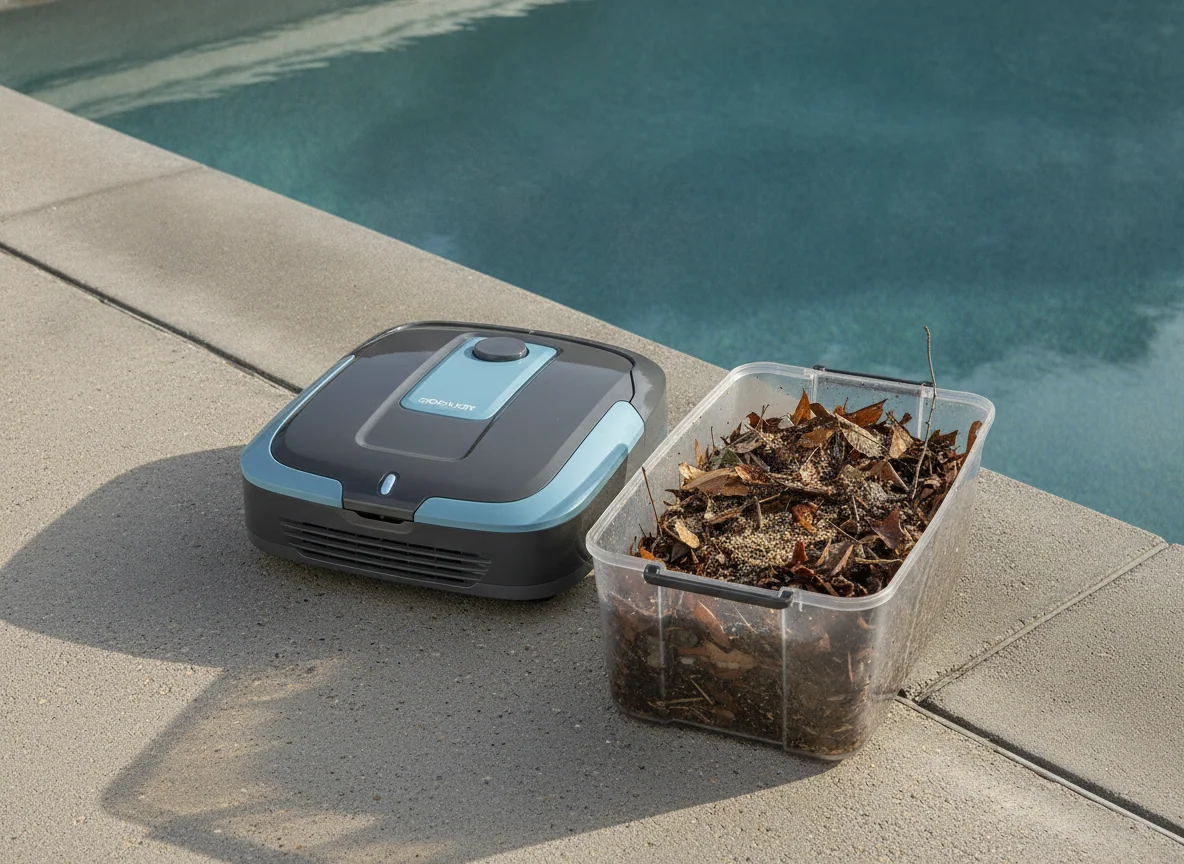
14. WYBOT C1 — The WYBOT C1 is the lower-cost wall-climbing gamble.
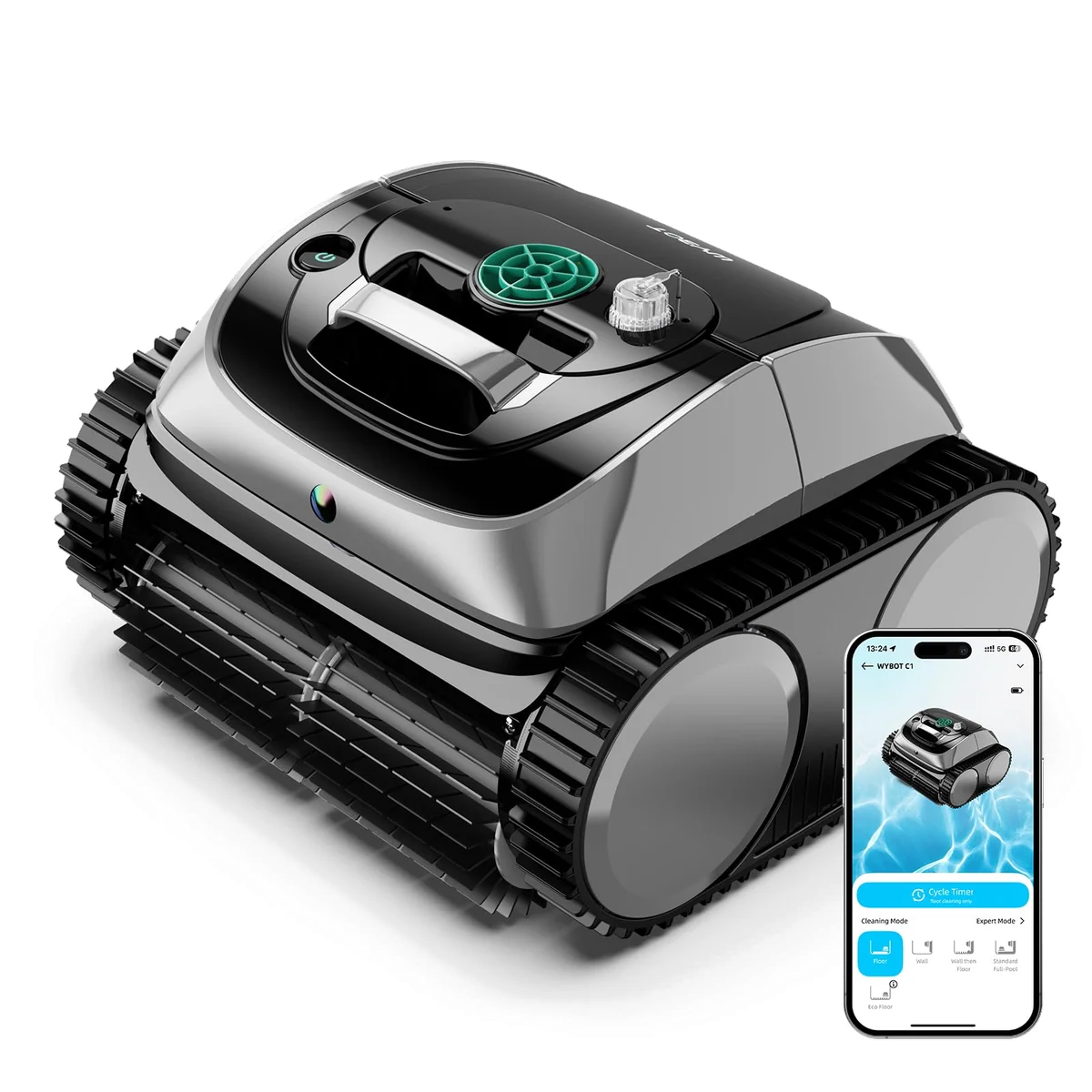
It can collect routine dirt, visible sand, moderate leaves, and ordinary debris across open floors while climbing conventional walls and reaching the waterline.
Only four exact reviews support this version, while earlier C1 histories raise credible concerns about charging, electronics, incomplete coverage, difficult support, and missed steps or shelves.
Its advertised 160-minute maximum and gyroscope-guided paths do not guarantee one-charge coverage, especially near the stated pool-size ceiling. The 180-micron screen is suitable for ordinary fine dirt, not equivalent to the Aiper S1’s secondary 3-micron layer. Buy through the retailer with the clearest replacement route and test every transition immediately.
Strengths
- Open floors and routine maintenance debris are its strongest cleaning case.
- Wall and waterline cleaning can be convincing in pools with simple continuous surfaces.
- The top-access filter and cordless form make an ordinary cleaning cycle easy to manage.
- Exact-product reports support pickup of sand and at least some large leaves.
Limitations
- Steps, shelves, benches, and awkward shallow transitions can derail coverage.
- The advertised runtime may not finish a large or complicated pool on one charge.
- The app appears more useful before launch than while the cleaner is underwater.
- Earlier C1 reports raise credible concerns about electrical or battery failures and difficult support.
15. Aiper Scuba N1 renewed — The renewed Aiper Scuba N1 is an undocumented battery bet.
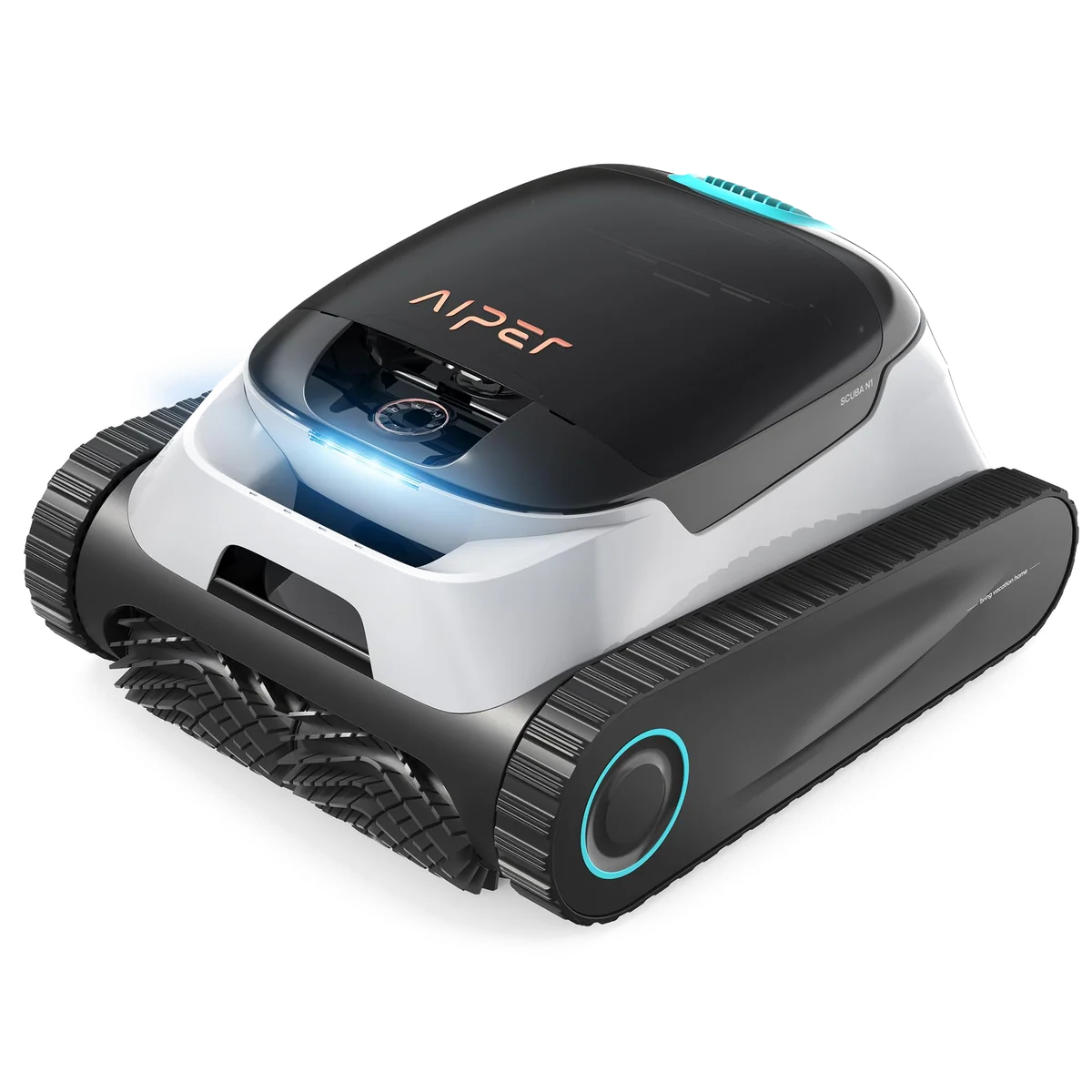
The underlying N1 can provide useful focused floor cleaning, broad coverage, leaf collection, and wall access in a conventional pool.
The renewed listing does not identify the refurbisher, battery condition, renewal work, included accessories, delivered runtime, warranty coverage, or return-shipping responsibility.
An “up to 150 minutes” model specification says nothing about the remaining capacity of the individual battery shipped to the buyer. The recorded price was only slightly above the new-listing WYBOT C1, which is too small a gap to compensate for undocumented condition. Skip unless every battery, accessory, warranty, and return question receives a clear written answer.
Strengths
- Cordless operation removes the floating cable or hose from the pool.
- Floor-only mode has produced excellent routine coverage for some exact-model owners.
- The top-loading basket is easier to service than many bottom-access filter systems.
- The tracked body can climb ordinary walls and reach the waterline in compatible pools.
- Successful runs have collected leaves, pollen, hair, dirt, and fine sand.
Limitations
- The renewed listing does not document battery condition, refurbisher identity, included accessories, or warranty coverage.
- Navigation can repeat lanes, miss patches, and struggle with curved transitions or shallow shelves.
- Fine debris may clog the filter, bypass it, or leak back into the pool during retrieval.
- Wall climbing does not eliminate manual algae brushing on every finish.
- Every cycle ends with lifting, draining, rinsing, charging, and redeployment.
- Replacement filters, batteries, seals, and other parts may be difficult to obtain.
16. (2026 Upgrade) Aiper Scuba S1 — The updated Aiper Scuba S1 is the best choice for fine debris when it still qualifies.
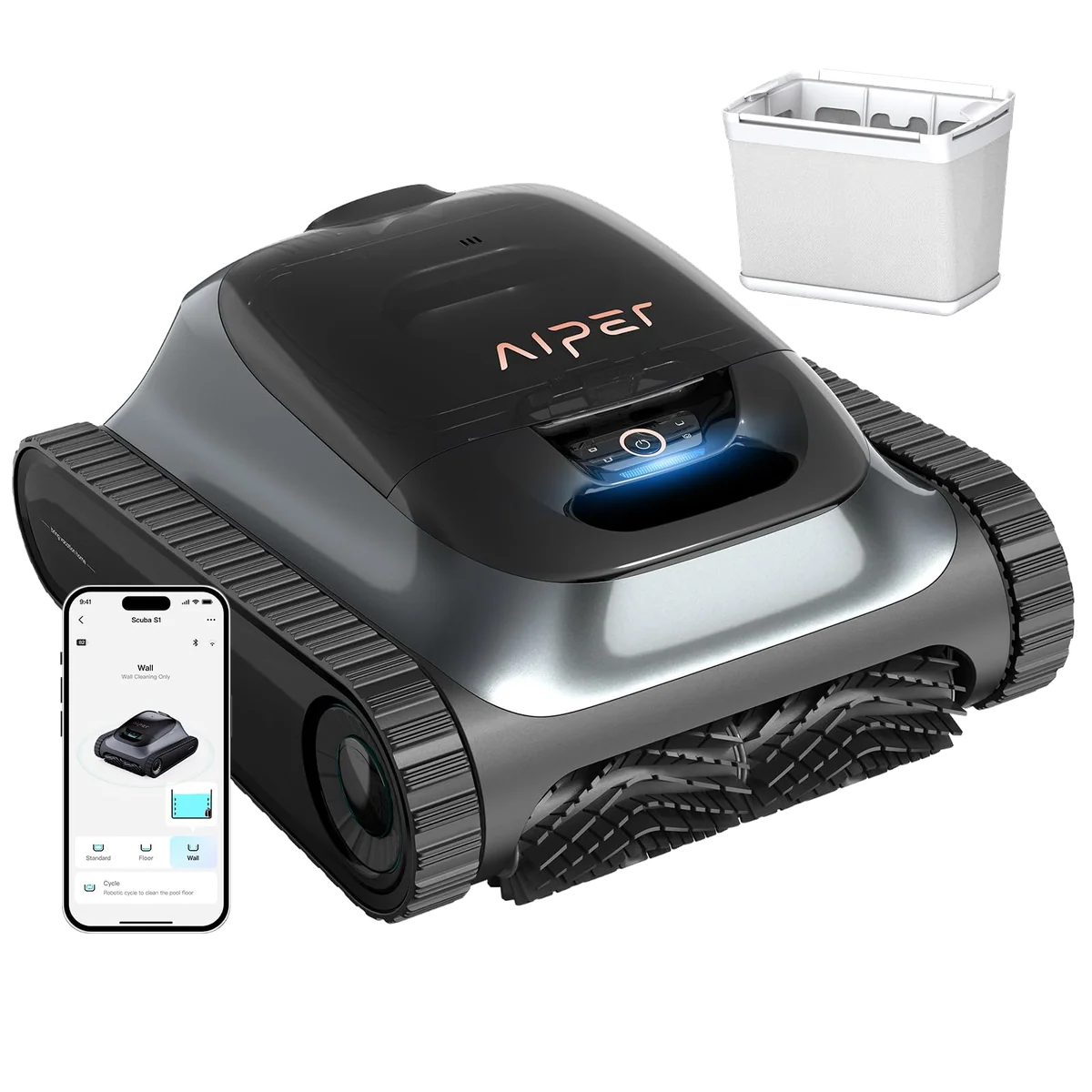
Its 180-micron basket, replaceable 3-micron insert, strong open-floor coverage, long standard runtime, and substantive wall performance form the most complete cleaning package in the group.
It consumes the full recorded budget, struggles with complicated steps and shelves, demands slower filter care, produces a substantial first wet pull, and carries a credible reliability warning.
The 270-minute headline applies only to Eco maintenance, while ordinary cleaning modes are listed at up to 180 minutes. The fine insert is excellent for maintained-pool dust, silt, and sand, but it can clog or bypass material and may need a mid-cycle rinse during a dirty cleanup. Choose the S1 over the winner only when fine-particle retention matters enough to justify the higher qualifying price and your pool has uncomplicated geometry.
Our #1 Pick: TALOSBO C1
Check Price on AmazonThe budget line is the easy part
A product can meet this page’s budget and still be a poor value if it circles one patch, strands itself on a drain, returns fine silt to the water, or becomes disposable when its battery fails. Smart Pool Bots ranked these cleaners by the job they can defend, not by the largest runtime, flow, or pool-area number in the listing.
| Cleaner | Recorded price position | Cleaning scope | Best assignment | Reason to hesitate |
|---|---|---|---|---|
| TALOSBO C1 | Midrange | Floor, walls, waterline | Routine full-pool cleaning in conventional geometry | Preset routing can fail around curves, fixtures, and irregular deep ends |
| PoolMr | Second-lowest | Floor only | Loose debris in a smooth above-ground pool | No deliberate wall cleaning and no verified parts ecosystem |
| AIPER Scuba 2025 | Lowest | Floor only | Small, flat, taut-lined above-ground pools | Random coverage, weak fine-debris retention, and battery concerns |
| iGarden KN35 | Upper midrange | Floor, walls, waterline | Long routine cycles in an open pool | Steps, ladder gaps, raised fixtures, and mixed-model review evidence |
| WYBOT C1 | Midrange | Floor, walls, waterline | A lower-cost full-pool gamble with retailer protection | Very thin exact-model history and a serious related-model reliability warning |
| Aiper Scuba S1 | At the budget ceiling | Floor, walls, waterline, qualifying shallow areas | Fine dust, silt, and sand in a simple pool | It uses the full budget, demands more filter care, and has a mixed durability record |
| BUBLUE F10 | Lower midrange | Surface only | Continuously arriving leaves, insects, flowers, and needles | It cannot vacuum settled debris, walls, or the floor |
Scope came before specifications
A floor-only cleaner is not an inferior wall cleaner when the pool is small, flat, and easy. It is simply a different tool. Likewise, a surface skimmer should not outrank a submerged vacuum because it catches more leaves; one intercepts floating material while the other collects what has already sunk. Our guide to surface skimmers versus pool vacuums explains where those jobs separate.
Geometry came before advertised pool area
A maximum square-foot figure says a robot is intended for a pool of that size. It does not prove that one charge will cover the floor, walls, steps, and waterline. Raised drains, ladder pads, shelves, coves, wrinkles, and sharp depth changes repeatedly mattered more than the catalogue ceiling.
Retention came before water-flow claims
Moving water is not the same as holding debris. A coarse basket may collect leaves while recirculating silt, and a fine insert may trap dust while clogging early enough to shorten a productive cycle. The most useful filter is the one matched to the debris actually in the pool.
Ownership counted as part of cleaning
Cordless machines remove a floating cable, but they do not remove labor. The owner still has to deploy the robot, recover it from the water, wait for it to drain, empty and rinse the filter, dry the charging connection, and recharge it. Unclear battery, charger, seal, track, and warranty support therefore affected the ranking as much as pickup performance.
Choose around the pool you own
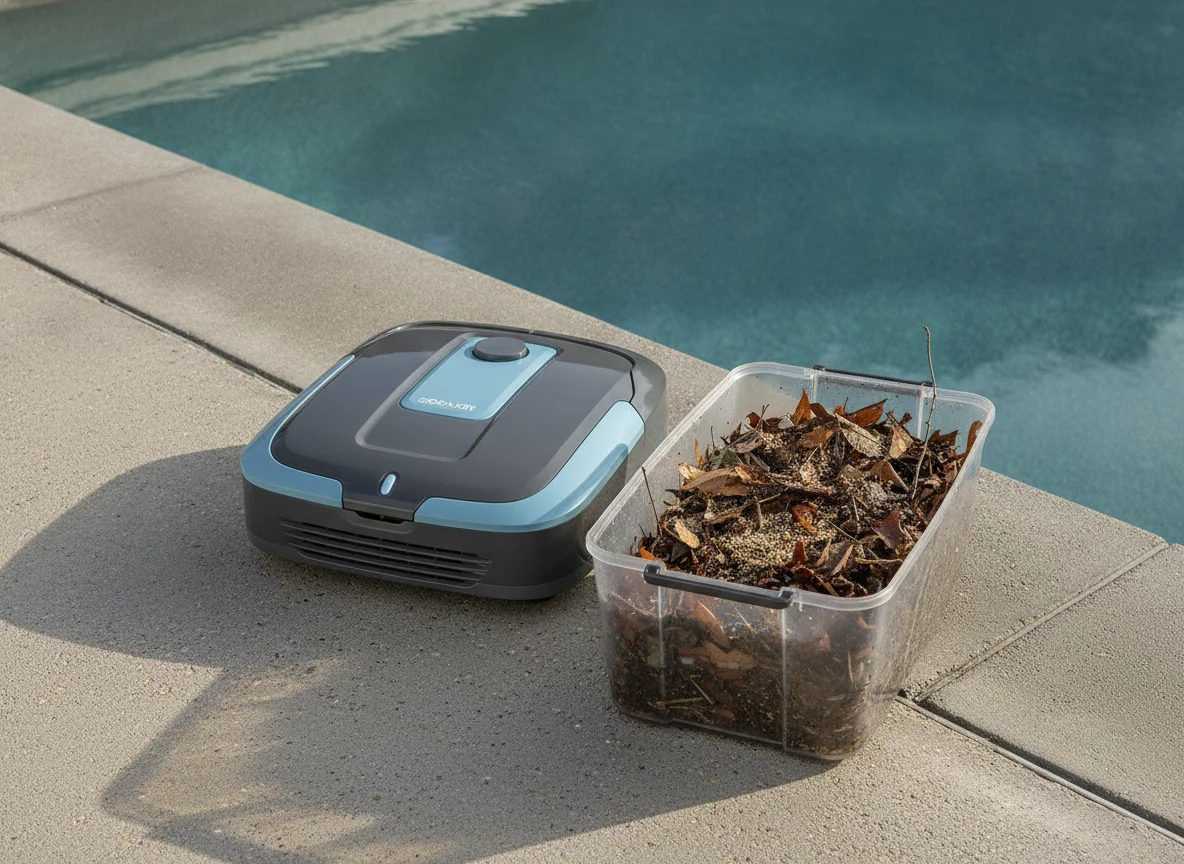
Start with the part of the pool that is actually dirty
If loose dirt settles on a smooth above-ground floor, a basic floor robot can be more rational than a wall climber carrying motors and tracks you do not need. If walls and the waterline collect regular debris, buy a machine with demonstrated climbing rather than assuming every four-wheel cleaner can leave the floor. If leaves stay afloat, begin with a skimmer instead of asking a submerged robot to wait for them to sink.
Buyers dealing with heavy leaf fall should also read our guide to robotic cleaners for leaves and floating debris, while persistent sand or silt calls for the filtration distinctions in our fine-debris recommendations.
Draw the awkward parts before comparing square footage
Make a quick inventory of the pool’s raised drains, ladder feet, wrinkles, coves, sharp slopes, benches, broad steps, tanning ledges, and shallow shelves. These are the places where tracks lose contact, small wheels stop, or route logic wastes a charge. A robot rated for a much larger pool can still fail in a small freeform shell.
- Open rectangle or gentle oval: the TALOSBO C1, iGarden KN35, WYBOT C1, and Aiper Scuba S1 have their strongest cases here.
- Flat above-ground floor: the PoolMr is the value choice, with the AIPER Scuba 2025 as a cheaper but narrower helper.
- Wrinkled liner or uneven bottom: small floor robots are especially vulnerable to stalls, so an easy return policy matters more than an optimistic area rating.
- Steps, shelves, and ledges: expect partial contact rather than complete coverage, then keep a brush or manual vacuum for the misses.
Our separate guide to walls, steps, drains, slopes, and ledges explains why climbing ability should never be translated into complete coverage.
Match the filter to the debris
A basket around 180 microns is a common baseline for visible dirt, insects, and ordinary sand. Secondary foam helps the TALOSBO C1, PoolMr, and WYBOT A1 retain smaller material. The Aiper Scuba S1’s replaceable 3-micron insert is the clearest upgrade for fine dust and silt, but the finer layer adds rinsing time and can restrict flow when heavily loaded.
For a leaf-heavy run, capacity and an unobstructed intake may matter more than the finest filter. For settled dust in an otherwise maintained pool, fine retention matters more than a dramatic gallons-per-hour claim. No filter specification guarantees that every particle at that size will be captured under real flow, loading, and seal conditions.
Read every runtime number with its mode attached
The TALOSBO C1’s 180-minute figure belongs to Eco, the iGarden K36’s longest figure belongs to floor-only use, and the Aiper Scuba S1’s 270-minute maximum belongs to Eco maintenance rather than an ordinary full-power cycle. Wall climbing, restrictive filters, heavy debris, repeated routes, and obstacle stalls all consume the same battery.
Runtime is useful only while the robot is cleaning new area and retaining debris. A shorter systematic floor run can outperform a longer cycle spent revisiting one lane. If floor debris is the principal problem, select Floor mode instead of paying a battery penalty for repeated wall attempts.
Treat the app as a launch panel
Bluetooth and Wi-Fi commonly disappear after these cleaners submerge. The useful app functions are mode selection, pool settings, schedules, logs, firmware updates, and battery checks while the robot is reachable. Do not buy the K36, KN35, WYBOT B1, WYBOT C1, or TALOSBO C1 expecting dependable live underwater steering.
Scheduling also does not create a self-sufficient cleaner. The battery still needs charging, the basket still needs emptying, and the robot still needs retrieval. The site’s guide to pool-cleaner apps underwater covers those connection limits in detail.
Make the return window part of the specification
Pool geometry produces opposite outcomes from machines that look identical on paper, so the first week should be an acceptance test rather than a honeymoon. Use every mode you expect to need, inspect the full floor after the cycle, watch wall grip more than once, place ordinary debris near corners, and confirm the cleaner can escape the most awkward step or transition.
- Verify the charger, retrieval hook, basket, fine insert, brushes, and instructions before the robot enters the water.
- Run a dedicated floor cycle and inspect for untouched strips rather than judging only by what appears in the basket.
- Run wall and waterline mode after cleaning the filter so restricted flow does not distort the result.
- Watch raised drains, ladder feet, shelves, steps, coves, and the shallow-to-deep transition for repeated stalls.
- Confirm the app pairs, the physical controls work, the charging connection stays dry, and the stated retailer return route is usable.
Decide whether cordless is worth the ownership trade
Cordless removes the floating cable and deck-side power box, which makes launch simpler and avoids cord management. It also makes the battery, sealed charging connection, recovery hook, and recharge delay central to ownership. If durability, parts access, and immediate repeat cycles matter more than cable freedom, compare the corded and cordless tradeoffs before buying.
A corded alternative can be more sensible than gambling on a young marketplace battery platform. The site’s Dolphin Nautilus CC review covers one established wall-climbing option, while the broader best robotic pool cleaners guide removes this page’s budget ceiling.
Do not buy a robot to solve a chemistry problem
A cleaner can collect loose dead material after treatment and may brush a light film, but established algae requires correct sanitation, circulation, filtration, and manual brushing. Floor-only robots without active brushes are especially unsuitable as algae-removal tools. Our debris guide explains what robots can collect and what they tend to leave behind.
Frequently Asked Questions
Can a budget robotic cleaner really climb pool walls?
Yes, the TALOSBO C1, iGarden KN35, iGarden K36, WYBOT C1, and Aiper Scuba S1 can climb suitable walls, but finish, angle, filter loading, geometry, and battery state determine how much wall and waterline they actually cover.
Is the longest cordless runtime automatically the best choice?
No, a long battery can be wasted repeating lanes, spinning on an obstacle, or climbing walls when the floor is the real job.
Will a pool-cleaner app control the robot underwater?
Usually not, because these apps are primarily useful before launch for modes, settings, schedules, logs, and firmware rather than dependable live underwater steering.
Can a budget pool robot remove algae?
It may collect loose dead algae after treatment, but it does not replace sanitation, circulation, filtration, and manual brushing for attached growth.
Which cleaner is best for a simple above-ground pool?
The PoolMr is the strongest inexpensive floor-only choice for a smooth open floor, while the TALOSBO C1 is the better fit when conventional walls and the waterline also need attention.
Should a cordless robotic pool cleaner stay in the water between cycles?
Treat these as retrieve-after-cycle machines unless the exact manual explicitly allows otherwise, then empty the filter, rinse the robot, dry the charging area, and store or charge it somewhere dry.
Is a renewed cordless pool cleaner a good way to save money?
Only when the seller documents battery condition, renewal work, included accessories, warranty coverage, minimum delivered runtime, return timing, and return-shipping responsibility in writing.
What does self-parking mean on a budget pool robot?
It normally means the cleaner attempts to stop near a pool wall for retrieval, not that it docks, charges itself, returns to the launch point, or rises to the surface.
Our Top Pick
The TALOSBO C1 earns the top spot. The TALOSBO C1 is the best overall value for a conventional pool.
Compare Top Picks
Sources (2)
- Amazon listings and customer reviews
- Owner and reviewer video, 1 channel