The PoolMr is useful for routine floor cleaning, but its support story is too thin for an easy recommendation
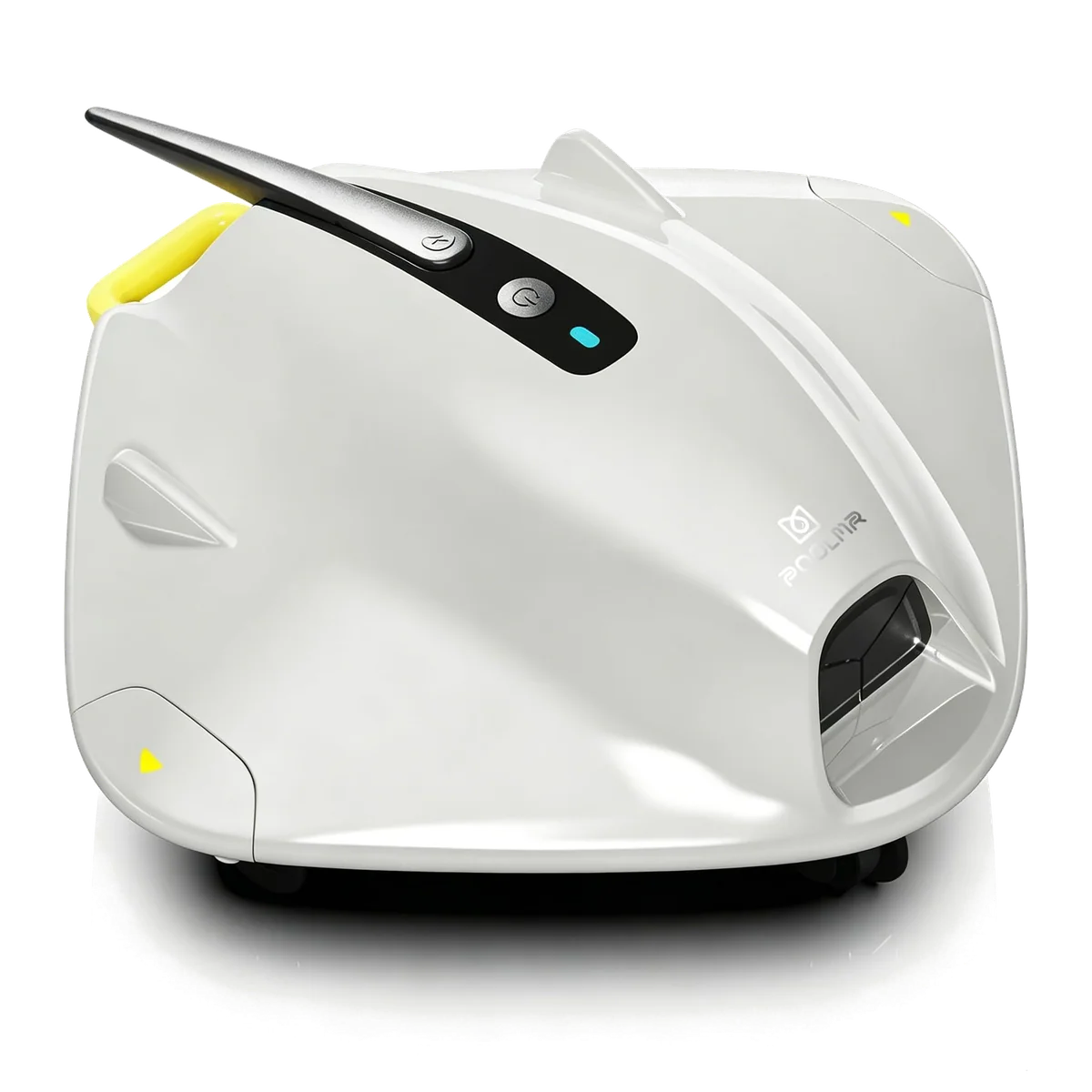
Buy the PoolMr for routine floor debris in a simple above-ground pool only if cordless convenience matters more than wall cleaning, proven spare-parts support and storm-cleanup strength.
Final call
The PoolMr makes sense as a helper for a flat or gently sloped above-ground pool with routine dirt, insects, twigs, sand and modest leaves. Give it the whole cycle, accept that a second run may be needed for settled fines, and keep a net or handheld tool for large debris and awkward spots. In that narrow role, the owner evidence supports meaningful labor savings.
It is not the right purchase for wall and waterline cleaning, complicated steps, severe algae recovery, heavy leaf fall or a pool close to the advertised maximum area. It is also difficult to recommend without reservation to anyone who expects a proven parts supply and a clearly documented long-term service path.
Our conclusion remains conditional: buy for simple floor maintenance and cordless convenience, but walk away if this robot would be your only cleaning tool or if an unanswered charger question could turn a small failure into a complete replacement.
A routine cleaner, not a rescue machine
The best case for this PoolMr is refreshingly modest. Drop it into a fairly uncomplicated pool, let it roam for its full cycle, retrieve it with a hook and rinse out the debris it saved you from vacuuming by hand. Exact-model owners report pickup of dirt, sand, silt, twigs and ordinary leaves, and the most informative account describes a clean floor after roughly two hours in a 24-foot pool. That owner had gone almost two months without reconnecting the hose vacuum.
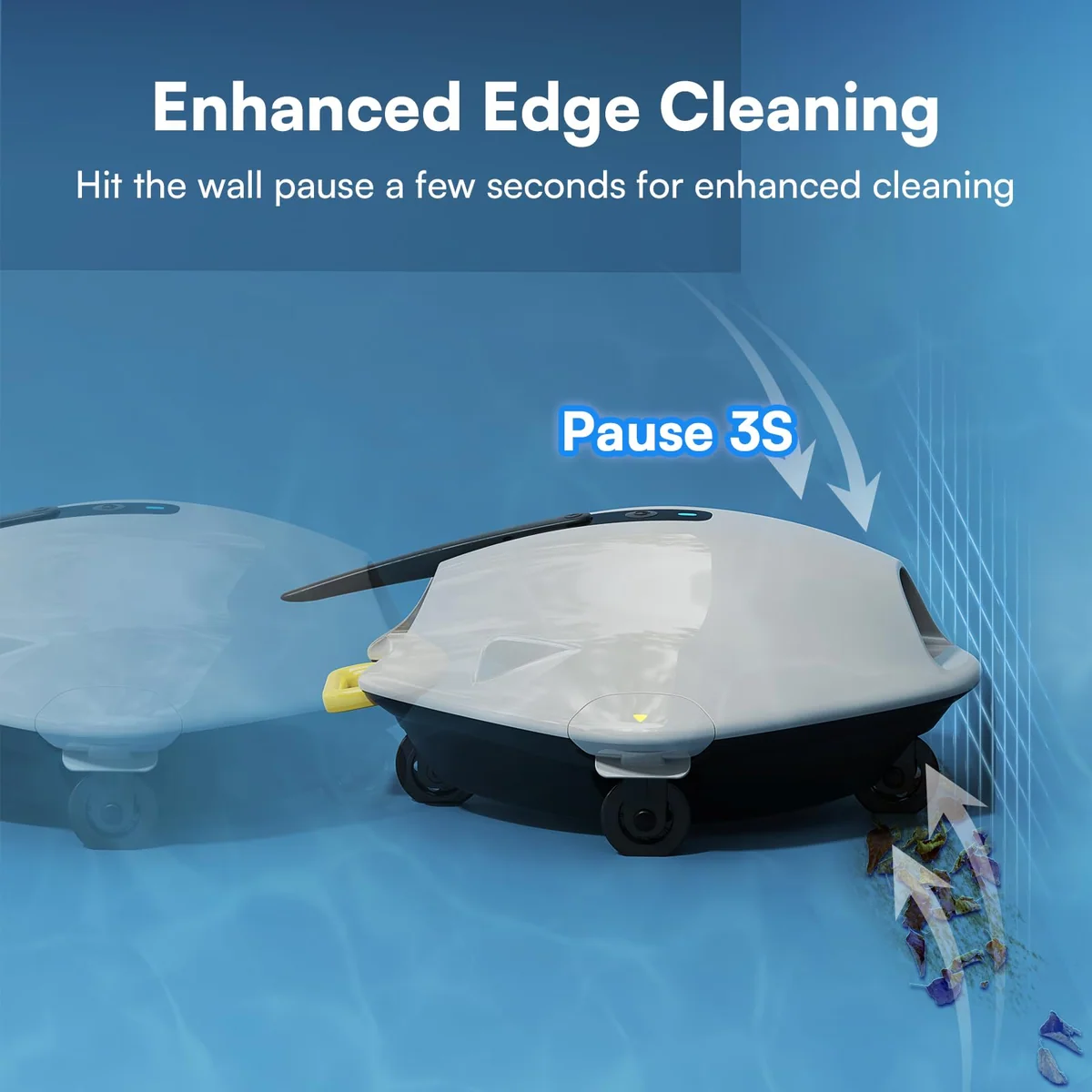
The catch is that it does not clean like a deliberate person making slow, overlapping passes. It can drive through a debris pile, stir material into the water and appear to have missed the job. Its method is repetition: it returns to the same area over a complete cycle and gradually collects what settles back down. That can work well for maintenance debris, but it is a poor match for anyone expecting every visible pile to disappear on contact.
The negative evidence draws a clear boundary. One owner found the single fast speed badly suited to a smaller pool after heavy rain, trees and an algae problem, and the machine failed to collect the large leaves on the floor. Another owner still had fine silt remaining after a run. The PoolMr may reduce routine manual cleaning, but a leaf net or existing handheld vacuum should remain nearby for storm debris, corners and precise cleanup.
This is also a floor robot. The exact listing does not claim wall climbing, step cleaning, waterline scrubbing, app control or mapped navigation. Videos of a PoolMr Manatee scaling walls concern a different and substantially more capable product, not this off-white model. Buyers who need vertical cleaning should start with our guide to robots designed for walls and the waterline instead.
Key Specifications
The cable disappears, but the chores do not
Cordless operation removes a genuine nuisance. There is no floating cable to untangle, route around a ladder or pull away before swimming. The PoolMr is also self-contained, so its collected dirt ends up in the onboard filter rather than depending on the pool’s circulation system.
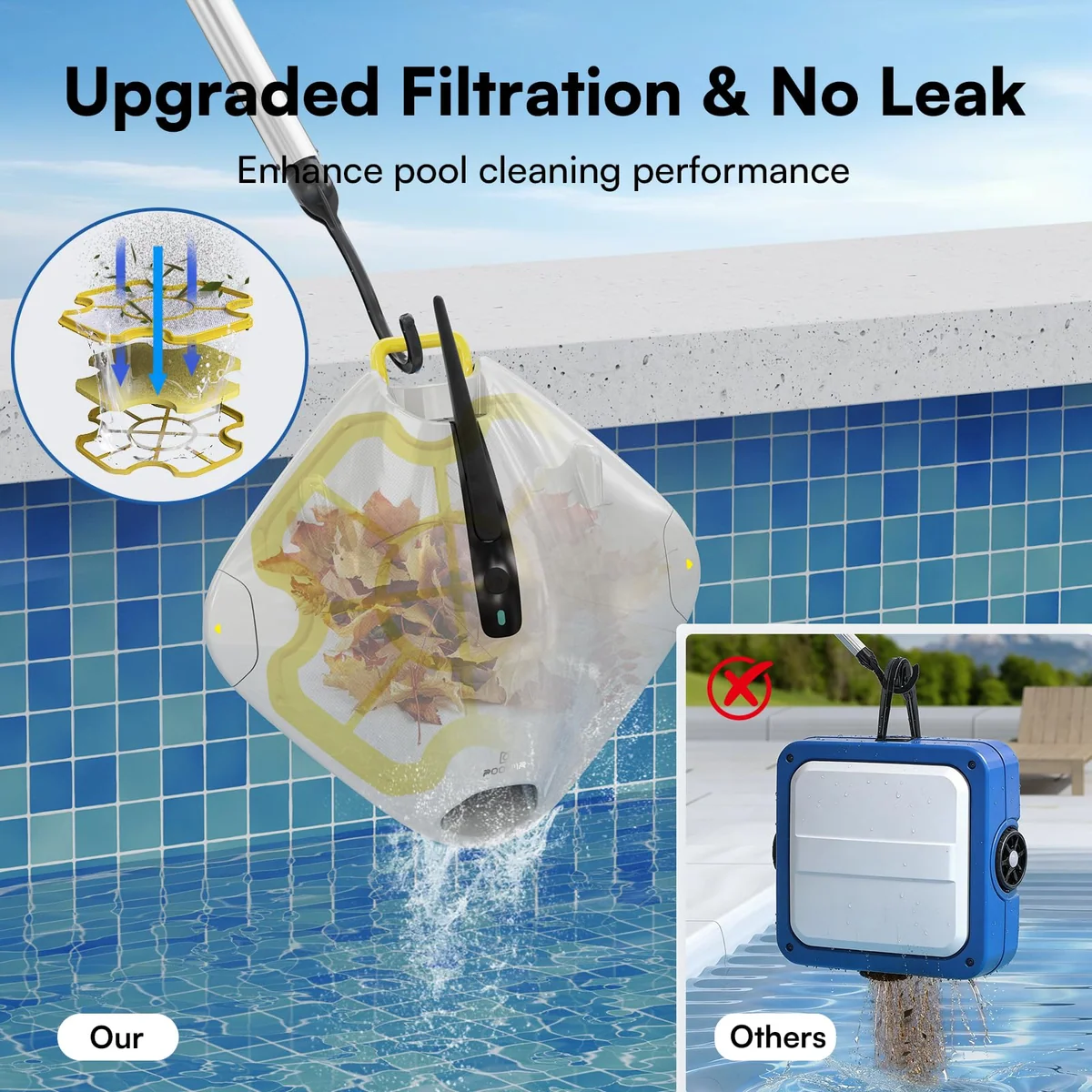
“Self-parking” is less autonomous than the name suggests. The robot is designed to finish against an edge when the battery runs low, and at least one owner saw it waiting at the wall after its cycle. It does not climb out, rise to the surface or dock itself on a charger. You still attach the supplied hook to a pool pole, lift the machine to the waterline and wait while retained water drains away.
That first lift may feel heavier than the dry product suggests because the chassis is still full of water. Related PoolMr floor-cleaner demonstrations reinforce the sensible technique: pause at the surface and let the unit drain before raising it the rest of the way. Those videos show sibling models with different runtime and coverage specifications, so they illuminate the retrieval process rather than proving exact-model performance.
A realistic post-cycle routine
- Retrieve the robot soon after its cycle rather than treating the pool as permanent storage.
- Open the debris compartment and rinse the mesh, sponge and lower chassis.
- Let the robot and charging port dry before connecting the charger.
- Inspect the port and plug for water, corrosion or physical damage.
- Close the charging-port cover completely before the next immersion.
- Store the cleaned unit away from prolonged direct sunlight.
Removing, rinsing and drying a pool robot after use is ordinary category maintenance, not a PoolMr-specific defect. Independent pool-cleaner guidance recommends keeping robots out of the water between cycles and protecting them from unnecessary ultraviolet and chemical exposure. Follow the exact PoolMr manual wherever its instructions differ.
If that routine sounds like too much involvement, cordless may not be delivering the kind of automation you want. Our corded versus cordless guide explains the trade more fully, while the cordless cleaner roundup places this convenience in a wider field.
Strengths & Limitations
Strengths
- The roughly two-hour runtime is supported by the most detailed exact-model owner account.
- The mesh-and-sponge filter gives fine dirt a better chance of staying captured than a coarse basket alone.
- Cordless operation removes cable management from routine floor cleaning.
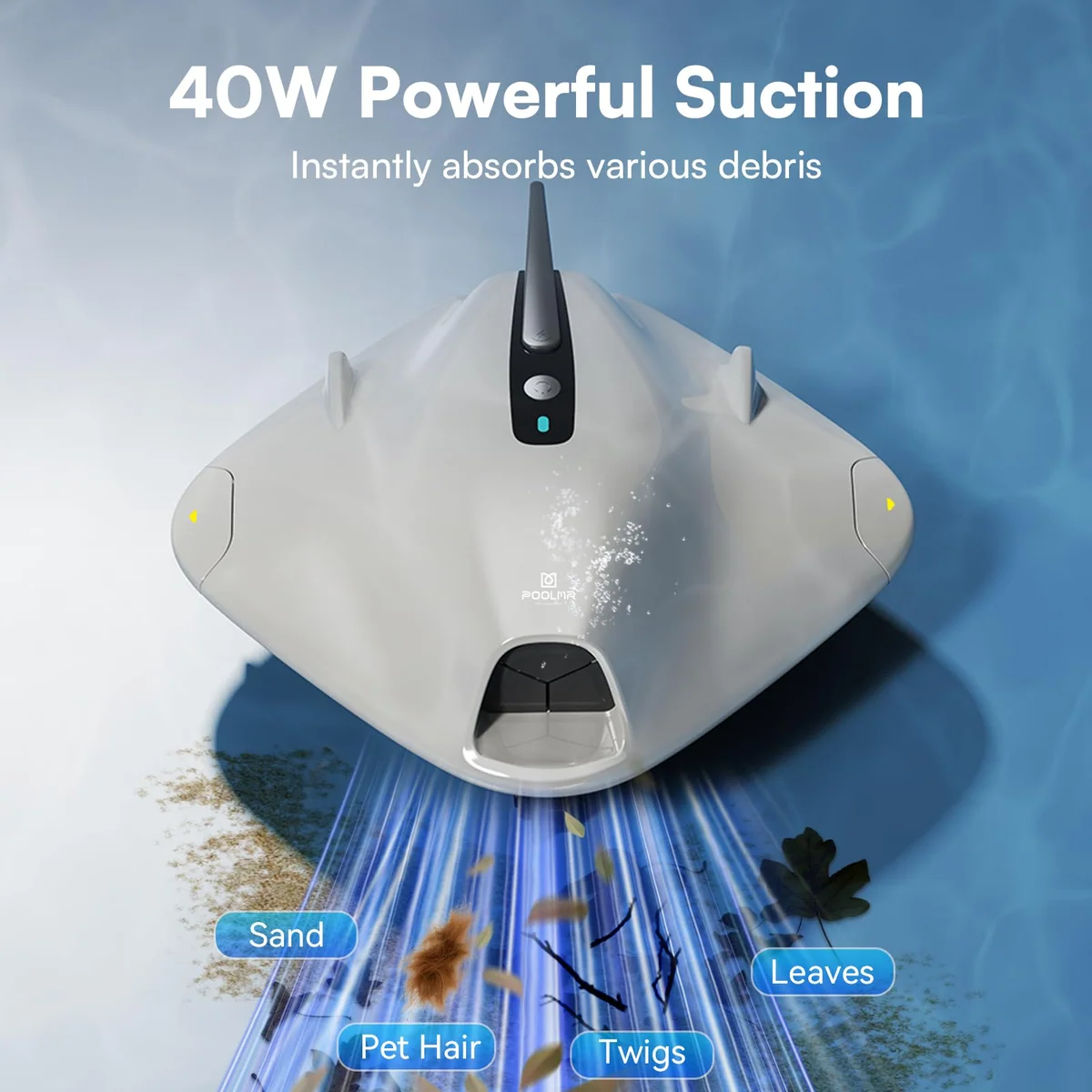
- Owners report useful pickup of dirt, sand, silt, twigs and ordinary leaves.
- Edge stopping can place the robot within reach of the supplied retrieval hook.
Limitations
- Large leaves, heavy post-storm debris and algae-laden cleanup can overwhelm its fast single-speed approach.
- It does not claim wall, step or waterline cleaning.
- A ladder can trap it, and repeated passes are not the same as systematic mapped coverage.
- The advertised maximum area is not independently demonstrated by an exact-model owner.
- Replacement-charger, filter, battery, warranty and service details remain unverified.
What it is likely to collect, and what it may leave behind
The dual-layer filter is the most persuasive part of the specification sheet. A 180-micron mesh provides the main screen, while a dense sponge adds a second barrier for finer material. That arrangement makes the reports of sand and silt pickup plausible, but it does not turn one cycle into a guarantee. Fine filtration also brings its own housekeeping: the sponge needs a thorough rinse, and retained sediment can reduce flow as it accumulates.
| Task | Assessment | What to expect |
|---|---|---|
| Dirt and insects | Good fit | Routine bottom debris is the clearest use case reported by owners. |
| Sand and fine silt | Capable, not perfect | It can collect a useful amount, but settled material may need a full cycle, a filter rinse and another run. |
| Small and medium leaves | Generally suitable | Owners report ordinary leaf pickup, although a full basket can shorten an effective cleaning session. |
| Large leaves and fronds | Weak fit | The exact owner record includes a large-leaf failure, and a related PoolMr demonstration left an oversized palm fragment for a net. |
| Algae-heavy cleanup | Not recommended | It may collect some loose material, but it does not replace brushing, sanitation or water-balance work. |
| Walls, steps and waterline | Outside its stated role | The exact listing presents a floor-and-edge machine rather than a full-pool scrubber. |
The runtime claim is stronger than the coverage claim
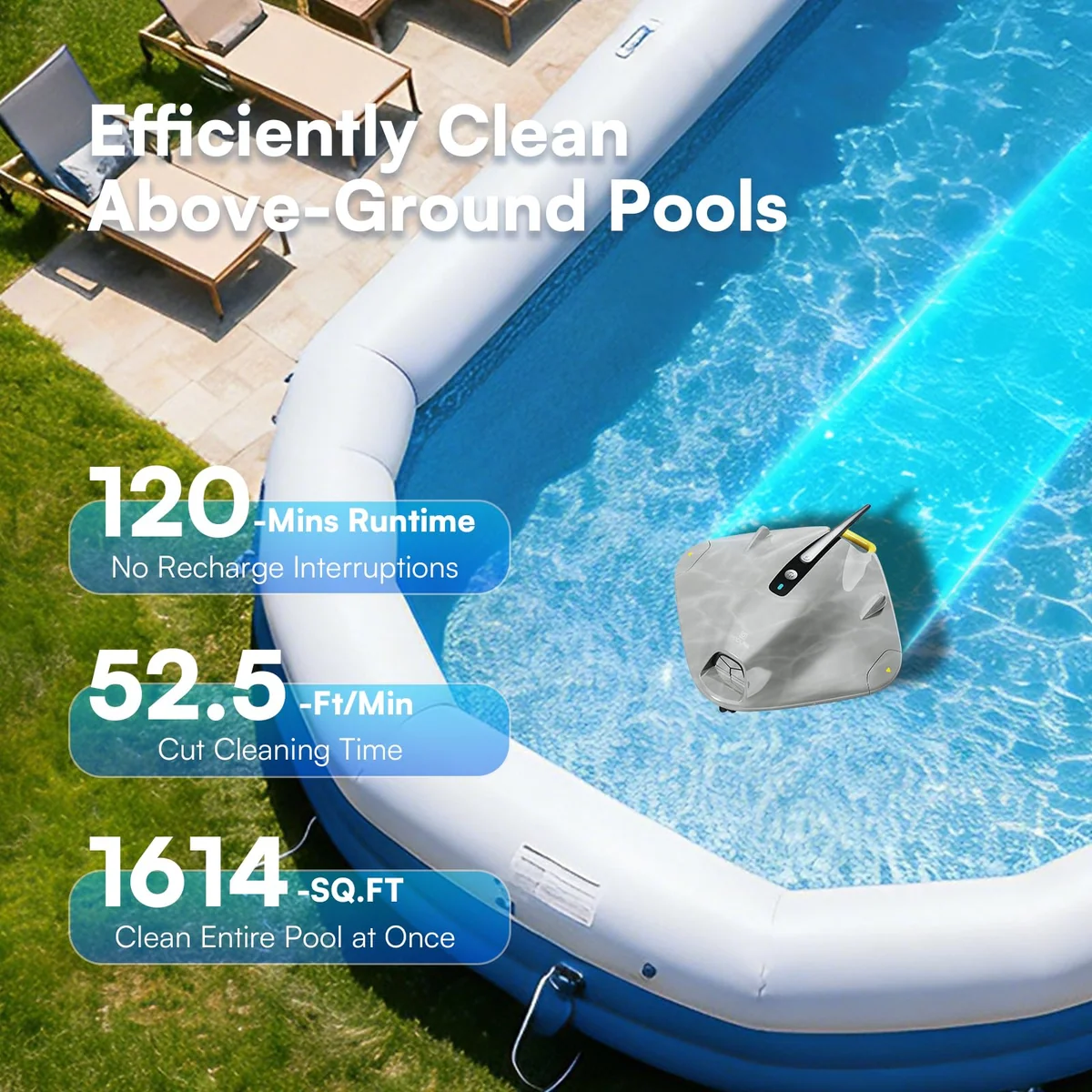
PoolMr advertises up to 120 minutes, and an exact-model owner independently describes a run of about two hours. That makes the runtime figure credible as a best-case observation rather than an empty number. It does not prove that every battery, water temperature or debris load will produce the same result.
The advertised 1,614-square-foot ceiling deserves much more caution. No exact-model account in the retained evidence demonstrates thorough cleaning of a measured pool that large in one charge. Broader comparative guidance also warns that maximum-area claims often describe where a robot can operate rather than what it can clean completely, so a pool substantially below the headline maximum is the safer match.
Fast movement cuts both ways
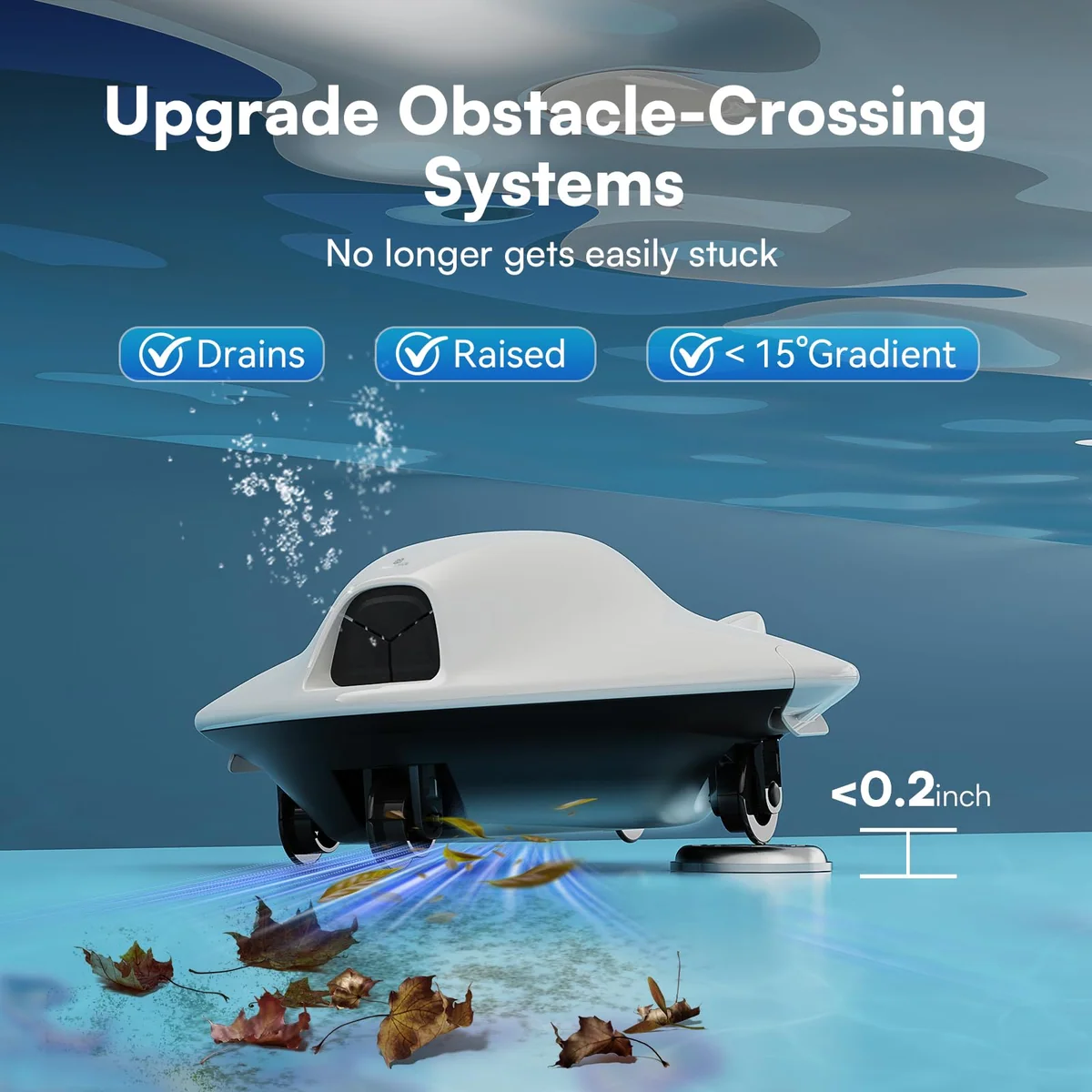
Momentum may help a simple wheeled robot cross a drain cover or modest liner wrinkle, but speed can also scatter fine debris before the intake captures it. The listing claims passage over 0.2-inch wrinkles and slopes up to 15 degrees, yet the supplied exact-owner accounts do not validate those dimensions. Treat them as compatibility claims, not a promise that every seam, drain and transition will be harmless.
Pool geometry matters more than the words “above-ground” or “in-ground.” One exact owner reports occasional trapping behind a ladder, and no claim on the listing establishes that the robot can negotiate steps, benches or shallow shelves. If your pool has those features, watch the first several cycles and identify its trapping points before leaving it to roam.
The unanswered charger and parts questions matter
Short-term cleaning is only half the buying decision for a battery-powered machine that lives around chlorinated water. The supplied exact-model evidence does not establish where to buy a replacement charger, sponge, basket, wheel or battery. It also does not confirm a warranty term, a service route or whether the battery can be replaced. Those omissions do not prove the parts are unavailable, but they prevent Smart Pool Bots from treating ownership support as a solved problem.
The sponge deserves particular attention because it is both useful and consumable. A related PoolMr floor-cleaner reviewer described its foam layer as fragile and expected eventual replacement, yet the exact evidence does not identify a verified source for that replacement. Before ordering, ask the seller for written links to the correct charger, filter components and manual for ASIN B0GVF5LF72 rather than assuming similarly named Rayfish, Stingray or Manatee parts will fit.
This weakness is not unique to PoolMr. Comparative research across cordless robots has found patchy replacement-part availability even among more expensive machines, which is precisely why buyers should investigate before a failure rather than after one. A low initial cost loses some of its appeal if a damaged plug or worn filter retires the entire cleaner.
If it does not charge or turn on
No exact-model reset sequence is established in the supplied evidence, so resist improvised repairs. Confirm that the outlet and charger show power, dry and inspect the connector, clean accessible contacts, check the filter and intake for an obstruction, and consult the exact manual or seller support. Do not connect power to a wet or damaged charging port, and do not open a sealed battery housing unless authorized service documentation explicitly permits it.
Anyone who ranks local servicing, known spare parts or a documented repair path above cordless freedom should consider an established corded option. The Dolphin E10 review covers an above-ground-focused alternative with active scrubbing, while the Dolphin Nautilus CC review is the more relevant next stop when wall climbing is essential.
Frequently Asked Questions
Does the PoolMr pick up sand and fine silt?
It can collect sand and a useful amount of fine silt, but exact-model owners show that one cycle may not remove every settled particle.
Will it collect leaves from the pool floor?
It is suitable for ordinary smaller leaves, but large leaves and heavy storm debris are not reliably collected.
Can this PoolMr climb walls or scrub the waterline?
No, the exact listing presents it as a floor-and-edge cleaner and makes no wall or waterline-cleaning claim.
Does it really run for two hours?
PoolMr claims up to 120 minutes, and one detailed exact-model owner reports a run of about two hours.
Will the robot get stuck behind a ladder?
It can, because one exact-model owner reports occasionally having to jostle it free from behind a pool ladder.
Can it clean an algae-heavy pool?
Do not rely on it for algae recovery, because chemical sanitation and brushing remain necessary and the exact negative account came from a difficult algae-and-storm cleanup.
Can I buy a replacement charger or filter?
Smart Pool Bots could not verify exact-model replacement availability, so ask the seller for written parts links tied to ASIN B0GVF5LF72 before buying.
What should I check if it will not charge or turn on?
Verify power, dry and inspect the connector, clean accessible contacts, check for intake obstructions and follow the exact manual rather than attempting an undocumented electrical repair.
Should the cleaner stay in the pool between cycles?
No, remove it after use, rinse and dry it, protect the charging port and store it away from prolonged direct sunlight unless the exact manual directs otherwise.
Sources (4)
- Amazon listings and customer reviews — Poolmr Cordless Robotic Pool
- Owner and reviewer video, 2 channels
- Pcworld — Article — www.pcworld.com
- Reviewed — Article — www.reviewed.com