The Dolphin Nautilus CC cleans floors well, but its cord keeps it from feeling effortless.
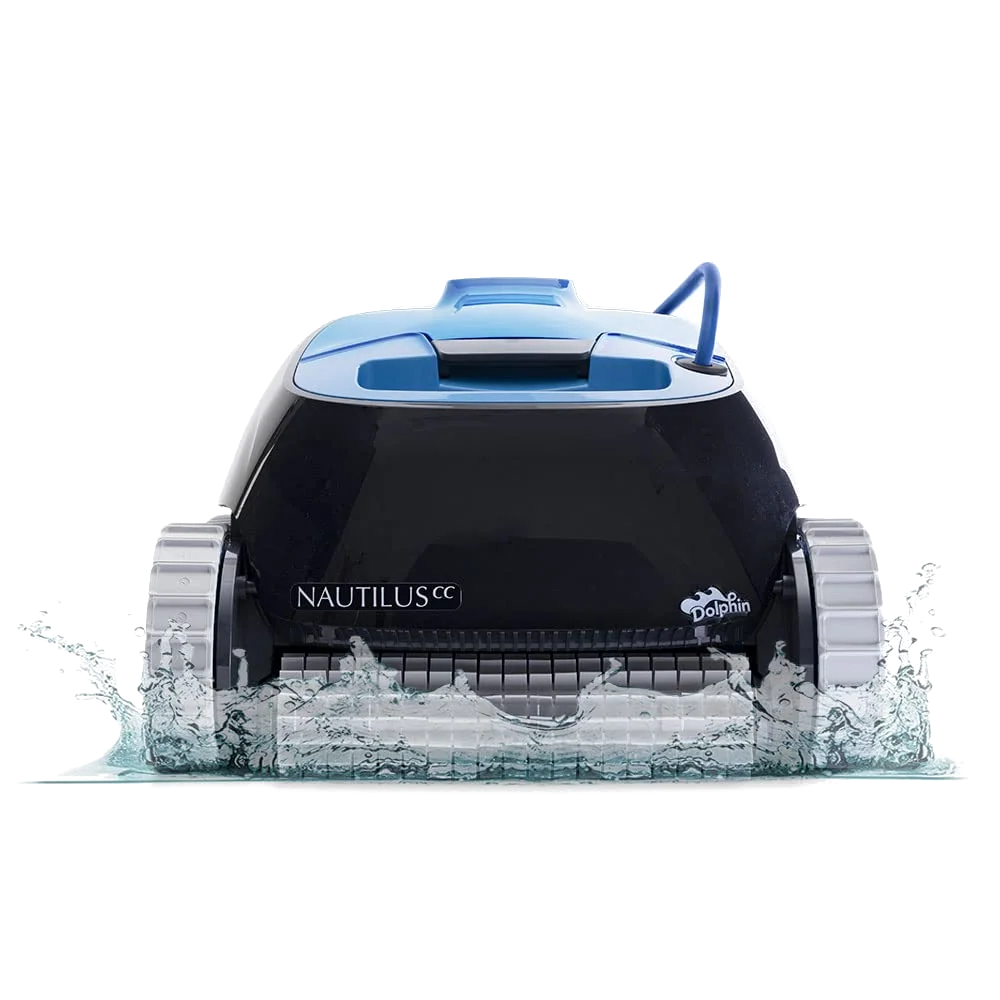
Buy the Dolphin Nautilus CC for a straightforward pool up to 33 feet when reliable floor cleaning matters more than schedules or waterline polishing; skip it if steps, ledges, a tangle-prone cord, or a one-year warranty will sour the deal.
Final verdict
The Nautilus CC is worth buying when the alternative is dragging out a manual vacuum every week and the pool is simple enough for the robot’s strengths to dominate. Its lightweight body, top-load basket and dependable open-floor work solve a real chore without introducing charging or app setup.
It is not the inexpensive route to every premium Dolphin feature. The current base model asks its owner to press the button, manage the cord, rinse the basket, brush the steps and finish the waterline. Accept that division of labor and the CC is a useful pool appliance; expect hands-off whole-pool detailing and it will feel obsolete on the first run.
The Nautilus CC succeeds at the part of pool care that consumes the most patience: repeatedly moving a vacuum across the floor. Owners describe it collecting ordinary dirt, bugs, leaves, acorns, pebbles, sand and some silt while they do something else. In simple pools, a single cycle can leave nearly all of the open floor clean, although square corners and dirt packed against the wall may need to be brushed into its path first.
That is enough to make this robot useful, but not enough to make it comprehensive. It can climb vertical walls, sometimes reaching or briefly breaching the surface, yet it does not settle at the tile line and travel sideways as a dedicated waterline cleaner would. Steps, benches, tanning ledges and abrupt corners are similarly unreliable territory.
The distinction matters because the product name now sits inside a crowded Nautilus family. This is the base CC, model 99996113-US, not the larger CC Plus, the connected CC Pro or the feature-rich CC Supreme. Buying by the word “Nautilus” alone is an easy way to expect a timer, app, swivel or waterline behavior that this exact machine does not provide.
Key Specifications
The best feature is how little ceremony it requires
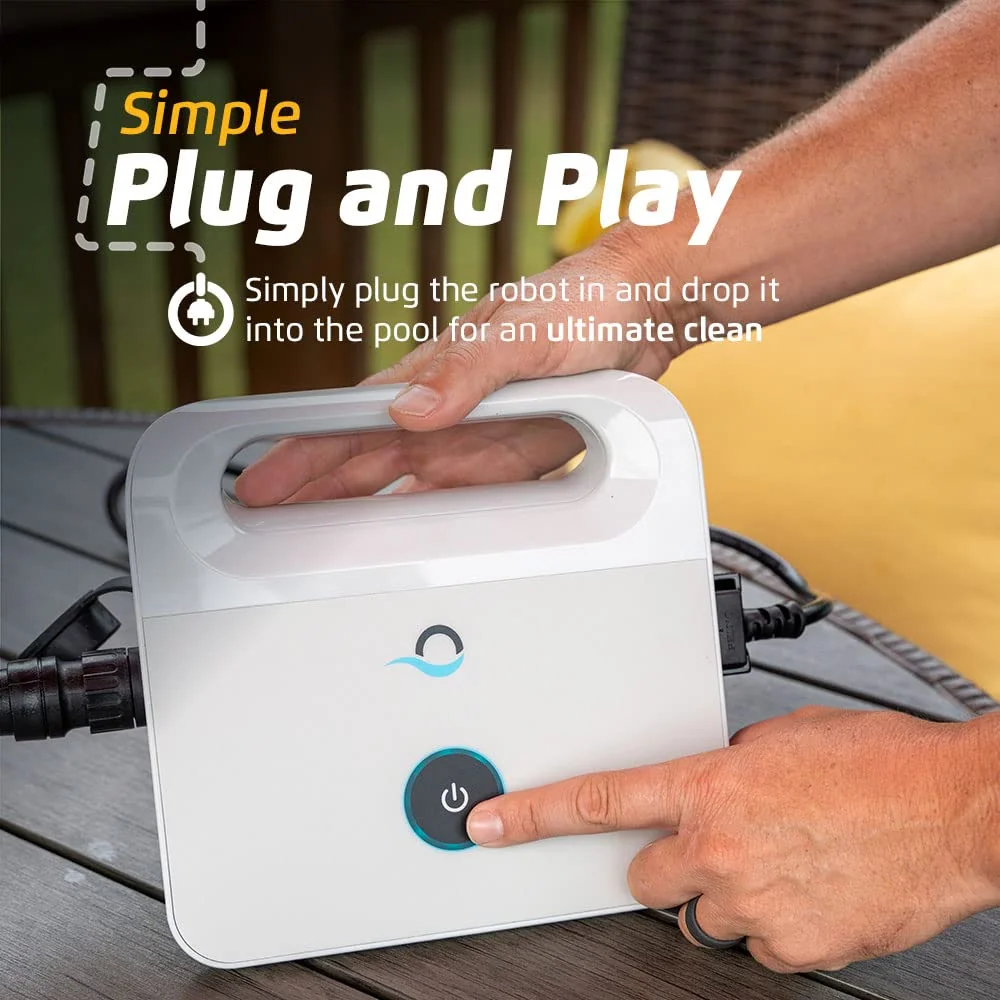
Setup is pleasantly literal. Connect the floating cable to the power supply, lower the robot into the water so trapped air can escape, place the supply safely away from the pool, plug it into a suitable outlet and press the button. There is no skimmer hose, booster pump, return-line connection or app pairing to negotiate.
The top-load basket earns its place
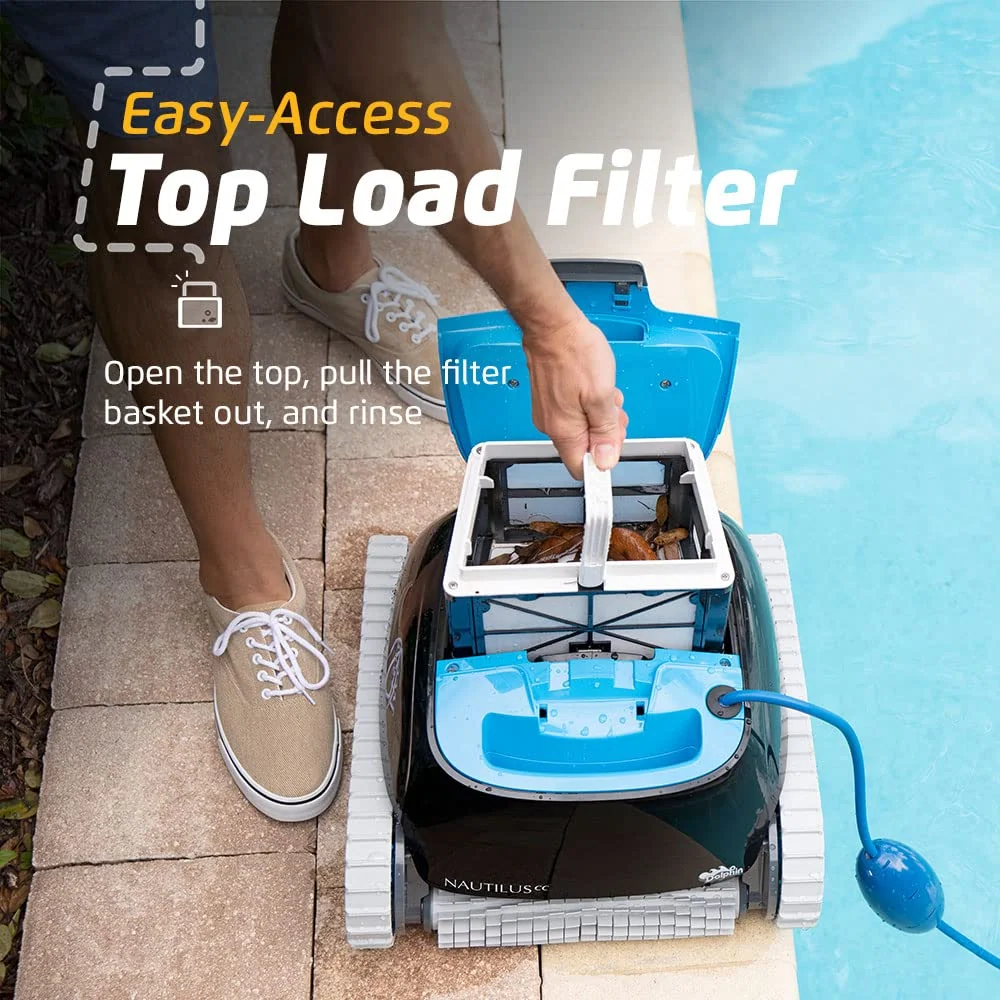
The filter basket is the clearest everyday advantage. The lid opens from above, the basket lifts by its handle, and the debris can be dumped before the panels are rinsed with a hose. Owners who previously used bottom-loading cloth pouches found this arrangement substantially easier, even if hosing the basket can splash water back at the person cleaning it.
The included basket is capable rather than magical. It can capture visible dirt, sand and some silt, but results with pollen, very fine dust and dead algae vary. Persistent ultra-fine sediment may pass through the standard media or be stirred back into suspension, so it is wiser to judge the included filter in your own pool before adding compatible fine-filter panels.
CleverClean is broad coverage, not clairvoyance
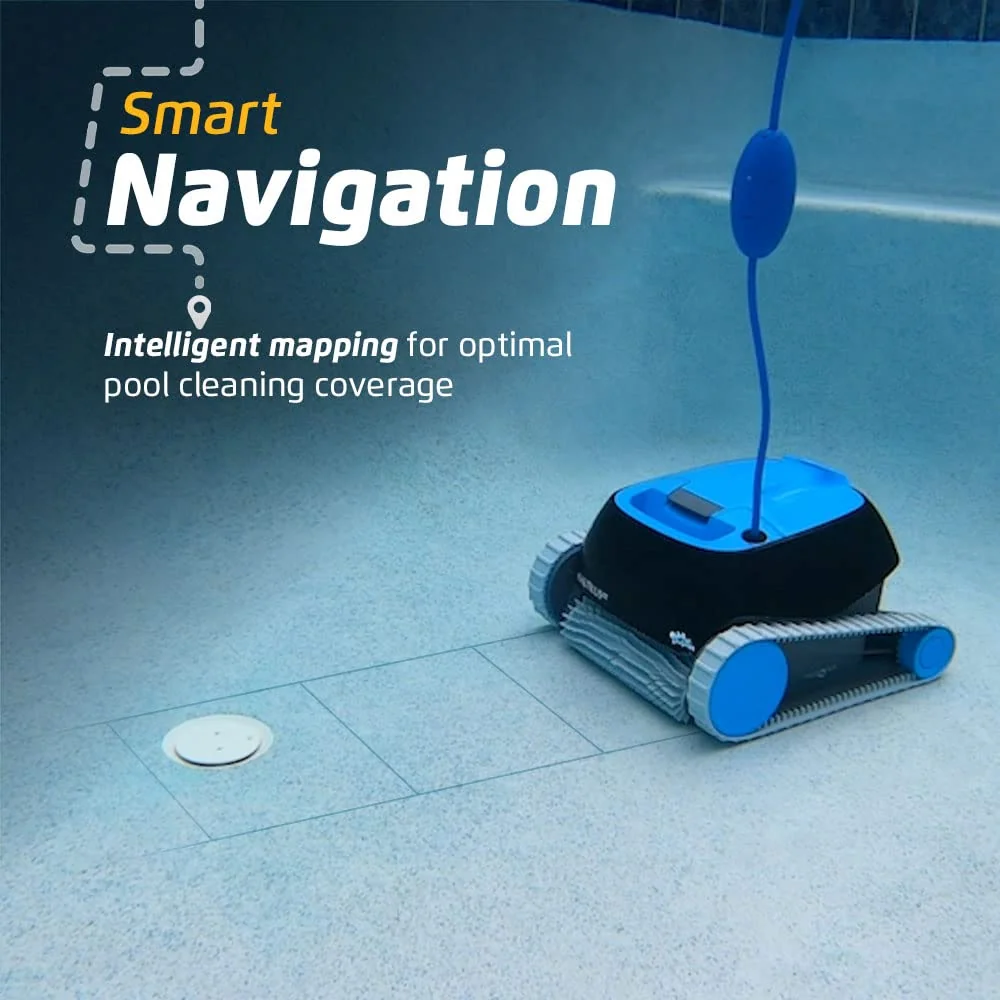
The route can look random from the deck. The robot may revisit one patch while leaving another untouched until late in the cycle, and it does not recognize a visible pile of dirt and make a deliberate turn toward it. Its navigation is best understood as autonomous direction changes that usually produce broad coverage over time, not a stored map or a promise to clean every inch.
Simplicity also sets the ceiling. The current base model has a single cleaning cycle and a manual start button, with no remote steering, phone control or repeating weekly schedule. That is fine if you plan to remove and rinse the robot after every run; it is disappointing if “automatic” means expecting the machine to wake itself up all week.
Strengths & Limitations
Strengths
- Open-floor cleaning is strong enough to replace most routine manual vacuuming.
- The top-load basket is simple to remove, empty and rinse.
- At about 14 pounds dry, the robot is comparatively manageable at retrieval.
- It collects common dirt, leaves and larger plant debris without loading the pool’s primary filter.
- Replaceable tracks, wheels, bushings, brushes and filter media support practical repair.
Limitations
- The non-swivel floating cable can twist, tangle and eventually wear.
- Wall climbing does not provide dedicated sideways waterline cleaning.
- Steps, sharp corners, benches and tanning ledges often still need a brush.
- The current base model has no app, remote or repeating weekly schedule.
- The standard filter can struggle with persistent ultra-fine dust, pollen and dead algae.
- A one-year warranty leaves more long-term risk with the owner.
What it cleans, and what still needs a brush
The open floor is the Nautilus CC’s convincing territory. Exact-model owners report successful pickup ranging from ordinary dirt to oak leaves, acorns, sweetgum balls, pine straw and bark. That does not mean a modest basket can swallow an entire seasonal leaf dump without attention, but it does mean the robot is not limited to dust-sized debris. Heavy loads may require an empty basket and another cycle.
| Area or debris | What to expect | What may remain |
|---|---|---|
| Open floor | Strong routine pickup across simple shapes | Isolated missed patches during a single cycle |
| Leaves and larger debris | Capable of ingesting leaves, acorns and plant material | Repeated passes or a mid-cycle basket clean under heavy loads |
| Sand and silt | Some owners report good capture | Persistent ultra-fine material may pass the standard filter |
| Vertical walls | Credible climbing in many straightforward pools | Uneven upper-wall coverage in awkward shapes |
| Waterline | May touch or briefly scrub the surface during a climb | No sustained sideways travel along the tile line |
| Steps and ledges | May reach a low bench or platform by chance | Reliable cleaning usually requires a manual brush |
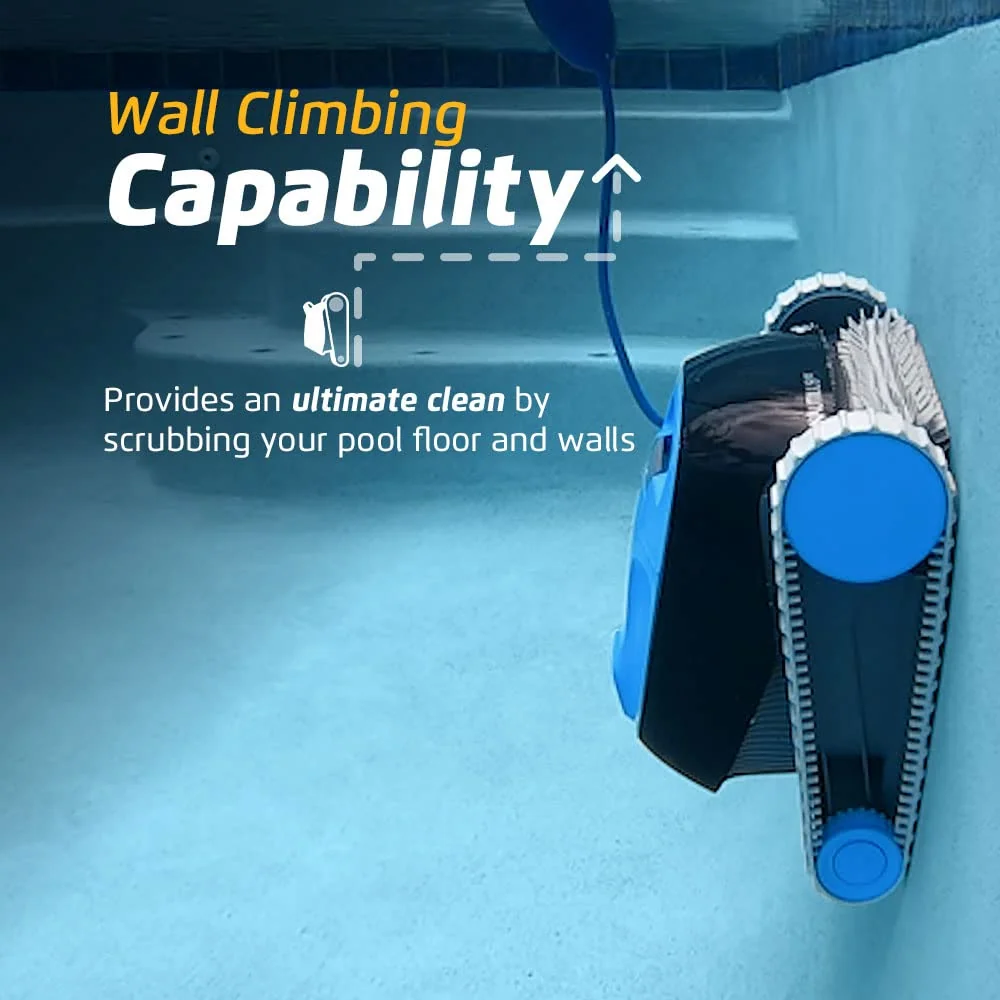
Wall-climbing accounts sound contradictory until “reaching the waterline” and “cleaning the waterline” are separated. In some pools, the CC drives high enough for part of its body to leave the water, then backs or drops down. That can scrub a vertical strip at the surface, but the machine does not stay planted there and traverse the perimeter. Buyers who care about a persistent scum line should treat waterline work as unfinished business.
Geometry is the more predictable limitation. Owners of rectangular fiberglass and gunite pools report missed 90-degree corners, dirty wall bases and steps the robot could not climb. A practical routine is to brush those areas toward the open floor immediately before starting the cycle. Main drains are less consistently troublesome, with several owners reporting that the CC crossed theirs without getting stuck.
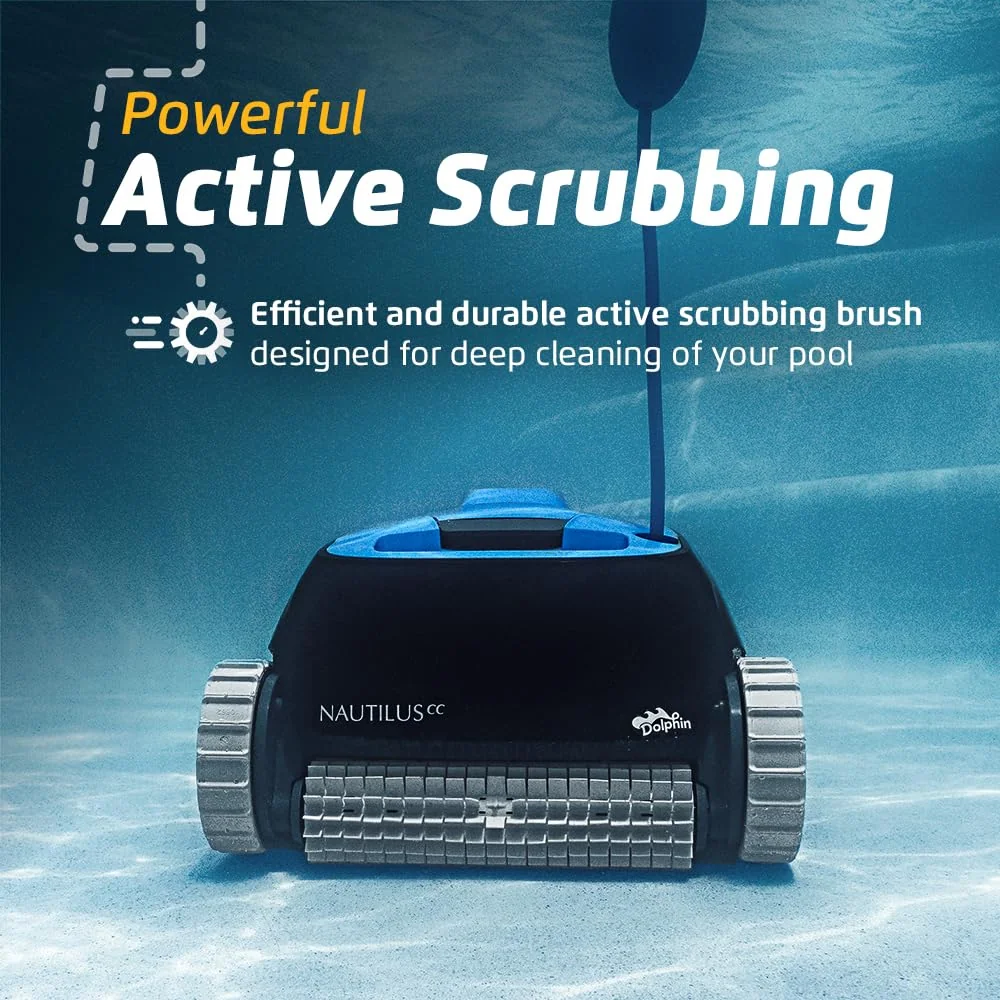
The active front brush helps loosen ordinary attached dirt, but it is not a treatment for a green pool. Live algae calls for corrected water chemistry, and the robot’s useful role comes afterward, when loose material needs to be collected. Expecting the brush to replace chemistry and hand work sets the machine up for a job it was not built to finish.
Basic is a virtue only when it matches the pool
The value case has little to do with feature count. It rests on exchanging an hour with a manual vacuum for roughly ten minutes of setup, retrieval and basket care around an unattended cleaning cycle. Owners who had cycled through suction cleaners, skimmer hookups and battery vacuums often valued the Nautilus CC precisely because it performs that central job without involving the pool’s circulation system.
The strongest fit
Choose it for a straightforward pool within the stated size limit, routine leaves and floor dirt, some wall cleaning, convenient outlet placement and an owner willing to brush architectural trouble spots.
The wrong fit
Look elsewhere for a large or complex pool, genuine waterline traversal, scheduled operation, remote control, freedom from cable management or dependable coverage of steps and shallow shelves.
The 50-foot cable deserves a tape measure rather than a glance at the 33-foot pool claim. The power supply must remain safely back from the water, depth consumes some reach, and an outlet at the wrong end can make a nominally compatible pool impractical. One owner encountered exactly that problem, while another made the cleaner work in a much longer pool only because power was available near the midpoint.
If a larger pool, connectivity or waterline work is driving the decision, compare the base machine against the Nautilus CC Plus and Nautilus CC Pro before buying. If the cable itself is the objection, our guide to corded and cordless pool robots explains the trade between cable handling and battery charging without pretending either approach is maintenance-free.
The cord is the ownership tax
The base CC has no anti-tangle swivel, and cord twisting is the most persistent complaint in the exact-model ownership record. Some units run without meaningful interference, but others wrinkle, coil or catch around a track. Laying the cable straight after a run, deploying it loosely and avoiding tight storage coils can help; none of those habits turns a non-swivel cable into a swivel cable.
Continuous submersion raises the stakes. One heavy seasonal user left the robot in chlorinated water for months at a time and later saw the submerged cable deteriorate and shed blue flakes, while a more careful saltwater owner stored the robot out of the pool and reported no comparable deterioration entering the third year. Those accounts do not establish a universal lifespan, but they make a persuasive case for rinsing, straightening and storing the machine rather than treating the pool as its permanent garage.
Expect wear parts, not an immortal appliance
Long-lived units exist, including exact-model robots still working after two or three years of regular use. Their maintenance stories include replacement tracks, bottom brushes, a rear wheel and eventually a floating cable. Another owner restored a stalled robot by removing hair wrapped around the impeller, avoiding an unnecessary conclusion that the motor had died.
That repairability is a genuine advantage for a mechanically comfortable owner. Replacement guidance identifies wheels, bushings and tracks as serviceable parts whose wear can cause slipping, weak climbing, mid-cycle stopping or incomplete coverage. Parts are not free and belt work can be fiddly, but several common movement failures can be investigated without discarding the entire cleaner.
Durability is variable rather than uniformly reassuring. The retained record also includes a unit that deteriorated within two weeks, another with a broken filter handle after about ten months, and an exact-model complaint about a power supply that failed after four uses. The company complaint page is selected for unhappy experiences and cannot reveal a failure rate, but it does expose the inconvenience of waiting for parts or warranty help when an early failure does occur.
The current one-year warranty makes that uncertainty harder to dismiss. Older reviews and videos sometimes mention two-year coverage, but those accounts describe previous generations or sales conditions rather than the present base model. A nearby service option and a willingness to replace wear parts become more important once the first year ends.
Frequently Asked Questions
Does the Dolphin Nautilus CC clean the waterline?
It may reach and briefly scrub the surface during a vertical climb, but it does not remain at the waterline and travel sideways around the pool.
Does the current Nautilus CC have a weekly timer or app?
No, the current base model has a manual start button, one approximately two-hour cycle and no app-controlled schedule.
Why do older instructions show settings marked 1, 2 and 3?
Those daily, every-second-day and every-third-day settings belong to an older power supply, while the current base model uses manual start.
Can it clean steps, corners and tanning ledges?
It may reach some low platforms, but steps, square corners and shallow ledges are recurring weak spots that usually need manual brushing.
Does the floating cable tangle?
It can, because the base CC lacks an anti-tangle swivel, although straightening the cable after use and storing it in loose coils can reduce the problem.
Can the Nautilus CC pick up leaves, sand and fine silt?
It handles routine leaves and dirt well and can capture some sand or silt, but heavy leaf loads may fill the basket and persistent ultra-fine material may require finer filter media.
What commonly causes a Nautilus CC to stop moving?
Hair in the impeller, worn tracks, damaged wheel teeth or worn bushings can imitate a major motor failure and are worth checking first.
Can this robot remove algae from a green pool?
No, its brush can loosen ordinary dirt and collect some dead residue, but active algae requires corrected water chemistry rather than a longer cleaning cycle.
How long does the Dolphin Nautilus CC last?
Exact-model accounts range from failures within the first weeks to more than three years of service, with cable, track, brush and wheel replacement becoming part of longer ownership.