Buy the vacuum first unless the mess never reaches the floor
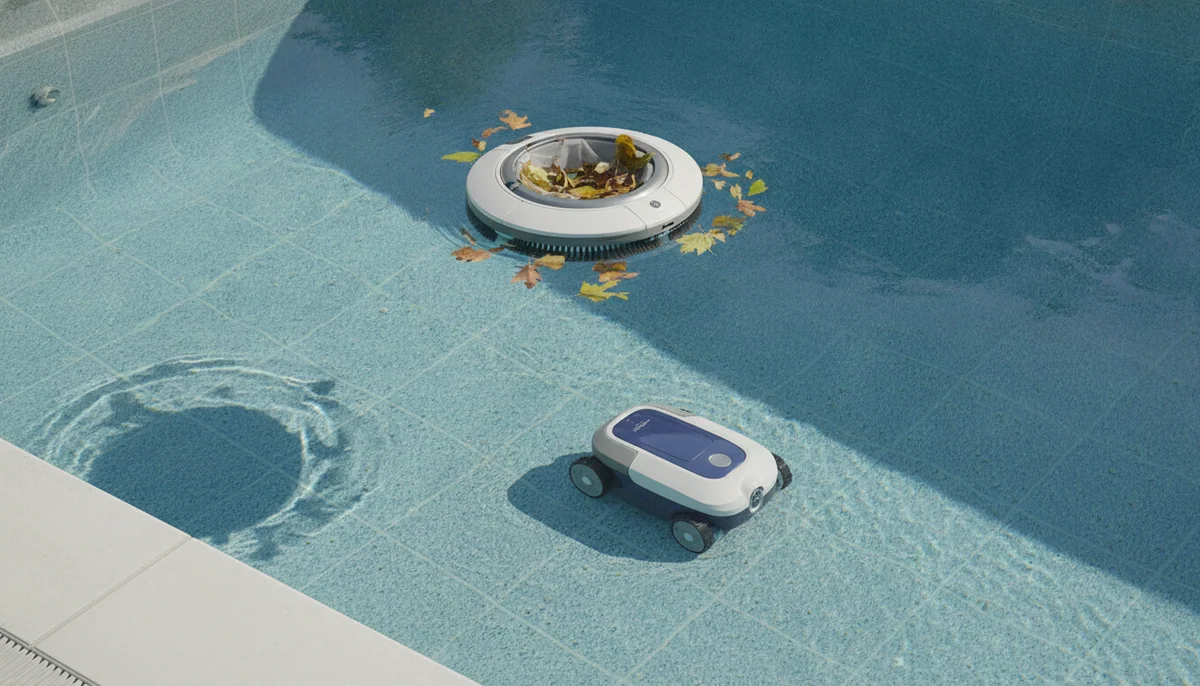
The distinction is simpler than the product names make it sound: a robotic skimmer works on top of the water, and a robotic vacuum works underneath it. One intercepts leaves, pollen, bugs, blossoms, grass and hair while they float. The other collects sand, grit, dirt, insects and leaves after they settle on the floor, with some models also climbing walls or scrubbing the waterline.
For a one-robot household, the vacuum usually removes the harder manual job. A hand net deals with a few floating leaves in minutes; pole-vacuuming a floor requires more setup, movement and cleanup. That default changes when the surface refills faster than anyone can net it. One Betta SE owner with two shedding dogs described spending at least an hour skimming after each swim before putting a surface robot on persistent fur duty, which is exactly the sort of pool where the skimmer deserves to come first.
Choose by the layer that gets dirty first, not by which robot has the longer feature list.
One pool, two different jobs
Think of the skimmer as prevention and the vacuum as recovery. A newly fallen leaf is a surface-skimmer problem. If it becomes waterlogged and drops to the deep end, it becomes a vacuum problem. Intercepting it early can reduce the load on the floor cleaner, fixed skimmer basket, pump basket and main filter, but it cannot eliminate material that sinks immediately or enters below the surface.
| Pool problem | Surface skimmer | Submerged vacuum |
|---|---|---|
| Floating leaves, insects and petals | Primary job | Usually waits for them to sink |
| Floating pollen, lint and pet hair | Good fit with suitable mesh | Not an open-surface cleaner |
| Settled leaves and bugs | Cannot reach them | Primary job |
| Sand, grit and floor dirt | Cannot reach them | Good fit with suitable filtration |
| Walls | No | Only on a genuine wall-climbing model |
| Tile-line scrubbing | No | Only on a dedicated waterline model |
| Steps and tanning ledges | No | Inconsistent and highly dependent on geometry |
| Algae, cloudy water and chemistry | Does not solve them | Does not solve them by itself |
A vacuum that advertises waterline cleaning is not secretly a surface skimmer. Waterline cleaning means the submerged machine reaches the wall’s upper edge and, on capable models, travels laterally while scrubbing there. It does not roam across open water collecting leaves. The reverse is also true: a floating skimmer may brush past the tile line all day without removing its adhered ring.
Let the pool diagnose the purchase
If the answer is not obvious, start with a clean slate rather than a product specification. Net the surface, clean the floor and watch what returns over the next day or two. The first recurring mess identifies the stronger purchase.
- Floating material returns first: choose a robotic skimmer when leaves, insects, pollen, petals, needles, clippings or hair repeatedly spoil the surface.
- The floor becomes dirty first: choose a robotic vacuum when sand, grit, ordinary dirt, small stones or settled organic debris is the persistent chore.
- Both layers refill quickly: consider two specialists when new debris keeps arriving and enough of it still reaches the bottom to justify regular vacuum cycles.
- Neither layer is the real problem: fix sanitation, circulation, filtration or attached algae before asking a robot to disguise it.
This test also exposes when a robot is unnecessary. If the built-in wall skimmer already clears the whole surface and only a handful of leaves escape it, another floating machine may create more basket care than time savings. If the floor is consistently clean but a pollen film reforms every afternoon, paying for wall climbing and app navigation misses the actual problem.
Buy the skimmer first
The pool is open to trees, wind, lawns, insects or swimming dogs; surface debris returns throughout the day; the hand net comes out before nearly every swim; or an existing cleaner already handles the floor.
Buy the vacuum first
The floor collects sand, grit, dirt or sunken leaves; manual vacuuming is the hated chore; the fixed skimmer already manages floating material; or walls and the tile line also need mechanical attention.
Buy both
Surface litter arrives continuously, floor debris still accumulates between cleanings and the avoided labor is worth two baskets, two storage spots and two operating routines.
When a surface skimmer earns its place
A net wins a sprint; a robotic skimmer wins only when the race keeps restarting. Its value comes from roaming while pollen drifts, insects land and trees continue dropping material. The machine catches some of that load before it sinks, but persistent patrol is not the same as instant cleanup. Leaves can bob ahead of an intake, escape during a turn, get pushed aside or sink before the robot reaches them.
Controlled EcoSurfer S2 testing illustrates the difference between a surface that looks clean and a basket that captured everything. After about three and a half hours, the water looked clear, yet roughly 80 percent of the synthetic debris was in the basket because much of the remainder had sunk. A skimmer can deliver the visual result while still leaving tomorrow’s vacuum something to collect.
The Betta SE is the straightforward sunny-pool specialist: it has extensive owner evidence for leaves, pollen, insects, blossoms and dog hair, but its solar-only charging makes prolonged cloud, winter shade and a dirty panel meaningful drawbacks. Its persistent random patrol can also be trapped by a wall-skimmer mouth, shallow shelf, cleaner cord or overhanging edge, so the “continuous” claim remains conditional rather than perpetual.
The Betta SE Plus is the more defensible Betta where sunlight is uncertain because it adds adapter charging, but the premium buys weather insurance rather than proof of better debris capture. It remains a surface-only machine, and the same currents, ledges, hoses and fixed-skimmer suction can interfere with it.
The AIPER EcoSurfer S2 suits buyers who value fine floating-debris pickup, battery information and app scheduling, but it is a patient leaf collector rather than a storm-cleanup machine. Its ownership record also includes basket-drive clacking, loose gears, circling and propeller or motor faults, which matters more than a tidy first demonstration.
None of those products vacuums the bottom. A large skimmer basket is not a floor filter, and a fine surface mesh does not prove that a submerged machine would retain dead algae or powdery silt. Readers comparing the specialist options can use the robotic pool skimmer guide, while pools dominated by leaves at both levels need the separate guide to robots that handle leaves and floating debris.
Why the vacuum is still the better first robot
Once debris reaches the floor, waiting for circulation will not make it climb back to the surface. Sand may never have floated at all. A submerged vacuum carries its own basket across the pool floor, and capable models add brushing, wall climbing or deliberate waterline travel. That removes the hose setup and repetitive pole work that usually make floor cleaning the larger burden.
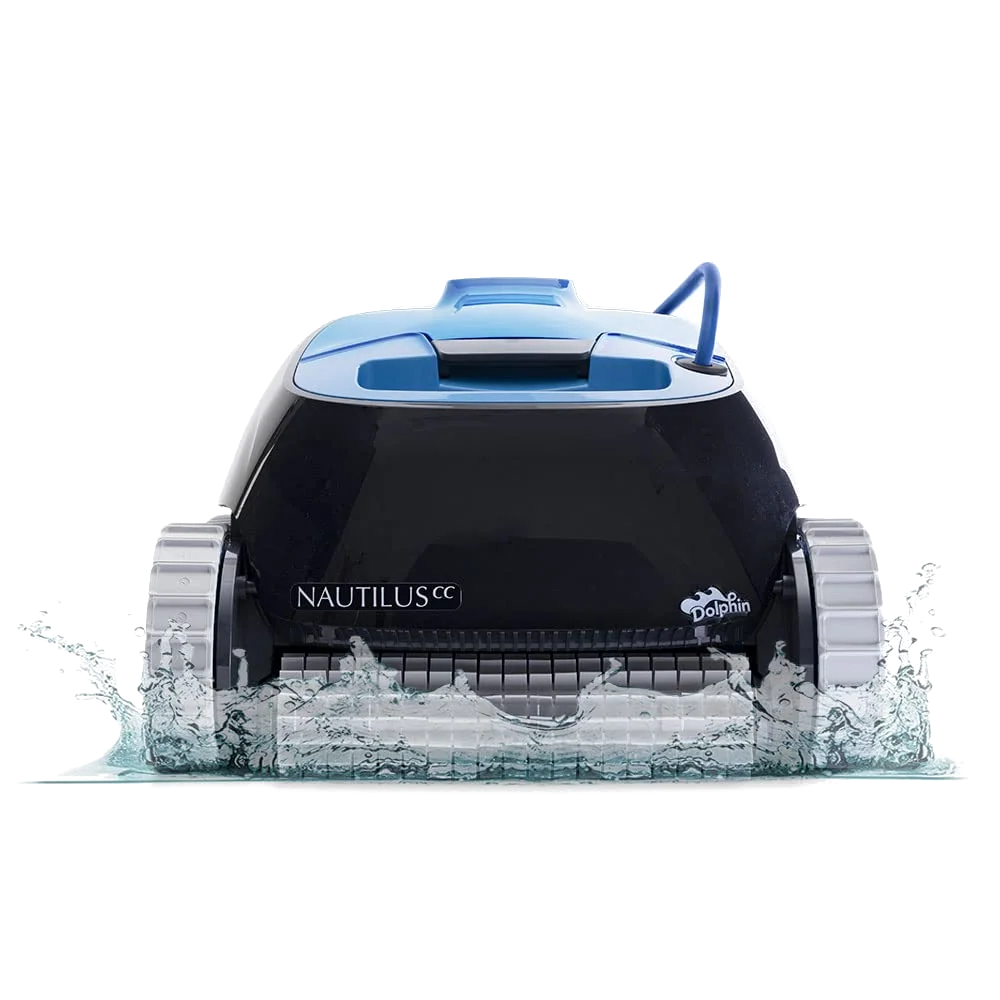
The Dolphin Nautilus CC is a useful corded baseline for a simple pool because it has strong evidence for routine floor pickup of leaves, bugs, dirt, sand, acorns and visible silt. Its honest limits are equally important: the base model does not perform sustained lateral waterline cleaning, its cable can twist, and steps, square corners and wall bases may still need brushing toward the open floor. One fiberglass-pool owner estimated that a cycle handled nearly all of the floor while leaving debris in sharp corners and on the steps, which is a good picture of substantial labor reduction rather than total automation.
The Dolphin Nautilus CC Pro makes sense only when corded waterline work is specifically wanted. It can travel deliberately along the tile line and uses a swivel cable, but it still cannot patrol the open surface; its stock flat mesh is also a poor match for dead algae, silt and very fine sand, and exact-model reports include controller, power-supply, motor, cable and app failures.
Cordless models remove the floating power cable, not the ownership routine. A typical cycle ends with hook retrieval, draining, basket rinsing, charging-port drying and another charge. Longer runtime does not turn a vacuum into an unattended skimmer, and “self-parking” usually means stopping near a wall rather than climbing out or returning to a charger.
A basic floor-only cordless robot can be enough for a genuinely flat, smooth above-ground pool with loose debris and modest expectations. It is a bad bargain when liner wrinkles, ladder feet, drains, slopes or fine silt define the pool. For the wider architecture decision, the corded-versus-cordless guide separates cable management from battery care, and the fine-debris guide focuses on filtration rather than impressive flow claims.
The one-machine compromise is real, but it is still a compromise
A few premium robots genuinely enter both categories. The Beatbot Sora 70 is the clearest supported example: it can clean the floor, walls and waterline, then operate at the surface and collect leaves or bugs. Its six-liter basket and automatic surfacing make it a credible one-chassis option for coarse debris, but its surface mode consumes the same finite battery as the underwater work, the standard filtration is a weak promise for fine dust and the large body still has to be drained, rinsed and charged.
That architecture fits a pool needing periodic pre-swim skimming rather than all-day interception. It does not fit an owner who wants a solar specialist roaming while the vacuum charges or cleans below. A surface mode can be useful without matching the availability of a dedicated skimmer.
A larger feature count does not guarantee a stronger hybrid. Controlled testing of the Beatbot AquaSense 2 Ultra found capable underwater work but only about 40 percent capture in a staged surface test, with its bow wave pushing debris away faster than the side brushes could funnel it. The exact product sold here is renewed, which adds battery condition, sensor clarity, accessories, account reset and written protection terms to an already heavy buying decision.
Choose an all-in-one when one battery, one basket and one storage footprint matter more than continuous surface patrol. Choose two specialists when surface debris falls all day and the bottom still gets dirty. Neither answer is more advanced; they simply allocate the work differently.
If you buy both, do not make them fight
The cleanest routine is a surface skimmer on persistent patrol and a submerged vacuum on periodic cycles after floor debris accumulates. Empty the skimmer more often during pollen, blossom or leaf season, because a full basket can turn an autonomous appliance into floating storage. Run the vacuum often enough that settled material remains a maintenance load rather than an opening-day rescue.
A floating skimmer can meet the surface loop of a corded vacuum or the hose of a suction-side cleaner. Some pools let the two coexist; others repeatedly trap the skimmer. Staggering their schedules is the safer default. A cordless floor vacuum removes that collision but replaces it with charging and battery care.
Pool geometry can defeat either specialist. Surface robots encounter fixed-skimmer suction, return currents, beach entries, tanning ledges, fountains, furniture and protruding coping. Submerged robots encounter raised drains, in-floor heads, ladders, liner wrinkles, curved bowls, abrupt slopes, narrow steps and shallow shelves. The product with the largest claimed coverage area can still be the wrong machine for one troublesome transition.
Both robots need their own basket or filter cleaned, and neither replaces circulation, the main pool filter or correct sanitation. Loose dead material may reach a vacuum basket, but established algae still calls for chemistry and brushing. Smart Pool Bots’ debris guide explains where leaves, sand, silt, pollen and algae residue separate into different filtration problems.
The final rule
Buy the robot that attacks the pool’s dominant debris layer. For most first-time buyers with a generally dirty pool, that is a vacuum because the floor is harder to clean manually. Put the skimmer first when floating leaves, pollen, bugs or hair return throughout the day, or when another system already handles the floor. Buy both only when both jobs recur often enough to justify two machines, and choose an all-in-one only after accepting that its surface work will be periodic rather than continuous.