Corded vs Cordless Pool Robots: Choose the Chore You Can Live With
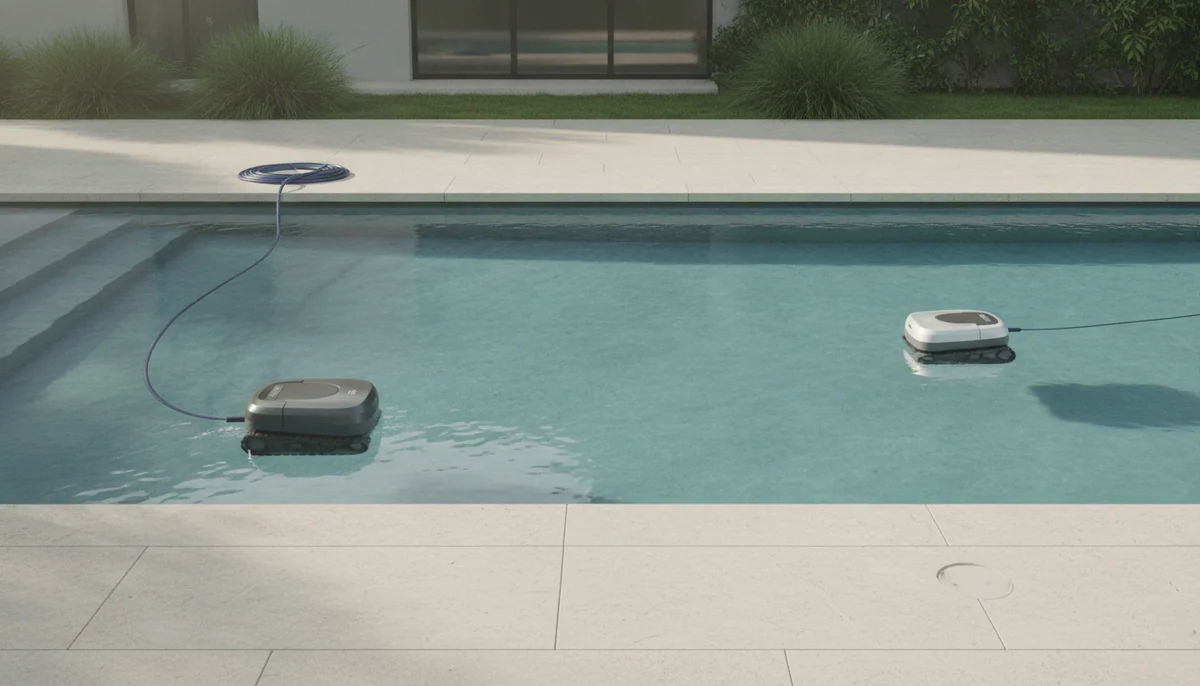
Corded makes you manage a cable. Cordless makes you manage a battery. That is the useful distinction, and it is less glamorous than the idea that one design represents the past while the other represents the future.
A corded cleaner brings a floating cable, a deck-side power supply, an outlet calculation, and some untangling into the job. In return, it can run another complete cycle as soon as the first one ends. A cordless cleaner removes that operating cable, then asks you to retrieve a wet machine, drain it, rinse its filter, dry its charging area, wait for a recharge, and put it back in the pool.
Neither routine is hands-off. The better one is the routine you will perform consistently, especially after a storm when the basket fills early and the pool needs more than a ceremonial lap.
Choose corded first
- Your pool often needs two or more cycles in one day.
- Leaves, opening debris, or storms regularly overwhelm one basket.
- You have a practical outlet and protected place for the power supply.
- You care about established replacement parts and repair options.
Choose cordless for a reason
- A cable would cross a walkway or interfere with an automatic cover.
- The outlet position makes safe cord reach impractical.
- Animals, other equipment, or swimmers make a floating cable troublesome.
- One battery cycle comfortably handles the pool’s normal maintenance load.
Do not compare a basic floor-only cordless sweeper with a tracked corded robot that scrubs walls and then credit every difference to the cord. Price tier, brushes, filtration, traction, navigation, warranty, and cleaning scope changed at the same time. The fair comparison begins with the job the machine must do.
The ownership trade, without the slogans
| Ownership question | Corded robot | Cordless robot | What to verify |
|---|---|---|---|
| Power during a cycle | Continuous mains-derived low-voltage supply | Finite internal battery | Runtime in the exact mode you will use |
| Second complete cycle | Can usually begin immediately | May require several hours of charging | Charge time and real full-pool endurance |
| Poolside setup | Floating cable, control box, and outlet | No powered equipment beside the pool during the run | Safe cable reach or a dry charging location |
| Post-cycle work | Drain, rinse, straighten cable, and store | Drain, rinse, dry contacts, charge, and store | Which routine you will actually complete |
| Recurring electrical concern | Cable, connector, and power-supply wear | Battery aging, charger, port, and seal condition | Parts availability and written warranty coverage |
| Scheduling | Supported models can draw power for each scheduled run | Most schedules divide one stored charge among shorter runs | Whether the robot recharges itself, which most do not |
| Retrieval | Manual lift after bringing the robot to the edge | Underwater edge parking or surface parking, depending on model | Wet lift, drainage, hook access, and parking type |
| Best natural fit | Repeat cleaning and predictable weekly operation | Deliberate cable-free maintenance cycles | Debris load, pool geometry, and owner routine |
Where corded earns its keep
The strongest case for corded power appears when a pool is dirty enough to need repetition. A two-hour cycle is not an endurance headline, but the owner can empty the basket and immediately run another two hours. That matters during spring opening, after wind drops a tree into the water, or whenever the filter fills before the route is complete.
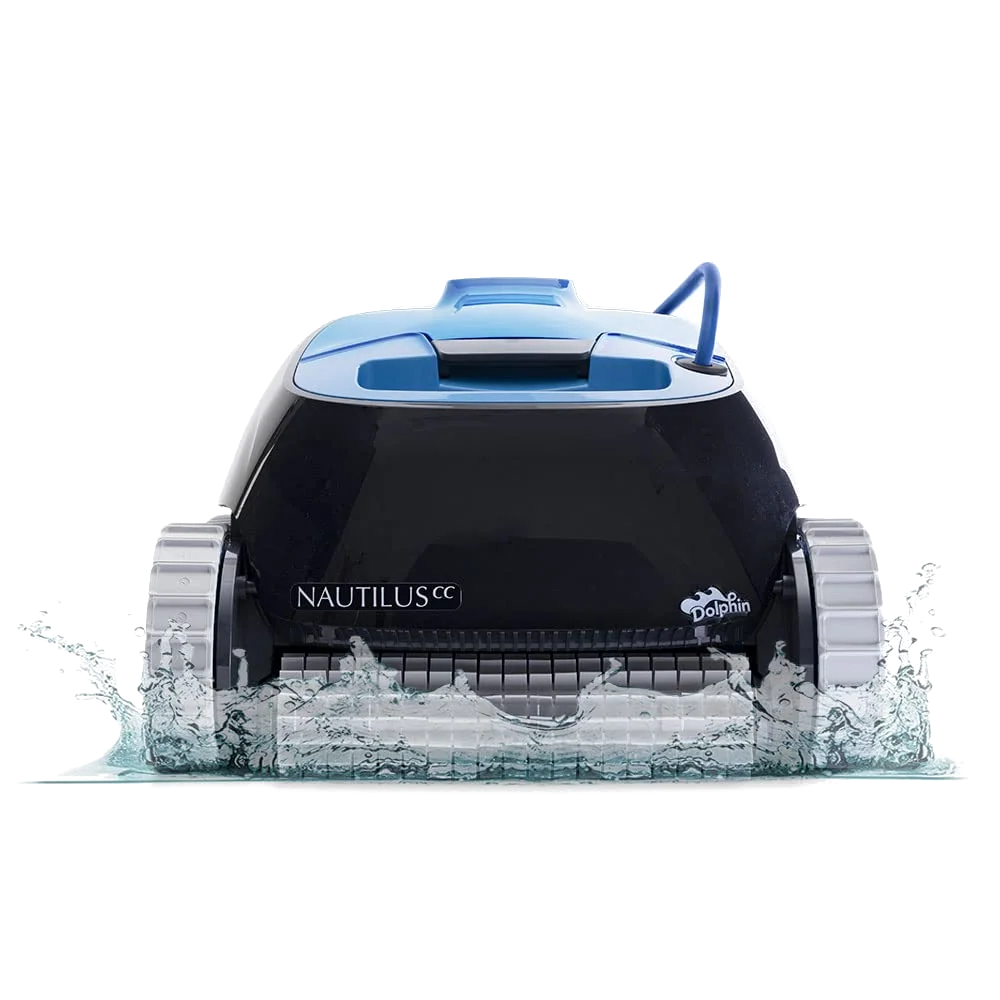
The Dolphin Nautilus CC is a useful baseline because its virtues and faults are easy to understand. It is a roughly 14-pound corded cleaner for pools up to 33 feet, with an active brush, top-load filter, wall climbing, and an approximately two-hour cycle. It does not provide dedicated waterline travel, an app, or a cable swivel, so the persistent drawback is exactly what a corded buyer fears: the cable can twist, kink, and occasionally tangle.
Yet the Nautilus CC also shows why a mature corded platform can age more like an appliance than a sealed gadget. Owners describe replacing tracks, brushes, wheels, and cable, while model-specific parts material identifies common service items rather than treating every fault as a reason to discard the whole cleaner. That does not make motors, cables, or power supplies cheap, but it gives an owner more possible exits when a wear part fails.
The Dolphin Proteus DX3 offers a similar proposition for conventional in-ground pools up to 33 feet: active scrubbing, wall climbing, a top basket, and immediate repeat cycles. Its scheduling controller can request daily, every-other-day, or every-third-day operation for a limited period, but it still carries a non-swivel cable, misses steps and deliberate tile-line work, and has exact owner reports involving power-box trouble.
Move up to the Dolphin Nautilus CC Pro and the cable becomes better rather than disappearing. Its longer swivel cable materially reduces twisting, while app scheduling, manual steering, wall climbing, and genuine lateral waterline travel make the powered connection more useful. The honest drawback is broader than its cord: stock filtration can pass fine sand, silt, and dead algae, coverage can remain patchy, and exact failure reports include the controller, power supply, cable, motors, app, and recovery behavior.
It means battery aging is absent from the failure list and another cycle does not wait for a recharge; cables, control boxes, motors, connectors, and support can still fail.
Where cordless changes the experience
Cordless wins most convincingly when the cable itself causes the trouble. A floating lead can cross a narrow deck, complicate an automatic cover, attract animal damage, interfere with another cleaner, or simply make deployment annoying enough that the robot stays in storage. Removing that obstacle can lead to more frequent cleaning, which matters more than winning an abstract technology argument.
Deployment can be pleasingly direct: charge the cleaner, select a mode above water, lower it into the pool, and leave the cable reel in the imagination. The pool also looks less occupied while the robot works. For owners who clean during swim season on a busy deck, that is a real quality-of-life improvement.
The catch arrives when the cycle ends. Most cordless robots still need to be hooked or grabbed, held over the water while they drain, carried to a cleaning area, opened, rinsed, dried around the charging connection, and recharged. Cordless removes one chore rather than removing chores.
A normal corded run
- Place the power supply as the manual requires.
- Lay out enough cable for the farthest underwater point.
- Start the cycle and keep excess cable orderly.
- Retrieve, drain, and rinse the robot and basket.
- Straighten the cable and store it in loose coils.
- Restart immediately if the pool needs another pass.
A normal cordless run
- Confirm that the battery has enough charge.
- Select the mode before the robot submerges.
- Retrieve the robot when the finite cycle ends.
- Drain, empty, rinse, and clear the intake.
- Dry the charging port or contact area.
- Recharge before the next substantial pass.
Cheap cordless can be useful, but keep the assignment narrow
The AIPER Seagull SE 2025 makes sense only as a simple floor sweeper for a flat, smooth, already-maintained above-ground pool. Its advertised cycle reaches up to 90 minutes after a claimed 2.5-hour charge, and it has no active scrubber, wall cleaning, waterline work, or sophisticated route planning. Loose coarse debris is the reasonable assignment; fine sediment passing through the screen, random misses, and recurring charging or battery failures are the reasons not to promote it as a miniature premium robot.
This is also why “cordless cleaners cannot clean” is the wrong conclusion. A low-cost floor-only sweeper is limited because its chassis, brushes, filter, route, battery, and cleaning scope are limited together. The missing cord is only one item on that list. Buyers comparing entry-level machines should start with the site’s lower-cost robotic cleaner guide, then check whether the chosen model is built for the actual floor and debris.
The cordless model that makes the strongest practical case
The Aiper Scuba S1 is evidence that a cordless robot can clean extremely well. The current version combines wall and waterline capability with a 180-micron main basket and a replaceable 3-micron insert, while its ordinary full-power modes are rated for up to 180 minutes. In one independent comparison, it recorded 99 percent floor coverage, 86 percent wall coverage, and 62 percent coverage of the stairs and bench.
That result also exposes what the battery label cannot answer. The floor performance was excellent, the walls were less complete, and the steps remained unfinished. The fine insert captures material that coarser baskets miss, but it clogs and adds rinsing work. Independent retrieval measurements placed the cleaner at roughly 39 pounds during the first water-filled lift and about 20 pounds after drainage, so “cordless” should never be used as a synonym for “light.”
The Scuba S1 is the balanced cordless recommendation for a simple pool with fine debris when one charge comfortably covers the job. Its honest drawbacks are awkward geometry, a rinse-intensive fine filter, an underwater app connection that cannot be trusted for live steering, and owner reports ranging from successful use beyond a year to early charging, control, and motor faults.
Readers committed to eliminating the cable can compare that trade against other models in the best cordless robotic pool cleaners guide, but the Scuba S1’s measured cleaning evidence is more useful than a longer runtime claim printed without a mode label.
Premium cordless solves retrieval better, not completely
The Beatbot Sora 30 offers one of the more meaningful cordless conveniences: it can rise at the end of a cycle, wait near the pool edge, and release water before the owner lifts it. That is substantially better than a robot that merely stops on the deep-end floor. It still does not climb onto the deck, empty its five-liter basket, dock, or recharge itself.
Its strongest case is a large or geometrically complicated pool where broad submerged ledges matter. Owner reports include former corded-Dolphin users who preferred the Sora 30’s deployment, retrieval, wall work, waterline cleaning, and shallow-platform behavior. The drawback is that its 300-minute headline belongs to floor operation, its standard 150-micron filtration is not designed for the finest silt, app experiences vary, and long-term evidence remains young.
Smart Pool Bots would choose the Sora 30 because its surface return or shallow-area behavior solves a specific pool problem, not merely because the cleaner lacks a cable. Readers considering it should start with the full Sora 30 review, where those geometry and filtration limits are treated as purchase conditions rather than footnotes.
The Beatbot AquaSense 2 Pro extends the same premium cordless idea with underwater cleaning, occasional surface skimming, surface parking, and app-controlled surface navigation. Floor cleaning is its strongest function, while skimming, fine-debris retention, and methodical coverage are more variable. At roughly 24 to 25 pounds dry, it can also be physically harder to own than its cable-free deck suggests.
It is reasonable for a buyer who insists on one cordless chassis for underwater cleaning and supplementary skimming, accepts manual docking and charging, and can lift it safely. Its honest drawback is consolidation: asking one heavy battery-powered robot to vacuum, scrub, skim, dispense clarifier, park, and communicate does not guarantee that it replaces the best specialized tool for every job. The AquaSense 2 Pro review examines that compromise before the buying action.
Scheduling is where cordless claims need translation
A supported corded timer and a cordless weekly plan are not the same system. The corded cleaner can draw fresh power for the next scheduled cycle. A conventional cordless cleaner divides the energy already in its battery among delayed sessions, then stops when that stored charge is gone.
The cordless robot also cannot empty a full basket, rinse a fine filter, dry its charging contacts, or judge whether a storm changed the assignment. Leaving it submerged between scheduled runs postpones those chores rather than eliminating them. Anyone seeking true recurring automation should ask what the machine does after the battery or basket reaches its limit.
Usually means several short runs rationed from one cordless charge.
Usually means setup, mode selection, logs, firmware, or surface functions rather than live submerged steering.
May mean stopping underwater near an edge, not rising to the surface.
Reduces deep-water fishing but still leaves lifting, rinsing, charging, and redeployment to the owner.
May describe floor-only or low-power operation rather than a full floor, wall, and waterline cycle.
Does not prove persistent mapping, complete coverage, or successful handling of drains and steps.
Power source does not decide what stays in the basket
A motor can move a great deal of water and still return the dirt through the wrong filter. Seller flow-rate claims are not standardized cleaning tests, and they say little about filter sealing, exhaust disturbance, loaded flow, or whether a fine insert is included. A robot that repeatedly drives over silt while blowing it into suspension has plenty of motion and not enough retention.
This problem crosses the cord. Exact Nautilus CC Pro owners report fine sand, silt, and dead algae passing its stock mesh. Budget cordless AIPER models commonly struggle with fine sediment. Premium cordless machines can also disappoint despite published micron figures because a rating alone does not describe how well the media seals or performs after loading.
If pollen, sand, silt, or dead algae is the real complaint, ignore power architecture at first and compare the actual included filtration. The site’s guide to robots for sand, silt, and fine debris addresses that narrower job, while the debris explainer shows what pool robots can realistically retain.
A battery cannot fix steps, and a cable cannot fix navigation
Steps, benches, tanning ledges, abrupt slopes, curved transitions, ladder gaps, and raised drains defeat both architectures. A cleaner may climb a vertical wall yet fail to mount a broad first step. It may touch the surface during a climb without travelling sideways along the waterline. It may run for four hours while repeating the same easy lane.
The independent Scuba comparison is a useful warning: 99 percent floor coverage coexisted with 62 percent stairs-and-bench coverage for the S1, while the Scuba V3 reached 99 percent on the floor but only 10 percent on stairs and the bench. Both are capable cordless machines, and neither battery solved the chassis-to-geometry mismatch.
Corded Dolphins also commonly miss steps, platforms, corners, and shallow shelves. The distinction between wall climbing and purposeful tile-line travel matters, so buyers who care about those surfaces should use the guide to wall and waterline cleaners or the separate analysis of how robots handle walls, steps, ledges, drains, and slopes.
Test difficult geometry while the return window is useful. Watch the robot approach each drain, transition, step, bench, and shallow shelf. A pool-size label does not settle any of those encounters.
Measure the inconvenience before buying it
Corded sizing starts on the deck, not at the pool’s longest wall. Measure from the intended protected power-supply position to the farthest underwater point, including the required setback, water depth, cable descent, and route across the floor. A “33-foot pool” label is not a promise that every outlet position in a 33-foot pool will work.
Cordless sizing begins with the mode the owner will actually select. Wall climbing, waterline work, Turbo settings, repeated reversals, and difficult geometry consume more energy than a calm floor-only pass. Square-foot capacity and maximum runtime are not one-cycle coverage guarantees.
Before checkout, get answers in writing
- What is the runtime in full-pool mode rather than Eco or floor-only mode?
- How long does a full recharge take before another complete cycle?
- Does parking mean an underwater edge stop or actual surface return?
- What does the cleaner weigh dry and during the first water-filled lift?
- Which filter media are included, and what replacements are available?
- Can the battery, charger, cable, tracks, brushes, basket, and seals be purchased separately?
- Does the warranty cover the battery or cable, and who pays freight?
- Does app control work underwater, or only before immersion and after resurfacing?
- Can the robot cross the pool’s drains, slopes, ledges, steps, and liner transitions?
- For corded models, where can the control box sit and how much usable cable reach remains?
The long-term split is repair path versus battery history
Corded ownership avoids traction-battery aging, but it does not avoid electrical failure. The cable jacket can deteriorate, a connector can fail, a control box can die, and a proprietary replacement can be expensive. The advantage appears when the manufacturer or dealer offers separable parts and a credible service path.
Cordless ownership puts a large rechargeable battery inside a waterproof appliance. That battery is a wear component whether or not the product page describes it that way. Before buying, determine whether it is replaceable, who performs the work, what coverage applies to it, and whether a failed unit must be shipped away during pool season.
Renewed cordless cleaners deserve greater skepticism because the discount can conceal an undocumented battery history. A meaningful renewed offer identifies the refurbisher, states whether the battery was replaced or capacity-tested, lists the included dock and charger, and provides written battery coverage. Without those facts, a new lower-tier cleaner may be the less speculative purchase.
Warranty length is not enough. Ask whether the cable, battery, charger, motors, and water ingress are covered; whether an authorized seller is required; whether outbound freight is yours; and whether “replacement” means new, repaired, or refurbished. Save the listing and warranty language because those pages can change long before the machine fails.
The final call
Most buyers with a practical outlet should start with corded. Immediate repeat cycles, no charging delay, and a potentially better parts path are more valuable across an entire cleaning season than an uncluttered two-hour run. Accept the cable only after measuring reach and deciding where the power supply and loose coil will live.
Choose cordless when the cable is not a hypothetical annoyance but the obstacle that would stop regular use. Give the battery comfortable margin over the pool’s real full-cleaning cycle, confirm that the wet lift is manageable, and treat charging, drying, and eventual battery service as part of ownership rather than unpleasant surprises.
Cordless is not an upgrade over corded in the abstract; it is the better purchase only when removing the cable solves more trouble than adding the battery creates.
Frequently Asked Questions
Do cordless robotic pool cleaners clean as well as corded models?
Some cordless models clean floors, walls, and waterlines extremely well, because filtration, brushes, traction, navigation, and pool geometry matter more than the power source alone.
Are corded robotic pool cleaners always tangled?
Non-swivel cables can twist and occasionally tangle, but correct cable length, loose storage, regular straightening, a swivel-equipped model, and compatible pool geometry can reduce the problem substantially.
Can I run a corded pool robot twice in a row?
A corded robot can generally begin another supported cycle immediately after the basket is serviced, while a depleted cordless model may need hours of charging first.
Can a cordless pool robot follow a weekly schedule without charging?
Most cordless schedules divide one stored charge among shorter sessions, so the robot eventually still needs retrieval, filter cleaning, drying, charging, and redeployment.
Does app control work while a cordless pool robot is underwater?
Ordinary Wi-Fi and Bluetooth usually do not provide dependable submerged communication, so many apps are limited to pre-launch settings, logs, updates, schedules, and surface functions.
Does self-parking mean the robot leaves the pool?
Self-parking usually means stopping near an underwater edge or rising to the waterline, while lifting, draining, rinsing, charging, and redeployment remain manual.
Is a cordless robotic pool cleaner lighter?
Not necessarily, because its sealed battery can make the dry body heavy and retained water can add substantial weight during the first part of retrieval.
Which type is better for leaves after a storm?
Corded has a practical advantage when several cycles are needed, but basket size, intake design, route quality, and the need to empty a full filter still matter more than the cable alone.
Which type is better for fine sand, silt, or dead algae?
Choose by demonstrated filter retention, sealing, and fine-media availability rather than cord type, because both corded and cordless robots can recirculate particles their filters cannot hold.
Are corded robotic pool cleaners more reliable?
Corded models avoid battery aging and may offer better parts support, but their cables, power supplies, connectors, motors, and control systems can still fail.
Sources (2)
- Amazon listings and customer reviews
- Owner and reviewer video, 4 channels