A robot beats a suction-side cleaner for most pools, but it moves the work to the deck
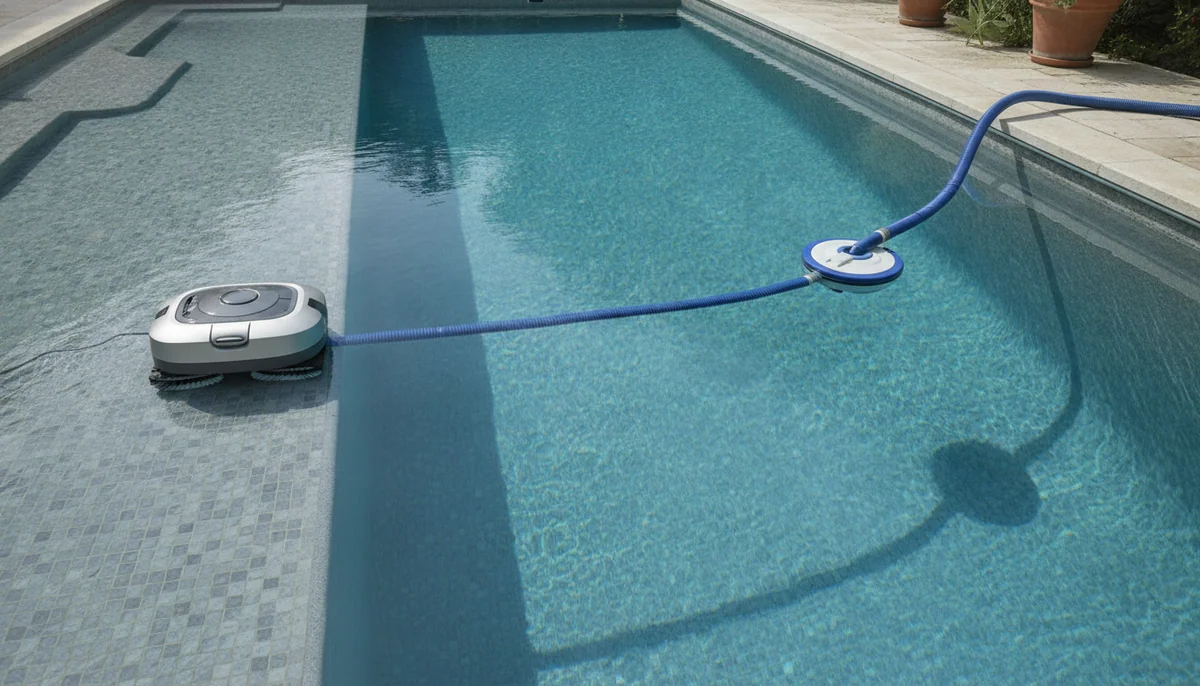
The difference is not intelligence, an app, or the word “automatic.” It is where the cleaning system lives. A suction-side cleaner connects by hose to a skimmer or dedicated suction line, borrows flow from the pool pump, and sends collected material through the pool’s filtration path. A robot brings its own drive, water-moving system, brushes, and removable filter.
A robotic cleaner therefore does have suction. Its impeller moves water through an intake and an onboard basket instead of relying on the skimmer line. That independence is the reason to buy one: the robot can collect floor debris without asking the circulation system to propel it or making the primary filter accept everything it finds.
Independence does not mean freedom from chores. The robot must be launched, retrieved, drained, and rinsed. A corded model adds a floating cable and deck-side power supply; a cordless model replaces those with charging, dry-contact care, finite runtime, and a battery that will age. Suction-side ownership leaves the hose and pump connection in the equation, but it avoids a traction battery and can continue operating whenever the circulation schedule allows.
Choose robotic when you want most routine floor vacuuming moved away from the pool pump and value an easy-to-empty debris basket, active brushing, or credible wall and waterline coverage.
Choose suction-side when you already have a suitable suction connection, prefer mechanically simpler equipment, and would rather service the pool’s filtration path than lift, rinse, charge, or cable-manage a separate machine.
The chore never disappears; it changes address
The useful comparison is the routine you will repeat, not the cleaner’s feature list. A permanently connected suction-side cleaner may be nearly effortless to start, but its hose remains in the water and its debris enters the pool system. A robot keeps that debris in a visible basket, yet the basket is now another filter that somebody must empty.
| Part of the job | Robotic cleaner | Suction-side cleaner |
|---|---|---|
| Cleaning power | Own drive motor and water-moving system, powered by a cable or battery. | Pool pump supplies the flow through a skimmer or dedicated suction line. |
| Debris destination | Removable basket, cartridge, or layered filter inside the robot. | Pool filtration path, with the exact destination determined by the installed system. |
| Before a run | Deploy a cable and controller, or launch a charged cordless machine. | Connect and prime the hose unless the cleaner stays installed, then establish suitable suction. |
| After a run | Retrieve, drain, empty, rinse, and then manage either the cable or charging routine. | Inspect the cleaner and hose, then service the pump basket and main filter as their load requires. |
| Operating limit | Cordless runtime is finite and mode-dependent; corded robots can begin another cycle without charging. | Runtime follows pump operation rather than an onboard battery. |
| Surfaces | Ranges from floor-only machines to models with active wall and true waterline programs. | Coverage depends on the exact cleaner, available suction, surface, hose behavior, and pool shape. |
| Wear items | Brushes, tracks, wheels, filters, cables, power supplies, motors, seals, batteries, and electronics. | Hoses, diaphragms, turbines, shoes, bearings, seals, and other model-specific mechanical parts. |
| Best fit | An owner who wants independent debris collection and accepts regular machine handling. | An owner who values pump-powered continuity and accepts a hose plus pool-system maintenance. |
Owners who changed systems usually describe the robot’s gain in plain terms: less time assembling vacuum equipment, priming hoses, or guiding a pole around the floor. One iGarden KN owner said the robot spared the pool’s DE filter and eliminated much of the old vacuum setup, although the machine still had to be purged of air, lifted wet, rinsed, and charged.
Another owner moved from a suction cleaner to a cordless robot specifically to reduce wall brushing and broaden coverage. The robot handled the walls and waterline in that pool but still became stuck occasionally on rounded stairs. That is the comparison in miniature: broader cleaning, followed by a new kind of intervention.
Where a robot earns the extra machinery
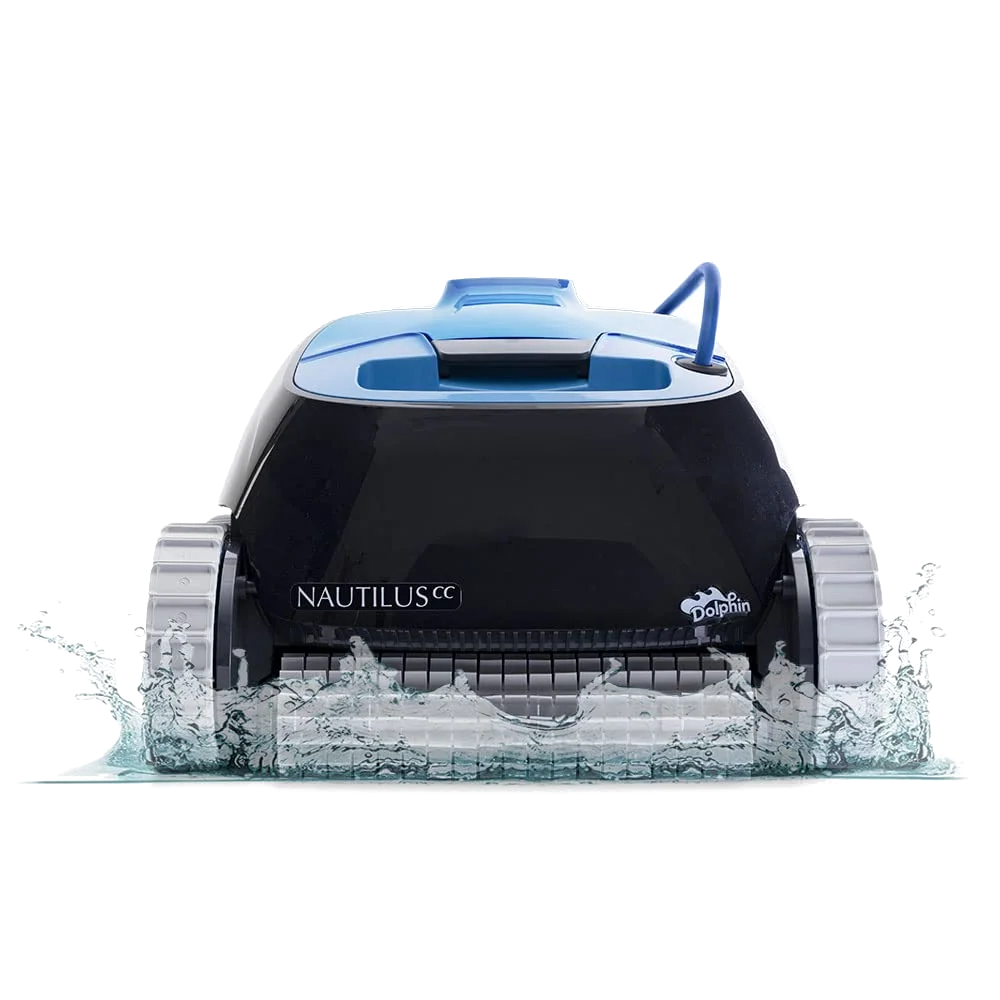
Open floor is the robot’s strongest assignment. It can roam while the owner does something else, scrub as it travels, and retain leaves, bugs, grit, and ordinary dirt in a lift-out basket. A Nautilus CC owner who had been spending at least an hour a week on manual bottom cleaning reported useful pickup of leaves, acorns, sand, and pale silt in one autonomous cycle. The same long-term account later included cable wear, tangling, tracks, brushes, and a wheel, so the time saving did not make the hardware maintenance vanish.
The separate basket is especially attractive in a leaf-prone pool because the owner can see and discard the load without routing every leaf through the primary filter. Capacity still matters. A small basket can fill before the route is complete, a clogged inlet can weaken pickup, and some machines release a little debris during retrieval. For a serious leaf problem, compare inlet shape and basket volume rather than the largest advertised flow number, or start with the site’s guide to robots selected for leaves and floating debris.
Active brushing is another real robotic advantage. Several Dolphins and tracked cordless machines turn a brush faster than the chassis travels, which can loosen settled dirt while the intake passes over it. That reduces routine brushing on broad surfaces, but it does not cure algae, dissolve scale, or reach every corner. Chemistry and attached growth remain separate jobs.
Fine debris can reverse the result
An onboard basket is not automatically better filtration. Many robotic baskets use relatively open mesh that catches leaves and visible grains while passing pollen, powdery silt, or dead algae. A suction-side cleaner may perform better on those particles when the pool’s main filter is appropriate, correctly configured, and maintained, because the robot’s convenience does not compensate for media that cannot retain the material.
Some robots solve this with a second filter. The current Aiper Scuba S1 pairs a coarse main basket with a much finer insert, while the WYBOT C2 Vision combines its ordinary basket with a fine secondary layer. Those inserts can collect striking amounts of settled dust, but they add another surface to rinse and may restrict flow as they load. The right question is not how much water the cleaner claims to move; it is whether the complete filter assembly can keep the debris that matters in your pool.
If sand, silt, pollen, or dead algae is the recurring enemy, read the dedicated guide to robot filtration for fine debris before choosing the power system. A coarse robot can leave a systematic route over a still-dirty floor, while a well-filtered machine can look less elegant and deliver the better result.
Wall climbing is not step cleaning
“Wall cleaning,” “waterline cleaning,” and “full-pool cleaning” describe different capabilities. A floor robot may never leave the bottom. A wall climber may rise to the surface and immediately fall away. A genuine waterline machine turns and travels sideways along the perimeter. None of those movements proves that it can settle onto a shallow horizontal stair tread.
Independent comparison work on modern cordless robots illustrates the geometry penalty. The tested machines could cover nearly all of an open floor while leaving much larger gaps on walls, stairs, and benches; one camera-guided model collected every deliberately placed leaf quickly but reached only a small share of the stair-and-bench area. Route intelligence cannot create traction where a shelf is too shallow, a curved step redirects the chassis, or a raised drain supports the robot’s belly.
Robots are at their most convincing on broad, continuously submerged surfaces with few traps.
Selected robots climb conventional walls, but grip changes with finish, algae film, filter load, and transitions.
Look for sustained sideways travel rather than a listing that merely says the cleaner reaches the surface.
Expect manual touch-ups unless the exact machine has credible evidence in geometry similar to yours.
Most submerged cleaners do not skim the surface, regardless of whether they touch the waterline.
Neither cleaner replaces correct chemistry, and even an active brush can miss corners and architectural features.
A wall-and-waterline robot can still be worthwhile when the stairs remain manual because the floor and long vertical surfaces account for most of the labor. Just price that remaining work honestly. The guide to walls, steps, drains, slopes, and shallow ledges explains why pool shape can matter more than the navigation label.
Corded and cordless robots solve different annoyances
A corded robot removes the suction hose but not the in-water tether. Its floating cable must reach the farthest point after accounting for depth and the power supply’s safe deck position. The payoff is repeat power: once a cycle ends, another can start without waiting for a battery.
A cordless robot gives the pool a cleaner appearance during the run and avoids cable twists. In exchange, the owner must lift a water-filled chassis, wait for it to drain, dry the charging area, and recharge it before another substantial cycle. Advertised runtime is usually a ceiling tied to a particular mode; floor-only or Eco operation can last much longer than a floor, wall, and waterline program.
A schedule stored in a cordless robot does not create indefinite automation. It divides one charge among delayed sessions until the battery or basket reaches its limit. “Self-parking” usually means stopping near an underwater edge, not climbing out, emptying itself, or finding a charger.
App control deserves similar skepticism. Ordinary Wi-Fi and Bluetooth usually disappear once the robot is submerged, so the useful functions are often mode selection, delayed scheduling, firmware updates, battery status, and post-run logs. If live underwater steering is the reason for buying, verify that exact behavior rather than assuming it from an app icon. The full trade is covered in the comparison of corded and cordless robotic cleaners.
Do not award the cost argument to either side without your pool
A suction-side machine may be mechanically simpler, but hoses and moving parts still wear, and every collected load becomes part of the pool-system workflow. A robot isolates the load and may save substantial hands-on vacuuming, but it introduces motors, seals, filters, tracks, cables or batteries, and sometimes an app account. One failed control box, traction battery, or proprietary cable can erase years of apparent convenience.
There is not enough controlled evidence to promise that every robot uses less electricity than every suction-side installation. Pump size, speed, circulation schedule, cleaner run time, and whether the pump would operate anyway all change the answer. Compare the actual operating schedule instead of accepting a universal energy-savings percentage.
Before buying a robot, confirm the written warranty, return window, replacement-filter supply, charger or power-supply availability, and whether common wear parts can be ordered separately. For a cordless unit, battery coverage and replacement policy belong in the purchase decision even when the battery is sealed. Owner reports document possible failure modes, not a category-wide failure rate.
Three robotic paths worth considering
If the comparison has pushed you toward a robot, choose the architecture before the brand. A basic corded cleaner suits repeated floor work, a more capable corded model can add true waterline travel, and a cordless model buys freedom from the cable at the cost of charging and battery risk. The site’s broader robotic-cleaner guide covers more pool shapes and debris profiles.
The Dolphin Nautilus CC is the uncomplicated corded pick for a conventional pool.
Its active brush, top-loading basket, and pump independence make routine floor debris far less laborious.
The non-swivel cable needs straightening, while steps, corners, and sustained waterline cleaning still belong to the owner.
The Dolphin Nautilus CC Pro is the corded upgrade for genuine waterline work.
Choose it when lateral waterline scrubbing, longer reach, and a swivel cable justify a more complex robot.
Its stock filtration is weak for the finest sediment, and uneven coverage plus exact-model failure reports make written protection important.
The Aiper Scuba S1 is the cordless pick when fine filtration matters.
Its dual filtration and strong open-floor coverage suit a fairly simple pool with recurring sand, silt, or settled dust.
Steps and abrupt transitions remain unreliable, the first wet lift is substantial, and the longest runtime applies only to Eco operation.
Make the decision by naming the nuisance
Buy a robot if:
- You want leaves and grit in a separate lift-out basket instead of the pool’s filtration path.
- Most of the work is on an open floor, conventional walls, or a waterline that a specific model credibly covers.
- You value active brushing and are willing to clean the robot’s filters after productive cycles.
- You can manage the machine’s wet weight and have a sensible place for its controller or charger.
- You are choosing between cable management and battery management with open eyes.
Keep suction-side in contention if:
- Your pool already has a suitable suction connection and a filtration system you are comfortable loading.
- You prefer pump-powered operation without a sealed traction battery, app, or charging routine.
- A hose left in the pool is less irritating than carrying and rinsing a separate machine.
- You can obtain the cleaner’s wear parts and value straightforward mechanical repair.
- You do not need a robot’s independent basket, active scrubbing, or model-specific waterline program.
For most households trying to reclaim the hour spent guiding a vacuum, the robot is the stronger tool because it separates cleaning from the pool pump and carries the debris away in its own basket. Suction-side remains the honest choice for an owner who prefers a hose, pump power, and simpler mechanics to wet lifting, filters, cables, batteries, and electronics. Neither choice is maintenance-free; buy the inconvenience you will actually tolerate.
Frequently Asked Questions
Does a robotic pool cleaner use the pool pump?
No, a true robotic cleaner uses its own motor and filter system rather than connecting to the pool’s suction line.
Which type is better for leaves?
A robot with a large basket keeps ordinary leaves out of the main filter, while heavy leaf fall can overwhelm either a robot’s capacity or a suction-side system’s debris path.
Will a robot clean steps and a tanning ledge?
Only some robots can handle sufficiently broad and submerged shelves, while stairs and shallow ledges remain unreliable even for models that climb vertical walls.
Is a cordless robot easier to own than a suction-side cleaner?
It is easier for an owner who hates hoses, but harder for someone who dislikes wet lifting, drying charging contacts, recharge delays, and eventual battery aging.
Does a longer battery runtime guarantee complete coverage?
No, useful coverage still depends on the selected mode, route efficiency, filter load, pool geometry, and whether the robot becomes trapped or repeats the same area.
Which type costs less to run?
There is no honest universal winner because pump speed, circulation time, robot charging, cleaning frequency, repair costs, and replacement parts vary by installation.
Can either cleaner remove algae?
Either can collect loose or dead material, but neither replaces balanced chemistry or manual brushing of attached growth and missed surfaces.
Does waterline cleaning mean the robot skims floating debris?
No, waterline cleaning scrubs the perimeter at the water boundary, while surface debris usually needs the built-in skimmer, a net, or a dedicated robotic skimmer .
Can a robotic cleaner stay in the pool between runs?
Do not assume so, because storage and chemical-exposure guidance varies by model and the exact manual should decide whether the cleaner is removed after use.
Sources (2)
- Amazon listings and customer reviews
- Owner and reviewer video, 1 channel