A robotic pool cleaner still needs care after nearly every run.
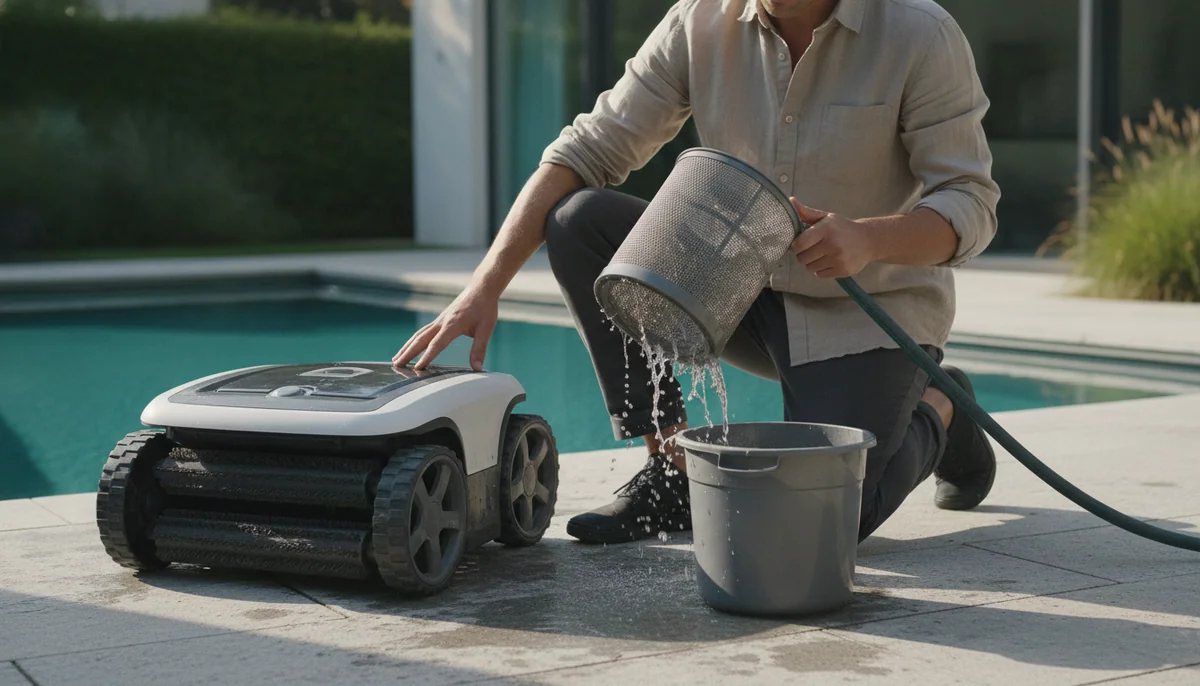
A robotic cleaner is a labor swap. Instead of steering a vacuum head around the pool, you spend a few minutes retrieving a machine, dealing with the debris it collected, and preparing it for the next run. That is a good trade for most owners, but it is not a maintenance-free one.
The lightest routine belongs to a clean, uncomplicated pool: lift the robot correctly, empty the basket, rinse the filter, check the intake, and put the machine somewhere shaded. A pool beneath trees adds basket cleanouts and impeller checks. A corded cleaner adds cable care. A cordless model adds drying and charging. A solar skimmer can remain on patrol much longer, but its basket, panel, sensors, and propellers still need attention.
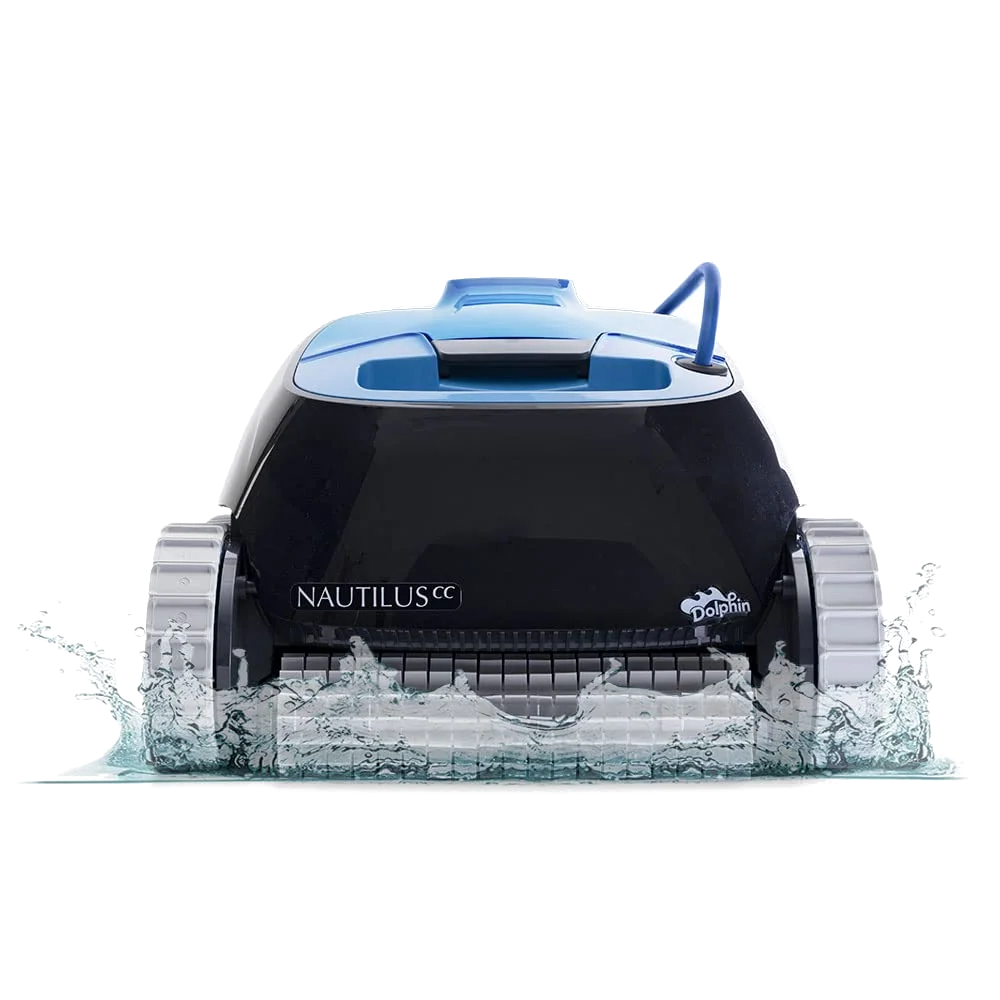
Long-term Nautilus CC owners provide the clearest picture of the bargain. Useful service over several seasons came with replacement tracks, brushes, a wheel, cable care, and removal of hair from the impeller, while another exact-model unit failed within two weeks. Those accounts cannot reveal a universal lifespan or failure rate, but they do show why “automatic” describes the cleaning cycle rather than the ownership experience.
Expect a small task after nearly every cycle, an occasional deeper inspection, and eventually a wear part or service decision if the cleaner remains in regular use.
The routine is short because neglect makes it long
Deal with the cleaner while the debris is still loose and the symptoms are easy to understand. A freshly collected leaf empties cleanly; the same leaf left wet in a basket becomes compacted organic sludge. A few strands of hair around a propeller are easy to remove; a bound shaft can resemble a failed motor. A mild twist in a floating cable can be relaxed; repeated tight coiling can teach the cable to kink.
- Bring the robot to the edge without hauling on vulnerable parts. Use a retrieval hook where the model provides one, draw a corded cleaner close gently, and lift the body by its handle after the water begins to drain.
- Empty the debris container before storage or charging. Open the basket, bag, drawer, or lower chamber according to the model’s design and remove leaves, grit, insects, hair, and other material.
- Rinse the filter with clean water. Work from the cleaner side of the media toward the dirty side when practical, and use ordinary hose pressure rather than trying to blast delicate mesh or pleats clean.
- Look through the intake and moving parts. With the machine switched off and disconnected from power, check for twigs, hair, string, pine needles, or seed material around the impeller, brushes, wheels, tracks, and propellers.
- Let the cleaner drain and dry where its design requires it. This is essential before connecting a charger to a cordless underwater robot, and it is sensible care for electrical connectors, seals, and storage surfaces.
- Store it without deforming the parts that touch the pool. Keep the power supply dry, avoid resting a heavy cleaner on a brush that can take a permanent set, and do not force a floating cable into tight coils.
That list is deliberately based on events rather than a stopwatch. A robot that returns with a nearly empty basket does not need the same intervention as one that has swallowed a storm’s worth of leaves, but both deserve a glance before the next cycle.
Each power system creates its own chore
Maintenance burden depends less on whether a cleaner has an app than on how it receives power and where it works. The practical differences are easier to see when the three common designs are placed side by side.
| Cleaner type | After a normal cycle | Recurring nuisance | Long-term concern |
|---|---|---|---|
| Corded underwater cleaner | Empty and rinse the filter, inspect the intake, drain the body, and manage the cable. | Twists, tangles, poor outlet placement, and a power supply that needs protection from water and sun. | Tracks, brushes, wheels, bushings, cable jackets, power supplies, and motors can wear or fail. |
| Cordless underwater cleaner | Retrieve it, open and rinse the filter chamber, dry the charging area, and recharge the battery. | Charging delay, wet connectors, missed cycles, and a battery that may not be readily user-serviceable. | Battery capacity, seals, chargers, drive motors, and limited replacement-parts support can determine the useful life. |
| Solar surface skimmer | Empty the basket, clear the intake, inspect the propellers, and keep the solar panel exposed. | Leaves compacting in the basket, hair around shafts, dirty sensors, shade, and stranding around pool features. | Propulsion motors, gears, basket mechanisms, batteries, and ultraviolet exposure remain relevant even without a charging cable. |
Cordless does not mean choreless. Exact Seagull SE owners describe the full cycle as retrieval, opening the housing, rinsing the screen, waiting for the charging area to dry, and then recharging; the same record also contains shortened runtimes, charging failures, and machines that stopped powering on within months.
Solar skimmers remove the daily plug-in ritual when the pool receives enough light, but they exchange it for continuous exposure and more frequent contact with floating organic debris. EcoSurfer S2 owners report strong solar endurance alongside basket-gear noise, propeller faults, circling, and an impeller drive that could sound active without turning.
Use a maintenance trigger, not a ceremonial calendar
Pool load, run frequency, water chemistry, weather, and model design make universal intervals misleading. The useful schedule starts with what just happened and what the machine is telling you.
| Trigger | What to do | Why it matters |
|---|---|---|
| After an ordinary run | Empty and rinse the filter, inspect the intake, and drain the cleaner. | Fresh debris is easier to remove and cannot decay inside the machine. |
| After a storm or heavy leaf fall | Check the basket during the run and inspect the impeller or propellers afterward. | A packed filter restricts flow, while sticks and fibrous material can bind moving parts. |
| When pickup weakens | Clean and reseat the filter, clear the intake, and compare the debris with the media’s filtration ability. | Weak retention can look like weak suction when fine material is simply passing through the filter. |
| When movement changes | Inspect tracks, wheels, brushes, propellers, cable twists, raised drains, and shallow obstacles. | Slipping, circling, stopping, and poor climbing can begin with wear or obstruction rather than an electrical failure. |
| When a cordless cycle shortens | Confirm a complete charge, a dry connection, free-moving parts, and suitable storage temperatures. | Mechanical drag and incomplete charging can imitate battery deterioration. |
| Before a long shutdown | Rinse, dry, inspect, loosely arrange cables, and store the cleaner and power equipment indoors or as its manual directs. | Months of damp debris, chemical exposure, heat, or a deeply discharged battery are avoidable damage. |
The filter is usually the maintenance bottleneck
Owners naturally focus on suction figures and navigation, but filtration decides whether collected material stays collected. Leaves and grit can be obvious in a basket while fine silt, pollen, or dead algae travels through coarse mesh and settles again after the water calms. Repeatedly running the robot does not fix media that is too open for the debris.
Start with the supplied filter and inspect what returns to the pool. If fine sediment is the recurring problem, verify that a compatible finer filter exists before buying an accessory with a similar family name. Dolphin’s Nautilus range alone contains closely named models with different baskets, panels, cables, controls, and pool-size limits, so “fits Nautilus” is not a safe compatibility standard.
Finer media also asks more from the owner. It can clog sooner, demand a more deliberate rinse, and reduce flow when neglected. The right filter captures the debris you actually have without becoming a packed wall of dirt halfway through every cycle; our guide to what robotic cleaners can capture explains the difference between loose leaves, sand, silt, pollen, and treated algae.
The pool itself can masquerade as a broken robot
Before assuming an expensive internal failure, look at the environment. A raised main drain can high-center a tracked cleaner. A liner wrinkle can stop a small cordless vacuum. A return jet can keep a surface skimmer trapped at one end. A wall-skimmer opening can hold a floating robot against suction, while a cleaner cord or pressure-side hose can become a barrier across the surface.
The first several cycles should therefore be observed. Watch the places where the robot repeatedly stops, listen for new clicking or squeaking, and notice whether the basket contains the debris that disappeared from view. A machine that clears most of the pool but always fails at the same physical feature has a compatibility problem, not necessarily a navigation defect.
This distinction prevents unnecessary disassembly. Correct the water level, reposition an approved bumper, stagger two robots’ schedules, redirect a return where appropriate, or brush inaccessible debris into the open cleaning area before opening a sealed motor housing.
Do not leave an underwater cleaner soaking for convenience
Long submersion exposes cables, plastics, brushes, seals, and metal parts to pool chemistry while doing no cleaning between cycles. A Nautilus CC owner who deliberately left the cleaner submerged through much of the season later reported deterioration and blue flaking from the chlorinated section of the cable. A CC Pro owner similarly described cable material shedding after one season and said manufacturer support advised removal from the pool and protection from chlorine and sun.
Surface skimmers are a different design because extended floating operation is their purpose, but even they should not be forgotten indefinitely. Emptying the basket, clearing shafts, inspecting contact points, and following winter-storage guidance remain necessary. The site’s full answer on leaving a robotic cleaner in the water separates operating convenience from good long-term care.
What the maintenance burden means for these seven cleaners
A buying decision should include the chore that arrives with the box. These are not seven versions of the same machine: three are corded underwater Dolphins, one is a small cordless floor cleaner, and three are floating skimmers with very different controls and failure records.
The Dolphin Nautilus CC is the easiest recommendation here for a straightforward pool.
Buy it when reliable floor cleaning, a top-load basket, identifiable wear parts, and immediate corded reuse matter more than apps or waterline coverage.
Its no-swivel cable needs straightening, steps and ledges remain manual work, and the current one-year warranty makes early electrical failure consequential.
The base Nautilus CC has the most intelligible maintenance story in this group. Its basket is easy to reach, and exact owners have identified tracks, brushes, wheels, bushings, finer filters, and the cable as service items. The honest drawback is that serviceability does not eliminate upkeep or guarantee a long life. Read the full Nautilus CC review before treating a familiar brand name as a promise of zero repairs.
The Dolphin Proteus DX3 is a reasonable floor-first cleaner for a conventional in-ground pool.
Buy it for ordinary leaves, grit, a washable top basket, and simple corded operation in a pool no longer than its stated 33-foot class.
Its cable lacks a swivel, raised drains can interrupt movement, and reported power-box trouble makes local service and written warranty terms important.
The DX3’s routine resembles the base Nautilus: empty the basket, rinse the mesh, inspect the active brush and drive components, then relax the cable before storage. Exact owners report useful floor cleaning and easy basket care, but the record also includes repeated power-box replacement and a unit that would run briefly before stopping.
The Dolphin Nautilus CC Pro is a narrow choice for buyers who specifically need waterline cleaning.
Consider it when a swivel cable, top-load basket, larger-pool reach, manual app steering, and genuine waterline movement justify the extra complexity.
Skip it for easy ownership because fine filtration may require another filter set and exact owners reported controller, power-supply, motor, cable, app, and recovery failures.
More capability does not automatically reduce maintenance. The CC Pro adds Wi-Fi, a swivel, deliberate waterline behavior, and a larger cleaning remit, but its exact-model record contains failures across several systems and uncertainty around current warranty coverage. Smart Pool Bots does not recommend it casually; the CC Pro review explains why its waterline mechanism is more convincing than its ownership record.
The Betta SE is the low-intervention skimmer for a sunny pool with persistent floating debris.
Buy it to intercept leaves, pollen, insects, blossoms, grass, and pet hair when dependable direct sun can sustain its solar-only routine.
It cannot clean below the surface, and its basket, solar panel, sensors, shafts, guide wheels, feet, and propulsion motors still require inspection or occasional service.
The Betta SE’s recurring chore is mostly visible from above: lift out and rinse the basket, wipe the panel and sensors, and clear hair or plant fibers from the rear propellers. Exact owners report both years of useful service and an early electrical failure, while repair demonstrations show that bound propulsion motors are a real fault with a plausible replacement path.
The Betta SE Plus is the more forgiving skimmer when sunshine is unreliable.
Buy it when steady surface debris justifies continuous patrol and plug-in backup charging is valuable during shade, cloud, or winter.
It still needs basket rinsing, propeller checks, sensor care, occasional charging, and intervention around cords, skimmer openings, furniture, and shallow shelves.
The Plus does not escape the Betta maintenance routine; it adds a recovery option when solar input falls short. That makes it a better fit for inconsistent light, although someone must still retrieve and connect it to use the adapter. Exact owners also report that hoses and sun-shelf furniture can require physical changes or staggered schedules.
The AIPER Seagull SE 2025 is a skip for most buyers despite its simple appearance.
Consider it only for light coarse debris on a genuinely flat, smooth above-ground pool floor when a cheap cordless helper is enough.
Its random coverage, weak fine-debris retention, charging routine, non-routine battery replacement, and exact reports of early failure make the apparent simplicity deceptive.
The Seagull has fewer external parts to manage than a corded Dolphin, but the sealed battery becomes the ownership gamble. A cleaner that must be opened and waterproofed again to replace its battery is physically repairable without being responsibly user-serviceable. The Seagull SE review also explains why several positive-looking ratings actually describe a failed Seagull followed by a different replacement model.
The AIPER EcoSurfer S2 is a qualified choice for fine floating debris and app-led scheduling.
Buy it for pollen, insects, petals, hair, scattered leaves, solar endurance, backup charging, and phone controls in a sunny open pool.
Its small basket and slow patrol dislike leaf avalanches, while repeated basket-gear, impeller, propeller, and drive-motor reports create a credible durability concern.
EcoSurfer maintenance begins with its front drawer, fine filter, intake spindle, and rear propellers. Persistent clicking, squeaking, circling, or a clear propeller that will not power deserves prompt attention rather than acceptance as normal operating noise. Buyers choosing between surface specialists can use the EcoSurfer S2 and Betta SE Plus comparison to weigh app features against simpler ownership.
Diagnose from the outside inward
A cleaner that stops moving does not immediately need a motor. Begin with the reversible checks that do not compromise seals, warranties, or personal safety.
- Confirm the energy source. Check the protected outlet and power supply on a corded robot, or complete the specified charging routine on a cordless model.
- Empty and reseat the filter. A full, misaligned, or incorrectly latched basket can restrict flow or interfere with a driven intake mechanism.
- Remove visible obstructions with power disconnected. Inspect accessible intakes, impellers, brushes, tracks, wheels, and surface-skimmer propellers for hair, twine, leaves, or small sticks.
- Move the machine away from the suspected obstacle. Test whether a raised drain, shelf, wrinkle, hose, cable, skimmer opening, or return current caused the apparent fault.
- Listen and watch during a brief normal test. Circling suggests unequal propulsion, repeated stopping can indicate obstruction or power trouble, and a new grinding or clacking sound warrants shutdown.
- Use the exact model number when seeking parts or support. Similar family names do not establish compatibility for cables, controllers, filters, motors, batteries, or baskets.
Opening a waterproof motor or battery compartment can defeat its seal, create electrical risk, and weaken a warranty claim, so internal diagnosis belongs with authorized support unless the machine is out of coverage and the repairer understands waterproof electrical work.
The final accounting
Robotic pool cleaners need little routine maintenance compared with the manual cleaning they replace, but that comparison is the reason to buy rather than permission to neglect them. The best ownership pattern is repetitive and unglamorous: collect the machine, empty the dirt, rinse the filter, inspect the moving parts, and store or recharge it correctly.
The bigger maintenance burden arrives when the design conflicts with the pool. A no-swivel cord in a twisting route, a battery robot on a slope, a solar skimmer under permanent shade, or a surface machine beside a floating hose creates rescue work that no cleaning schedule can solve. Choose the power system and geometry first, then the features.
A good robot should remove far more labor than it creates. If basket care, cable management, charging, or obstacle rescue already sounds unreasonable, the machine is not becoming easier after checkout. If those chores sound modest beside pushing a pole around the pool, the maintenance trade is usually worth making.
Frequently Asked Questions
Should I clean the filter after every robotic pool-cleaner cycle?
Yes, emptying and rinsing after each completed cycle is the safest default because it preserves flow, prevents organic debris from decaying, and reveals damage early.
Can I leave an underwater robotic cleaner in the pool between uses?
Regular removal, rinsing, draining, and shaded storage is the more protective routine unless the exact current manual expressly directs otherwise.
Do solar pool skimmers need less maintenance than underwater robots?
They avoid floor-cleaner retrieval and routine charging in favorable sun, but they still need basket cleaning, panel and sensor care, propeller inspection, and seasonal storage.
How often should I inspect the impeller or propellers?
Inspect them whenever pickup, movement, sound, or runtime changes and after heavy loads of hair, pine needles, stringy plants, twigs, or storm debris.
Why is my pool robot moving but leaving fine dirt behind?
The filter may be too coarse for the sediment, so confirm what remains inside the basket after the water settles before blaming suction or navigation.
Can I pressure-wash a robotic pool-cleaner filter?
No, ordinary hose pressure is the safer choice because aggressive cleaning can deform mesh, damage pleats, or force debris deeper into delicate media.
Are robotic pool-cleaner batteries normally replaceable by the owner?
Many cordless units seal the battery inside a waterproof housing, so physical replacement may be possible without being a supported or prudent owner repair.
What parts commonly wear on a corded robotic pool cleaner?
Brushes, tracks, wheels, bushings, filters, cables, and occasionally power supplies or motors appear as service needs in the supplied ownership records.
Does a robotic cleaner replace the pool filter and normal water care?
No, the robot collects physical debris while the circulation system and correct chemistry remain responsible for filtering the water and controlling contamination or algae.
Should I repair a robot that starts circling or making a new grinding noise?
Switch it off, clear accessible obstructions, reseat the basket, compare both drive sides, and contact support if the abnormal motion or sound remains.