A Robotic Pool Cleaner Is a Filter That Drives Itself
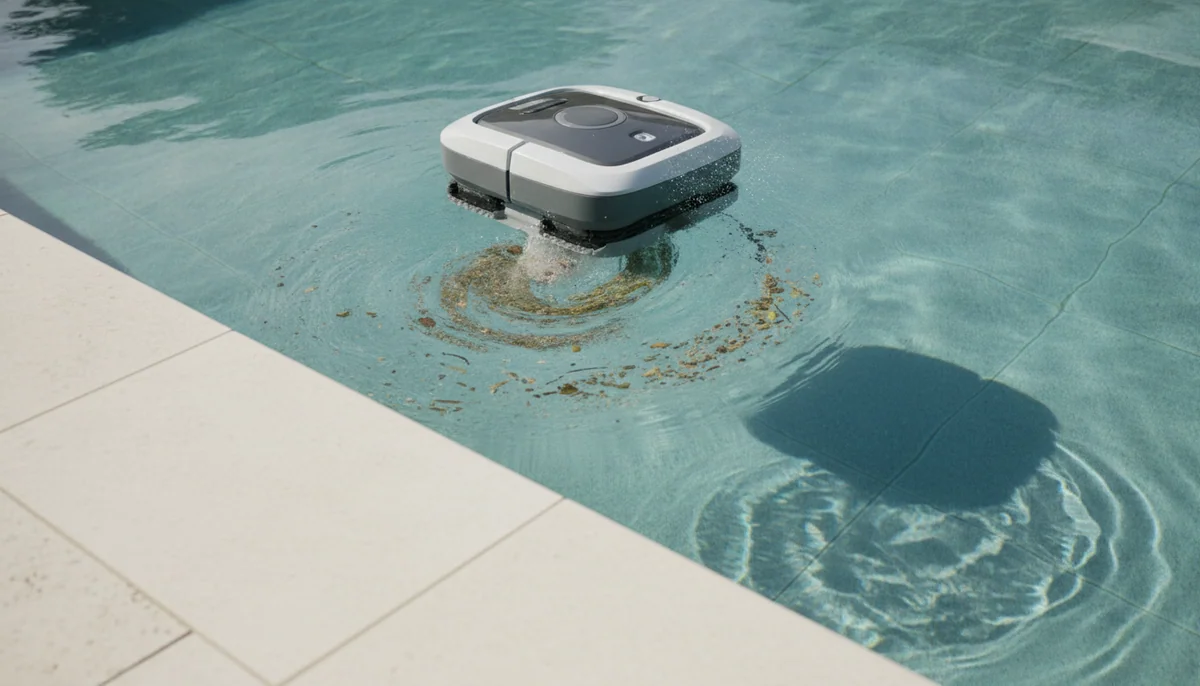
A submerged robotic pool cleaner is a small self-propelled filtration appliance: electric motors turn its wheels or tracks, an internal pump draws debris-laden water through an intake, brushes loosen material in its path, and a removable filter traps whatever its media can retain.
The robot’s sensors, timers, and software decide when to drive, turn, reverse, climb, change zones, or stop. Corded machines receive low-voltage power through a floating cable connected to a deck-side supply, while cordless machines carry a sealed rechargeable battery. Neither type normally connects to the pool’s suction line or sends collected debris into the pool’s main filter.
That is the clean answer, but it needs one correction before the marketing gets involved: “robotic pool cleaner” describes several machines with different jobs. An underwater vacuum collects settled debris. A robotic surface skimmer floats and intercepts leaves, insects, pollen, and hair before they sink. A basic floor robot may do nothing beyond roaming and collecting loose debris, while a more capable tracked machine may tackle walls and the current waterline.
None of them tests sanitizer, balances water, cures live algae, empties its own basket, or guarantees steps, shelves, corners, drains, and every strip of wall. The valuable part is narrower and more believable: the machine can remove much of the repetitive vacuuming or netting while the owner does something else.
The cleaning loop, from launch to rinse
The engineering differs by model, but a submerged robot usually completes the same sequence:
- Power becomes available. A corded cleaner draws from its external supply, or a cordless cleaner starts with energy stored in its battery.
- The body settles underwater. Trapped air escapes so the cleaner can sit upright and maintain enough contact with the pool surface.
- The drive system starts moving. Wheels suit many simple, level floors, while tracks generally provide more contact for slopes and walls.
- Brushes disturb the debris. A powered brush can agitate ordinary dirt more effectively than a fixed scraper or passive strip.
- The pump moves water through the intake. Leaves, bugs, sand, and loosened dirt enter with that water when the robot passes close enough to collect them.
- The filter separates debris from water. Material that is too large to pass the filter stays in the basket, while the water exits the cleaner.
- The navigation system keeps choosing a direction. Depending on the machine, that can mean simple reversals, sensor-guided paths, zone routines, or camera-assisted targeting.
- The cycle ends. A timer or low-battery threshold stops the robot, sometimes after it has attempted to park near an edge.
- The owner finishes the job. The cleaner must be retrieved, drained, opened, rinsed, inspected, and either recharged or stored with its cable.
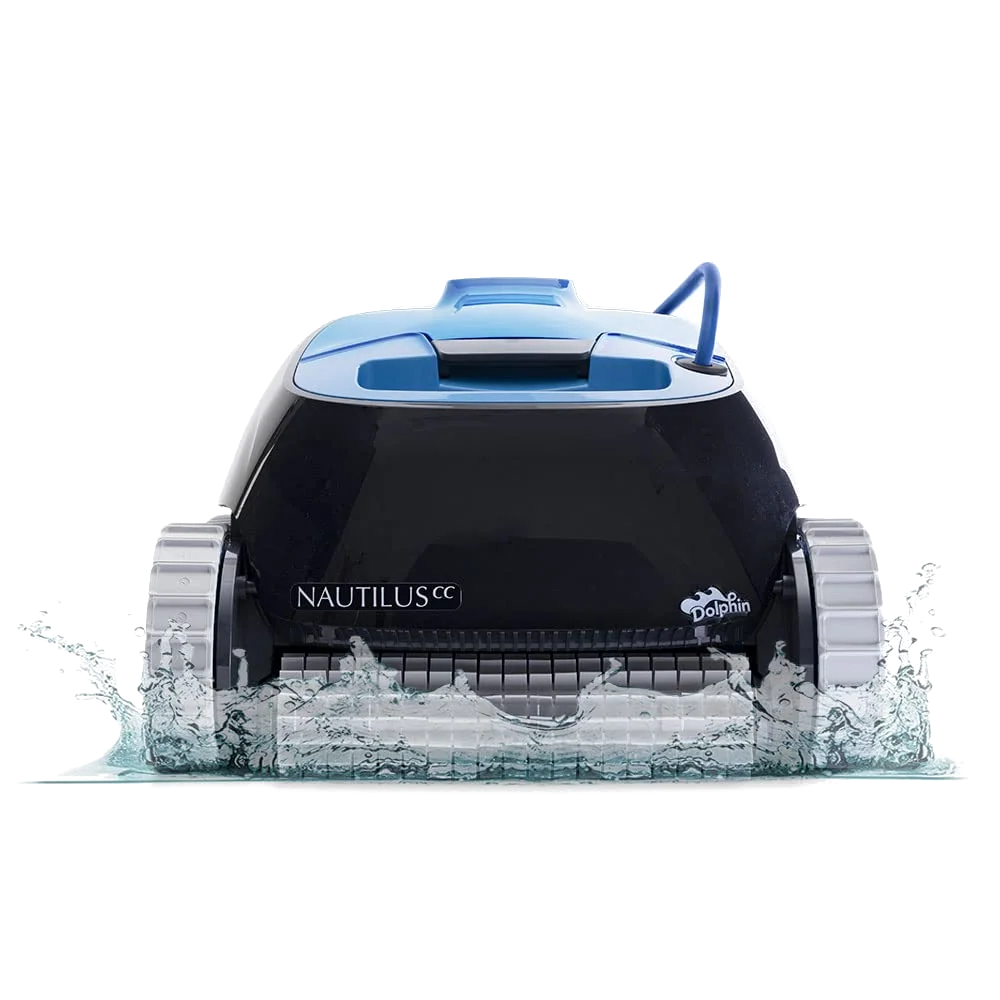
The Dolphin Nautilus CC is a useful conventional example: it carries its own pump and active brush, receives power through a cable, traps debris in a top-loading basket, and can climb suitable walls without relying on the pool pump. Its uncomplicated design does not make it perfect, because owners still report cable twisting and unfinished corners, ledges, or wall bases.
First identify which layer of the pool needs cleaning
The word “surface” causes more confusion than it should. The pool floor, a vertical wall, the waterline, and the top of the water are four different cleaning zones. Reaching one does not establish that a robot can clean the others.
| Cleaner type | Where it works | What moves the debris | Honest limitation |
|---|---|---|---|
| Floor-only robot | Submerged floor | Onboard pump and intake | Usually misses walls, steps, shelves, and floating debris |
| Wall-capable robot | Floor, suitable walls, and sometimes the waterline | Onboard pump, brushes, wheels, or tracks | Coverage still depends on traction and pool geometry |
| Surface skimmer | Top of the water | Forward motion funnels floating debris into a basket | Cannot collect anything that has settled |
| Hybrid cleaner | Several underwater zones plus a surface mode | Different drive and flow routines for each mode | One machine and one battery must divide their time among several jobs |
| Suction-side cleaner | Connected submerged surfaces | Pool pump suction through a hose | Uses the circulation system rather than carrying a complete filter path |
A solar skimmer such as the Betta SE patrols at the air-water boundary and catches floating leaves, blossoms, insects, pollen, grass, and hair in its own basket. It can reduce what reaches the built-in skimmer or eventually sinks, but it does not vacuum the floor. Betta owner reports support persistent debris interception while also showing the limits of a solar-only energy supply during extended poor weather.
The AIPER EcoSurfer S2 performs the same broad surface job with solar and adapter charging, app functions, and fine surface filtration. Independent testing found that a surface could look clear even though some staged leaves had sunk instead of entering the basket, which is a useful reminder that visible cleanliness and captured debris are not identical measurements.
If floating debris is the actual nuisance, start with our explanation of when a skimmer makes more sense than an underwater vacuum; a floor robot cannot solve a problem that remains above its reach.
Pickup and retention are two separate tests
A pump’s flow rating tells you how much water the manufacturer says the machine moves. It does not tell you whether a leaf fits the intake, whether a brush keeps contact with the floor, whether exhaust flow scatters silt, whether the route crosses the dirty patch, or whether the filter retains the particle after ingestion.
Filter construction often decides the final result. Coarser media preserves water flow and handles leaves, insects, grass, ordinary dirt, and some sand without clogging quickly. Finer media can hold pollen, powdery silt, dead algae, and fine dust, but it loads faster, takes longer to rinse, and may reduce intake flow or climbing performance as it becomes restricted.
The Aiper Scuba S1 illustrates the trade well. Its primary basket handles routine debris, while its much finer secondary layer can collect substantial dust, sand, mud, silt, and loose green residue. That finer layer also needs more cleaning and can restrict flow when heavily loaded. The honest routine for a dirty pool is often a coarse first pass for leaves, followed by a fine-filter pass after the larger material is gone.
At the other end, the WYBOT A1 is a basic floor vacuum with random movement and no active scrubbing brush. Its layered filtration can retain useful residue, but wrinkles, drains, slopes, and missed routes can leave debris untouched even when the filter itself is capable.
A clean-looking floor immediately after a run is not proof that the finest material stayed captured. Let the water settle, inspect what is actually in the basket, and look for a new dust layer later. If silt, dead algae, or powdery sediment is the recurring problem, choose from cleaners evaluated specifically for fine-debris filtration rather than comparing suction headlines alone.
A brush is not an algae treatment
Marketing often compresses vacuuming and scrubbing into one heroic verb, but the hardware can be quite different. Intake flow carries already-loose debris. A fixed scraper may disturb material as the chassis passes. An active brush rotates independently of the robot’s travel and can loosen routine dirt or film more aggressively.
Even an active brush works only where it maintains contact. It does not correct sanitizer levels, kill an active algae bloom, dissolve mineral scale, or guarantee removal of stubborn growth. Chemistry and circulation solve the biological problem; brushing loosens the residue; the robot or main filter then has a chance to collect it.
The Dolphin E10 is a useful warning against assuming too much from a familiar brand name. It has an active scrubber and autonomous route logic, yet it remains a floor-only machine. “Smart” does not silently add walls or waterline cleaning.
Navigation manages probability, not certainty
The cheapest robots usually travel until they encounter a boundary or reach a timed interval, then reverse or turn. That can look crude, but repeated passes may clean a simple round or rectangular floor surprisingly well. It becomes less convincing when the battery is spent crossing the same clean lane while another area remains untouched.
Sensor-guided machines can use orientation, wall detection, gyroscopes, ultrasonic sensing, depth information, or programmed paths to reduce wasted movement. An S-shaped route can be more orderly than random travel without creating a saved map. A route shown in an app proves that movement was recorded, not that every recorded strip was cleaned.
Camera-guided cleaners add a genuinely different ability: conspicuous debris can be recognized and targeted. The AIPER Scuba V3 has evidence of rapid staged-leaf collection and excellent open-floor coverage, but the same comparison found materially weaker wall coverage, very poor stairs and bench coverage, and fine sediment being disturbed. Camera targeting improved one task without abolishing the others.
Software can also change the route. Scuba V3 owners report that firmware updates and different navigation settings sometimes improved coverage, while some AI modes added repeated rotations or skipped areas. A “smart” cleaner is therefore not a fixed mechanical object: settings and software can make the same chassis behave better or worse in the same pool.
Cleaning power determines the strip behind the robot; navigation determines how many useful strips it reaches.
Pool geometry gets the final vote
Pool-area ratings are easy to print because square footage is easy to count. The harder questions concern shape: Can both tracks contact the transition? Is the step wide enough for the chassis? Is the shelf deep enough to keep the intake submerged? Can the robot clear the drain without resting its weight on the center shell?
Common trouble spots include compound steps, narrow treads, benches, tanning ledges, beach entries, sharp shallow-to-deep transitions, raised drain covers, liner wrinkles, ladder feet, curved spas, square corners, overhanging tile, and strong return currents. A smaller free-form pool can demand more from a robot than a much larger plain rectangle.
Wall climbing works when tracks or wheels maintain friction while pump flow and thrust help hold the cleaner against the surface. The floor-to-wall transition must suit the chassis, and grip can weaken as the filter loads, the battery falls, or the surface becomes slick. A robot that climbs one wall is wall-capable; that does not prove uniform cleaning of every wall.
Waterline cleaning is another step beyond climbing. Some robots rise, brush briefly at the current water level, and descend. A dedicated waterline routine holds the body near the boundary and may move laterally along it. Neither behavior scrubs an old mark above the present water level.
Steps and shelves remain harder because the robot may bridge the feature while its tracks lose contact. The Beatbot Sora 30 has unusually credible shallow-platform hardware and demonstrations, but even there the result depends on depth, shelf width, approach angle, and both tracks reaching the transition. If architectural features are the reason for buying, consult the models selected specifically for steps, shelves, and tanning ledges rather than treating a generic wall-climbing claim as enough.
Corded and cordless robots move the same chore
Corded
Continuous low-voltage power allows another cycle without a recharge delay, which suits repeat cleaning and heavy debris.
The cost is cable reach, tangling, controller placement, deployment, straightening, and storage.
Cordless
A sealed battery removes the floating lead and the need to calculate cable reach across the floor.
The cost is finite runtime, wet retrieval, drying, charging, battery aging, and waiting before another full cycle.
The advertised pool length of a corded model is not the same as usable cable reach. The cable must descend into the water, cross the bottom, and leave the power supply safely back from the edge. Outlet position can make a nominally compatible pool an awkward fit.
Cordless runtime must always be read with its mode. Floor-only travel generally consumes less energy than repeated wall climbs, high-flow cleaning, or combined floor-wall-waterline routines. A long runtime is an energy allowance, not a promise that the route will cover a maximum-size pool.
Scheduling can be misleading too. A cordless robot may divide one stored charge into several shorter sessions while left in the pool, but it does not empty its basket or replenish the battery between those sessions. A corded weekly timer has continuous external power, although the owner still needs to follow the exact manual on removal, filter care, chemical exposure, and storage.
Neither architecture wins automatically. The practical choice is whether cable handling bothers you more than wet lifting and charging, a trade explored in our full corded and cordless cleaner comparison.
Apps stop being impressive underwater
Ordinary Wi-Fi and Bluetooth signals become unreliable or disappear when a cleaner submerges. An app can still be useful for pairing, firmware updates, selecting a mode before launch, setting schedules, viewing completed history, changing a pool profile, or receiving a notification after the robot resurfaces.
What it usually cannot provide is reliable live steering at depth, a continuously updated underwater map, instant mid-cycle mode changes, or a command that rescues the cleaner from a drain. Surface skimmers are different because their antennas remain at the air-water boundary, so app steering and battery reporting can work while they patrol.
Physical controls retain real value. A robot that can begin a basic cycle from a button or dial is less dependent on an account, a pairing process, a phone, or a software service that may not remain available for the cleaner’s entire life.
“Self-parking” still leaves someone holding the hook
Basic edge parking means the robot attempts to stop on the floor near a wall when its battery is low. More elaborate surface parking brings the machine upward, lets it wait near an edge, and may drain some retained water before lifting. Neither behavior means it climbs onto the deck, empties itself, or connects itself to a charger.
Parking is not guaranteed to put the robot at its launch point or within arm’s reach. Currents, remaining battery, pool shape, and the final route affect where it finishes. Keep the retrieval hook, attach it to a suitable pool pole, bring the cleaner within reach, lift by the specified handle, and pause at the waterline while the body drains.
Dry weight understates the first part of retrieval because the chassis and basket still contain water. That makes handling a selection criterion, especially for anyone with limited grip, reach, balance, shoulder strength, or safe access between the pool and storage area.
What these robots clean well
The strongest shared assignment is routine debris in a maintained pool: leaves small enough for the intake, insects, grass, blossoms, hair, pine needles, ordinary dirt, grit, and some sand. Open floor areas are usually the most dependable zone because the robot has uninterrupted contact and room to complete repeated passes.
Fine sand, silt, pollen, dust, and dead algae are conditional. Filter fineness, basket seals, route coverage, exhaust turbulence, and filter loading all matter. A large leaf load is conditional for a different reason: the machine may ingest leaves perfectly until the inlet or basket fills, ending useful cleaning while battery remains.
Heavy opening-season debris, branches, mud, an untreated green pool, attached algae, mineral scale, inaccessible upper steps, and material trapped in tight corners remain poor assignments. A manual net, pole brush, or vacuum is faster for concentrated storm debris, while the robot makes more sense after the worst material has been removed.
For leaf-heavy pools, compare basket capacity and inlet design among robots chosen for leaves and floating debris; for an overall buying shortlist, start with the site’s best robotic pool cleaners after measuring the pool’s hardest feature rather than its easiest open floor.
The work that remains after the cycle
- Confirm the mode, charge, cable position, and filter setup.
- Remove branches or debris likely to block the inlet immediately.
- Lower the robot correctly and let trapped air escape.
- Retrieve by the approved hook and handle, then let water drain.
- Empty and rinse the basket before debris compacts or dries.
- Inspect the intake, impeller, brush, tracks, wheels, and cable for hair or twigs.
- Dry charging contacts or ports before connecting power.
- Rinse and store the body as the exact manual directs.
- Straighten a floating cable and avoid tight coils or kinks.
That routine is not maintenance-free, but it is still much less work than manually vacuuming a whole pool. The realistic promise is not perfection. It is a cleaner open floor, less debris reaching the circulation system, and fewer hours spent pushing a pole.
Smart Pool Bots’ bottom line is simple: buy for the surfaces a robot can physically reach, the debris its filter can retain, and the ownership routine you will actually tolerate. Walk away from any model whose case depends on a suction number, an app label, or a pool-area ceiling while ignoring steps, filtration, retrieval, and power.
Frequently Asked Questions
Does a robotic pool cleaner connect to the pool pump?
A self-contained robotic cleaner normally uses its own drive, pump, and filter rather than the pool’s suction line or main filtration path.
Can every robotic cleaner climb walls?
Wall cleaning requires a model designed for it plus suitable surface grip, transition geometry, water depth, filter flow, and battery or cable power.
Will a wall-climbing robot clean the steps?
Steps are often less reliable than walls because narrow treads, shallow water, curved approaches, and lost track contact can stop the robot from settling on them.
Can a robotic pool cleaner remove algae?
A robot can collect some loosened dead algae when its filter is fine enough, but sanitation, balanced chemistry, circulation, and brushing must solve the algae problem itself.
Does the cleaner’s app work while it is underwater?
Ordinary Wi-Fi and Bluetooth rarely support dependable live control at depth, so most apps are chiefly for setup, modes, updates, schedules, and post-cycle information.
Does self-parking mean the robot charges itself?
Self-parking usually means an underwater stop near a wall or a temporary rise to the surface, not autonomous exit, emptying, docking, or charging.
Can a solar pool skimmer keep moving at night?
A solar skimmer can operate after dark from stored energy when it received enough light, but shade, weather, season, debris, and battery condition prevent perpetual operation.
Does a robotic cleaner replace a pool service?
It can replace much routine vacuuming or skimming, but it does not replace chemistry management, equipment inspection, repairs, opening work, or every manual cleaning task.
Sources (3)
- Amazon listings and customer reviews
- Owner and reviewer video, 4 channels
- Pcworld — Article — www.pcworld.com