The Dolphin Nautilus CC Plus is the better buy for a larger pool, but the base CC is smarter for a small one.
Buy the Nautilus CC Plus for a conventional in-ground pool that needs its longer reach; choose the base Nautilus CC only when the pool is no longer than 33 feet and lower weight matters more than scheduling.
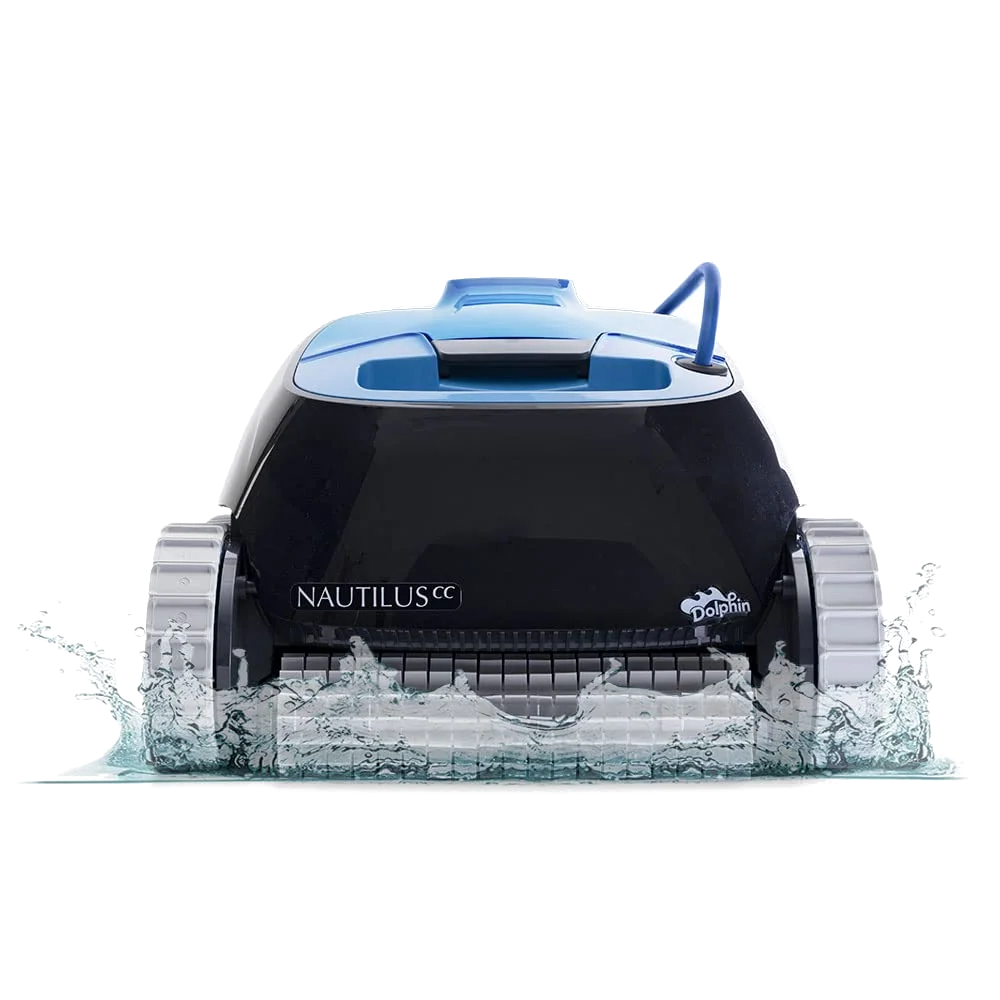
Dolphin Nautilus CC
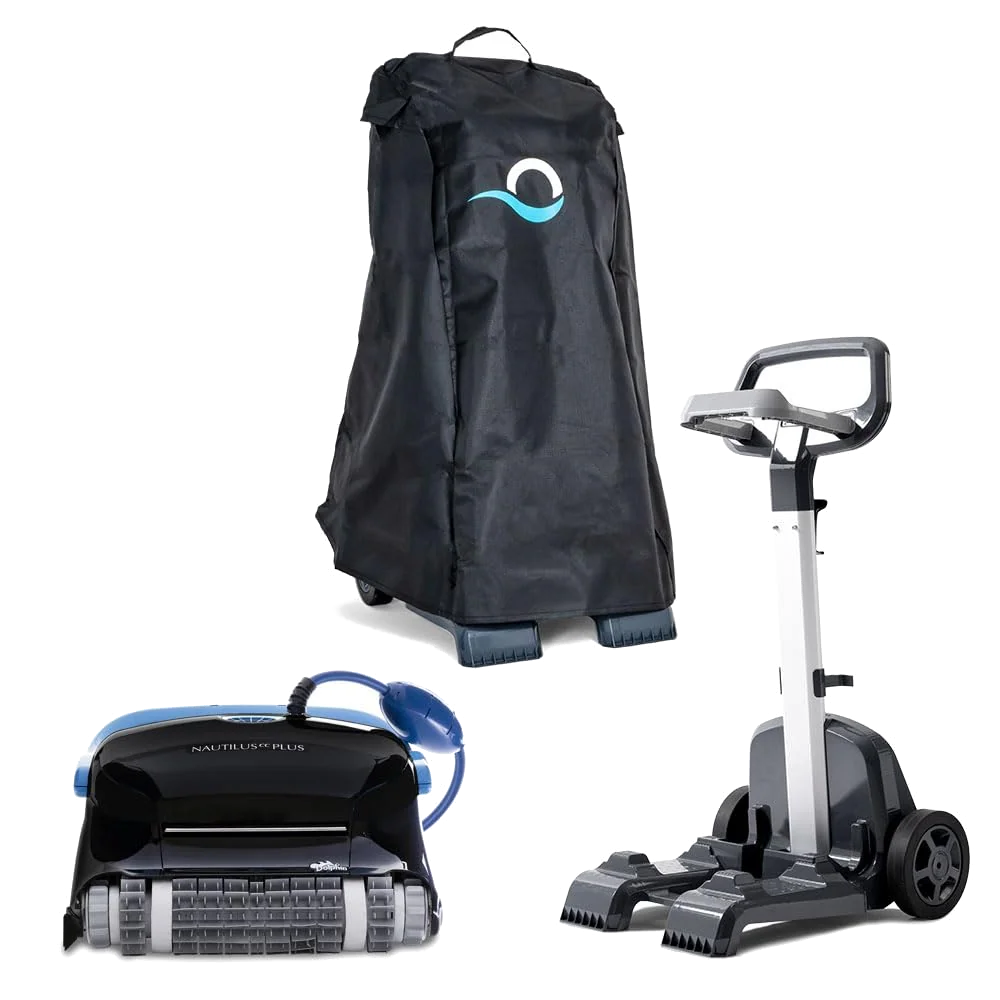
Dolphin Nautilus CC Plus Wi-Fi
These Dolphins share a name, a roughly two-hour cleaning cycle and the same basic division of labor: they handle the open floor and climb ordinary walls, while their owner manages the cord, brushes awkward architecture and finishes the tile line. The CC Plus does not become a radically smarter cleaner because “Wi-Fi” appears on the box. It wins because its larger operating envelope is more useful in the pools where buyers are most likely to compare the two.
The base CC is specified for above-ground and in-ground pools up to 33 feet, weighs about 14 pounds dry and uses an approximately 50-foot cable without an anti-tangle swivel. The CC Plus is intended for in-ground pools up to 50 feet, weighs roughly 20.5 to 22 pounds, uses a longer swivel cable and adds app scheduling. Those differences affect whether the cleaner can reach the far end, how unpleasant retrieval feels and how often the cable becomes part of the chore.
Neither machine deserves to be bought as a whole-pool detailing service. The base CC can rise to the surface during a wall climb without traveling sideways along the waterline, and the Plus has the same fundamental limitation. Steps, benches, tanning ledges, sharp corners and raised obstacles can remain dirty or disrupt coverage.
Choose the CC Plus
It is the stronger default for a straightforward in-ground pool longer than 33 feet, or for an owner who will use scheduled starts and the included storage gear.
Choose the base CC
It makes more sense for a smaller above-ground or in-ground pool when easy lifting, simple controls and fewer connected features are advantages.
Choose neither
Keep looking if dependable waterline travel, step cleaning, ledge coverage, manual steering or freedom from a floating cable is essential.
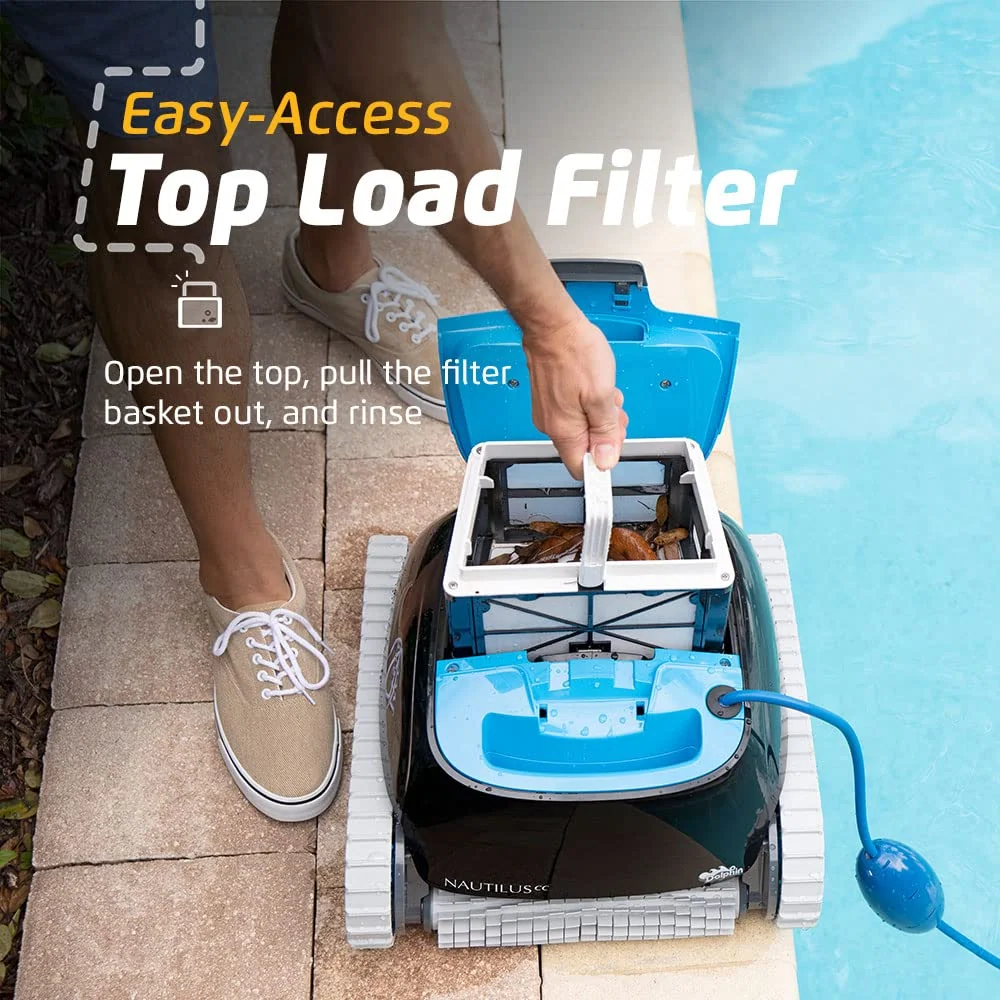
Dolphin Nautilus CC
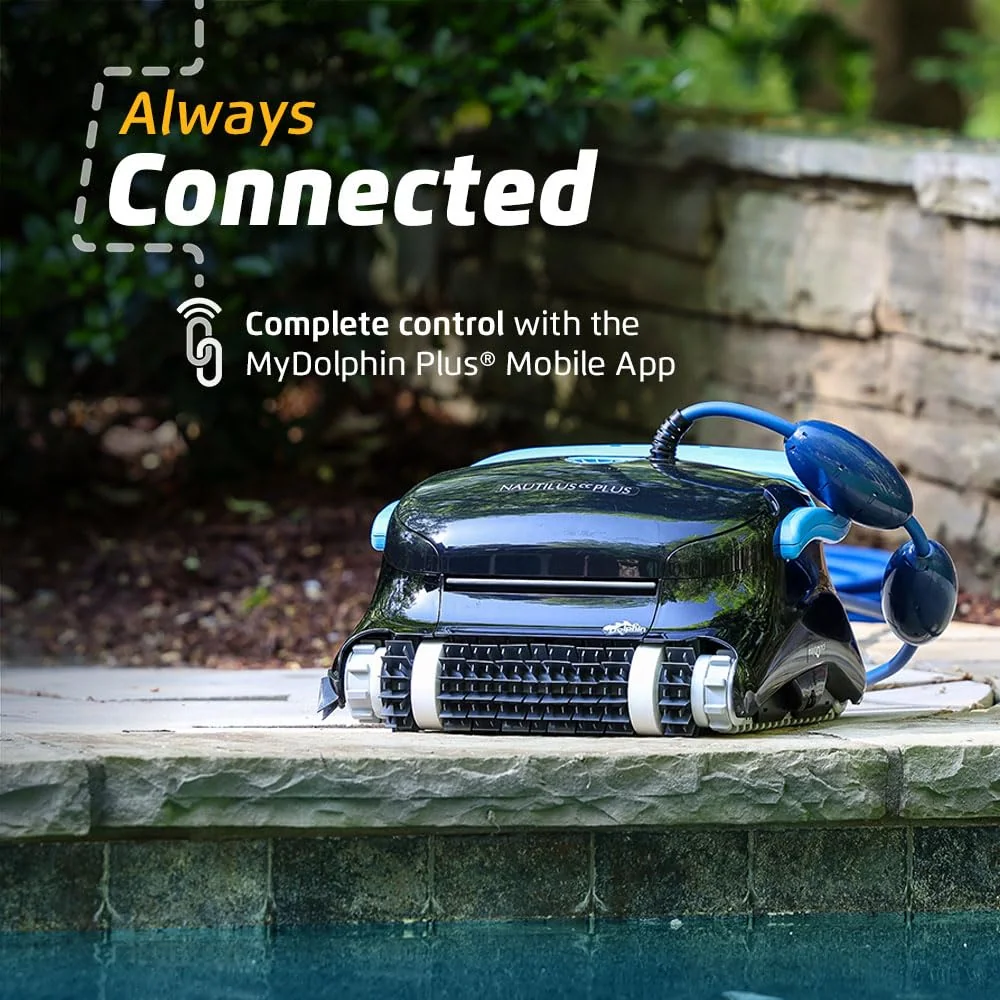
Dolphin Nautilus CC Plus Wi-Fi
At a Glance
| Feature | Dolphin Nautilus CC | Dolphin Nautilus CC Plus Wi-Fi |
|---|---|---|
| Price Range | $500–$1,000 | $500–$1,000 |
| Check Price on Amazon | Check Price on Amazon |
The Plus wins on reach, while the CC wins on restraint
The comparison becomes easier once the Wi-Fi badge stops dominating it. The base machine is a lighter, manually started pool-floor worker. The Plus is a larger-pool version with a longer cable, a swivel, remote scheduling and a storage bundle. Cleaning ambition changes much less than ownership logistics.
| Decision point | Nautilus CC | Nautilus CC Plus Wi-Fi bundle |
|---|---|---|
| Intended pool | Above-ground or in-ground pools up to 33 feet | In-ground pools up to 50 feet |
| Normal cycle | Approximately two hours | Approximately two hours |
| Dry weight | About 14 pounds | Roughly 20.5 to 22 pounds |
| Floating cable | Approximately 50 feet without a swivel | Approximately 60 feet with a swivel |
| Controls | Physical start button and one current cleaning cycle | Physical start plus app-based starting, stopping and scheduling |
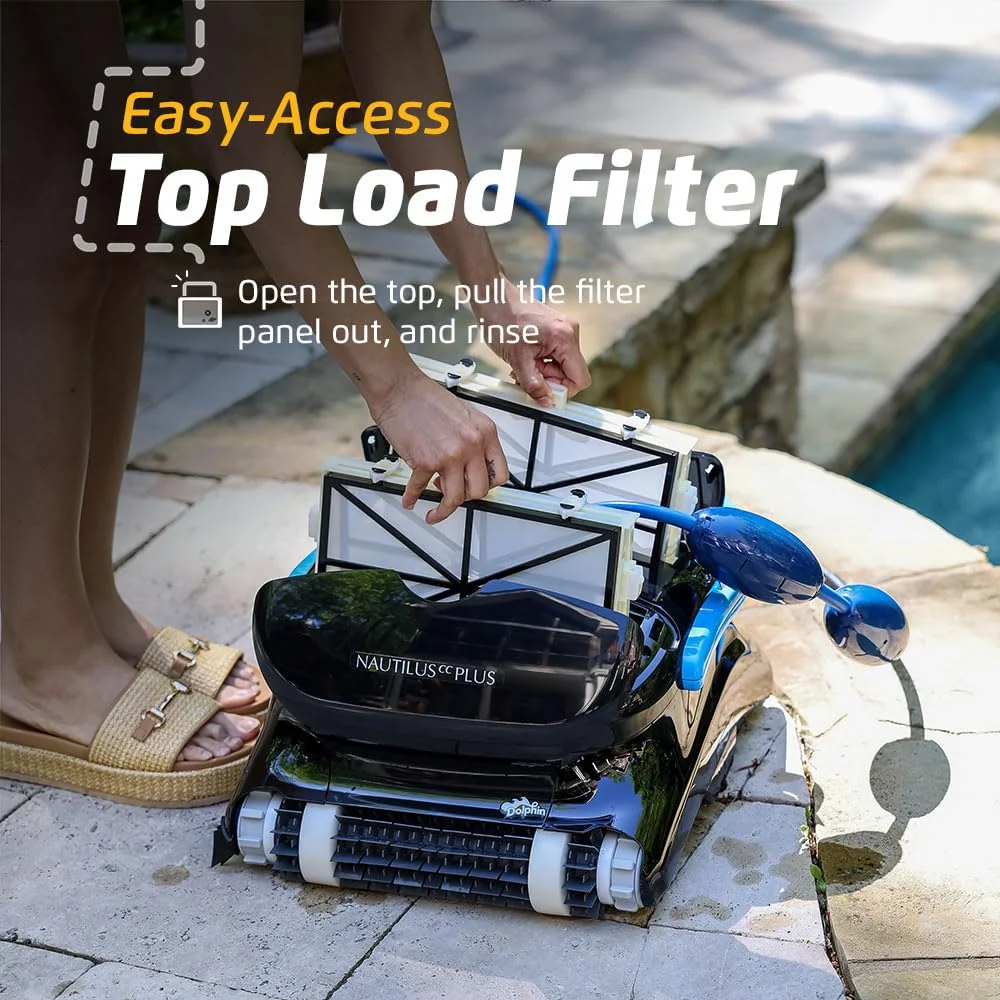
| Filtration access | Removable top-load basket | Two top-access cartridge assemblies |
| Storage equipment | No caddy or cover in the specified listing | Caddy and Classic Cover included in the specified bundle |
| Waterline behavior | May touch the surface during a climb but does not traverse the perimeter | May make incidental contact but is not a dedicated waterline cleaner |
| Best reason to buy | Lower lifting burden and adequate coverage for a smaller pool | Greater reach and easier cable handling in a larger in-ground pool |
Pool length is not merely a label on the carton. The power supply has to sit safely back from the water, pool depth consumes cable and the outlet may be nowhere near the ideal midpoint. Measure from the planned power-supply position to the most distant point on the pool floor, not just from one coping stone to another.
The CC Plus is the stronger all-around cleaner for a conventional in-ground pool.
Its longer swivel cable, larger stated pool range, scheduled starts and included caddy make it the more useful package once a pool exceeds the base model’s comfortable reach.
The heavier body, modest app, awkward obstacle handling and unreliable waterline coverage keep it well short of a premium whole-pool robot.
The CC Plus earns first place on cleaning capacity rather than digital cleverness. Exact-bundle owners report substantial pickup of dirt, dog hair, settled sludge and ordinary debris, while a detailed two-month account from an 18-by-40-foot vinyl pool estimated that normal cycles removed at least 95 percent of insects, sand and occasional leaves. That same test found a small amount of deliberately placed sand after guided passes and a full cycle, so strong suction should not be mistaken for dirt detection or targeted spot cleaning.
Its navigation works best when the basin gives it room to be unsophisticated. In an open rectangle, oval or gently freeform pool, repeated autonomous turns can produce broad coverage without a stored map. Add wide steps, a bench, drop-in stairs, ladder rails or raised drains, and the route can turn into repeated climbing, spinning or revisiting. Brushing those areas into the open basin before a cycle is more dependable than waiting for the robot to discover architectural judgment.
The app is useful as a remote switch and recurring timer. It does not add a visible pool map, dirt recognition or well-supported directional steering. The physical button still starts a normal cycle when connectivity becomes troublesome, which protects the cleaner’s central function, but an exact-bundle owner lost the connected features after the Wi-Fi module failed and reported a poor support experience.
The bundled caddy and cover are more persuasive than the Wi-Fi. A 20-pound cleaner, long wet cable and separate power supply are inconvenient objects to carry and store individually. The caddy keeps them together and lets the robot drain before transport, although exact-bundle feedback describes the cart as functional rather than sturdy, with wobbly wheels and a cable holder that may need a reusable strap.
Confirm that the exact offer is B0C2JGNFCZ if the accessories matter. The listing says the cleaner, caddy and cover can arrive in separate packages and at different times, so a lonely first box does not necessarily mean the bundle is incomplete. The same listing promises top-load filtration but does not establish that ultrafine panels are included.
Fine debris is therefore a question for the seller rather than a safe assumption. The standard cartridges can handle routine insects, hair, sand and light leaves, but persistent pollen, fine silt or dead algae may justify compatible ultrafine media. Even then, the robot remains a settled-debris cleaner rather than a substitute for the pool’s filtration system or correct water chemistry.
The base CC is the better minimalist for a smaller and simpler pool.
Its light body, top-load basket and credible floor cleaning preserve the useful part of the Dolphin formula without charging an ownership tax in app setup or bulky storage gear.
The non-swivel cable can twist and wear, while manual starts, weak architectural coverage and no dedicated waterline travel make the simplicity impossible to ignore.
The base CC is not merely a cheaper-looking Plus. It is the model to choose when carrying and rinsing the robot after every run matters more than starting it from a phone. At about 14 pounds dry, it gives up less of the robot-cleaner convenience during retrieval, and its single top-load basket is straightforward to lift, empty and hose clean.
Its strongest evidence comes from uncomplicated floor work. Exact-model owners describe pickup ranging from ordinary dirt and bugs to leaves, acorns, pebbles, sand and some silt. Rectangular pools can still retain dirt in square corners or at the base of a wall, but brushing those deposits toward open floor before starting often turns the remaining manual work into a short preparation rather than a full vacuuming session.
Wall climbing is real but easily oversold. The robot may rise until part of its body breaches the surface, then back away or drop down. That movement can scrub a vertical strip near the top without providing the sustained horizontal travel needed to maintain an oily or scaled waterline. Steps, shallow shelves and benches remain chance encounters rather than promised coverage.
The current base model is also genuinely basic. Its power supply provides a manual start and one approximately two-hour cycle, without app control or a current repeating weekly schedule. Older instructions and owner accounts can show timer settings from previous versions, which is why buying by the word “Nautilus” instead of the exact model number creates avoidable disappointment.
The cable is the clearest reason not to buy it. The approximately 50-foot lead lacks an anti-tangle swivel, and exact-model ownership accounts include wrinkling, track entanglement and eventual jacket deterioration after extended pool exposure. Laying it straight after a run, avoiding tight storage coils and keeping the robot out of the water between cleanings can reduce the abuse, but those habits do not add the missing swivel.
That weakness comes with a partial consolation: the machine is not sealed against all practical repair. Tracks, wheels, bushings, brushes and compatible filter media are replaceable, and hair wrapped around the impeller can imitate a serious drive failure. A mechanically comfortable owner may keep an aging CC moving without replacing the entire cleaner, although parts and troubleshooting still consume time.
What neither Dolphin finishes
The shared blind spots matter more than small differences in debris pickup. Neither model should be counted on to clean a staircase, broad tanning ledge or every sharp corner. Neither provides the deliberate sideways waterline pass associated with a true tile-line cleaner. Both may miss a visible deposit because autonomous coverage is not the same thing as seeing dirt.
Leaves also need context. Both can collect routine plant debris, but neither has an unlimited basket. A storm load, autumn drop or neglected opening may require a mid-cycle filter clean and another run. For pools where leaves define the entire maintenance problem, the site’s guide to robots for leaves and floating debris is a more useful next comparison than choosing between these two by cable length alone.
Fine sediment creates the opposite problem. Material can be small enough to pass standard media or return to suspension, even when the intake and brushes are doing their jobs. Buyers fighting sand, silt, pollen or dead algae should use the fine-debris shortlist and treat filter type as a primary specification rather than an accessory decision.
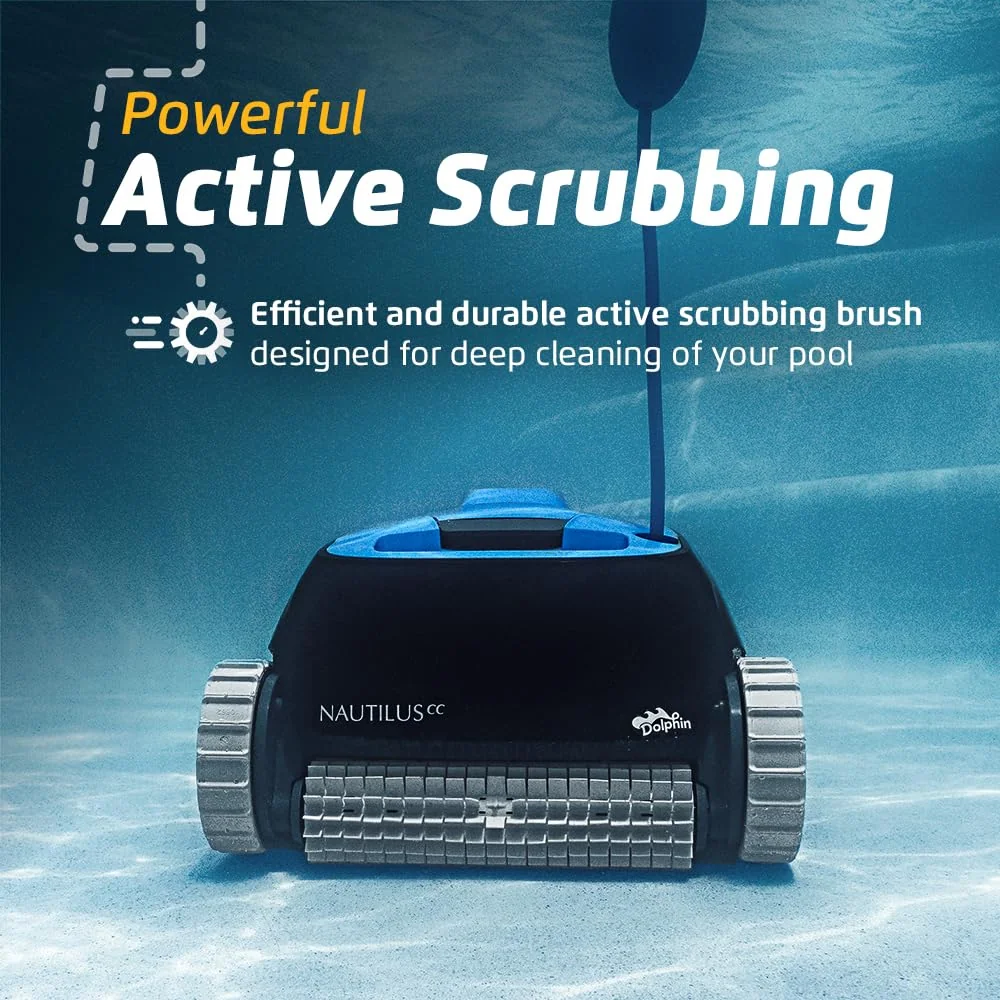
Dolphin Nautilus CC
Dolphin Nautilus CC Plus Wi-Fi
Match the machine to the pool, not the suffix
The CC Plus belongs beside an open in-ground pool
Choose it when the basin is conventional, the farthest cleaning point demands more reach than the base cable comfortably provides and scheduled starts would actually enter the weekly routine. The caddy is especially worthwhile when storage sits away from the water and the cleaner must be rolled rather than carried.
The base CC belongs beside a modest pool
Choose it for an above-ground or in-ground pool within the stated 33-foot limit, provided that a suitable outlet and safe power-supply position leave enough usable cable. It is the more coherent purchase for someone who expects to start, retrieve, rinse and store the robot after each run.
Complex geometry rules out both
Broad steps, shallow shelves, kid ledges, raised drains and railings turn these robots’ simple coverage logic into a liability. The guide to cleaners for steps, ledges and shallow areas is the better place to look when those surfaces represent a meaningful share of the pool.
A spotless tile line calls for another model
If the pool develops a persistent ring at the surface, compare machines built for deliberate waterline travel rather than treating incidental contact as a promise. The Nautilus CC and CC Pro comparison explains what a genuine move toward waterline cleaning changes within the Dolphin range.
Five checks matter before either buying action
- Measure from the safe power-supply location to the farthest point on the pool floor, including the cable consumed by depth.
- Identify every step, bench, ledge, drain cover and rail that could trap the cleaner or divide its route.
- Decide whether the dominant debris is ordinary leaves and dirt or fine pollen, silt and dead algae that may need different media.
- Confirm that the person retrieving the cleaner can handle its drained weight without using the floating cable as a lifting rope.
- Verify the included filters, warranty, return terms and bundle contents for the exact seller and ASIN rather than relying on an older Nautilus manual.
A cable-free deck is not one of the choices here. Anyone already annoyed by the thought of straightening, coiling and storing a floating lead should read the site’s corded versus cordless guide before rationalizing that irritation away. Corded power removes charging and battery limits, but it does not remove handling.
The CC Plus takes the overall win because its reach, swivel and storage bundle solve more consequential ownership problems than its extra weight creates, while the base CC remains the sharper purchase when a small pool makes those upgrades unnecessary.
Frequently Asked Questions
Is the Nautilus CC Plus worth choosing over the base CC?
Yes for a conventional in-ground pool that needs the longer cable, swivel or scheduling, but not for a pool within 33 feet where lower weight and simple manual operation are more valuable.
Does either Dolphin clean the waterline?
Both may touch or briefly scrub the surface during a wall climb, but neither should be relied on for sustained sideways cleaning around the waterline.
Can the CC Plus app steer the robot to a dirty spot?
No supported evidence establishes useful manual steering on this model, so its Wi-Fi should be valued mainly for starting, stopping and scheduling cycles.
Does CleverClean create a map of the pool?
No user-visible map or remembered dirt location is provided, and the cleaners instead use autonomous direction changes to build coverage over time.
Which model is easier to lift from the pool?
The base CC is substantially easier to handle at about 14 pounds dry, compared with roughly 20.5 to 22 pounds for the CC Plus before retained water has drained.
Can the base Nautilus CC clean an above-ground pool?
Yes, it is specified for suitable above-ground and in-ground pools up to 33 feet, subject to adequate cable reach from a safe power-supply location.
Will the cables tangle?
The base CC’s non-swivel cable is more vulnerable to twisting, while the CC Plus swivel reduces cable rotation without making tangles impossible.
Are replacement parts available for the Nautilus CC?
Yes, common wear items such as tracks, wheels, bushings, brushes and filter media can be replaced, although the exact model number should be checked before ordering.
Can either robot clean algae from a green pool?
No, the robots can collect some loosened or dead residue, but active algae requires corrected water chemistry and manual attention to surfaces they cannot reach.