Wall climbing is common, but reliable stair cleaning is not
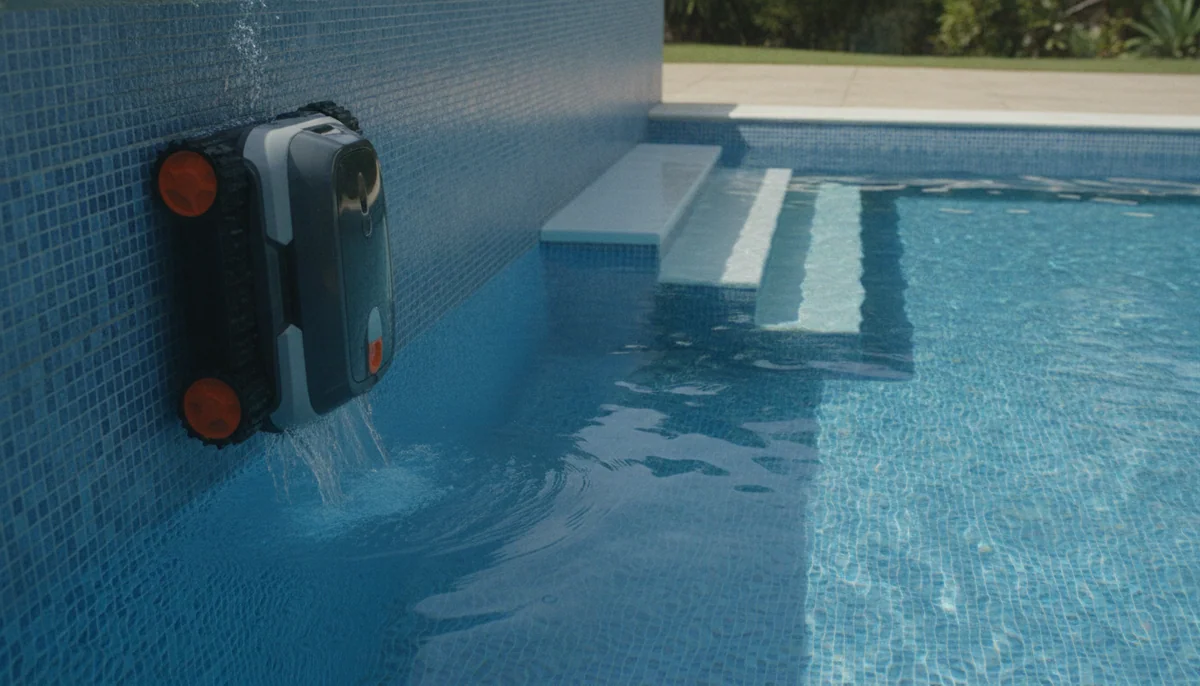
A robotic pool cleaner can scale a five-foot wall and still lose a fight with an eight-inch step. That is not a contradiction. A broad vertical wall lets the tracks stay planted while water flow holds the chassis against one continuous surface. A stair asks the same machine to cross an edge, settle onto a short tread, keep its intake submerged, turn in restricted space and escape without beaching itself.
This distinction separates a useful specification from an expensive misunderstanding. Wall climbing is a credible capability on many tracked cleaners. Dependable coverage of every step, bench, tanning ledge, drain, corner and shallow shelf is not. The realistic promise is less brushing and vacuuming, not the retirement of the pool brush.
Walls: Often within reach of a capable tracked cleaner.
Waterline: Possible, although brief contact and dedicated lateral scrubbing are different abilities.
Slopes: Usually easier than steps when both tracks remain planted.
Drains: Sometimes crossed cleanly and sometimes capable of trapping the chassis.
Steps and shallow shelves: The least dependable parts of almost every pool.
The evidence is unusually blunt. In one controlled comparison, an Aiper Scuba S1 covered 99% of the floor, 86% of the walls and 62% of the stairs-and-bench area. The camera-equipped Scuba V3 also covered 99% of the floor, but managed 69% of the walls and only 10% of the stairs-and-bench area. More intelligence on the box did not widen the treads or deepen the water.
A wall is the easy version of climbing
A climbing robot needs traction, balance and enough water flow to press its chassis against the surface. Tracks or rollers provide grip, while the pump and redirected exhaust help maintain contact. A smooth radius between the floor and wall gives the robot time to establish that contact before the body rotates into a vertical position.
Several ordinary conditions can weaken a machine that climbed properly last week. Algae and biofilm make the finish slippery. A full basket or clogged filter restricts flow. A fine-filter insert can improve silt retention while reducing the water movement needed for adhesion. Worn tracks, low battery, cold water, obstructed exhausts and a slick tile band can also turn a clean ascent into a short wheelie followed by a fall.
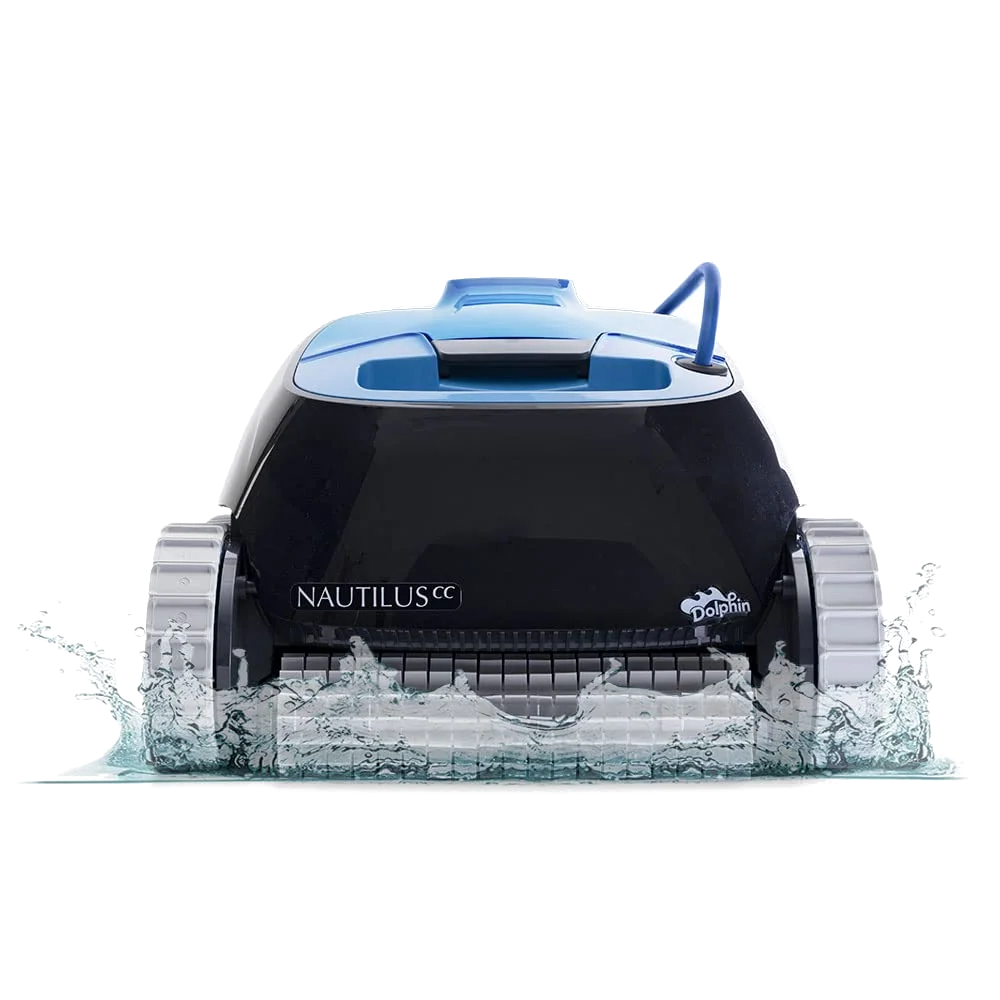
The basic Dolphin Nautilus CC illustrates the useful middle ground. Owners have seen it climb until part of the body breaches the surface, scrub conventional walls and leave straightforward pools largely clean. The same evidence includes failed stair climbs, brief visits to a submerged platform and residue left at square wall bases. Its wall climbing is real; systematic step and tile-line cleaning are not. Our Nautilus CC review explains that trade-off in full.
The Dolphin Proteus DX3 tells a similar story. It can make useful wall passes and reach a submerged bench or swim seat, yet exact owners report it giving up on stairs or nearly tipping during the attempt. It may touch the upper wall, but the evidence does not establish sustained lateral waterline travel. The Nautilus CC and Proteus DX3 comparison is the relevant choice for buyers deciding between these two corded wall climbers.
Reaching the surface is not the same as cleaning the waterline
A basic wall climber may ascend vertically, push part of its body above the surface, brush for a moment and fall away. That is waterline contact. A dedicated waterline cleaner reaches the boundary, redirects its flow and travels sideways while the brush remains on the tile or liner. The second behavior gives the robot a chance to scrub along the perimeter instead of touching it in separated vertical strips.
The Dolphin Nautilus CC Pro Wi-Fi provides clear evidence of the dedicated version: it climbs, turns at the surface and moves laterally while brushing. Its honest drawback is a concerning exact-model reliability record, along with reports of missed sections, raised-drain difficulty and units that tilt or flip, so it is not Smart Pool Bots’ default recommendation merely because the waterline mechanism is legitimate. Read the full Nautilus CC Pro Wi-Fi review before treating its tile-line ability as a reason to buy.
Dedicated travel still does not promise a spotless ring. The robot works at the current water level, so an older mark above that level can remain. Fresh film, pollen and ordinary scum are more plausible targets than established scale, stains or algae. Gaps between wall approaches are also possible, particularly around corners, returns, ladders and changing wall profiles.
Waterline cleaning is not surface skimming either. A submerged robot brushing the wall cannot collect floating leaves from the middle of the pool. That requires a buoyant surface mode or a separate skimmer. Readers whose main problem is floating debris should start with the distinction in our guide to robotic skimmers and pool vacuums.
Why steps and tanning ledges win so often
A conventional wall offers more usable real estate than a conventional stair. The robot can keep both tracks on the wall for several feet. On a stair, the nose may clear the edge while the belly rests on the bull-nose and unloads the tracks. The motors continue turning, but the machine has no useful contact from which to move.
Water depth is just as important as tread width. Very shallow water can leave the intake or exhaust in the wrong position, increase buoyancy and prevent the pump-thrust system from holding the robot down. This is why a broad lower bench can receive useful cleaning while the narrow upper step above it remains untouched.
A robot mounting a ledge once proves access, not coverage.
Approach angle decides many borderline cases. A robot may climb onto a shelf when it arrives squarely and fail when one track reaches the edge first. Even after mounting the shelf, it can roll straight across, reverse immediately or fall off without making orderly vacuuming passes. A camera can choose a target, but it cannot create enough room for the chassis to settle and turn.
The Beatbot Sora 70 has the strongest shallow-feature evidence among the covered machines. Broad seating, long steps, a swimout and a large tanning ledge have worked with roughly 7.5 to 8 inches of water, while a five-inch shelf remained inaccessible and other owners still reported step trouble. Its large basket and true surface mode add useful coarse-debris coverage, but fine silt results are mixed and narrow upper treads remain a manual zone. The complete Sora 70 review separates those credible abilities from the broad full-coverage pitch.
The updated Aiper Scuba S1 is a more restrained option for partial architectural coverage. Its controlled result on stairs and a bench was materially better than the Scuba V3’s, but 62% is still unfinished work, and the listing requires more than 12 inches of water for shallow-area cleaning. It is a credible wall-and-waterline cleaner whose limitation is incomplete coverage of compound stairs, tight transitions and very shallow shelves. Our Aiper Scuba S1 review covers the geometry and retrieval burden in detail.
If steps and tanning ledges are the recurring burden rather than a secondary annoyance, compare only machines with direct shallow-area evidence in our guide to robots for steps, tanning ledges and shallow shelves. Even there, the correct expectation is best-supported partial coverage, not a universal stair-cleaning promise.
Drains are obstacles before they are cleaning zones
A low, smoothly contoured drain cover may pass beneath a robot without drama. A raised or domed cover can catch the intake, lift the belly or unload one track during a turn. Some robots pause and free themselves. Others return to the same fitting until much of the cycle has been spent spinning in place.
The WYBOT B1 has been filmed crossing a raised main drain and climbing roughly five-foot walls, so both capabilities are genuine possibilities. Its limitation is repeatability: owner reports also include confused wall behavior, missed floor dirt, trouble with sloped sides and a robot stranded on steps. It is proof that a successful obstacle crossing does not establish compatibility with every raised fitting. The WYBOT B1 review is the better place to judge that inconsistency against its compact design.
Nepturox SAT25 evidence runs in the opposite direction. Its wall climbing is credible and owners have seen some favorable step transitions, yet exact reports include repeated main-drain stalls lasting several minutes and climbing that weakened after debris entered the basket. Emptying the basket restored adhesion in one account, but it did not change the drain’s physical profile. Our Nepturox SAT25 review explains why that capability still comes with quality-control caution.
Turning off the pool pump can reduce current around a cleaner, but it cannot flatten a raised cover. Buyers with prominent drains, pop-up cleaning heads or floor fittings should watch several early approaches from different directions. “Obstacle crossing” and a large sensor count are not substitutes for that test.
Gradual slopes are easier, until they are not
A gentle slope lets both tracks remain planted while the chassis changes angle. That usually makes it more manageable than a step edge. Abrupt shallow-to-deep transitions, rounded bowls, vinyl wrinkles and compound curves can still interrupt traction or confuse the programmed route.
The floor-only AIPER Seagull SE shows why a robotic label does not imply climbing. It is designed for flat-bottom above-ground pools and does not clean walls, steps, ledges or the waterline. Exact owners reported different results even on modest center slopes, ranging from useful crossing to slow uphill movement and wasted runtime. Its honest use is simple floor pickup in favorable geometry, not weak or occasional wall cleaning. The Seagull SE review covers the limits of that inexpensive floor-only design.
Full-zone tracked cleaners are better slope candidates, but steepness figures on listings should remain claims unless reproduced in a relevant pool. Finish and approach matter as much as the advertised angle. A robot that repeatedly retries a slope can spend its cordless battery budget proving that it can climb rather than cleaning the floor.
A compact capability matrix
| Cleaner | Walls | Waterline | Steps and ledges | Key limitation |
|---|---|---|---|---|
| AIPER Seagull SE 2025 | Not designed | Not designed | Not designed | Flat-floor geometry only |
| Dolphin Nautilus CC | Proven | Brief contact | Weak | No dedicated lateral tile-line travel |
| Dolphin Proteus DX3 | Proven | Incidental | Weak | Bench visits do not become stair coverage |
| Aiper Scuba S1 | Proven | Pool-dependent | Partial | Shallow areas require enough water and room |
| Aiper Scuba V3 | Pool-dependent | Dedicated | Very weak | Camera vision does not solve tread geometry |
| Beatbot Sora 70 | Proven | Dedicated | Best on broad deep features | Very shallow shelves and narrow steps still fail |
| WYBOT C2 Vision | Proven | Dedicated | Lower steps plausible | Upper treads remain vulnerable to buoyancy |
These labels describe demonstrated capability, not the percentage of pools in which each result will occur. Owner reports establish possibilities and failure modes, while controlled tests establish what happened in one defined setup. Neither can guarantee the transitions in a different pool.
Use the return window as the final compatibility test
- Measure before ordering. Record the tread width, water depth over the highest shelf, drain-cover height, bench dimensions and the sharpness of every major transition.
- Begin with clean walls and an empty coarse basket. This isolates basic traction from algae and filter restriction.
- Run the intended wall or full-pool mode. A floor-only cycle says nothing about a machine’s climbing route.
- Distinguish contact from cleaning. Watch whether the robot travels across a step or waterline section, vacuums it and leaves unaided.
- Approach the drain more than once. A single lucky crossing is weaker evidence than repeated escape from several directions.
- Repeat after the basket collects debris. A machine that loses wall grip under an ordinary load may waste much of every maintenance cycle.
- Inspect after disturbed dirt settles. Clouds of moving sediment can look like cleaning even when the filter releases the same material back into the pool.
- Protect the deadline. Firmware changes and several cycles may improve routes, but do not let promises of learning consume the return period.
Reject a machine that repeatedly wheelies, flips, beaches on the same step, exhausts itself on a fitting or loses climbing almost immediately. Keep one that consistently removes the bulk of the work while leaving a small, predictable manual zone. Predictable imperfection is more useful than a full-coverage claim followed by a rescue mission in the deep end.
The five-minute manual finish
Brush debris from steps, shelves, corners, coves and wall bases into the open floor before or after the robotic cycle. Empty a loaded basket when climbing weakens, remove oversized leaves with a net and use a separate wall or waterline mode when the cleaner provides one. For fine sediment, compare performance with and without the fine insert because better retention can come at the cost of flow and adhesion.
This is not an admission that robotic cleaners do not work. It is the operating method that respects what their chassis can reach. Readers deciding whether that remaining effort is worthwhile can continue with our guide to the real labor savings from robotic pool cleaners.
Wall-capable robots are worth buying for broad floors, conventional walls and, on the right models, purposeful waterline work; steps, shallow ledges and raised fittings should remain part of the manual maintenance plan until the exact machine proves otherwise in the exact pool.
Frequently Asked Questions
Why can a robot climb a vertical wall but fail on a step?
A wall provides continuous track contact, while a step forces the robot across an edge and onto a short, often shallow tread where its belly, buoyancy or turning radius can defeat traction.
Does waterline cleaning mean the robot collects floating leaves?
No, waterline cleaning scrubs the wall at the water boundary, while floating leaves require a true buoyant skimming mode or a separate robotic skimmer.
Will a robotic cleaner handle a tanning ledge?
A broad ledge with adequate water depth may receive partial coverage, but very shallow shelves and narrow transitions should be assumed manual until the exact robot proves otherwise.
Can a pool robot cross a raised main drain?
Some robots cross a low or smoothly contoured cover, while a taller dome can high-center the chassis, unload the tracks or trap the route repeatedly.
Does a full basket stop a robotic pool cleaner from climbing?
A loaded or clogged filter can reduce water flow and adhesion, so emptying it is a sensible first check when a previously capable robot starts falling from the wall.
Will an app let me steer the cleaner off a step underwater?
Usually not, because Bluetooth and Wi-Fi commonly disappear after submersion and most cleaners must resolve obstacles autonomously until they return to the surface.
Do repeated cycles eventually clean every missed area?
Extra cycles can fill ordinary navigation gaps, but they cannot make an inaccessible upper step, undersized tread or extremely shallow shelf physically usable.
Sources (2)
- Amazon listings and customer reviews
- Owner and reviewer video, 2 channels