Aiper Scuba S1 review: A strong floor cleaner with a reliability catch
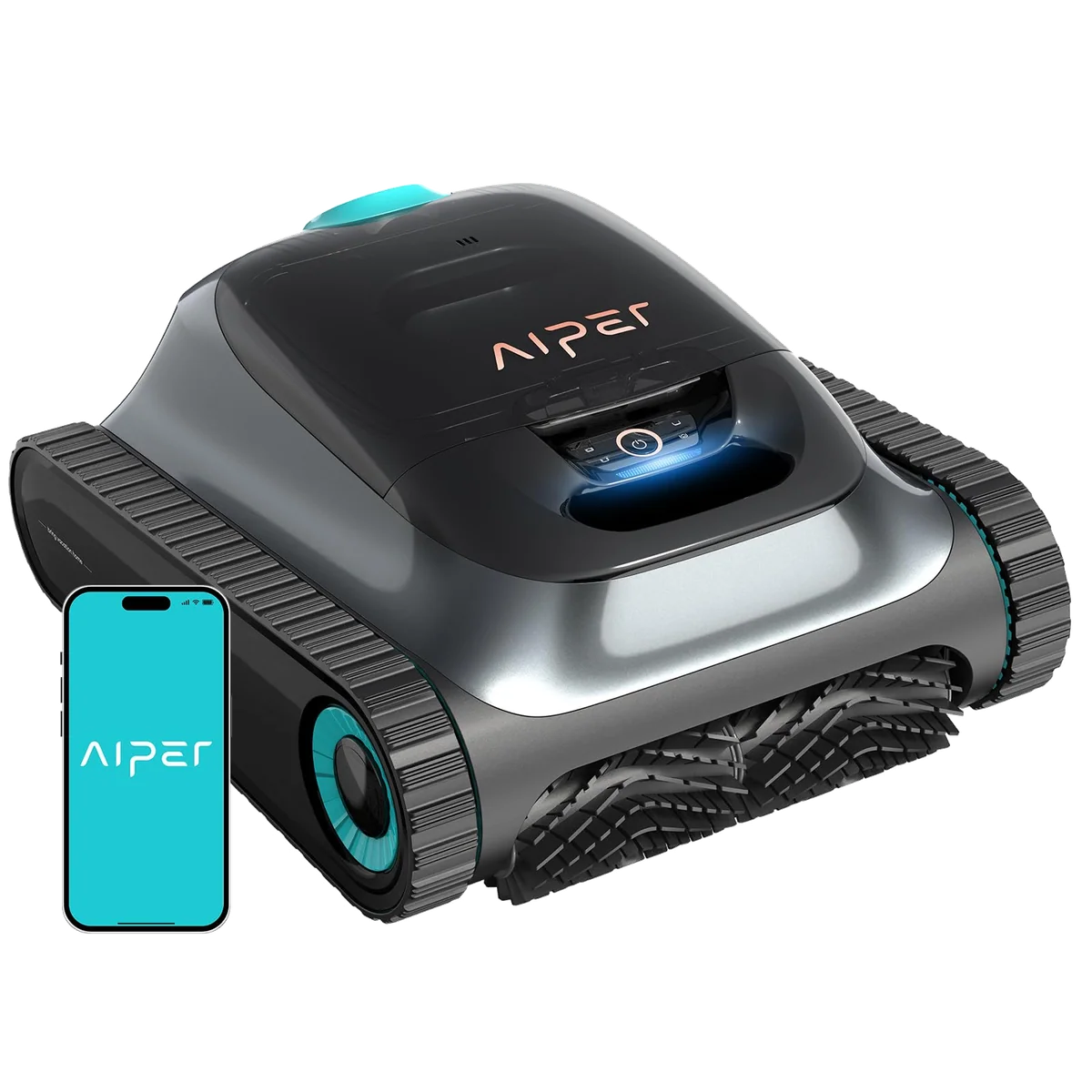
Buy the Aiper Scuba S1 for a simple pool where cordless floor cleaning matters most, but choose something else for complex steps, difficult transitions, or a low tolerance for reliability risk.
Our recommendation
The updated Aiper Scuba S1 earns a qualified recommendation because its floor cleaning, long runtime, cordless design, and secondary fine filter solve real maintenance problems. It does not earn an unconditional one because geometry-sensitive coverage and uneven durability make the outcome less predictable than the feature list suggests.
Buy the exact updated listing only when your pool is relatively simple, fine settled debris is a major problem, and the retailer gives you enough time to prove wall grip, step behavior, app setup, charging, and full-floor coverage in your own water. For complicated pools, demanding waterlines, heavy daily leaf fall, or buyers who prioritize repairability over cable freedom, the S1 asks for too much faith.
The Scuba S1 has a compelling best case. It can run for hours without a cable, move across an open floor in a deliberate pattern, collect ordinary leaves and grit, climb suitable walls, and use a secondary filter that catches material a coarse basket would recirculate. For the right pool, that is the difference between frequent manual vacuuming and a quick brush of the awkward spots after the robot finishes.
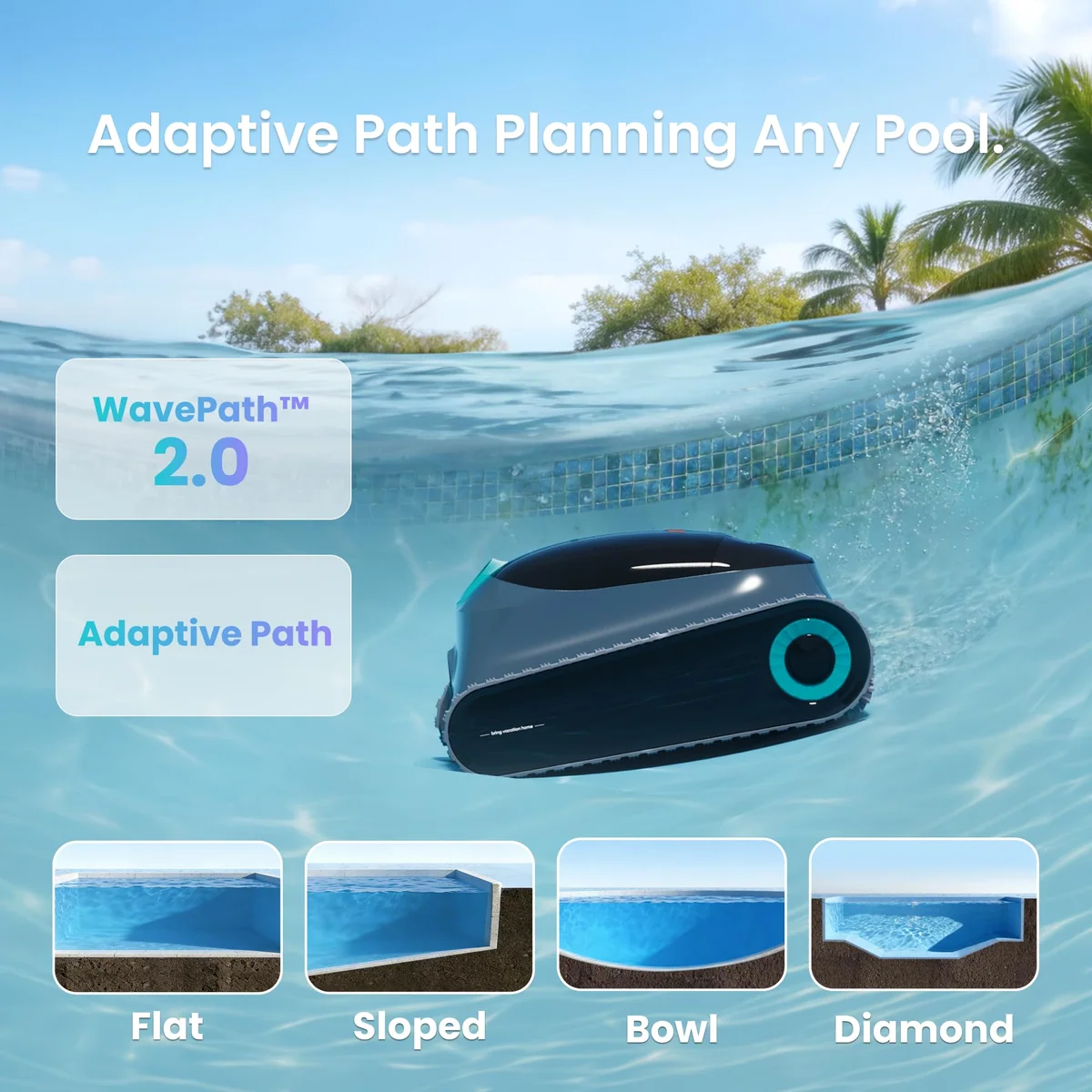
The catch is not that the S1 cannot clean. The catch is that its performance is unusually sensitive to the pool around it. Curved steps, benches, circular spa sections, sharp changes in depth, compound slopes, and wide shallow shelves can turn systematic movement into wheelies, repeated routes, stranded treads, or untouched patches. Some owners report excellent results in kidney-shaped pools; others with apparently ordinary pools describe large missed sections and repeated intervention. That variance is the central fact of this review, not a footnote.
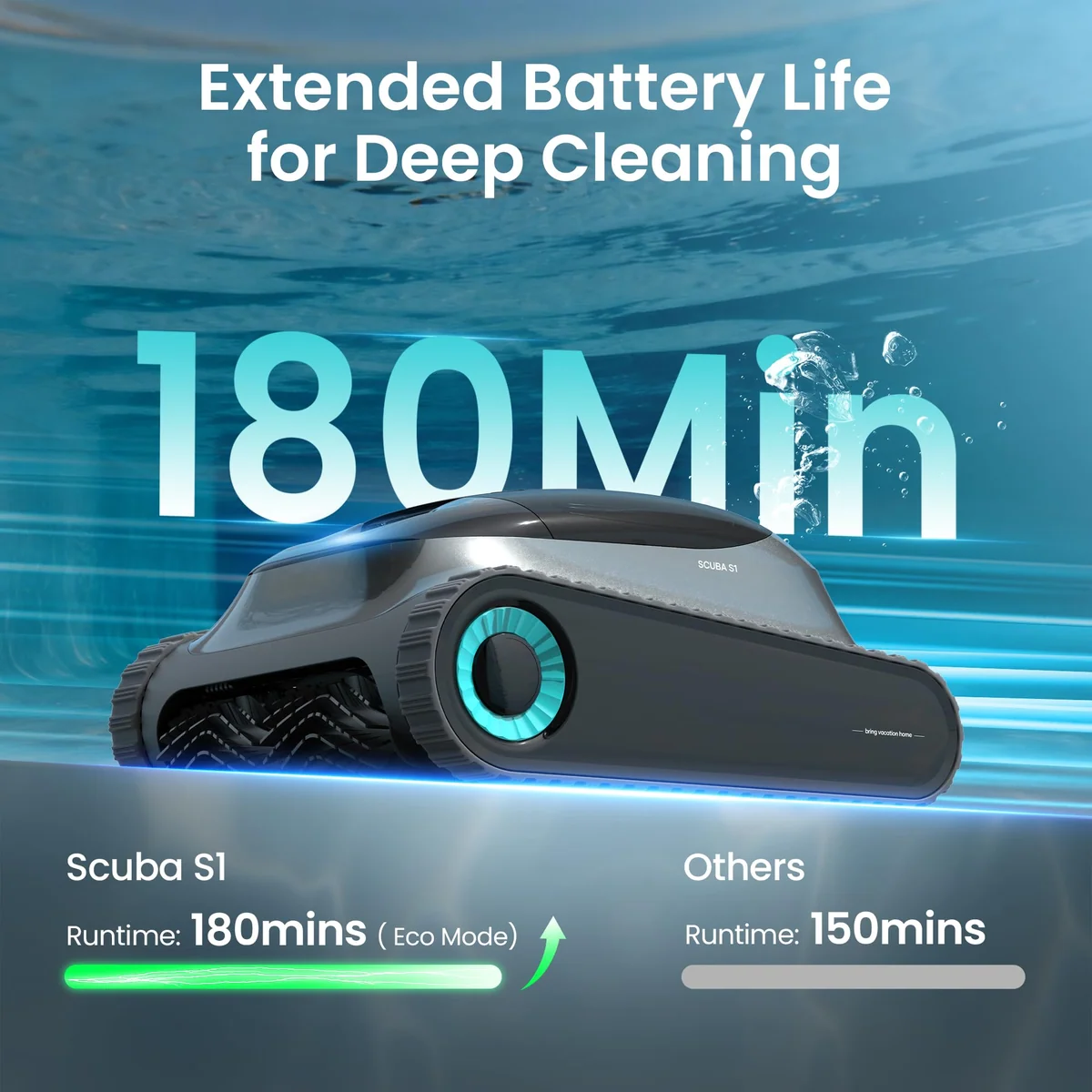
There is also a version problem. The older listing, ASIN B0FJ818NNZ, advertises up to 180 minutes, dual filtration, app support, and OTA updates, while the black 2026 listing, ASIN B0H9LS51C4, reserves its 270-minute headline for Eco maintenance and lists 180 minutes for the normal cleaning modes. Older reviews referring to a 150-minute S1, no app, or mesh-only filtration may describe a previous configuration rather than either current listing. Check the exact ASIN before treating any review, accessory, or manual as applicable to the machine in your cart.
| Exact listing | Runtime claim | Meaningful distinction |
|---|---|---|
| B0FJ818NNZ | Up to 180 minutes | Dual filtration, app support, OTA updates, and the updated S1 feature set. |
| B0H9LS51C4 | Up to 270 minutes in Eco; up to 180 minutes in standard modes | Adds a weekly custom plan and makes the longer figure specific to maintenance cleaning. |
In plain terms, the S1 is a capable cordless vacuum rather than a guarantee that every submerged surface will be cleaned without supervision.
Key Specifications
The fine filter earns its place, then earns a rinse
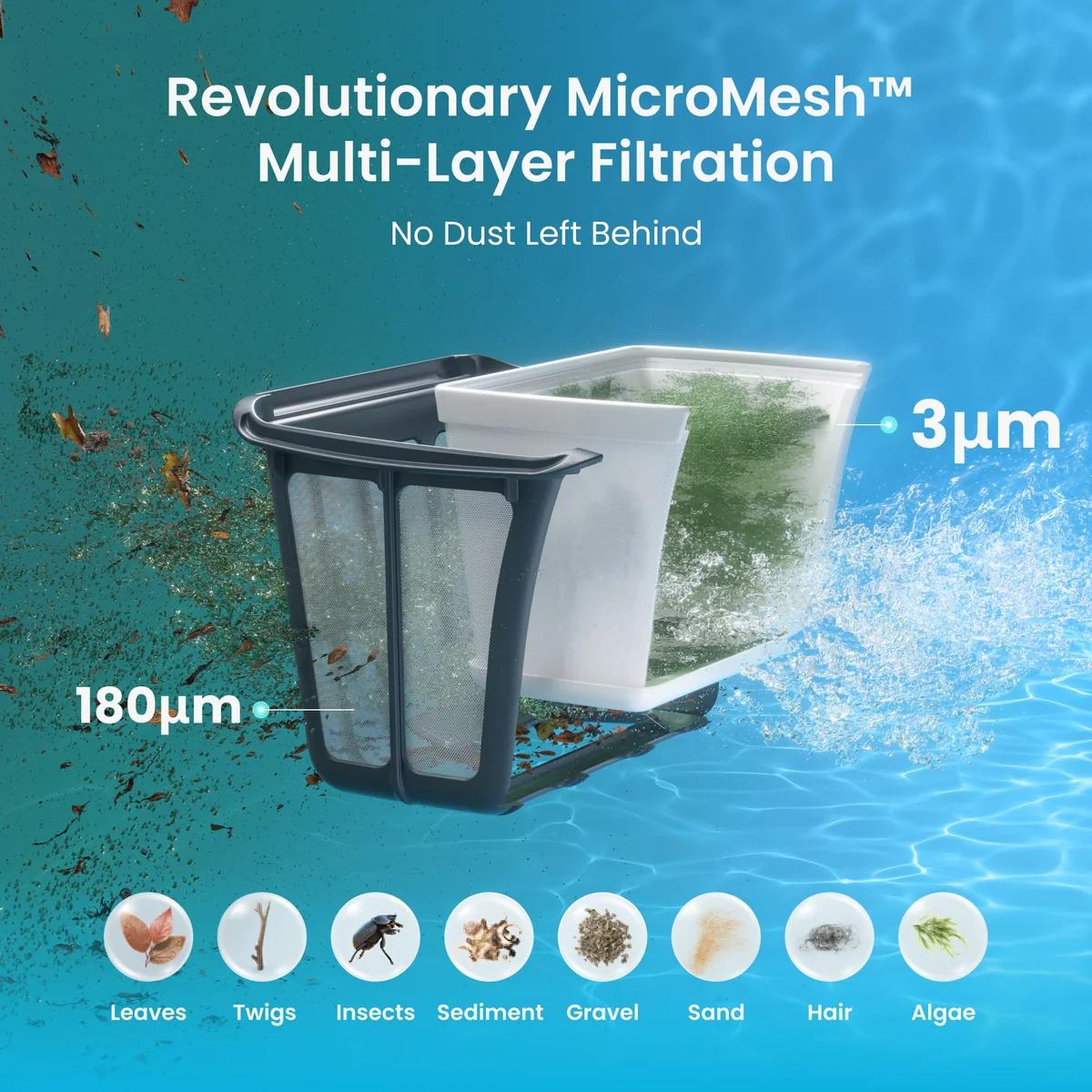
The dual-layer filter is more than a marketing flourish. The standard 180-micron basket handles larger material, while the removable 3-micron layer is intended for dust, sand, and other fine debris. Exact-listing owners repeatedly describe strong fine-particle collection, including material that had passed through other cleaners or returned through pool circulation.
The extra layer also changes the maintenance equation. Fine media loads faster than the outer basket, can restrict flow when packed with algae or silt, and takes longer to rinse than a simple open basket. In the 2026 comparison, the S1 was among the slowest machines to clean after a cycle because its hinged top and separate filter insert demanded more rinsing, even though access itself was straightforward. The test also saw some sand re-enter the water column, so a 3-micron component should not be read as a guarantee that every particle stays captured.
Use the fine layer when the pool has settled dust, silt, or very small debris, and expect to inspect it before the outer basket looks full. For a leaf-heavy run, removing the secondary insert may preserve flow and usable capacity, but it also gives up the feature that most clearly separates this S1 from a coarse-filter robot.
The app is useful before the robot dives
The current listing assigns real jobs to the app: selecting modes, configuring Eco operation, viewing logs, installing OTA updates, and setting the weekly plan. That does not mean a phone becomes an underwater remote. Owner reports note that ordinary Wi-Fi and Bluetooth communication drops after submersion, so settings should be chosen before launch and the physical control remains important.
OTA support has at least a plausible practical purpose. The 2026 comparison observed behavior consistent with a firmware change that reduced the S1’s tendency to stir leaves when tilted. Software can improve route or motor behavior, but it cannot change tread contact on a badly matched step or recharge the battery while the robot sits underwater.
Long runtime is not the same as complete cleaning
The black 2026 listing’s 270-minute figure belongs to Eco Mode, not a four-and-a-half-hour maximum-power deep clean. Auto, Floor, Wall, and Scheduled modes remain listed at up to 180 minutes. A current comparison recorded 245 minutes from a Scuba S1, which makes a very long healthy-unit cycle plausible, but that test did not establish that the machine was this exact ASIN or that every owner will approach the maximum.
Productive minutes matter more than elapsed minutes. A long Auto cycle can spend substantial time climbing walls before switching to the floor, while a fine filter packed with debris can reduce useful pickup. Buyers primarily concerned with floor debris should consider Floor mode rather than assuming the longest available cycle will allocate time in the most useful way.
Strengths & Limitations
Strengths
- Systematic routing can deliver excellent coverage across an unobstructed pool floor.
- The removable 3-micron layer catches much finer debris than the standard basket alone.
- Cordless operation removes the hose, floating cable, and deck-side power equipment.
- Healthy updated units can run long enough to finish a typical residential-pool cycle.
- Physical controls preserve basic operation even when the underwater connection disappears.
- The listed two-year warranty is backed by several examples of fast replacement service.
Limitations
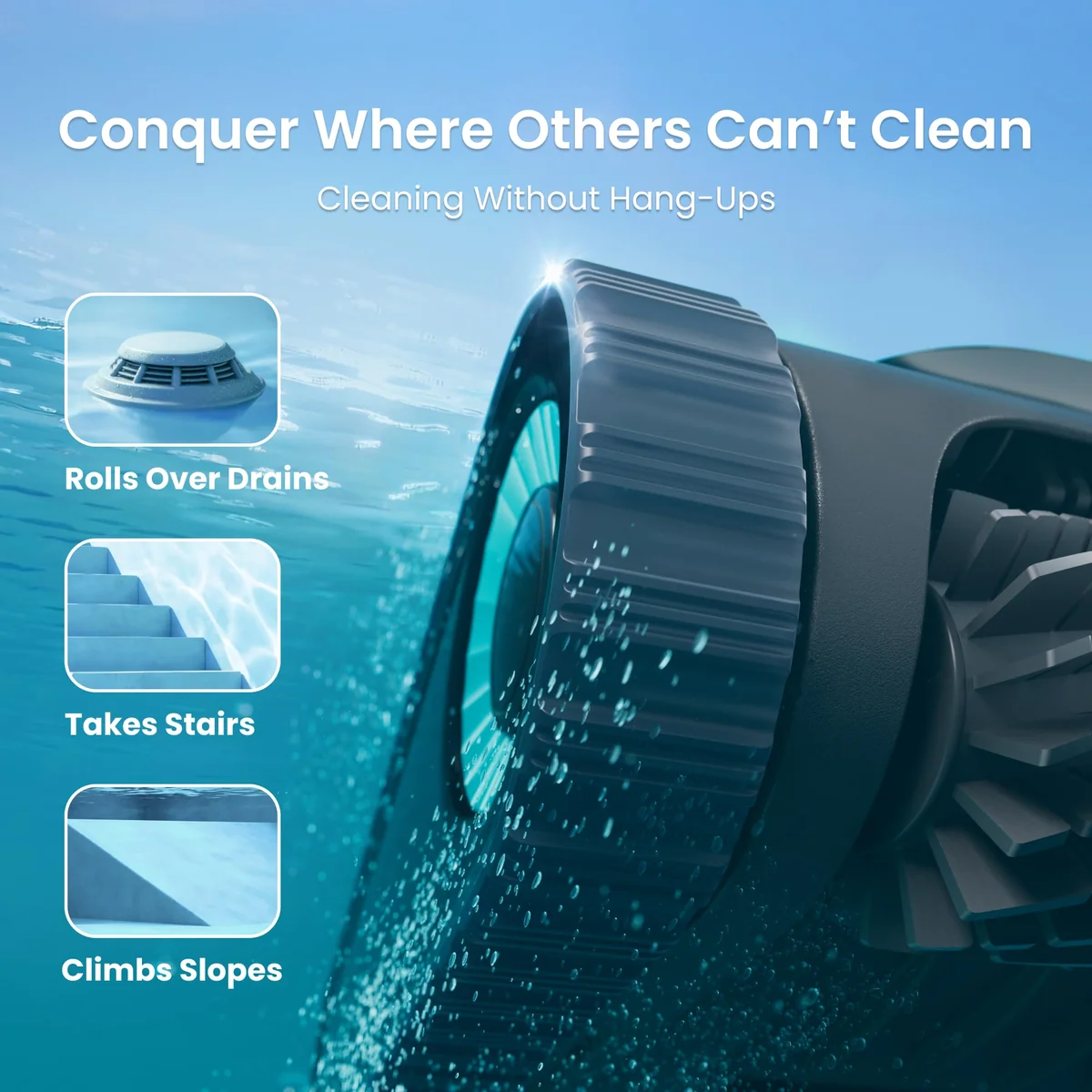
- Steps, benches, sharp slopes, curved transitions, and circular areas can defeat its route or traction.
- The secondary filter adds rinsing time and may load before the outer basket is full.
- Owners must retrieve, drain, clean, dry, and recharge the robot between substantial cycles.
- Detailed reports show a concerning mix of charging, motor, control, and water-ingress failures.
- The app should not be mistaken for reliable live control while the robot is submerged.
- Waterline contact is not strong enough to guarantee removal of scale or attached buildup.
The floor is its argument; the pool’s geometry is the rebuttal
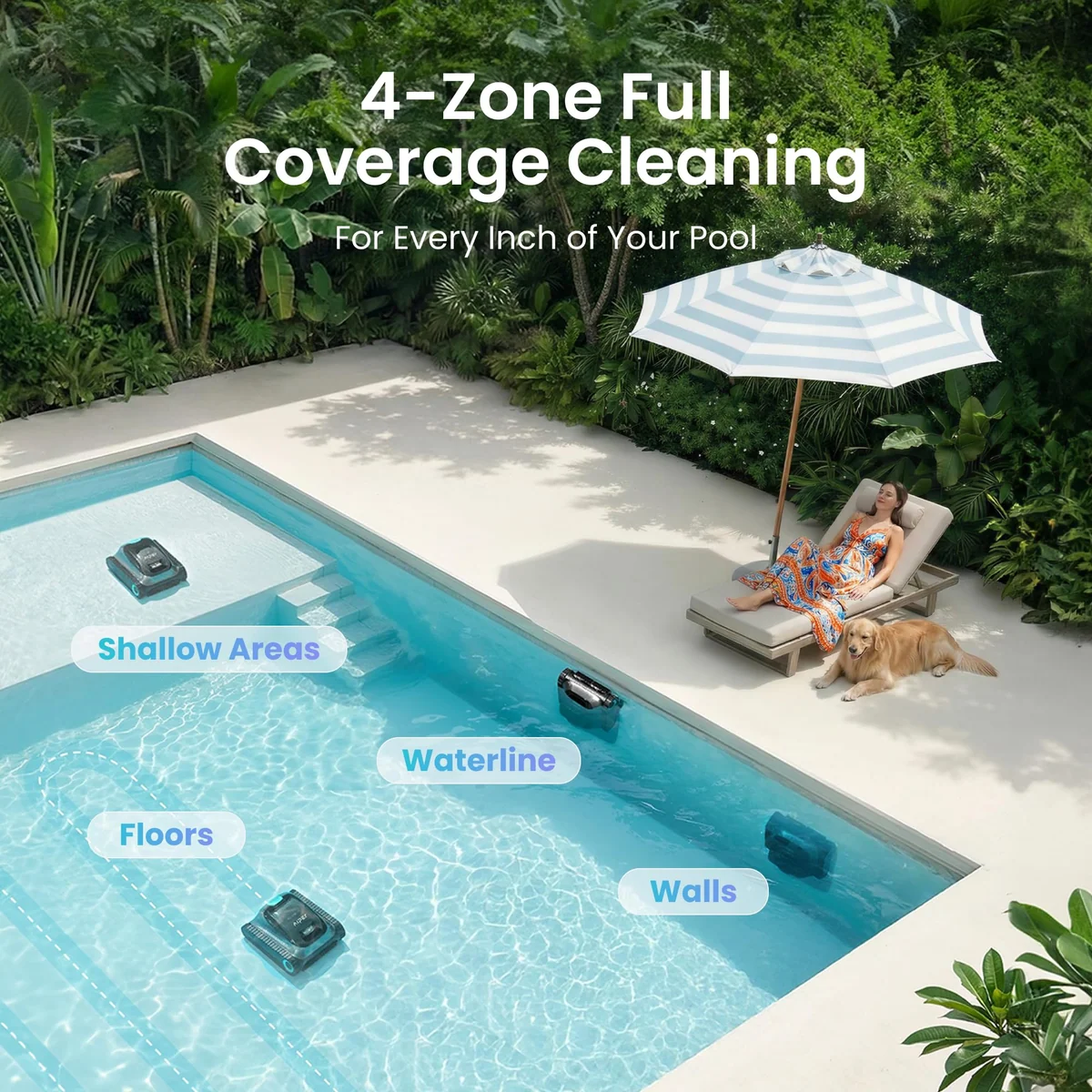
A broad 2026 comparison gives the S1 its strongest performance case. In that test pool, it covered 99% of the floor, 86% of the walls, and 62% of the stairs and bench during a four-hour, five-minute session. Those results make the floor claim credible and the feature-cleaning claim conditional. The same robot can be close to complete on a broad horizontal surface while leaving a meaningful portion of steps and vertical areas untouched.
That distinction matters more than the sensor count. Eleven sensors and a branded route algorithm sound precise, but neither proves that the machine creates a stored map or understands a pool the way a camera-based robot might. The useful outcome is whether the S-pattern reaches the debris. In a compatible pool it often does; in an incompatible one, the robot can methodically repeat the wrong part of the job.
Open floors suit it best
Detailed owner reports from both exact listings repeatedly describe strong collection of settled dirt, silt, moderate leaves, and routine debris on reachable floor areas. Some owners found the S1 more orderly than previous robots, and several said a single cycle left little visible material behind. The current listing’s review set also contains an immediate “walking motor jammed” failure, repeated-route behavior in a free-form pool, and a case where the fine filter overloaded before a medium pool was complete. The positive results are real, but so are the boundaries around them.
Wall climbing is a capability, not a promise
Suitable walls can produce the satisfying result buyers expect: the tracks climb, the robot pauses at the waterline, and the brush works along the tile before the machine descends. It is less convincing against scale or firmly attached deposits, where manual brushing can still be necessary. A direct comparison with the Ecovacs Ultramarine P1 found the S1’s floor route structured and adequate but its wall climb slow, inconsistent, and prone to losing grip; the reviewer allowed that the particular S1 might have been faulty and that wall material or angle could change the result.
That caveat is exactly why this is a conditional recommendation rather than a blanket rejection. Pool finish, wall angle, cove shape, tread contact, and the transition from floor to wall all influence whether the S1 reaches the waterline cleanly. A robot that climbs plaster in one rectangular pool may struggle on a different finish or a compound curve.
Steps and shelves remain manual-cleaning territory
The 2026 listing includes shallow areas deeper than 12 inches, but that threshold is not a promise to clean every step, tanning ledge, bench, or beach entry. A wide shelf can support the center of the shell while leaving the tracks suspended, and a narrow stair tread may trigger wall-climbing logic before the robot can traverse it. The controlled comparison’s 62% stair-and-bench result is respectable for incidental coverage, but not enough to retire the pool brush.
If the main annoyance in your pool is a broad open floor, the S1 addresses the right problem. If the main annoyance is a curved staircase, circular spa, shallow sun shelf, or abrupt deep-end transition, the robot’s most fragile capability becomes your most important one.
Who should buy it, and who should leave it alone
Buy it for a simple, accessible pool
The strongest buyer is maintaining a rectangular, oval, or otherwise uncomplicated pool with an open floor, manageable walls, few steps, and routine deposits of grit, silt, small leaves, and settled debris. That owner values the absence of a cable, can handle the wet lift, and accepts brushing steps or stubborn waterline deposits after the robot finishes.
For that use, the S1 combines three useful traits that cheaper floor-only cleaners often separate: long cordless operation, wall and waterline capability, and an actual fine-debris layer. See where it sits among the site’s best cordless robotic pool cleaners, or compare it with the broader field in the Aiper buying guide.
Walk away if your pool is mostly obstacles
A compound staircase, circular attached spa, broad tanning ledge, sharp deep-end break, pronounced cove, or several depth changes makes the purchase substantially riskier. The S1 may still work, but the evidence does not justify betting on it without easy return rights. Buyers focused on that geometry should start with the site’s guide to robots for steps, ledges, and shallow shelves.
The same answer applies if you cannot comfortably lift a water-filled robot, dislike rinsing fine filter media, expect live phone control underwater, or want a cleaner with a proven multi-season record and easily replaced internal parts.
The most useful alternatives solve different weaknesses
The Scuba S1 and Ecovacs Ultramarine P1 comparison is the direct place to look if wall grip and fine-debris retention matter more than the S1’s compact handling. A direct test favored the P1 for wall climbing, brush contact, and aggressive pickup, although that result came from one pool and did not include every upgrade claimed for the latest S1 listing.
Buyers interested in Aiper’s camera-equipped step up should read the Scuba S1 versus Scuba V3 comparison rather than assuming more sensors automatically mean better coverage. The 2026 controlled test gave both machines 99% floor coverage in its pool, while the less expensive S1 actually covered more of the walls and feature area; the V3’s case rests more on targeted debris detection, shallow-shelf attempts, and dock charging.
If the battery ritual itself is the deal-breaker, the Dolphin Nautilus CC review covers the corded alternative: continuous mains power and no recharge cycle, exchanged for a cable in the pool. The deeper category trade is explained in our corded versus cordless guide.
Cordless removes the cable, not the ownership cycle
The S1 avoids a floating power cable, deck-side control box, suction hose, and dependence on the pool pump. That is a genuine improvement when cable routing is awkward, animals damage cords, or pool fencing makes a wired cleaner impractical. It is also more pleasant to look at while it works.
Between cycles, the labor returns in a different form. Retrieve the robot with the hook, lift until enough water drains, carry it to a suitable area, empty and rinse both filter layers, let the charging connection dry, and recharge it. In the 2026 comparison, the S1 weighed about 39 pounds at the first wet moment and about 20 pounds after draining, making it the lightest robot in that field but still a meaningful initial lift.
This is why “cordless” and “hands-free” should not be treated as synonyms. The weekly plan can distribute stored battery power across scheduled maintenance runs, but the robot cannot replenish itself or empty its filter. A corded timer model asks you to manage a cable; the S1 asks you to manage the machine between runs.
Reliability is the unresolved risk
The older exact listing’s retained reviews include an apparent faulty unit, a power-switch failure after roughly ten months, filter-material and button-finish complaints, and two highly critical reviews whose final five-star ratings followed exchanges to different Aiper models. Those revisions are good evidence that support can rescue an ownership experience, but weak evidence that the original S1 cleaned reliably.
The broader exact-S1 record is equally divided. ProductReview’s self-selected Australian sample showed 3.0 out of 5 across 32 reports, with accounts ranging from strong performance after 12 to 15 months to charging, corrosion, control, motor, and total-failure problems inside the first year. That sample cannot establish a failure rate, but the cluster is large and consistent enough to make durability the principal ownership concern.
Reddit reports add the same uncomfortable contrast: some S1 units clean simple pools well for a year or longer, while others stop charging, stop moving, repeat a small area, fail on slopes, or make more than one trip through a warranty process. Support outcomes range from fast prepaid replacements to long email chains and stalled collection logistics.
Smart Pool Bots separates those two judgments. Aiper’s willingness to troubleshoot, repair, replace, or occasionally upgrade a dissatisfied owner is a positive. The need for that intervention in so many detailed accounts remains a product risk. Customer service can shorten downtime; it cannot turn downtime into cleaning performance.
Make the return window part of the test
Run the robot in every relevant mode as soon as it arrives. Check the entire floor after a cycle, watch the slope transition, confirm that both wall grip and waterline contact are repeatable, place ordinary debris near corners and the starting area, and observe what happens at the widest step or shelf. Also verify app pairing, charging, indicator behavior, filter fit, and the listed accessory contents before the easiest return option expires.
A simple pool-specific trial answers more than another hour of reading reviews because the evidence says two outwardly similar pools can produce opposite results.
Frequently Asked Questions
Does the Aiper Scuba S1 clean steps?
It may reach part of a broad step or bench, but stair cleaning is inconsistent enough that owners should expect to brush steps manually.
Does it work in kidney-shaped or free-form pools?
It can work well in some irregular pools, but curved steps, circular areas, compound slopes, and depth transitions make coverage substantially less predictable.
Is the advertised 270-minute runtime a full-power cleaning cycle?
No, the current listing assigns up to 270 minutes to Eco maintenance and lists up to 180 minutes for Auto, Floor, Wall, and Scheduled modes.
Does the Scuba S1 pick up sand and silt?
The 3-micron insert can collect substantial fine debris, but filter loading, fit, and particle size can still allow some sand or silt to be disturbed or recirculated.
Will it remove algae from the pool?
It can capture loose fine material with the secondary filter, but it should not replace chemical treatment and manual brushing for attached algae.
Can the app control the cleaner underwater?
The app is useful for setup, mode selection, schedules, logs, and updates, but the supplied evidence does not support dependable live control after the robot is submerged.
Can the Scuba S1 stay in the pool for scheduled cleaning?
Scheduled and Eco modes can distribute stored charge across maintenance runs, but the robot still needs retrieval for filter cleaning, inspection, drying, and recharging.
How difficult is the Scuba S1 to lift?
An independent comparison measured about 39 pounds at the initial water-filled pull and about 20 pounds after draining, so the first part of retrieval may be difficult for some owners.
Does the Aiper Scuba S1 have a two-year warranty?
Both updated Amazon listings state a two-year warranty, although owner reports show that the speed and outcome of a claim can vary.
Is the Scuba S1 a suction-side pool cleaner?
No, it is a self-contained cordless robot with its own motors and debris basket rather than a hose-driven cleaner powered by the pool pump.
Which Scuba S1 version should I buy?
Match the listing by ASIN and choose the updated feature set you want because older S1 reviews, manuals, runtimes, filters, and app descriptions do not reliably apply to every version.
Is the battery user-replaceable?
The supplied exact-product evidence does not establish a user-replaceable battery, so buyers should confirm current service and replacement terms before purchase.
Sources (4)
- Amazon listings and customer reviews — Aiper Scuba S1
- Owner reports across r/PoolPros threads
- Owner and reviewer video, 2 channels
- Au — Article — www.productreview.com.au