The Beatbot A100 Pro cleans well below the surface, but its premium pitch falls apart
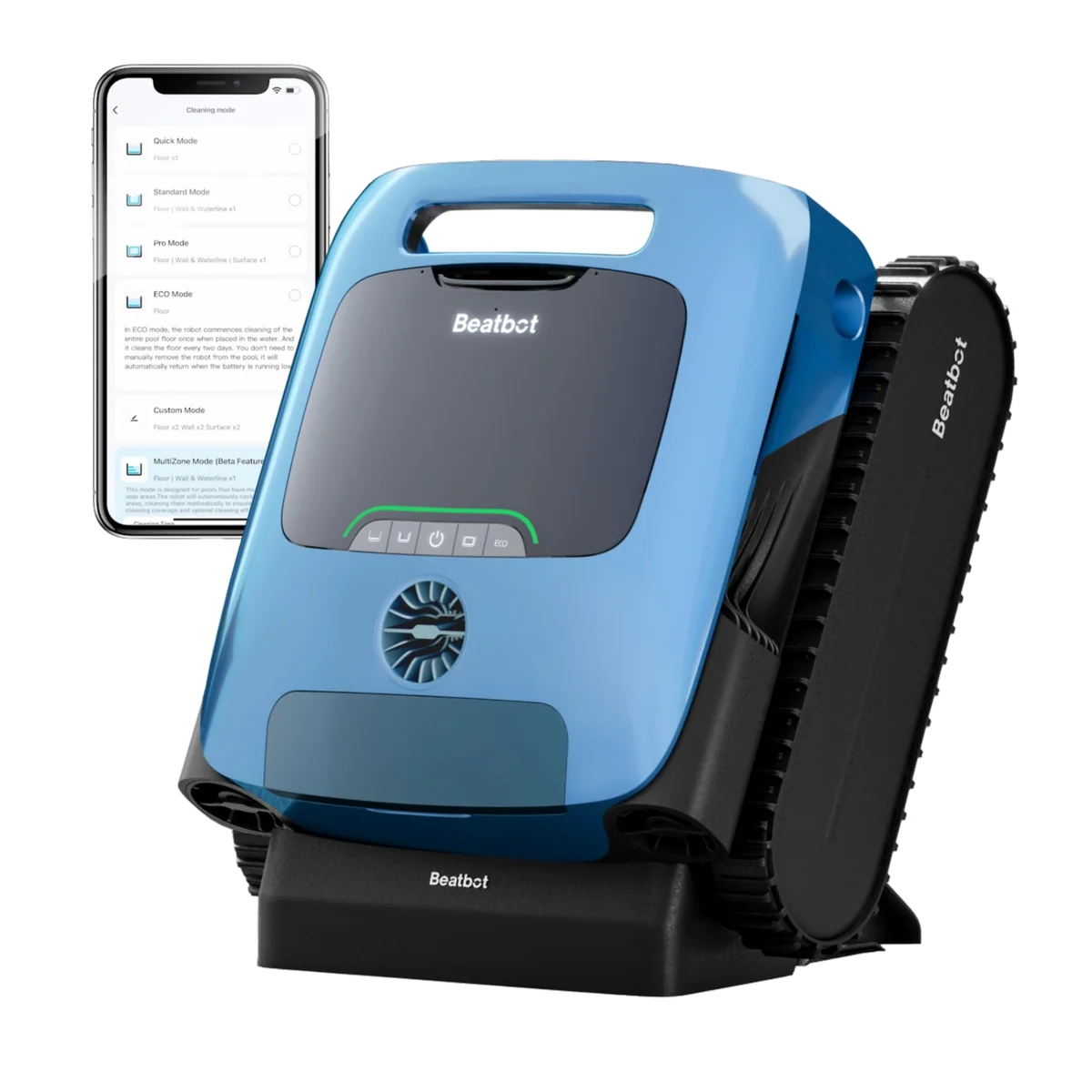
Skip the Beatbot A100 Pro unless eliminating the deck cable matters more to you than dependable surface skimming, light handling, and proven long-term durability.
Who should still consider it
The best candidate has a large, mostly open pool; dislikes or cannot use a deck cable; wants long cordless cycles; cares most about routine floor, wall, and waterline maintenance; and is comfortable lifting a heavy wet cleaner onto a manual charging stand. A favorable return policy and clear warranty route matter because the durability record includes both satisfied multi-season owners and early replacement cases.
The wrong candidate expects one machine to skim continuously, clean curved stairs and a six-inch shelf, report live progress under water, retrieve and charge itself, or eliminate manual brushing. Owners with a bad back should assess the full wet lift rather than relying on the surface-parking promise alone.
The Beatbot A100 Pro is a capable cordless underwater cleaner carrying several extras that sound more complete than they perform, so the default answer remains no unless freedom from a power cable is the feature you value above everything else.
Before judging the cleaner, identify what is actually being sold. Amazon calls the product the Beatbot 92055 A100 Pro but places “HTH” in the brand field, while Beatbot lists the A100 Pro as a retail edition and an offline exclusive. Its specifications closely resemble the original AquaSense Pro platform, yet Beatbot maintains the two labels separately, so findings from that better-documented sibling are useful context rather than proof that every component and firmware behavior is identical.
The bargain it asks you to make
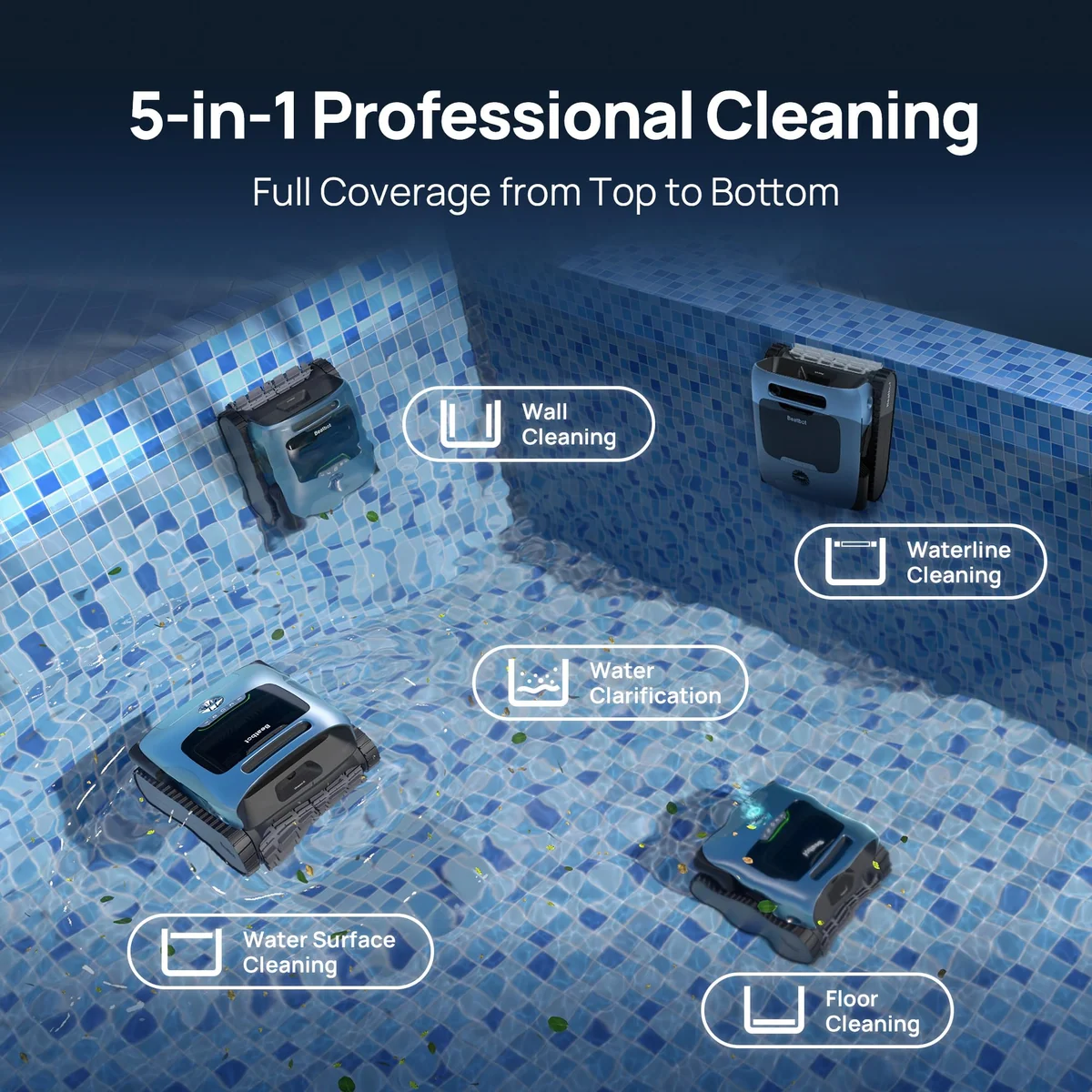
The A100 Pro tries to collapse an entire equipment pad into one cordless machine. It vacuums the floor, climbs walls, scrubs the waterline, patrols the surface, and can dispense a separate clarifying product. The appeal is obvious: no power cable across the deck, no hose attached to the pool system, and no second surface robot waiting for its turn.
That promise is larger than the dependable result. The best-supported part of the design is conventional underwater cleaning, particularly on open floor and wall areas. Surface collection is far less convincing, steps and shallow shelves remain troublesome, and the app becomes mostly a setup and reporting tool once the cleaner is submerged. “Five in one” accurately counts modes; it does not establish that all five can replace dedicated equipment.
The exact-model record is also too divided to excuse those compromises. One retained Amazon owner praised floor, wall, tile-line, and surface cleaning, with particular appreciation for end-of-cycle surface parking. The other said the cleaner initially worked well but stopped retaining debris after a few months and became difficult to resolve through support. Two written reviews do not form a stable consensus, but the failure described by the dissatisfied owner strikes directly at the machine’s central job.
Smart Pool Bots would consider the A100 Pro only for a buyer who has already decided that cordless operation is non-negotiable and whose pool is dominated by broad, accessible surfaces. Anyone primarily paying for the surface-skimming claim, a useful underwater remote, or automatic whole-week ownership should walk away.
Key Specifications
The battery is the star, not the app
Battery capacity is the strongest argument for the design. PCWorld completed a custom AquaSense Pro routine with two passes each over the floor, walls, and surface in more than seven hours, although another run ended after the robot became trapped on a horizontal railing at 88 minutes. The long maximum should not be treated as a universal multi-zone cycle: Beatbot’s own model material ties the original AquaSense Pro’s 9.5-hour figure specifically to surface cleaning, while Amazon’s A100 Pro wording implies broader use.
The charging arrangement is tidy but less autonomous than “wireless charging” sounds. The owner retrieves the machine, lets it drain, empties and rinses the basket, carries the robot to an inclined stand, and places its contacts on the dock. It does not climb out of the pool or drive itself to the charger.
Smart control stops at the waterline
The app is useful on deck for selecting modes and creating custom combinations before a run. On the closely related AquaSense Pro, physical controls exposed only a smaller set of choices, while the updated app allowed zero, one, or two passes for floor, wall, and surface tasks. That is genuine flexibility, especially for a pool that needs extra floor work without another full routine.
Once the robot is under water, normal Wi-Fi and Bluetooth communication disappears. Reviewers could not rely on live progress, steering, cancellation, or a command to surface, and any cleaning history had to synchronize after the robot reconnected. Treat the app as pre-run configuration and post-run reporting, not as an underwater remote control.
Surface parking helps, but the lift is still substantial
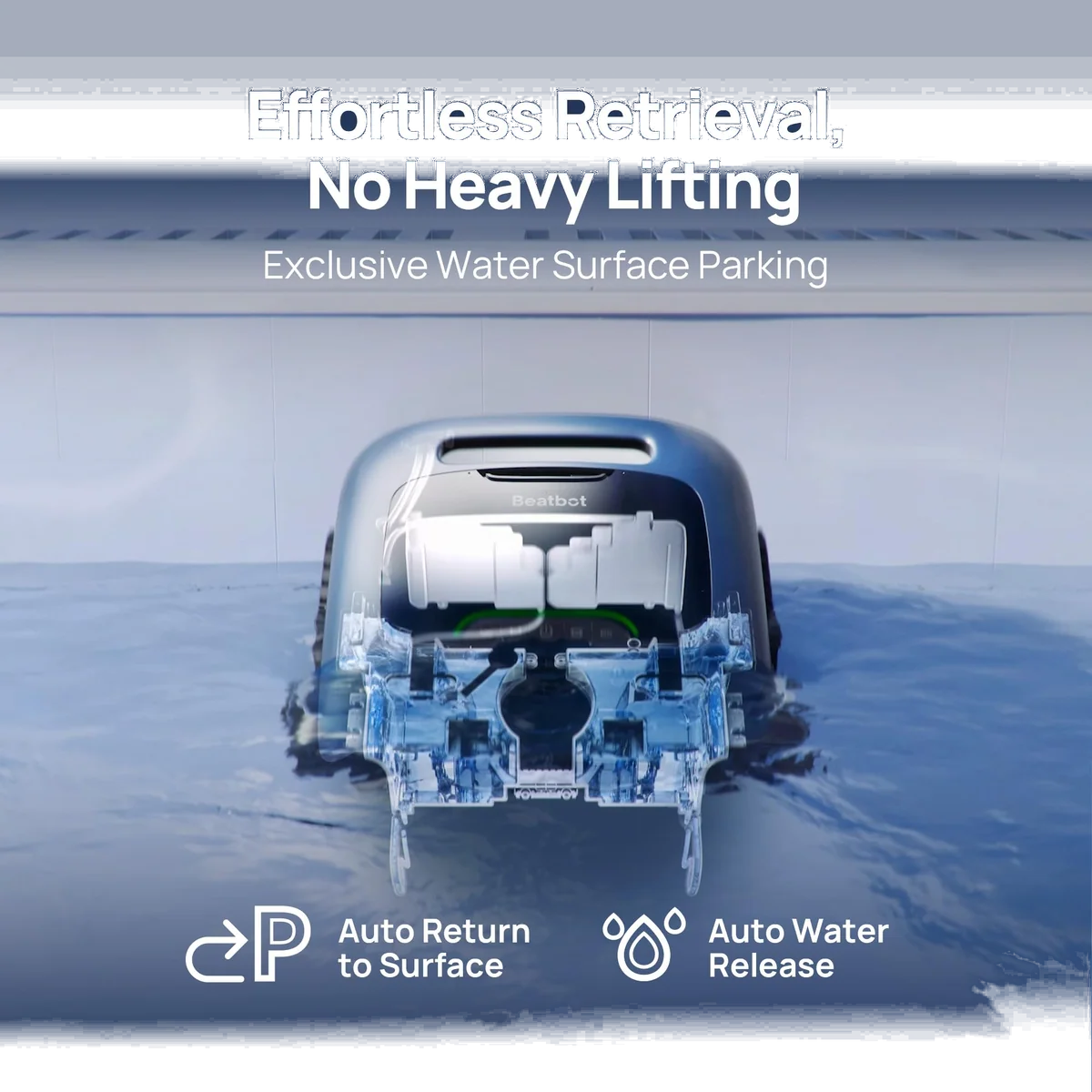
The closest tested platform weighs about 24 pounds dry, before retained water and debris complicate the lift. An exact A100 Pro owner with chronic lower-back pain found surface parking much easier than retrieving a cleaner from the pool floor, which is a meaningful accessibility benefit. Yet other runs did not end at the surface as expected, and a surfaced robot can eventually sink again if left until its battery is depleted.
Buyers with limited grip, shoulder strength, balance, or back tolerance should not confuse easier access with a light machine. The critical motion is still lifting a large wet object over the coping, allowing it to drain without losing control, and carrying it to the charging stand.
Strengths & Limitations
Strengths
- Open-floor, wall, and waterline cleaning are the strongest and best-supported parts of the platform.
- The large battery can support unusually long custom routines when navigation and obstacles cooperate.
- Cordless operation removes the deck cable and avoids dependence on the pool’s pump or pressure line.
- Surface parking can spare the owner from fishing the cleaner off the deep floor.
- The nested basket can capture leaves, visible grit, and fine sand under favorable conditions.
Limitations
- Surface skimming is too situational to replace a dedicated pool skimmer.
- Steps, curved corners, coves, and shallow tanning shelves remain unreliable cleaning zones.
- The app cannot provide dependable live control while the robot is submerged.
- A roughly 24-pound dry platform remains a demanding wet lift despite surface parking.
- Repeated saltwater reports identify corrosion at the exposed charging contacts.
- Exact-model accounts include debris-retention failure after months and replacement by the next season.
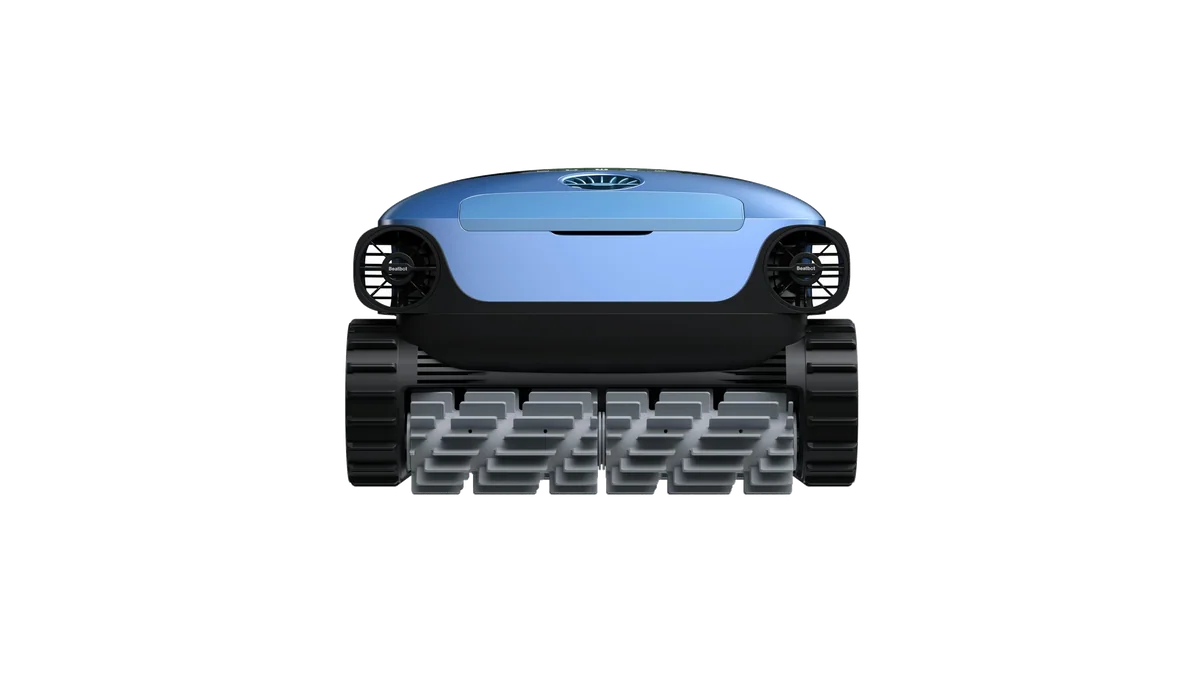
Strong under water, ordinary at the surface
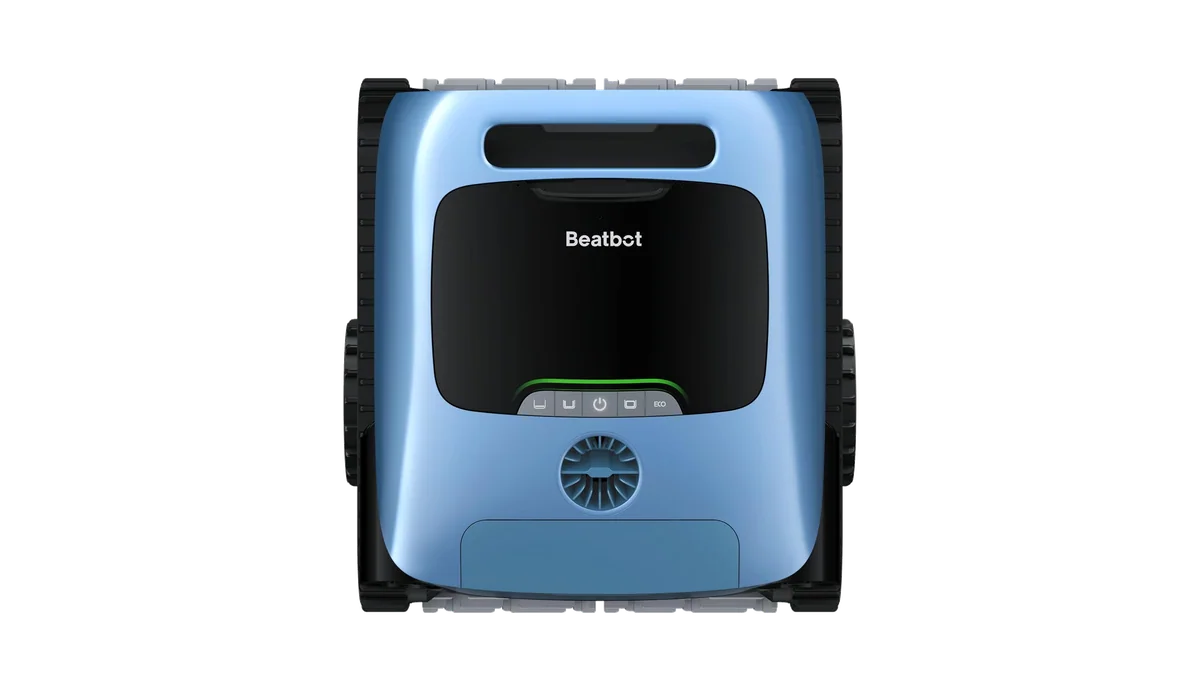
The original AquaSense Pro is the closest well-documented platform in the supplied evidence, with the same nine-motor description, 200-watt motor rating, 5,500 GPH claim, 10,400 mAh battery class, nested filtration, and five-zone concept. Its testing therefore shows what this design family can do, but exact A100 Pro performance can still vary with retail hardware, firmware, basket condition, pool surface, and geometry.
| Zone | Evidence-led expectation | Likely manual work |
|---|---|---|
| Open floor | Usually the strongest result, including leaves and visible sand | Brush or vacuum the finest dust, missed patches, and debris released during retrieval |
| Walls and waterline | Generally capable on accessible vertical surfaces | Check curved transitions, rails, and areas where the robot cannot establish grip |
| Steps and shelves | Inconsistent, with occasional success on broad benches or toe ledges | Expect to brush curved steps, corners, narrow ledges, and very shallow shelves |
| Surface | Can collect material directly in its path but does not skim consistently | Keep the pool’s wall skimmers working or use a dedicated surface robot |
| Water clarification | An optional consumable-based supplement rather than filtration proof | Continue normal water testing, circulation, filtration, and chemical care |
The floor-cleaning case is real
In PCWorld’s updated AquaSense Pro test, only about 3 to 5 percent of the synthetic leaves placed on the floor remained, while the nested filter collected very fine sand and dirt. Owners of the same platform also reported good pickup of paver sand and windblown grit. That does not make the 150-micron basket a polishing filter: other owners still needed a manual vacuum after fine-dust events, and results deteriorated when debris was expelled or the machine skipped an area.
The practical distinction is particle size. Visible sand can be coarse enough for the basket even when finer silt passes through or remains in textured surfaces and corners. Buyers choosing specifically for sand, pollen, or fine dust should read our guide to cleaners designed around fine-debris pickup rather than assuming that “ultra-fine” marketing settles the matter.
The skimmer is the weak link
PCWorld’s surface test produced a revealing split: the AquaSense Pro collected about 40 percent of the leaves, pushed another 40 percent toward the pool’s built-in wall skimmers, and allowed the remaining 20 percent to sink. Floating material tended to move around the robot unless it approached close to the center of the intake. Owners described the same wake effect, although a minority were pleased with what the surface mode caught.
Surface mode can reduce hand-skimming on a favorable day, but it is not a dependable substitute for continuous collection. Pools under trees, beside flowering plants, or used by shedding dogs are better served by a dedicated machine from our robotic pool skimmer guide, leaving the underwater cleaner to work where this Beatbot platform is strongest.
Pool shape matters more than the word “AI”
One long-term owner reported successful travel over a toe ledge before the cleaner climbed the wall and reached the waterline, while another said it handled a submerged bench. Those successes did not extend to every feature: curved steps retained dirt, a six-inch tanning shelf was too shallow, and floor-to-wall coves sometimes needed brushing so debris would fall onto the flat floor.
Mapping deserves equal skepticism. Some free-form pools ended up clean even when no useful map appeared, while other owners saw strange classifications, repeated tracks, and large missed areas. PCWorld found that later software improved configuration and cleaning records, but the map feature that had failed in the earlier app was removed rather than repaired. A structured-looking path is not the same thing as an accurate, visible pool map.
Five jobs on paper do not equal five replacements
The A100 Pro earns value from cord-free deployment, strong battery reserves, competent open-floor pickup, and useful wall and waterline work. It loses value when surface mode is treated as a dedicated skimmer, clarification is treated as a replacement for normal water care, or the app is treated as a live underwater controller. Those are not peripheral disappointments; they are the extra capabilities used to distinguish this machine from simpler pool vacuums.
It is also a maintenance cleaner, not a rescue crew for a neglected seasonal opening. In Lifehacker’s difficult murky-pool attempt, the AquaSense Pro failed to return and remained on the bottom for ten days, even though it still held 65 percent charge when recovered. Once the pool was already relatively clear, a nearly three-hour floor pass removed roughly 85 percent of visible dirt but left obvious deposits on steps and in corners.
Buyers attracted to the A100 Pro because it resembles a higher-end Beatbot should compare the actual distinctions in our A100 Pro and AquaSense 2 Pro comparison. Anyone still committed to this brand can also see which feature sets earn their place in our Beatbot pool-cleaner guide.
The narrower alternative is often the more honest one. A conventional underwater robot paired with a dedicated skimmer gives each machine one clear job, while a corded cleaner trades the charging routine for a deck cable and constant power. Smart Pool Bots would choose the A100 Pro only when that cable is the deal-breaker and the buyer accepts that stairs, shallow ledges, fine dust, and much of the floating debris may still need another tool.
The ownership risk arrives at the charging contacts
Saltwater owners supplied the most specific recurring hardware warning. One AquaSense Pro developed corrosion around its charging sensors after a summer; another showed rust on the left charging prong after roughly a month, then repeated the same problem after only four carefully dried uses of the replacement. Both owners eventually received replacement machines, but recurrence on the second unit makes the visible contacts worth inspecting after every rinse and before every charge.
Exact A100 and A100 Pro longevity reports do not support a confident lifespan estimate. One owner reported two years without trouble, another had an A100 stop after a couple of years and receive a replacement, an A100 Pro bought in April 2025 declined by the following season, and the retained Amazon failure appeared after only a few months. This is not enough evidence to calculate failure rates; it is enough to reject any assumption that a premium feature list guarantees premium durability.
Support can be generous after it becomes responsive
Recent exact-model reports include successful motor diagnosis, prepaid returns, and complete replacement units, sometimes delivered quickly. Other owners encountered time-zone delays, repeated requests for videos, difficult return communication, or first-line representatives who could not answer basic operating questions. Lifehacker made nine business-hours calls and reached voicemail on seven of them. The defensible conclusion is not that support is uniformly bad or excellent, but that replacement outcomes can be strong while access and troubleshooting remain inconsistent.
The basket needs more than a quick glance
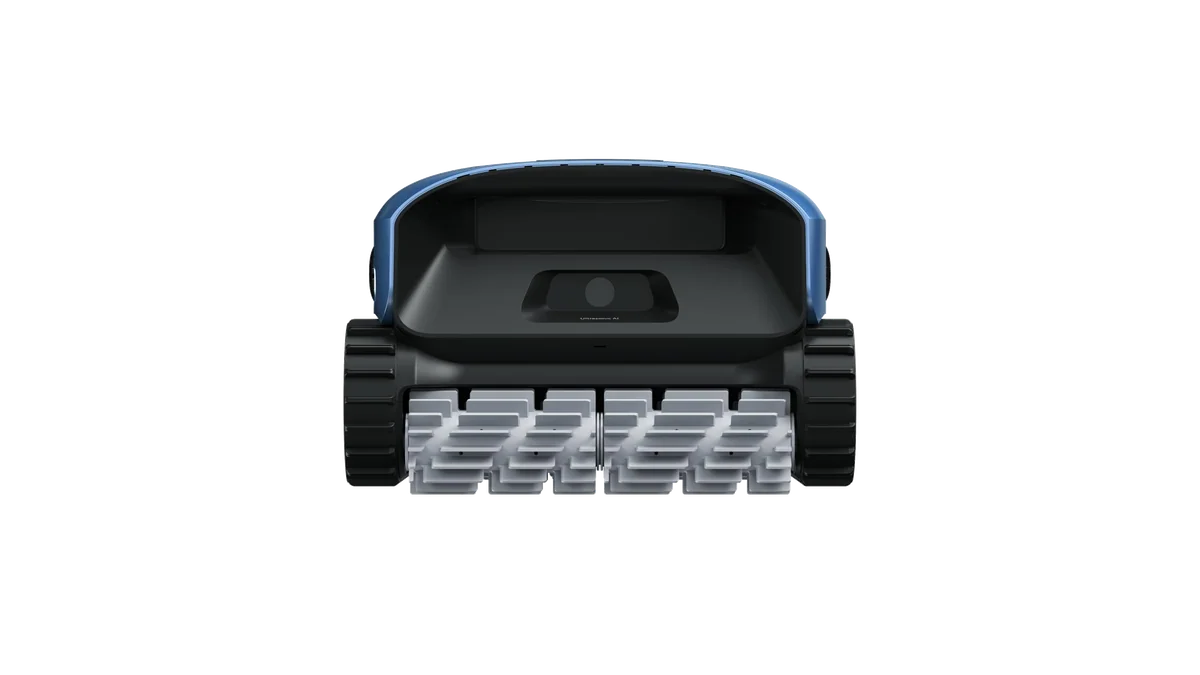
The nested filter can retain leaves and visible sand, but its crevices can hold stubborn material and a heavy leaf load may clog it. Rinse both sections after each cycle, inspect the basket seating before the next run, and do not assume the standard 150-micron mesh is equivalent to a much finer pleated filter. Routine care is still part of cordless ownership, as our pool-cleaner maintenance guide explains.
Frequently Asked Questions
Does the A100 Pro clean walls and the waterline?
It is generally capable on accessible walls and the waterline, although curved transitions, rails, and awkward geometry can interrupt coverage.
Can it replace a dedicated surface skimmer?
It can collect debris that reaches the center of its intake, but the evidence does not support relying on it for consistent continuous surface cleaning.
Can the app control the robot under water?
The app is primarily for setup before submersion and records after reconnection because normal Wi-Fi and Bluetooth control is lost under water.
Does it always return to the surface?
Surface parking worked and reduced retrieval strain for some owners, but failed or delayed returns mean a pole may still be necessary.
Is it a good choice for someone with back pain?
Surface parking avoids lifting from the pool floor, but the closely matching platform weighs about 24 pounds dry and becomes harder to handle when wet.
Will it clean steps and shallow tanning ledges?
Broad submerged benches or toe ledges may be possible, but curved steps, corners, and a six-inch shelf remained problem areas in owner reports.
What should I check if the cleaner stops charging?
Inspect the visible charging contacts for corrosion, dry the unit before docking, document the fault, retain the shipping box, and contact Beatbot without attempting electrical repair.
Where is the Beatbot A100 Pro manufactured?
The available listing and brand records do not establish a manufacturing country, so the location should not be inferred from a sales or contact address.