Yes, Robotic Pool Cleaners Are Worth It for Most Routine Cleaning
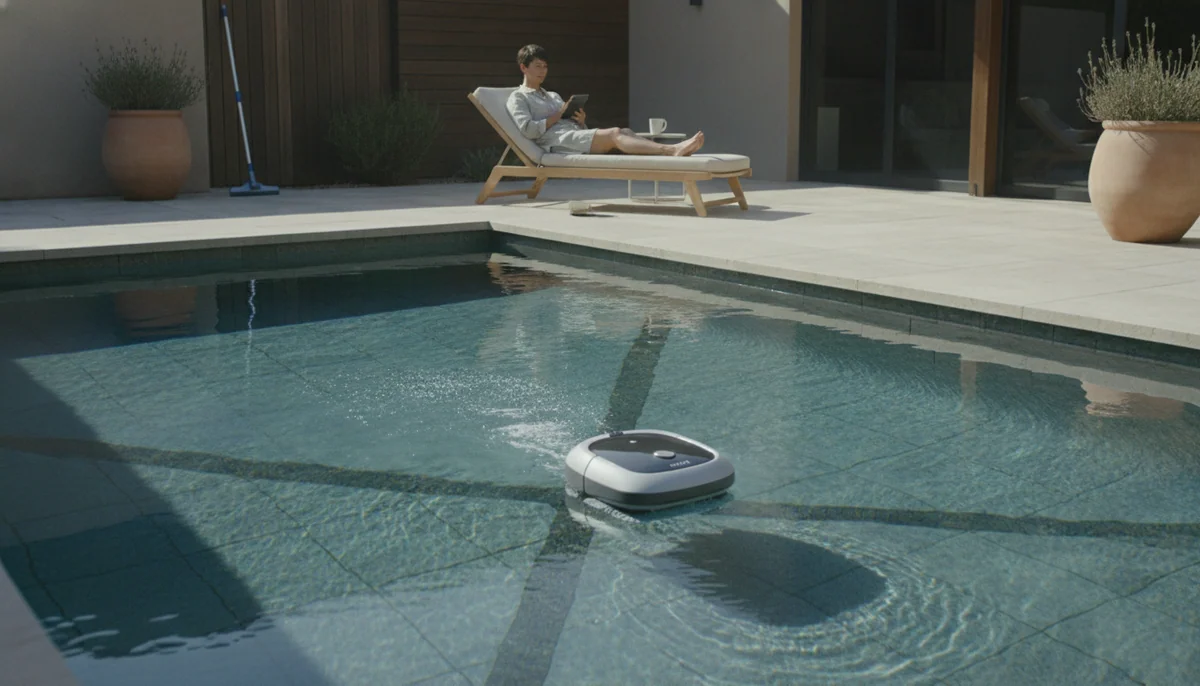
They really do collect debris. The strongest models remove most routine leaves, bugs, grass, hair, sand, and settled dirt while nobody guides a vacuum head from the deck. More capable machines climb suitable walls and scrub parts of the waterline. Floating skimmer robots can patrol the surface before that debris sinks.
The honest promise is less pool work, not no pool work. A robot does not test chemistry, dose sanitizer, cure algae, empty its own basket, clean the main filter, or guarantee every step and shelf. It is an autonomous cleaning cycle, not an autonomous pool.
One controlled comparison captures the category unusually well: an updated Aiper Scuba S1 covered 99% of the test floor, 86% of the walls, and 62% of the stairs and bench area, while the camera-equipped Scuba V3 found every staged leaf in eight minutes but managed only 10% of the stairs and bench area. The machines worked, yet neither made pool geometry disappear.
Buy
Routine floor vacuuming or surface netting consumes real time, most of the pool is open, and a little brushing around the edges sounds fair.
Walk away
The pool is dominated by narrow steps, shallow shelves, wrinkles, raised drains, attached algae, or debris light enough to handle with a net in five minutes.
Smart Pool Bots did not operate these machines; this verdict comes from exact-model owner records, independent comparisons, demonstrations, listings, and the disagreements between them.
The floor is where the promise holds
Open floor is the category’s home field. A plain rectangle, oval, or round pool gives the robot room to repeat passes until the intake has crossed most of the dirt. The route may look aimless from a deck chair, but elegance is not the result that matters. A clean floor and retained debris are.
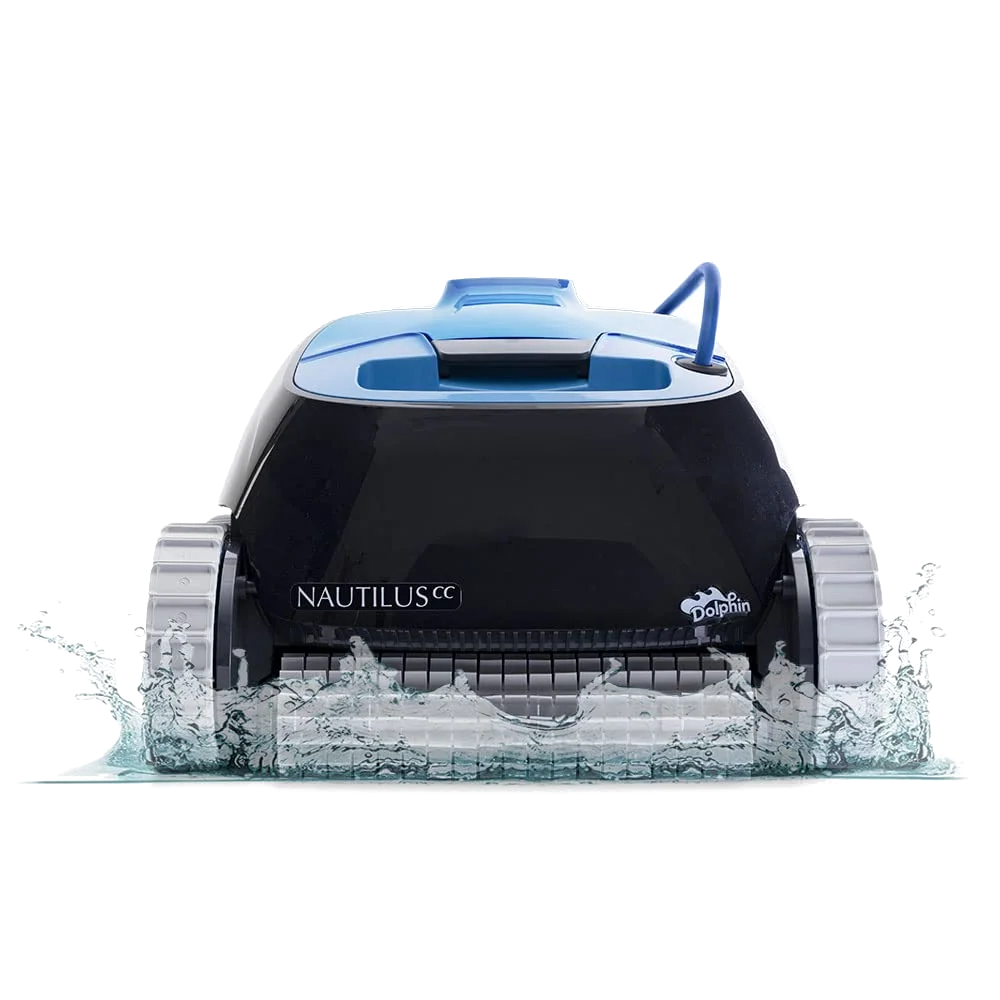
A Dolphin Nautilus CC owner estimated that a straightforward fiberglass pool was about 98% clean after its roughly two-hour cycle, with the remaining dirt concentrated in square corners and along wall bases. Other exact-model accounts describe leaves, acorns, sand, bugs, and pale silt reaching the top-load basket. The same record also contains early failure and cable complaints, so this is evidence of useful cleaning rather than a promise of universal durability.
A much simpler PoolMr floor robot supplies an even clearer definition of value. In one 24-foot pool, repeated passes initially scattered some material but eventually left the floor clean enough that the owner did not use the hose vacuum for almost two months. The robot occasionally needed help behind the ladder, and it still had to be retrieved and rinsed after each cycle. That is imperfect automation doing a meaningful job.
This is the standard to use: does the robot remove enough recurring labor that its missed patches become touch-ups rather than the main event? A machine that clears the open floor and leaves two corners can be worthwhile. A machine that leaves the steps, ledge, curved spa, deep-end transition, and half the floor has merely changed the shape of the chore.
A clean basket proves pickup, not complete cleaning
Cleaning performance is a chain. The robot must reach the dirty area, loosen the material, pull it through the intake, retain it in the filter, and keep it there during reversal and retrieval. Break any link and a large motor number becomes decoration.
| What bothers you | Best robotic assignment | What remains yours |
|---|---|---|
| Settled leaves, bugs, grit, and ordinary dirt | Underwater floor vacuum with enough inlet and basket capacity | Storm piles, trapped corners, and basket rinsing |
| Sand and visible fine dirt | Underwater cleaner with appropriately fine, well-seated media | Watching for bypass, clogging, and material that resettles |
| Powdery silt, pollen, or dead algae | Fine-media follow-up pass after proper water treatment | Chemistry, brushing, circulation, and the main filtration system |
| Floating leaves, blossoms, insects, and pet hair | Dedicated robotic surface skimmer | Emptying the basket and freeing it from pool-specific traps |
| Attached algae, scale, or a neglected opening | No robot as the primary solution | Treatment, brushing, filtration, netting, and targeted vacuuming |
Suction and filtration are not synonyms. A coarse basket may swallow a leaf and pass powdery sediment straight back into the water. A fine insert can catch smaller particles, but it also loads faster, restricts flow, takes longer to rinse, and may weaken climbing when dirty. For a leaf-heavy pool, the sensible routine is often a coarse pass first and a fine-media pass after the large load is gone.
The same restraint applies to algae. A robot can collect loosened or dead material after the water has been treated, especially when suitable fine media is installed. It cannot correct the sanitizer, circulation, or filtration problem that allowed growth, and a budget robot with stationary brushes will not scrub attached algae into submission. Our guide to what pool robots can actually retain separates leaves, sand, silt, pollen, and algae residue in more detail.
A vacuum and a skimmer are different purchases
An underwater robot cleans after debris reaches the floor. A surface robot tries to intercept it first. Buying one and expecting the other is an expensive way to conclude that robotics do not work.
If the floor is dirty and only one machine fits the budget, buy the underwater cleaner first. Manually netting a few floating leaves is usually easier than guiding a vacuum over the whole floor. A surface skimmer makes its strongest case as a second robot in an open, sunny pool where pollen, dog hair, insects, blossoms, or leaves arrive throughout the day.
The Betta SE demonstrates why that second machine can be worthwhile: the retained evidence includes pools where continuous pickup replaced long daily netting sessions, including a dog-owning household that had been spending at least an hour dealing with fur after swims. Its drawback is equally plain. It does not touch settled floor dirt, and shade, cloudy weather, skimmer openings, shallow features, or another cleaner’s cord can interrupt its patrol.
The AIPER EcoSurfer S2 shows why “the surface looks clear” is not the same as “everything was captured.” In one staged test, the water looked clear after about three and a half hours, but roughly 80% of the placed debris was in the basket; most of the rest had sunk. That is useful maintenance, not magical disappearance.
For cloudy climates or shaded yards, the Betta SE Plus is the more defensible Betta because adapter charging backs up its solar panel, but its random route, geometry traps, and surface-only scope remain the honest drawbacks. Owners still have to remove it for wired charging, empty its basket, and occasionally rescue it from a built-in skimmer or shelf.
If the distinction still feels slippery, the full robotic skimmer versus pool vacuum guide starts with the debris rather than the product label.
Your pool’s shape is the real specification sheet
Manufacturers like square-foot ceilings because the number is tidy. Pools are not. Cable reach, depth, slopes, drain covers, ladder feet, liner wrinkles, safety ledges, compound curves, shelves, and the transition from shallow to deep can all reduce practical coverage long before the advertised area is reached.
Conventional floor and wall transitions are the safe assignment. Narrow steps, upper treads, benches, tanning ledges, beach entries, and circular spas are not. A robot can genuinely climb a wall and still be poor at steps because climbing requires continuous track contact, while a narrow tread can support the middle of the chassis and leave the tracks spinning in open water.
The Beatbot Sora 30 is one of the few products with credible evidence on a broad submerged shelf: a direct demonstration showed it climbing onto and remaining on a Baja shelf around 14 inches deep. That makes it a rational specialist purchase when the shelf is a major part of the pool. The drawback is that the result depends on depth, width, approach angle, and room around fittings, while its standard filter is aimed at visible debris rather than the finest polishing job.
For that specific geometry, the Sora 30 earns its premium more convincingly than it does in a plain rectangle. For ordinary steps and ledges, assume some brushing remains unless exact-model evidence shows success on a feature shaped like yours. The broader guide to walls, steps, ledges, drains, slopes, and waterlines explains why those claims are not interchangeable.
Automatic, smart, and self-parking need translation
- Automatic
- The robot propels itself through a selected cycle after a person prepares and launches it.
- Smart navigation
- Sensors and programmed paths influence movement, but the phrase does not prove a saved map, memory, learning, or knowledge of which dirt remains.
- Self-parking
- Many cordless models simply stop near a wall on the bottom, where the owner still reaches down with a hook and lifts them out.
- Surface parking
- The machine rises or waits near an edge for retrieval, which is useful but does not mean it skims floating debris, climbs onto the deck, or recharges itself.
- App control
- The app commonly handles setup, modes, battery information, firmware, schedules, and post-cycle records while normal Wi-Fi and Bluetooth communication disappear underwater.
App control is therefore less like driving a remote-control submarine and more like programming an appliance before closing the door. Underwater steering, live battery data, mid-cycle mode changes, and recall should not be assumed unless the exact machine uses a proven alternative communication system.
Cordless schedules deserve particular skepticism. A weekly plan may divide one stored charge into several short maintenance sessions. It does not create a week of full-length runs, empty the basket, dry the charging contacts, or recharge the robot underwater.
Cordless removes the cable, not the ownership routine
| Power type | What it removes | What it adds |
|---|---|---|
| Corded | Charging delays and dependence on a sealed traction battery | Cable reach, twists, transformer placement, outlet planning, and cord storage |
| Cordless | The operating cable, deck-side power supply, and tangles during the cycle | Wet lifting, contact drying, recharge delays, battery aging, and possible sealed-component replacement |
| Solar skimmer | Routine plug-in charging when sun and battery conditions cooperate | Dependence on sunlight, clean panels, basket capacity, pool geometry, and healthy propulsion hardware |
Cordless can feel dramatically easier during deployment. It can also be the worse weekly routine for someone who dislikes lifting a water-filled machine, waiting for another charge, or drying a recessed port. The updated Scuba S1 weighed about 39 pounds at the first water-filled lift in one comparison and about 20 pounds after draining. Dry weight is not the weight your shoulder encounters first.
Corded cleaners answer with immediate repeat cycles and no aging traction battery, but the cable, controller, outlet position, and storage routine become part of ownership. There is no universally more convenient architecture. Our corded and cordless comparison is the better next read if the cleaning job is settled and the handling routine is not.
The second season decides whether the first clean was worth it
A basket full of leaves on day one proves cleaning ability. It says nothing about the battery, charger, cable, seals, motors, tracks, latches, or support channel after the marketplace return window closes.
The Dolphin Nautilus CC has a comparatively tangible repair story. Exact-model owners and repair demonstrations document replaceable tracks, brushes, wheels, cable components, and filter panels, including movement restored through a small wheel repair rather than whole-machine replacement. That does not guarantee inexpensive service, but it is materially better than a sealed product whose battery failure has no published consumer route.
Cheap cordless units can still be good buys when the pool is simple and expectations are narrow. The risk is that a convincing first summer becomes an unchargeable second spring. Exact AIPER Seagull SE accounts include failures within days or months, battery decline, and replacement experiences that sometimes ended with a different model. Good customer recovery deserves credit, but it does not turn the original failure into product success.
The Vidapool solar skimmer is the clearest reason to keep “works” separate from “worth it.” It can collect leaves, pollen, bugs, blossoms, and dog hair, yet five of eight retained exact-listing reviews described material failures within roughly one to four months across the basket mesh, solar contacts, paddles, structural plastic, or power system. Smart Pool Bots’ verdict is to skip the Vidapool skimmer because demonstrated pickup does not compensate for that ownership record and weak parts support.
Before paying, ask who administers the warranty, whether outbound freight is covered, whether the seller is authorized, and whether the exact battery, charger, filters, brushes, tracks, wheels, motors, or cable can be purchased. A long warranty headline has limited value when nobody identifies the warrantor or supplies the part that failed.
The sensible shortlist is built around missing work
- For a conventional pool and a straightforward floor-first routine
- The Dolphin Nautilus CC is a defensible default because it has credible ordinary-debris pickup, a manageable top basket, active brushing, and a more visible parts path; its cable, weak step coverage, incomplete corners, and lack of sustained horizontal waterline travel are the price of that simplicity.
- For a simple above-ground pool that only needs its floor cleaned
- The Dolphin E10 can be worth buying for its narrow job because its active brush and short floor cycle remove routine debris without pretending to clean walls; its cord can tangle, far-edge reach can be marginal near the stated pool limit, and the current record includes lid, latch, and early service complaints.
- For cordless cleaning where fine settled debris matters
- The updated Aiper Scuba S1 is one of the stronger candidates because its fine insert and measured open-floor coverage address a real cleaning problem; its wet retrieval weight, incomplete steps and shelves, route variability, and mixed warranty experiences keep it conditional.
- For a broad submerged tanning ledge
- The Beatbot Sora 30 is the specialist worth examining because its shallow-platform evidence is unusually specific; narrow steps, insufficient water depth, fine sediment, app friction, and a still-short durability record remain meaningful drawbacks.
- For relentless floating debris
- The Betta SE Plus is the stronger second-machine case because solar patrol and adapter backup can reduce repetitive netting; it cannot vacuum the floor, its route is persistent rather than mapped, and shade, currents, shelves, cords, or a wall skimmer can still trap it.
Buyers who want a broader market view can move to the best robotic pool cleaners roundup, while pool-specific shortlists cover in-ground pools, above-ground pools, and cordless models. Choose the job first, then the machine.
Use the return window before it uses you
- Confirm the exact model, seller, written warranty, battery coverage, return freight, and wet-product return rules before submersion.
- Charge it fully and test every physical control, mode, indicator, filter, accessory, and app feature during the first few days.
- Place recognizable debris in the shallow end, deep end, corners, wall seams, and beside the main drain so motion cannot be mistaken for cleaning.
- Watch every step, shelf, ladder gap, drain cover, slope, and floor-to-wall transition from more than one approach angle.
- Check whether fine sediment remains in place, enters the filter, passes through it, or merely hangs in the water before settling again.
- Retrieve the robot from its least convenient stopping point and decide whether the wet lift is safe for the person who will actually do it.
- Inspect debris retention during reversal and lifting, then repeat the test with a partly loaded basket.
- Run several intended cycles before assuming that firmware, route learning, or another season will fix a persistent incompatibility.
- Keep the packaging, serial number, order record, listing copy, warranty terms, and support correspondence until the machine has proved itself.
After each dirty run, let the water drain, empty and rinse the basket, clear accessible hair and needles, dry charging contacts as required, and store the machine out of prolonged sun and chemical exposure. Leaving a robot submerged may save one retrieval today while shortening the useful life of cables, plastics, seals, or contacts. The maintenance guide turns that routine into a short checklist.
Buy the robot if a ten-minute launch and cleanup routine can replace the laborious middle of manual vacuuming or netting; keep your money if the machine’s missed geometry, charging ritual, wet weight, rescue missions, or uncertain repair path would simply become the new pool chore.
Frequently Asked Questions
Can a robotic cleaner remove leaves and sand from a pool?
Yes, when the robot reaches the debris and its intake and filter are suited to it, though oversized leaves and powdery sediment may still need a net, finer media, or another pass.
Will a pool robot eliminate manual vacuuming?
It can eliminate most routine vacuuming in a compatible, regularly maintained pool, but storm piles, tight corners, steps, shelves, and very fine residue can still require manual work.
Can one of these machines replace professional pool service?
No, because it cannot test or dose water, inspect equipment, diagnose circulation problems, repair failures, or perform every seasonal maintenance task.
Is a cordless cleaner always easier to own?
No, because removing the cable adds wet lifting, contact drying, recharge delays, battery aging, and uncertainty about eventual battery service.
Will a wall-climbing model clean every step and tanning ledge?
No, because narrow, shallow, curved, or abrupt features often prevent the tracks from maintaining enough contact even when the same robot climbs conventional walls well.
Can a robotic cleaner fix an algae problem?
No, although a capable brush and fine filter may collect loosened dead material after chemistry, circulation, and manual brushing have addressed the actual outbreak.
Sources (3)
- Amazon listings and customer reviews
- Owner and reviewer video, 5 channels
- Pcworld — Article — www.pcworld.com