The Vidapool solar skimmer cleans the surface, but its reliability is the dealbreaker
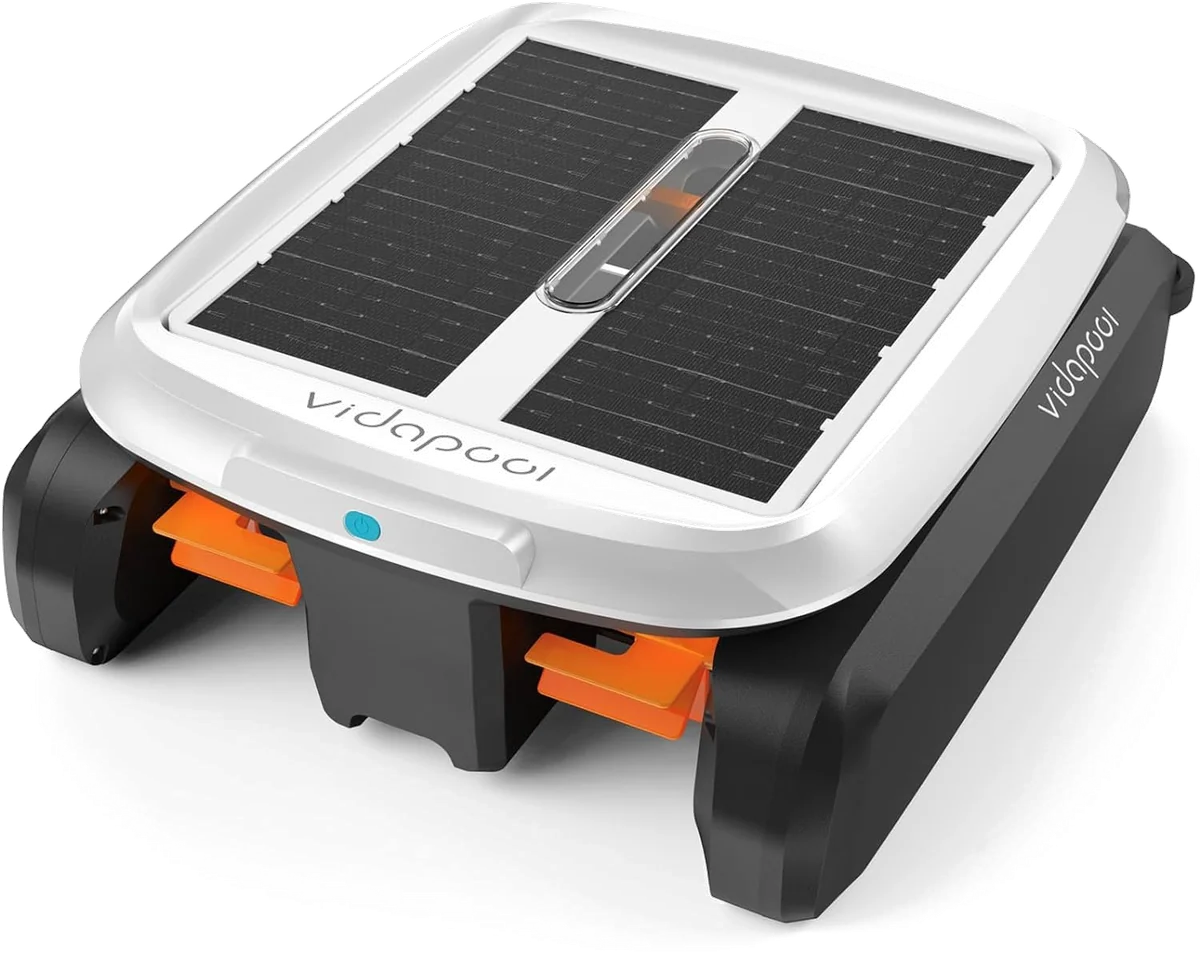
Skip the Vidapool VPSC01 unless a 10-liter basket matters more to you than quiet operation, charging flexibility and confidence that the machine can survive a season.
Final verdict
The Vidapool VPSC01 proves that a large solar skimmer can remove a meaningful amount of surface debris without cables, plumbing or an app. It also proves that basket capacity cannot compensate for an appliance that may become noisy, directionally confused, unchargeable or impossible to repair.
Most buyers should walk away. The exception is narrow: a buyer with abundant sun, heavy surface debris and an unusually strong need for a 10-liter basket who is comfortable gambling on durability and after-sales support. For everyone else, the more established alternatives cost less in uncertainty, which is the expense that matters after the first month.
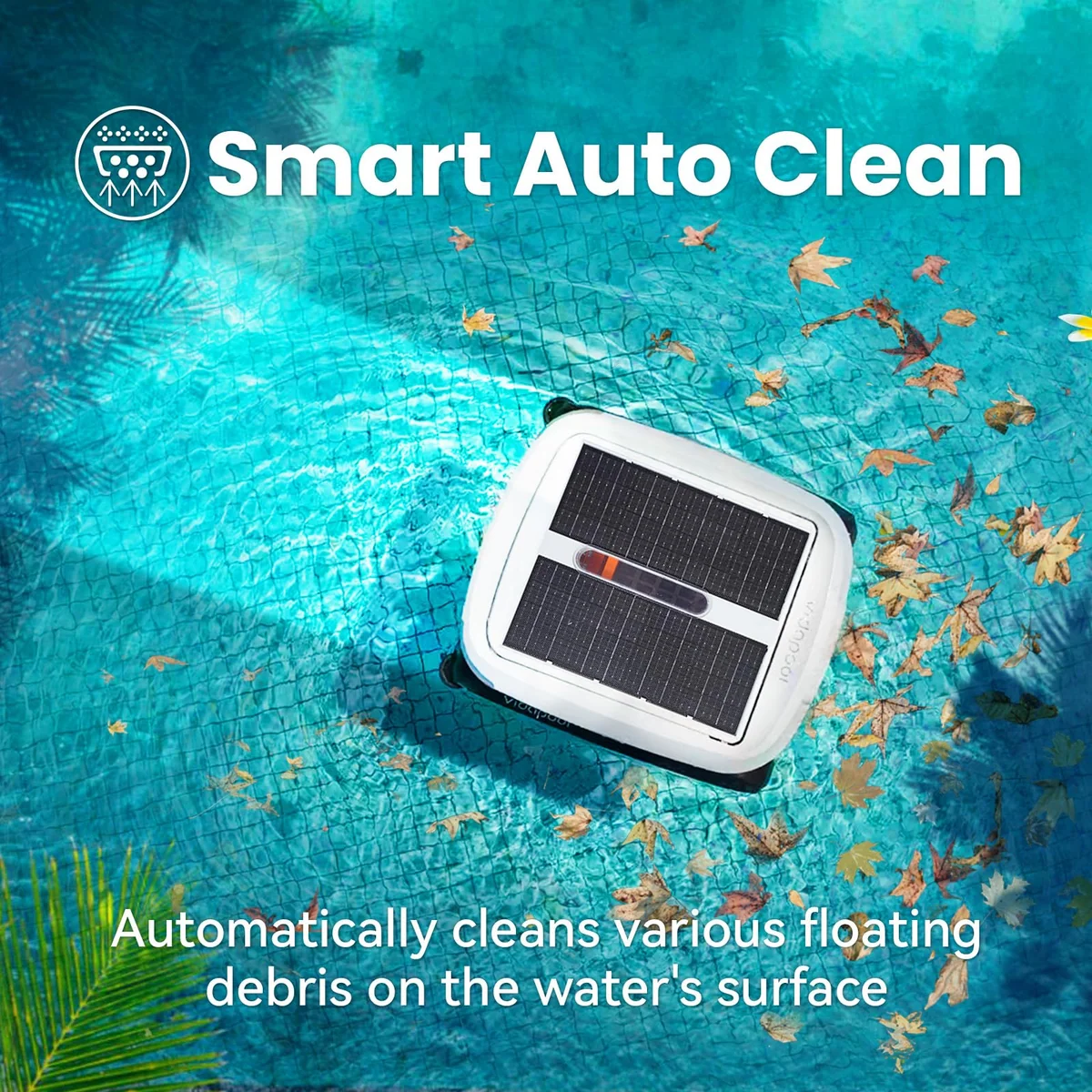
The Vidapool VPSC01 presents a persuasive little fantasy: place it on the water, let the sun pay the energy bill and stop chasing leaves with a net. The central idea works. Owners and filmed demonstrations show the skimmer gathering leaves, dog hair, pollen, bugs, blossoms and finer hair-like debris, while the oversized basket gives all of that material somewhere useful to go.
The trouble begins after the satisfying first basket. The captured Amazon listing stood at 2.9 stars from 63 ratings, and the retained exact-product reviews repeatedly move from “it cleans” to “it broke.” That distinction drives this review: surface pickup is not the same thing as dependable ownership.
A surface robot is most valuable when it works without supervision, particularly during pollen season, leaf fall or a trip away from home. One Vidapool owner bought it partly to keep the pool clear during a two-week vacation; the unit became completely unresponsive the day before departure, a little over a month after purchase, and a usable support route was nowhere in sight. A convenience appliance that cannot be trusted for the convenient part has missed the assignment.
Key Specifications
It skims the surface; it does not clean the pool
Vidapool calls this a robotic pool cleaner, but VPSC01 is more accurately understood as an automatic floating net. Its working territory is the top layer of water. Leaves and insects caught before they sink are its business; settled grit, algae, pool-floor dirt, walls, slopes, steps and the waterline are not. If that distinction is unfamiliar, our guide to robotic skimmers versus pool vacuums explains why many pools need both jobs covered.
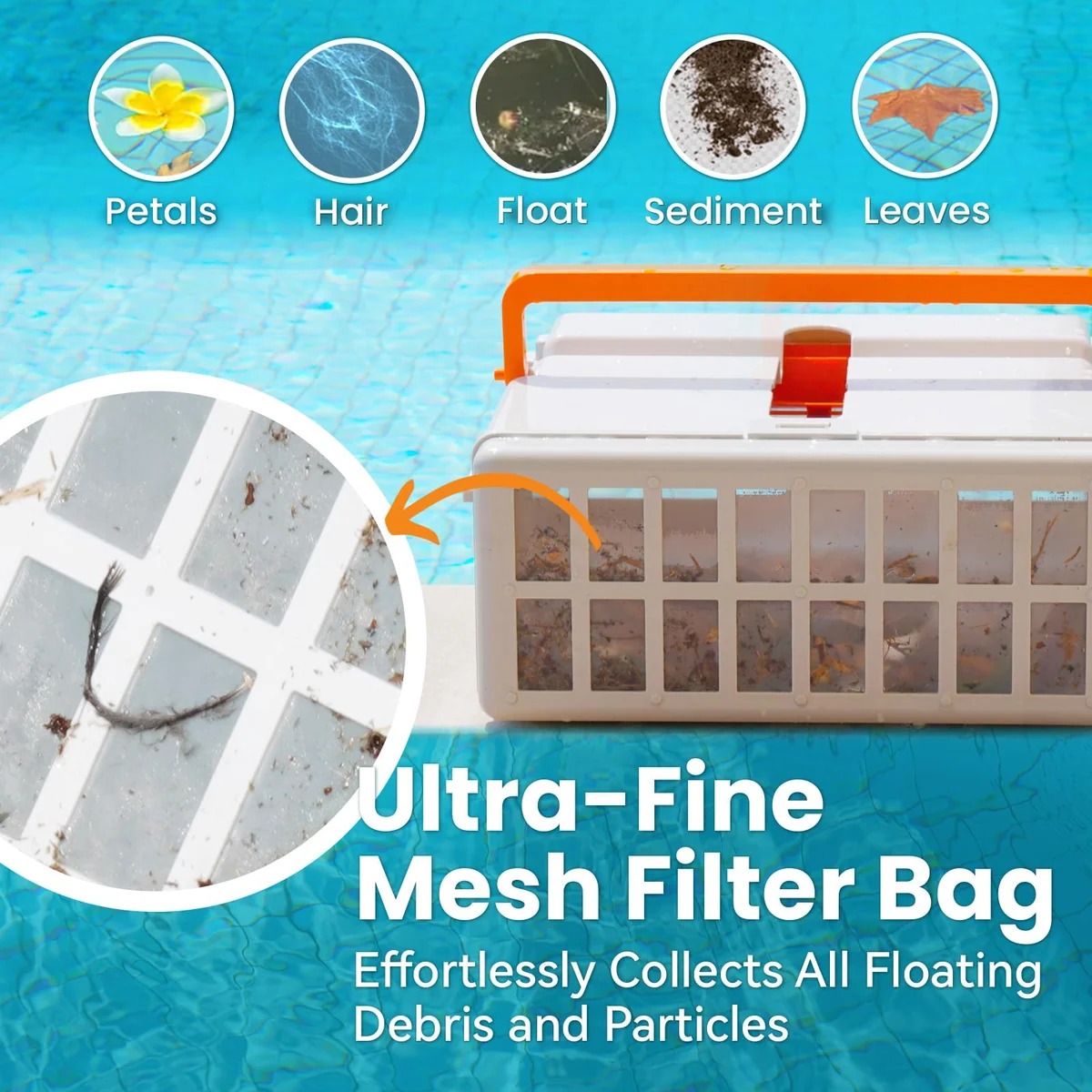
Within that narrow role, the Vidapool can make a visible difference. An owner running a dock-diving pool reported substantial dog-hair collection in a single day, while another owner in an uncaged Florida pool praised its removal of debris, bugs and pollen before a rear-paddle problem ended the honeymoon. A separate demonstration showed the basket holding large leaves and fine, hair-like material.
There is still a size limit at the intake. One owner found that small branches with leaves attached were too much for it and continued using a manual net occasionally. This is a labor reducer for ordinary floating debris, not a force field over the pool.
The 10-liter basket is its best argument
The reported 10-liter basket was the largest in an independent seven-skimmer comparison, narrowly exceeding a premium 9-liter competitor and substantially exceeding several 4-liter designs. That capacity is genuinely attractive around shedding trees, flowering plants and dog-heavy pools because it leaves more room before debris starts crowding the intake.
Capacity does not translate into a universal emptying schedule. One short-use creator emptied the basket once across four days, but a storm, a flowering tree or a weekend of dock-diving dogs could fill it far sooner. The sensible rule is to inspect it according to the pool’s debris load, not according to a calendar promised by someone else’s backyard.
Access is straightforward: open the solar-panel cover, lift the basket by its handle, empty and rinse it, then reseat it. The less polished part is retention. Demonstrations show the intake paddle holding debris during normal movement, but the basket is not fully enclosed, so tilting the unit during retrieval can spill material; frequent reversing may also let some debris escape. Keep the skimmer level when lifting it and treat the mesh gently, because one exact-product owner reported that the fabric shredded in under three months and then released debris during removal.
Strengths & Limitations
Strengths
- The reported 10-liter basket is unusually large for a robotic surface skimmer.
- Owner reports and demonstrations support useful pickup of leaves, pet hair, pollen, bugs and other ordinary floating debris.
- The lift-out basket is simple to empty and rinse when its mesh remains intact.
- A physical remote provides direct steering without an app, account or Wi-Fi connection.
Limitations
- Five of eight retained exact-product reviews describe a material failure within roughly one to four months.
- Solar-only charging provides no cable fallback during poor sunlight or a charging-system fault.
- The paddle-wheel drive is noticeably louder than quieter propeller-driven competitors.
- Owners repeatedly report missing replacement parts and unresponsive customer support.
- The open basket can spill when tilted, and one owner reported mesh shredding before a full season.
- Basic reversing behavior does not establish systematic coverage or universal compatibility with every pool.
Sunlight, circulation and noise set the real limits
Solar-only means there is no recovery cable
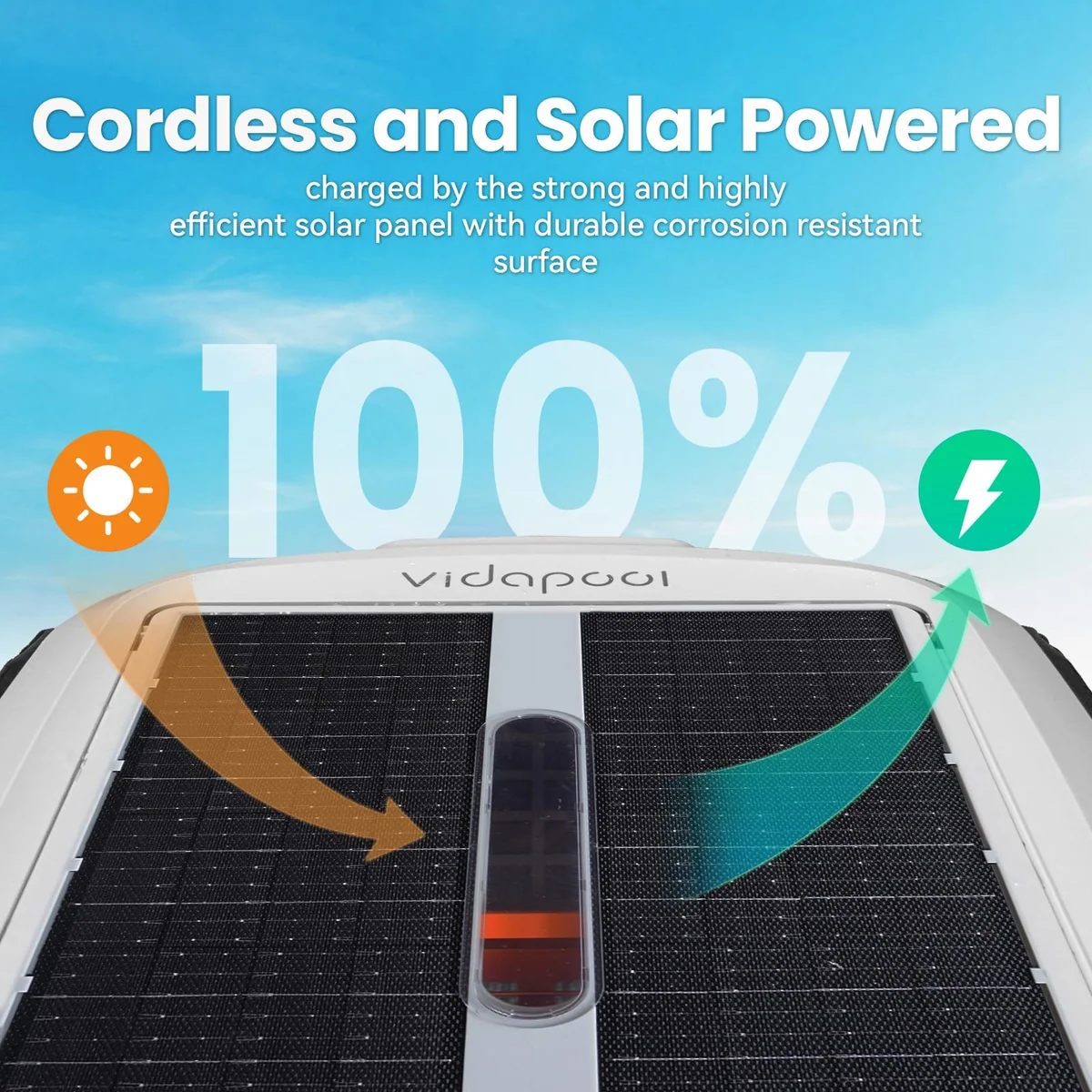
The VPSC01 has no charging port. Vidapool says that decision removes a possible route for water intrusion, but it also removes the owner’s fallback when shade, cloud, seasonal sun or a charging fault leaves the battery depleted. A missing port may simplify waterproofing; it does not prove a longer service life.
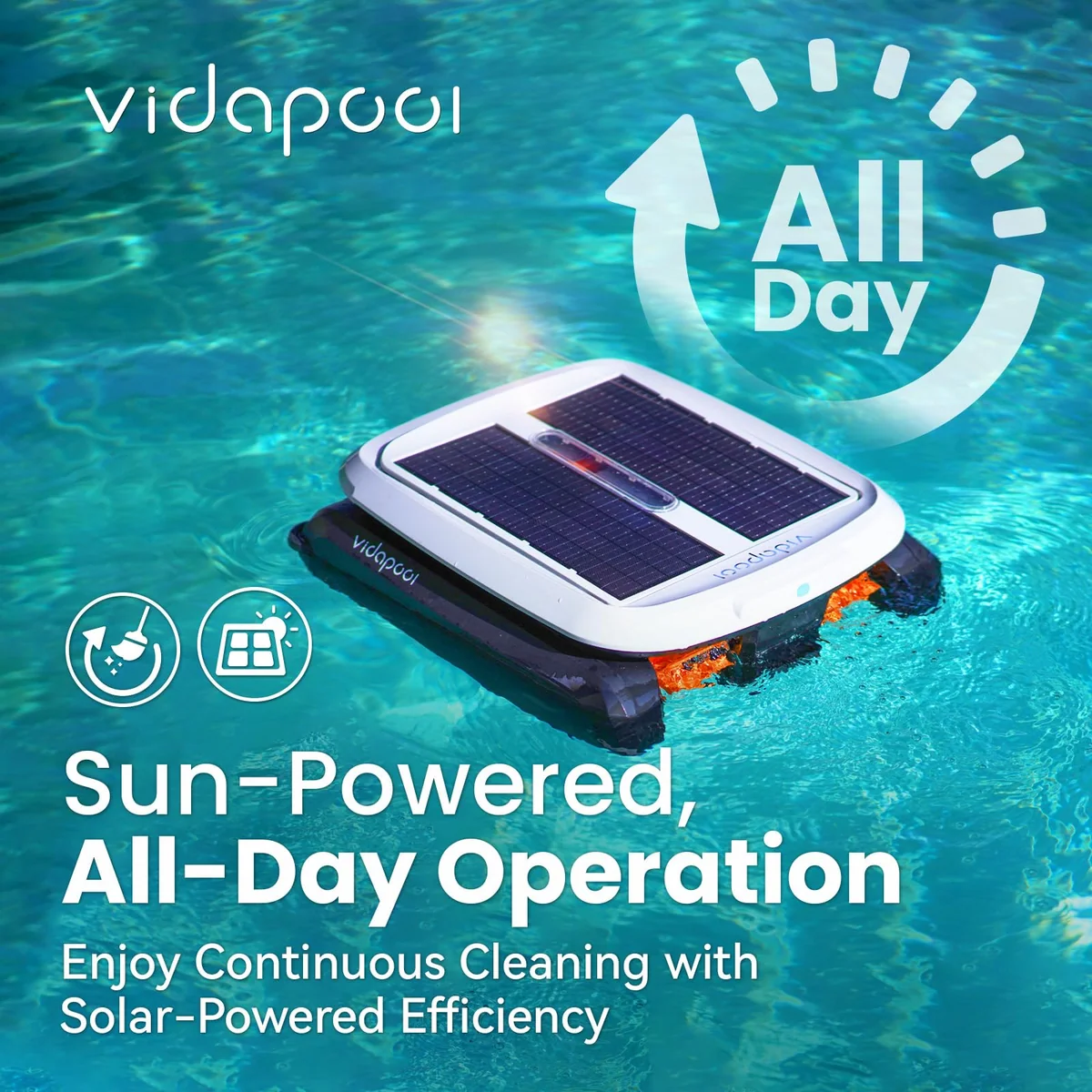
The skimmer can continue after dark when it has received enough sunlight. One above-ground-pool reviewer saw it still operating at about 2 a.m., and another reviewer found it usable through sunny swim-season days and nights. That supports “can run at night,” not “runs all night in every pool.” No dependable exact-product runtime was established, and the supplied secondary figures conflict.
The seasonal consequence is simple. A sunny, exposed pool gives this design its best chance; a shaded, screened, cloudy or winter-open pool exposes the lack of plug-in charging. One exact-product owner discovered the harsher version of that limitation when corroded solar contacts stopped charging the battery after three months, leaving no second charging route. Our guide to solar skimmer performance after dark and under cloud covers that tradeoff beyond this model.
Obstacle sensing is basic, not intelligent mapping
The Vidapool does react to ordinary walls. In a detailed demonstration it slowed, reversed, turned and resumed skimming, and the remote could steer it toward a missed patch or bring it back for retrieval. What the evidence does not show is mapped coverage, a systematic route or proof that every part of the surface will be visited.
In the independent comparison, its movement was effectively random and its below-water sensors produced relatively poor navigation across changing water levels. A Facebook owner in a 30-foot round saltwater pool also found that the unit reversed so frequently that debris escaped, while another related-unit report described a machine that eventually did little but drive in circles despite cleaning and unobstructed propellers. The listing’s promise that it suits all swimming pools is much broader than the evidence.
Pool circulation can matter as much as shape. Higher pump speed and stronger currents can reduce the machine’s ability to travel freely, so a variable-speed system may need a lower setting or a separate skimming window. Built-in skimmer suction, floating cleaner hoses, shallow shelves, unusual coping and tight corners are additional compatibility questions worth checking before purchase, not problems any surface robot should be assumed to solve.
The paddle wheels do not disappear into the background
The VPSC01’s exposed paddle propulsion produces a continuing water-wheel sound. One satisfied owner compared it with a small fountain and accepted it, but the independent comparator considered the noise a complete dealbreaker for a machine intended to operate around the clock. Neither reaction is wrong. Beside a lively family pool it may fade into the scene; beside a quiet chair, book and drink, it may become the scene.
The large basket is not enough to win the comparison
The independent seven-skimmer test did not reject Vidapool for being unable to collect debris. It rejected it mainly for persistent noise, with poorer navigation, sticky guide-wheel material, an open basket and unremarkable one-hour pickup adding to the case. That is an important distinction: the VPSC01 loses as an appliance, not as a floating proof of concept.
A buyer prioritizing established support and a deeper multi-season ownership history should start with the Betta SE Plus review. Betta is not failure-proof, and owners report occasional sticking, battery degradation and repairs, but the available record also includes machines running for two or three years and examples of responsive warranty service. That is a materially stronger ownership story than the Vidapool record.
The AIPER EcoSurfer S2 review is the more relevant alternative for buyers who want charging flexibility and controls. In comparative evidence, the AIPER offered dual charging, app functions, more efficient solar use and a smaller enclosed basket that retained debris better when lifted. The compromise is exactly what Vidapool buyers may notice first: the AIPER’s 4-liter basket needs attention sooner.
Neither alternative should be treated as automatically correct for every pool. Strong intake suction, awkward geometry and limited sun can trouble the category as a whole, so the wider robotic pool skimmer guide is the better next step if pool layout matters more than brand preference.
The only buyer who should still consider the Vidapool
Consider it only for a sunny, conventional pool with a heavy load of ordinary floating debris, where the 10-liter basket has unusual value and constant paddle noise is acceptable. That buyer must also tolerate solar-only charging, handle the basket gently, monitor circulation interference and accept a real possibility that replacement parts or support will not be available when needed.
Five failures, five different weak points
Eight retained Amazon reviews cannot establish a statistical failure rate, and they should not be mistaken for a random sample of all 63 ratings. They can reveal a pattern, however, and this pattern is unusually difficult to dismiss: five of the eight describe a material failure within roughly one to four months.
| Reported timing | Failure | Ownership consequence |
|---|---|---|
| A little over one month | Complete power failure | The skimmer stopped responding immediately before a planned trip. |
| Before three months | Basket mesh shredded | Collected debris fell back into the pool during removal. |
| Three months | Solar contacts corroded | The battery could no longer charge. |
| Four months | Rear paddle needed replacement | The owner could not source the part or obtain a response. |
| Four months | Bottom plastic ripped | The unit subsequently stopped turning on. |
All five reports come from retained reviews attached to the exact Amazon listing.
The spread of failures matters. This is not one defective batch of baskets or one owner misunderstanding the controls; the reports touch charging contacts, mesh, a paddle, the lower body and complete electrical operation. An independent comparison adds another warning from shorter exposure: the rubberized guide wheels became sticky after only a few weeks in sun and chlorinated water.
Support risk turns small breakages into terminal ones
A paddle should be a repair, not a eulogy. Yet the owner who needed one could not find the part, and repeated attempts to contact Vidapool went unanswered. Other exact-product owners reported missing online documentation, a product absent from the company site and no manufacturer response after failure. Related Facebook reports echo the same problems with unanswered email, missing mechanical information and an owner searching for help after a rear spinner stopped.
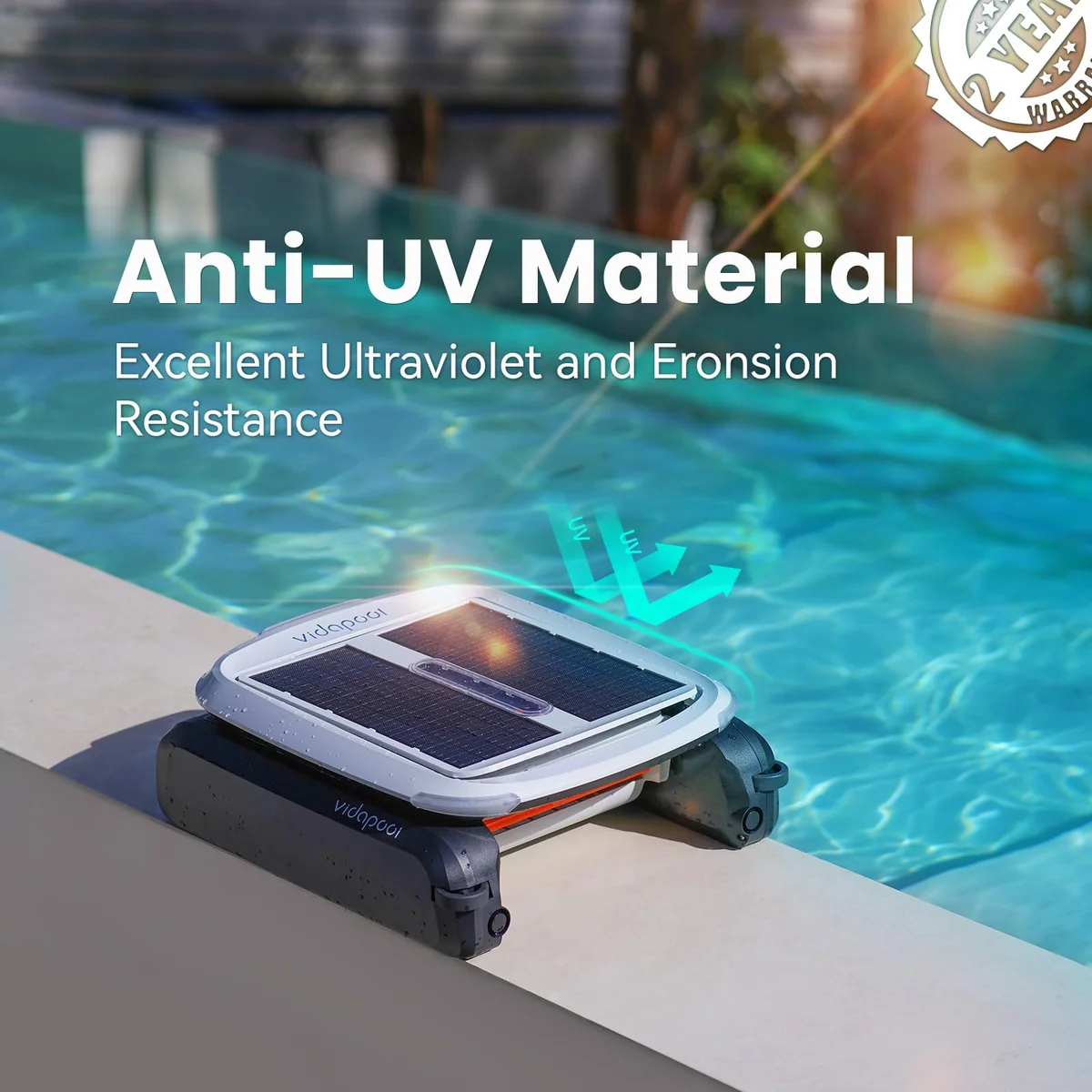
A secondary VPSC01 manual describes a two-year warranty, but it is published by an independent manual site under a different ASIN path, so Smart Pool Bots would not treat that as a secure promise for this exact listing. Even a valid warranty has limited value when the support channel does not answer and ordinary wear parts cannot be found.
This is the decisive drawback. The VPSC01 is not disqualified because a robot somewhere broke; every brand can fail. It is disqualified because several different early failures converge with repeated reports that owners could not get parts, documentation or a meaningful response.
Frequently Asked Questions
Can the Vidapool VPSC01 be used in a saltwater pool?
A VPSC01 manual claims freshwater and saltwater compatibility, and one owner used a related Vidapool in a saltwater pool, but neither source establishes long-term corrosion resistance.
Should the skimmer remain in the pool while people are swimming?
The supplied owner and manual guidance favors switching it off and removing it while people, children or pets are using the pool.
Does its tablet compartment replace normal pool sanitation?
No, the small underside tablet holder shown in demonstrations does not replace water testing, correct chemical dosing, circulation or the pool’s sanitation system.
Sources (6)
- Amazon listings and customer reviews — Vidapool Solar Pool Skimmer
- Owner reports across r/phoenix threads
- Owner and reviewer video, 3 channels
- Thesmarthomehookup — Article — www.thesmarthomehookup.com
- Facebook — Article — www.facebook.com
- Plus — Article — manuals.plus