Solar pool skimmers can clean after sunset, but only a charged battery makes that possible
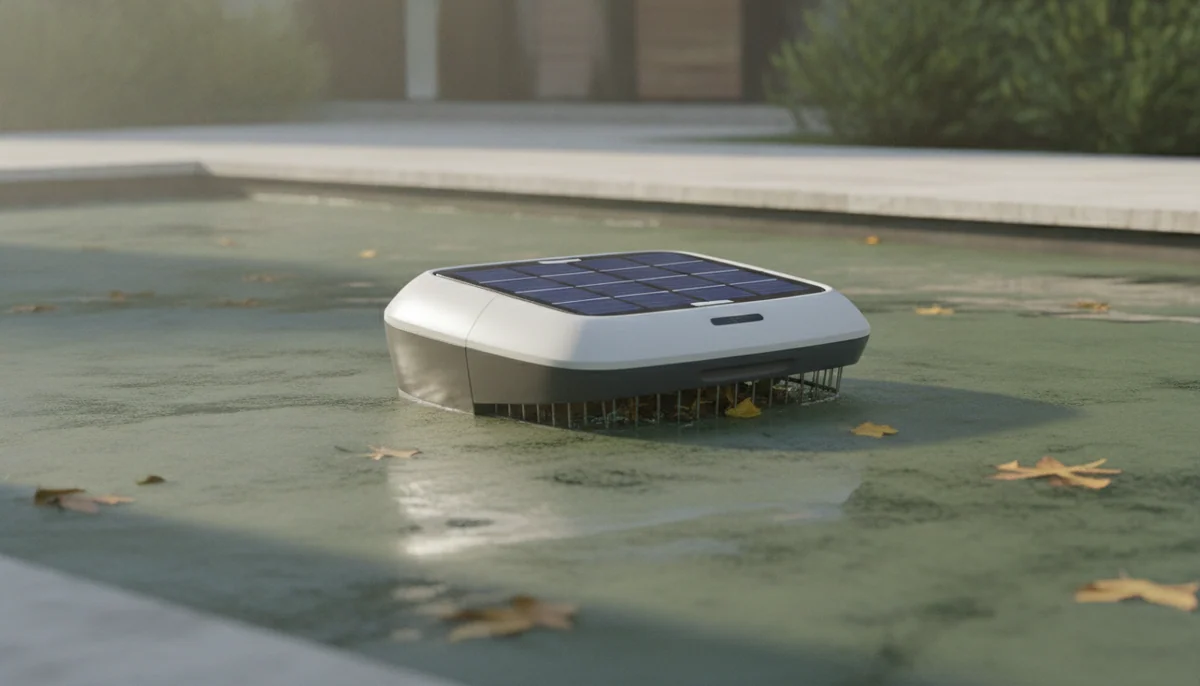
Yes, a solar pool skimmer can work at night, but it is not harvesting energy from darkness. It is spending energy stored during the day. Cloudy weather is less absolute: the panel may still contribute something, yet the robot stops once its motors consume more energy than the weak light can replace and its battery reserve runs out.
That distinction cuts through the most misleading phrase in this category: “24/7 cleaning.” The Betta SE, Betta SE Plus, and AIPER EcoSurfer S2 all have evidence of running into or through the night after adequate charging, while owner reports also document eventual stoppages after shade, winter sun, or consecutive gloomy days. Continuous operation is a favorable-condition outcome, not a perpetual-motion guarantee.
The second correction matters just as much: these machines skim the water’s surface. They intercept floating leaves, blossoms, pollen, insects, grass, and hair before much of it sinks, but they do not vacuum the floor, climb walls, scrub the waterline, remove settled silt, or treat algae. If one robot must handle the harder manual job, most owners should begin with a pool vacuum and read our guide to choosing between a surface skimmer and an underwater cleaner.
A solar skimmer becomes compelling as the second machine in a debris-prone pool. It patrols while nobody is holding a net, catches fine material that can slip through an ordinary mesh, and gives drifting debris fewer chances to become work for the pump basket or floor cleaner. That is a genuine maintenance advantage, provided the pool gives the robot enough light, open water, and useful debris to collect.
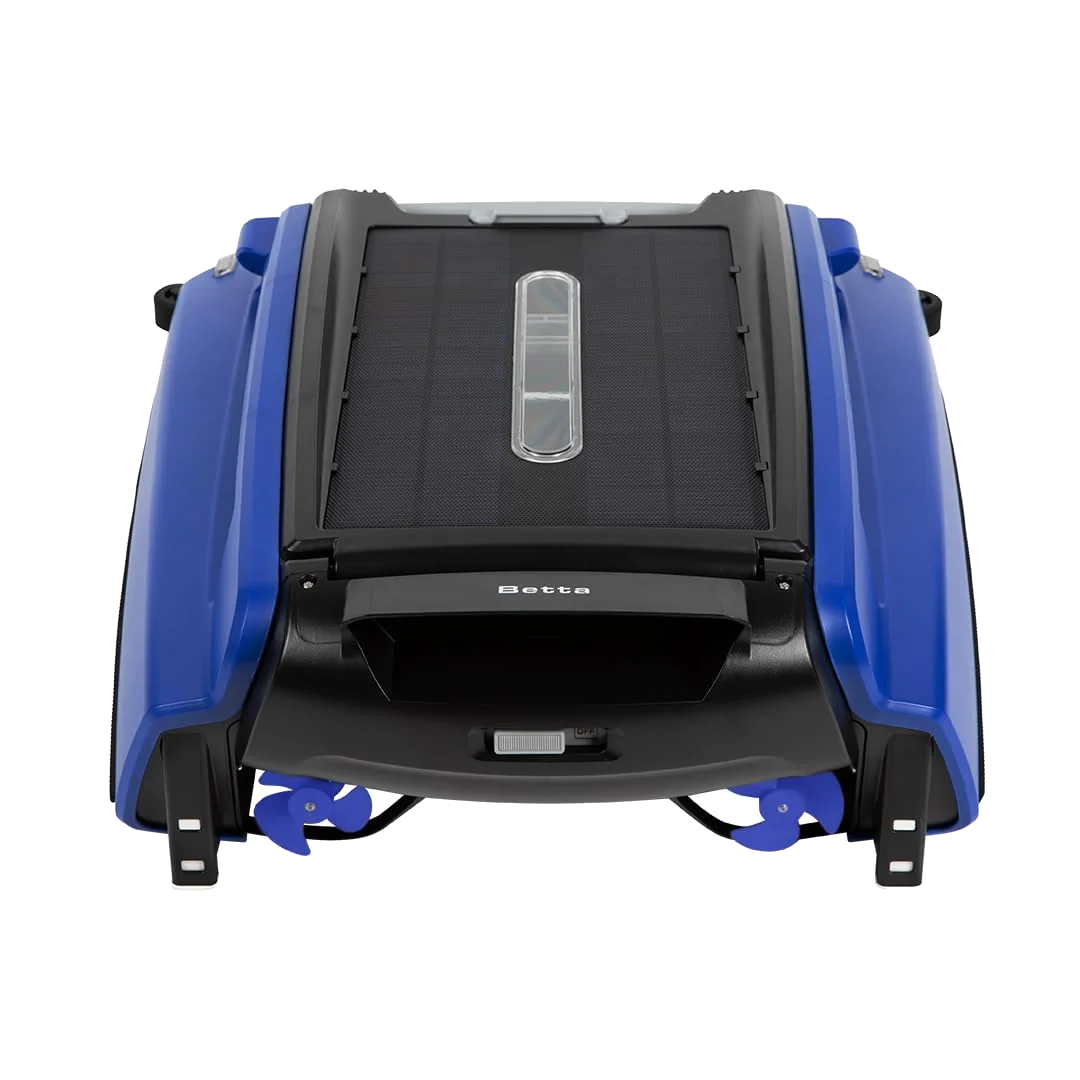
Night cleaning is borrowed daylight
Think of the battery as a reservoir. Direct sun fills it while the robot continues spending energy on propulsion and intake. After sunset, only the spending remains. Whether the skimmer lasts for another hour or reaches the next sunrise depends on its starting charge, battery condition, cleaning mode, resistance from wind or current, and whether tangled debris makes the motors work harder.
Manufacturer runtime figures describe what may be possible under specified conditions, not what every backyard will receive. Betta advertises more than 30 hours for both SE models, while AIPER says an EcoSurfer S2 charged through its DC adapter can run for up to 35 hours without sun. Those claims are useful for comparing design intent, but owner reports are more revealing about the boundary: long summer operation is common in favorable pools, and interruption becomes more likely during winter, shade, or several dark days in succession.
| Condition | What powers the robot | What to expect | What the owner should do |
|---|---|---|---|
| Strong direct sun | The panel contributes power while replenishing the battery. | This is the best chance of sustained daytime and overnight patrol. | Keep the panel exposed and inspect the basket before it becomes packed. |
| Bright overcast | Available light may contribute some charge while the battery covers any deficit. | The robot can keep working, although the reserve may finish the day lower than it began. | Watch the pattern across several days instead of judging one cloudy afternoon. |
| Heavy cloud or regular shade | The battery carries more of the workload because charging is limited. | Operation may become intermittent or stop after the reserve is exhausted. | Use plug-in backup if the model provides it. |
| Night | Stored battery energy supplies the motors and intake. | A well-charged unit may continue for hours or through the night. | Treat overnight operation as evidence of adequate daytime charging, not a separate solar mode. |
| Several poor-light days | Each day can begin with less stored energy than the previous one. | Even a normally autonomous skimmer may stop and wait for stronger sun. | Recharge by cable where possible or accept weather-dependent downtime. |
Cloud cover is therefore not a binary test. A skimmer that works through one gray day may fail during the third because the energy deficit accumulates. Conversely, a robot that pauses overnight may recharge after sunrise and resume without being touched. Judge the full cycle, not the moment when you happen to look through the window.
Backup charging separates convenience from dependence
The base Betta SE is the purist’s design. It has no wall-charging fallback, which removes cables and charging routines when the pool receives reliable direct sun. The same simplicity becomes its defining weakness in a shaded yard because a depleted unit must wait for better light.
The Betta SE Plus keeps the basic solar-skimming idea and adds adapter charging. That does not make poor weather irrelevant because somebody still has to remove, connect, and return the robot, but it converts an indefinite solar wait into a manageable intervention. Owner evidence supports solar operation through summer nights while also showing that winter and consecutive cloudy days can call for supplemental charging.
The AIPER EcoSurfer S2 also combines solar and plug-in charging. Its app adds battery information, schedules, steering, history, and obstruction alerts, so it suits an owner who wants more visibility into the energy budget. The trade is greater complexity and a credible durability concern involving basket gears, impellers, and drive motors in the retained ownership record.
Vidapool’s VPSC01 goes in the opposite direction. Its listing explicitly says there is no charging connection, so cloudy-weather recovery depends entirely on the solar system. That limitation would be easier to accept with a strong ownership record, but five of eight retained exact-listing reviews describe a material failure within roughly one to four months, including corroded charging contacts, torn basket mesh, a failed paddle, damaged plastic, and a completely unresponsive unit.
A skimmer is worth it when debris arrives faster than you want to net it
The strongest use cases are not subtle. An unscreened pool beneath shedding trees, a yard with persistent pollen or insects, lawn clippings carried by wind, blossoms that fall for weeks, or dogs that leave hair across the surface can give a skimmer useful work every day. In those conditions, persistent interception changes the maintenance routine rather than merely automating a five-minute weekly task.
A sheltered pool with light surface debris offers a weaker return. So does a pool whose visible problem is already on the bottom. Solar operation does not create value by itself; value comes from replacing enough repetitive netting and preventing enough material from sinking to justify another machine, another basket to rinse, and another set of moving parts to maintain.
Buy one
Buy when floating debris appears most days, the pool receives useful sunlight, and you are willing to empty a basket and resolve pool-specific traps.
Buy a dual-charge model
Choose solar plus adapter charging when trees, buildings, winter, or frequent cloud make the daily energy balance uncertain.
Buy a floor robot first
Start underwater when dirt, sand, algae, walls, or the waterline create more work than the floating material does.
Keep the hand net
Skip the robot when the pool is already sheltered and occasional manual skimming is quicker than maintaining another appliance.
A useful pre-purchase test costs nothing. For one week, note how often you skim, what the net contains, whether that debris was still floating, and how many hours of direct sun reach the water. That short diary answers the value question more honestly than a feature list because it measures the workload and the fuel supply in the pool you actually own.
Which solar skimmer makes the strongest case?
The Betta SE Plus is the most defensible general recommendation of these four. It catches the ordinary mix of leaves and fine surface debris, retains Betta’s simple physical controls, and adds the charging fallback that makes a solar appliance less dependent on perfect weather. Its weaknesses remain real: it still roams rather than maps, can be trapped by wall-skimmer suction or cleaner hoses, and does not report a precise battery percentage through an app.
The base Betta SE is the better minimalist choice for abundant direct sun. Its owner record includes effective collection of leaves, pollen, insects, blossoms, grass, dog hair, and other floating material, along with examples of multi-season use and replaceable propulsion parts. The drawback is decisive rather than cosmetic: there is no cable recovery after extended shade or bad weather.
The AIPER EcoSurfer S2 has the most persuasive control package and particularly strong evidence for pollen and other fine debris. It also includes adapter charging and a stated 24-month product-care term. Its slow leaf collection and repeated reports involving basket-drive noise, impeller alignment, and failed propulsion keep it behind the Betta SE Plus for buyers who value simple ownership more than app features.
Vidapool offers credible pickup and an unusually capacious basket, but those positives do not overcome solar-only charging, audible paddle propulsion, and the concentrated early-failure record. Smart Pool Bots would skip it rather than gamble that basket capacity will matter after the contacts, mesh, paddle, or body fails.
| Model | Best reason to choose it | Honest drawback | Smart Pool Bots’ call |
|---|---|---|---|
| Betta SE Plus | Simple surface cleaning with both solar and adapter charging. | Random coverage and pool fixtures can still demand intervention. | Best overall for uncertain sunlight |
| Betta SE | A straightforward, app-free design with a deeper ownership record. | Solar-only charging makes extended shade a hard limit. | Best for reliably sunny pools |
| AIPER EcoSurfer S2 | Fine filtration, adapter charging, scheduling, battery information, and phone steering. | Slow heavy-leaf pickup and specific mechanical failures weaken confidence. | Best for app control, with reservations |
| Vidapool VPSC01 | A large basket can hold substantial floating debris. | Solar-only power, paddle noise, early failures, and poor parts support compound the risk. | Skip |
For a closer decision between the leading dual-charge options, our EcoSurfer S2 and Betta SE Plus comparison separates app control and fine filtration from simpler operation and the available reliability evidence. Sunny-pool buyers can use the Betta SE and SE Plus comparison to decide whether backup charging earns its place.
The Betta SE Plus is the strongest all-weather choice in this group.
Choose it when regular surface debris justifies a skimmer and uncertain sunlight makes adapter charging valuable.
It remains a random-roaming surface specialist that can be trapped by skimmer openings, hoses, cords, and awkward shallow features.
The Betta SE is the cleaner choice for a conventional pool with dependable sun.
Choose it when you want simple app-free skimming and do not expect to need plug-in recovery.
Several dark or heavily overcast days can stop it because the base SE has no adapter-charging fallback.
The AIPER EcoSurfer S2 is the feature-rich choice for fine surface debris.
Choose it for pollen, insects, petals, scheduling, battery information, and phone steering if those controls outweigh the ownership concerns.
Its slow heavy-leaf collection and documented basket-drive, impeller, and propulsion failures prevent an unqualified recommendation.
The Vidapool VPSC01 is a skimmer most buyers should leave behind.
Its large basket cannot compensate for a weaker ownership proposition than the Betta and AIPER alternatives provide.
Solar-only charging, continuing paddle noise, early component failures, and elusive support make it an unnecessary gamble.
The pool can defeat a fully charged robot
Energy is only one limit. Wall-skimmer suction can pin a floating robot against the opening, strong return jets can trap it in one zone, and a cord or pressure-side hose can become a floating fence. Tanning ledges, beach entries, built-in furniture, ladders, protruding coping, and unusual corners can strand or scrape a machine that works perfectly in a plain rectangle.
Supervise the first several cycles with the circulation system operating as it normally does. Watch the wall-skimmer opening, shallowest ledge, strongest return, and any hose crossing the surface. Included bumpers and anti-stranding supports can solve some conflicts, while others require staggered cleaner schedules or make the pool a poor candidate for autonomous skimming.
Basket care also changes endurance. A packed basket restricts flow, plant fibers or hair can bind moving parts, and debris across the top panel reduces the light reaching it. Solar autonomy does not remove maintenance; it changes maintenance from repeated netting to shorter inspections, rinsing, and occasional rescue.
A broader survey of designs and debris capacities is available in our guide to the best robotic pool skimmers, while owners still questioning the category can compare the economics with other automation in our explanation of when robotic pool cleaners earn their keep.
How Smart Pool Bots reached this answer
Smart Pool Bots did not own or operate these four skimmers, so this page does not present borrowed owner experience as a hands-on test. The conclusion comes from the exact Amazon listings and the retained exact-model customer reviews supplied for the Betta SE, Betta SE Plus, AIPER EcoSurfer S2, and Vidapool VPSC01.
Manufacturer runtime, filtration, charging, and compatibility statements remain treated as claims unless the ownership record supports the practical outcome. Individual reviews establish credible behavior and failure mechanisms, but they do not establish universal runtime, cleaning percentages, or product-wide failure rates.
The final call
Solar pool skimmers do useful work after sunset and during cloudy weather when stored energy is available, but darkness never charges them and several weak-light days can eventually win. Buy one for a sunny pool where floating debris creates a daily tax, favor the Betta SE Plus when weather is uncertain, choose the base Betta SE when sunshine is dependable, consider the EcoSurfer S2 when app control and fine debris matter more than simplicity, and leave the Vidapool VPSC01 on the shelf.
Frequently Asked Questions
Can a solar pool skimmer run all night?
Yes, it can run after dark on stored battery energy if daytime charging left enough reserve for the overnight workload.
Will a solar skimmer charge on a cloudy day?
It may receive useful light under cloud, but weak charging can still leave the battery with a net loss across the day.
What happens after several rainy or overcast days?
The robot may slow, pause, or stop once its stored charge is exhausted, unless the model can be recovered with an adapter.
Is the Betta SE Plus better than the Betta SE for cloudy weather?
Yes, the SE Plus is the safer cloudy-weather choice because it adds plug-in backup charging while the base SE depends entirely on sunlight.
Does a solar skimmer replace a robotic pool vacuum?
No, a skimmer catches floating material while a pool vacuum handles debris on the floor and may also clean walls or the waterline.
Should a solar skimmer stay in the pool during a storm?
No, remove it when severe weather, lightning, high winds, or heavy falling debris could damage, overwhelm, or carry away the unit.
Is a solar pool skimmer worth buying for a shaded pool?
Only if the surface-debris workload is substantial and the chosen model has plug-in charging or the remaining sunlight is sufficient in practice.
How can I tell whether my pool gets enough sun?
Observe direct light across the water for several days and include tree shade, buildings, screened enclosures, seasonal sun angles, and the hours when the robot would normally operate.