You Should Not Leave a Robotic Pool Cleaner in the Pool
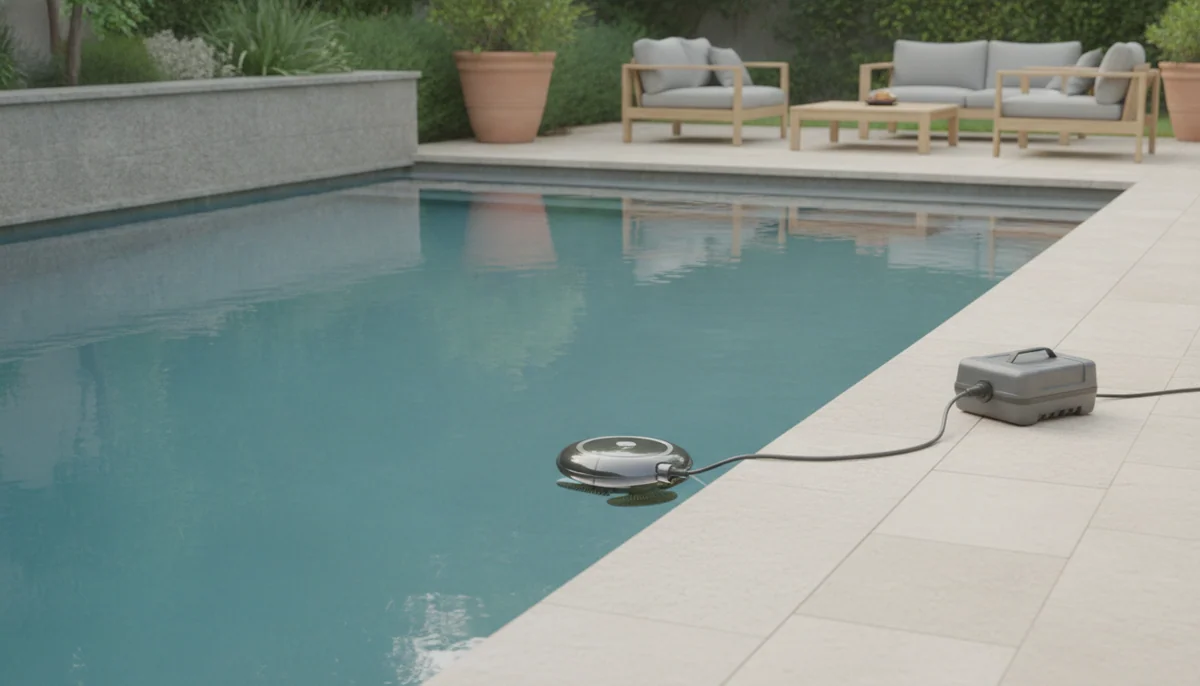
Underwater operation is not underwater storage. Once a floor-cleaning robot stops, leaving it at the bottom provides no further cleaning while its cable, plastics, brushes, seals, tracks, charging-port cover, and trapped debris remain exposed to treated water.
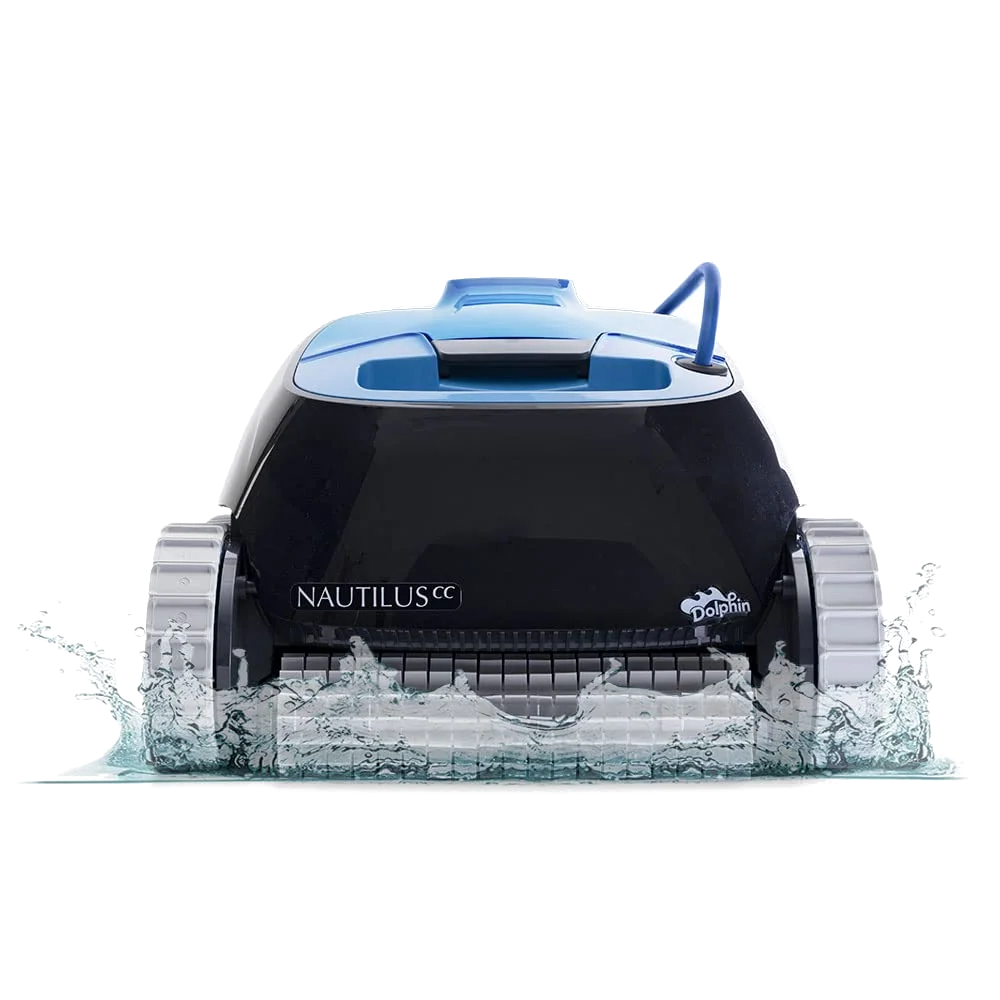
An accidental night in the pool is unlikely to destroy every robot. One Dolphin Nautilus CC owner reported leaving the cleaner in a saltwater pool for a few nights without an apparent problem. That same record also contains the more useful warning: another owner kept a Nautilus CC submerged through much of several swimming seasons, then watched the underwater section of its cable deteriorate and shed blue material. The cleaner survived the habit, but the habit was not free.
The exception is not a magic brand or a waterproofing claim. It is a different job. Solar surface skimmers such as the Betta SE, Betta SE Plus, and AIPER EcoSurfer S2 are designed to float, collect debris, and recharge while deployed. A submerged vacuum that finishes a cycle and sits idle should not inherit the storage rules of a machine built for continuous surface patrol.
“Waterproof” answers the wrong question
A robotic vacuum must resist water well enough to perform its intended cleaning cycle. That says nothing about whether chlorine, salt, ultraviolet light, heat, cable flexing, seal aging, and months of unnecessary immersion have no cumulative effect. A rain jacket can keep you dry without becoming your preferred wardrobe for the shower.
The most persuasive evidence is not an instant failure. It is gradual deterioration that appears while the cleaner still seems usable. The long-deployed Nautilus CC described above continued cleaning even as its cable became harder to relax, tangled sooner after deployment, and eventually flaked. Another Nautilus CC owner used more conservative storage, straightened the cable, kept pressure off the brush, and reported good performance entering the third year. Those are individual experiences rather than a controlled lifespan test, but together they expose the actual choice: retrieval takes effort, while permanent submersion spends some of the machine’s material life for convenience.
The Dolphin Nautilus CC Pro makes the scheduling argument even weaker. It offers connected controls, yet an exact owner who left it deployed through a five-month season reported light-blue cable debris in the pool. The owner said Maytronics attributed the damage to chlorine and sun exposure and advised keeping the cleaner out of both when it was not running.
A schedule automates motion, not ownership
A timer tells the robot when to start. It does not empty a basket, rinse a fine filter, straighten a cable, reseat a charging-port cap, clear an impeller, rescue a unit from a step, or recharge a spent battery. Scheduling can justify a defined period of deployment when the exact model was designed for it, but the word “schedule” is not blanket permission to use the pool as a storage cabinet.
Corded underwater vacuum
Default: Retrieve it after the active cycle or after the limited scheduling window allowed by its instructions.
Why: The cable and cleaner receive more chemical and sun exposure while an idle robot contributes nothing.
Cordless underwater vacuum
Default: Retrieve, drain, clean, dry, and charge it after the cycle.
Why: A discharged robot cannot clean or recharge underwater, and its filter and charging area still need attention.
Solar surface skimmer
Default: Leave it patrolling when conditions suit the model, then remove it for service, swimming, storms, and long shutdowns.
Why: Extended surface deployment is part of the job, but the basket, panel, sensors, and propellers still require human care.
The Dolphin Proteus DX3 illustrates the limit of a corded weekly scheduler. It can run recurring cycles during a seven-day period, but that function does not establish approval for all-season underwater storage, and its non-swivel cable still needs straightening and inspection.
Cordless scheduling is even easier to misunderstand. The TALOSBO C1 can preload delayed patterns, while the WYBOT C1 advertises app scheduling, but both still have to come out for filter service and dry charging. TALOSBO’s instructions specifically call for powering off the cleaner and drying the charging port before connecting the charger; WYBOT’s charging equipment is not waterproof, and its port cap must be secured before immersion.
Certain Aiper Scuba versions provide a genuine, narrow exception. Owners of some Scuba S1 variants describe periodic cleaning while the robot remains submerged between runs, and the current Scuba S1 listing advertises Eco and weekly scheduling functions. The retained records span different generations and controls, so do not assume that every unit bearing the Scuba S1 name follows the same interval or offers the same app behavior. Confirm the mode in the manual supplied with the exact unit.
A renewed Scuba N1 deserves still more caution. Its Eco mode can support a deliberate maintenance deployment, but a renewed listing does not disclose the complete history of the battery, seals, or charging connection. A feature intended to space out cleaning cycles is not evidence that unknown-condition hardware should be forgotten indefinitely.
The honest model-by-model answer
| Cleaner | Between cycles | The drawback that decides it |
|---|---|---|
| Dolphin Nautilus CC | Retrieve it after its cleaning cycle. | Long seasonal submersion has an exact-owner record of cable hardening, tangling, deterioration, and blue flakes. |
| Dolphin Proteus DX3 | Use only the limited scheduled window allowed by the exact controller, then retrieve it. | Its weekly timer does not approve permanent storage, and the non-swivel cable still accumulates turns. |
| Dolphin Nautilus CC Pro Wi-Fi | Retrieve it after use rather than treating app scheduling as storage permission. | An owner reported severe cable deterioration after one season of prolonged deployment. |
| Betta SE | Leave it patrolling the surface in suitable daily conditions. | Its basket, solar panel, sensors, and propellers need service, and long-term or winter storage belongs out of the pool. |
| Betta SE Plus | Leave it on surface patrol when sunlight, battery state, and pool geometry cooperate. | Clouds, shade, skimmer openings, shelves, hoses, and a full basket can interrupt the supposedly continuous routine. |
| AIPER Seagull SE 2025 | Retrieve it after every finished cycle. | It cannot charge underwater, and leaving a spent floor-only cleaner submerged merely delays cleaning, drying, and charging. |
| AIPER EcoSurfer S2 | Leave it skimming the surface under serviceable solar and pool conditions. | Low light, obstructions, a full basket, and propeller or drive faults can leave it present but inactive. |
| TALOSBO C1 | Use a documented delayed pattern only for its intended window, then retrieve it. | The basket needs rinsing and the charging port must be dry before charging. |
| BUBLUE Bubot 800P Gen2 | Retrieve it after the selected program unless the exact manual expressly permits a scheduled deployment. | Corded power avoids battery charging, but the cable can knot and the control box must remain dry. |
| WYBOT C1 | Retrieve, empty, rinse, dry, and charge it after its cycle. | App scheduling does not solve filter service or make the external charging equipment waterproof. |
| Aiper Scuba N1 Renewed | Use Eco deployment only if the exact unit’s instructions authorize it. | Renewed condition adds uncertainty about battery and seal history, while filter and charging service still require retrieval. |
| Aiper Scuba S1 2026 | Use its documented Eco or weekly plan for a limited maintenance deployment, not permanent storage. | Fine filtration can clog before the battery is spent, underwater connectivity may disappear, and the charging area still has to dry. |
The Seagull SE’s owner record includes battery and charging failures, which makes conservative drying and charging care more sensible, not less.
Bubot 800P documentation supports app control and timed cleaning programs, but it does not establish permanent underwater storage as an approved use.
What the extra hours actually cost
Chemical and sunlight exposure
Chlorine or salt compatibility means the cleaner can work in appropriately maintained pool water. It does not promise that every cable compound, plastic, gasket, brush, track, and exposed surface is unaffected by unlimited immersion. The floating section of a cord also lives at the harsh boundary between treated water, air, sunlight, and deck heat.
Wet debris sitting in the filter
A stopped robot may be holding leaves, insects, pollen, hair, sand, silt, or algae. That load can restrict flow on the next cycle, spill back into the pool during retrieval, or decay while packed into a wet basket. Fine filters make this more urgent because excellent particle capture often comes with less usable capacity.
Cables, batteries, and charging connections
A swivel may reduce tangling during a run, but it does not shield a cord from chemical or ultraviolet exposure. A cordless design removes the floating cable, yet replaces that issue with a finite battery, a charging connection, and external equipment that must remain dry. Neither design becomes maintenance-free by staying underwater.
People and pool obstacles
Remove the cleaner before swimming. A cord can obstruct the deck and water, while a cordless robot is still a heavy moving machine rather than a pool toy. Surface-skimmer owners also report that swimmer-created waves can release debris from the basket, and skimmers can become trapped around hoses, wall openings, shelves, or other equipment.
The routine that protects the machine
- Let the programmed cleaning cycle finish and use a return or parking function if the model provides one.
- Bring a corded cleaner within reach only as its instructions allow, without hoisting the water-filled body by its electrical cable.
- Lift by the intended handle or retrieval hook, pause at the waterline, and let the retained water drain before carrying it.
- Keep the cleaner reasonably level so collected debris does not pour back into the pool.
- Remove and rinse the basket, filter panels, foam insert, or fine-filter insert fitted to the model.
- Check the intake, impeller, tracks, wheels, brushes, cable, propellers, charging-port cover, and basket flaps for hair, fibers, twigs, or damage.
- Rinse the cleaner as its instructions direct, especially after use in a saltwater pool.
- Straighten a floating cable and store it in relaxed loops rather than tight coils or sharp kinks.
- Dry a cordless cleaner’s charging area completely before connecting its charger.
- Keep the power supply, charger, and control box dry, shaded, and protected.
- Store the robot so its brushes and tracks are not crushed or permanently deformed.
Wet cleaners can be awkward to lift, which is the strongest practical argument for leaving one submerged. Use the supplied hook and let the machine drain instead of turning that inconvenience into a reason to sacrifice cable, battery, or seal care. The full recurring routine is covered in the site’s robotic pool cleaner maintenance guide.
When leaving it deployed makes sense
A limited in-water stay is reasonable when the exact manual describes an Eco or recurring mode that requires it, the charging-port cover is secured, debris conditions will not overwhelm the filter, the pool is clear of snag hazards, and someone can retrieve the robot if it faults or becomes stranded. Set the program before submerging an app-enabled cleaner because wireless communication may weaken or disappear underwater.
Long surface deployment is also reasonable for a purpose-built solar skimmer. Betta SE owners report near-continuous use, while Betta SE Plus owners describe leaving the machine deployed through day and night in favorable conditions. These accounts support the category’s intended convenience, but they do not excuse full baskets, dirty solar panels, blocked propellers, winter neglect, or incompatible pool geometry.
EcoSurfer S2 owners likewise report extended solar-supported patrols, although winter light, shade, faults, and obstructions can stop active skimming. “Continuous” describes the intended operating pattern under favorable conditions, not a promise that the machine will run every minute without inspection.
If the real goal is a device that normally lives on the water, start with the best robotic pool skimmers rather than forcing a submerged vacuum into that role. The guide to solar-skimmer performance after sunset and in cloudy weather explains why even the correct category still depends on battery state and conditions.
If the goal is less retrieval rather than surface cleaning, compare scheduled cordless models with clear expectations: they divide stored battery power across cleaning sessions, but they do not empty themselves or become reliable unattended vacation care. The site’s corded and cordless cleaner comparison separates that convenience from the maintenance each design still demands.
Frequently Asked Questions
Will one night in the pool ruin a robotic cleaner?
Probably not, but an uneventful night does not make repeated overnight or seasonal storage good care.
Can a robot stay submerged because it has a weekly timer?
Only for the deployment period permitted by the exact instructions, because a timer schedules movement rather than authorizing indefinite storage.
Can an Aiper Scuba cleaner remain in the pool during Eco mode?
Certain Scuba variants are designed for intermittent in-water cleaning, but the model, generation, permitted interval, filter condition, and charging routine must match the exact manual.
Can a Betta solar skimmer remain in the pool all day and night?
Yes under suitable operating conditions, but it still needs basket service, inspection, sunlight or adapter charging as applicable, and removal for swimming or long-term storage.
Should the robot come out before pool shock treatment?
Yes unless the exact manufacturer instructions expressly approve that exposure, because no general waterproofing claim establishes tolerance for concentrated treatment conditions.
Can people swim while a cordless robot is cleaning?
No, remove the cleaner before swimmers enter even though a cordless model eliminates the floating power cable.
Does saltwater compatibility make permanent submersion safe?
No, saltwater compatibility supports cleaning in that environment but does not promise zero long-term wear on the complete machine.
Can an app monitor the robot continuously underwater?
Not reliably, because wireless communication may drop after submersion even when the app can configure a schedule beforehand.
Can I pull a corded cleaner out by its cable?
No, use the cable only as the exact instructions allow to bring the cleaner within reach, then lift the drained load by its handle.
How long is too long to leave a robotic vacuum underwater?
There is no defensible universal number, so follow the exact manual and make post-cycle retrieval the default whenever no scheduled-deployment permission is stated.