What Pool Robots Really Pick Up: Leaves Are Easy, Algae Is Not
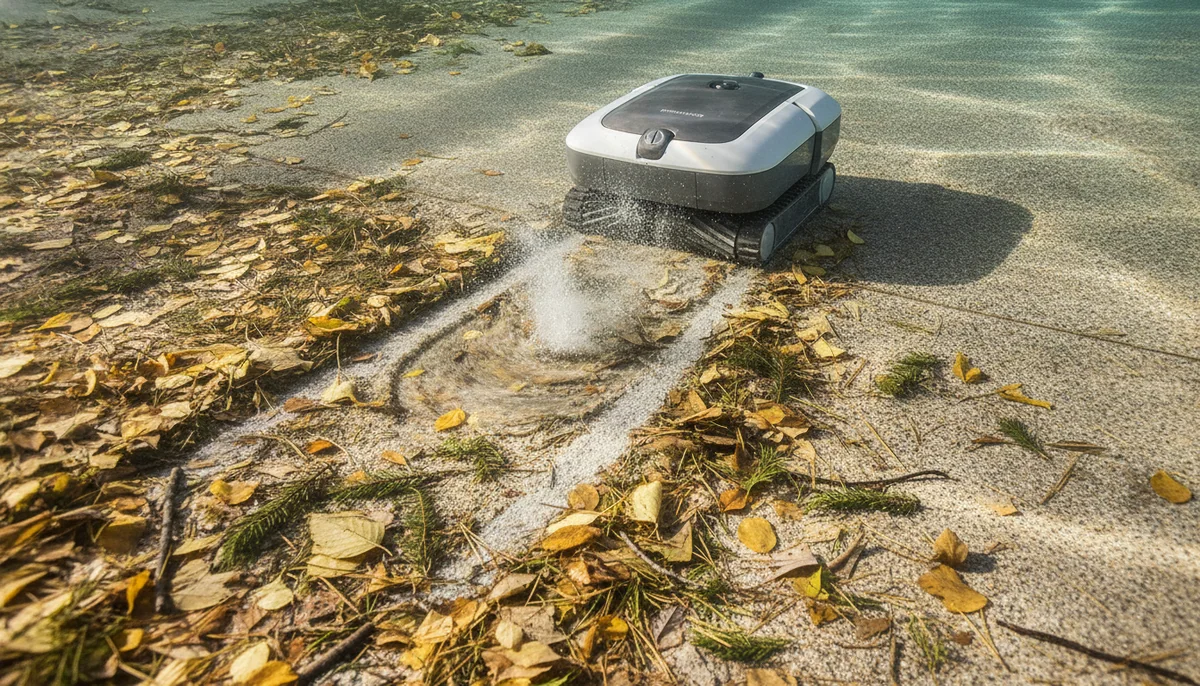
A pool robot is at its most convincing when the mess is loose, visible, and resting on an open floor. Leaves, insects, grass, acorns, grit, and ordinary dirt fit that description. Powdery silt does not. Pollen may not even be on the floor. Living algae is attached to the pool and still growing.
That is why the useful question is not whether a machine advertises strong suction. The robot has to reach the debris, loosen it when necessary, draw it through the intake, retain it in the filter, and finish the route before its basket clogs or its cycle ends. Failure at any one step leaves dirt behind.
- Reach it. The route must cross the deposit rather than circling it.
- Loosen it. Attached grime needs real brushing, not merely a plastic strip dragged across it.
- Ingest it. The intake must admit the leaf, twig, grain, or clump without pushing it away.
- Retain it. The filter must stop the particle rather than returning it through the exhaust.
- Carry it home. The basket must hold the load through the rest of the cycle and retrieval.
The last distinction is easy to miss. A robot can leave a clean-looking trail by blowing silt into suspension, yet remove very little from the water. Exact AIPER Seagull SE accounts describe silty material entering the cleaner, leaving through the other end, and settling again after the robot stopped. That machine’s advertised flow figure did not rescue its coarse screen from a filtration problem.
First find out where the mess lives
The surface, the floor, and the pool wall are three different cleaning zones. Most robotic pool vacuums are submerged machines. They can climb to the waterline without becoming surface skimmers, so a waterline claim does not mean the robot patrols the top of the water for floating leaves or pollen.
| Debris | Realistic expectation | What usually decides the result |
|---|---|---|
| Sunken leaves | Usually yes | Leaf size, intake opening, basket capacity, route, and whether sticks or fronds are mixed in |
| Visible sand | Usually yes | Grain size, floor coverage, filter sealing, and deposits around drains or wall junctions |
| Powdery silt | Sometimes | Fine secondary media, exhaust turbulence, filter loading, and repeat passes after settling |
| Pollen | Location dependent | A skimmer for floating pollen or a genuinely fine filter for pollen that has settled |
| Algae | Dead residue only, and not reliably | Chemical treatment first, brushing, particle fineness, and the main pool filtration system |
Corners, steps, tanning ledges, ladder gaps, wrinkles, slopes, and main drains create another boundary. A filter cannot capture material the chassis never reaches. If deposits collect in those areas, brush them toward an open section of floor or choose a cleaner specifically suited to steps, ledges, slopes, and awkward transitions.
Leaves and sand are the honest yes
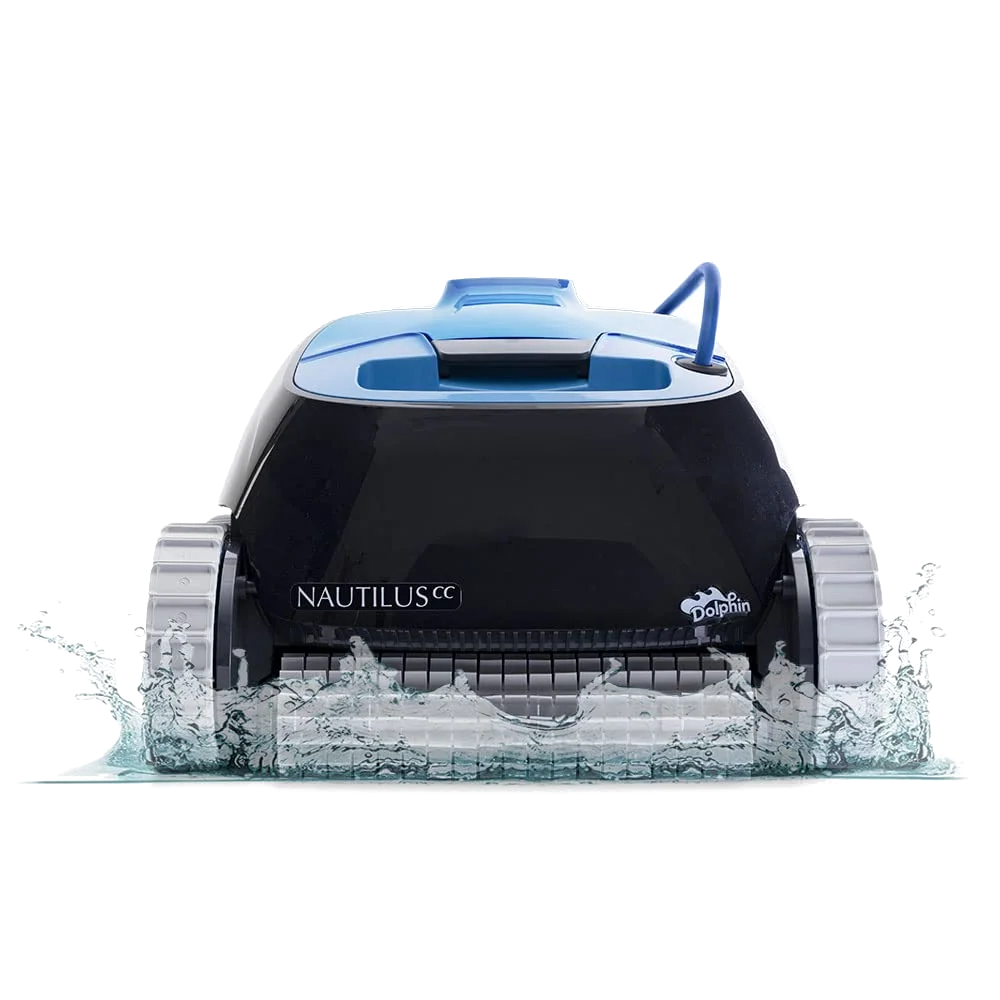
Ordinary sunken leaves are the workload most buyers can trust a competent robot to handle. Small oak leaves, blossoms, bugs, acorns, pine needles, and loose plant fragments appear repeatedly in successful owner accounts. The basic Dolphin Nautilus CC is a useful reality check: owners report baskets containing leaves, acorns, sand, white silt, and routine floor dirt, although its standard media is not equally successful with every powder-fine contaminant.
Quantity changes the answer. A basket that comfortably handles Tuesday’s leaf scatter may fill halfway through a storm cleanup. Flow then falls, wall climbing may weaken, and additional leaves remain on the floor even though battery time is left. Large fronds, branches, bark strips, and wet mats should be netted first because they can bridge an intake or obstruct an impeller.
Floating leaves remain outside a normal floor robot’s reach until they sink. Some premium all-in-one cleaners add a surface mode, but the evidence does not support treating that feature as equal to a dedicated skimmer. A controlled test of the AquaSense Pro platform collected about 40 percent of the floating test leaves, pushed another 40 percent toward the pool’s wall skimmers, and allowed the rest to sink; its wake diverted off-center debris before the intake could catch it.
Sand is generally the next safest promise because visible grains are dense enough to settle. The catch is that “sand” can mean coarse grit, fine paver sand, desert dust, or something closer to flour. A robot may retain the first two and recirculate the last two. Finding sand in the basket proves that some sand was collected, not that every grade was retained or every deposit was visited.
Silt is where the filter earns its name
Silt is lighter and finer than ordinary sand. The intake can disturb it before capturing it, the exhaust can throw it beyond the robot’s path, and basic mesh can pass it straight back into the pool. Standard baskets around 150 to 180 microns are best understood as visible-debris filters. They can retain some sand and sediment, but the number alone does not establish water-polishing performance.
A larger basket does not solve that problem. Capacity tells you how much material the robot may carry; fineness tells you which particles may stay inside. Nor does a larger advertised gallons-per-hour figure settle the argument, because cross-brand flow claims are not controlled measurements of suction at the floor, intake geometry, bypass around the filter, or retention as the media loads.
Fine inserts and pleated panels can change the outcome, but only when they fit and seal correctly. The Dolphin Nautilus CC Pro illustrates the trap: its large basket and active brush make it appealing for visible debris, while exact owners repeatedly report the supplied flat mesh returning fine sand, dust, brown sediment, or dead algae to the pool. Compatible pleated panels improved results, yet owners also encountered compatibility, cost, and availability frustrations.
Restrictive media also has a cost. As a fine insert fills, water flow falls and the robot may lose pickup or climbing performance. That is why the finest filter belongs in a follow-up pass, after leaves and coarse dirt have been removed, rather than in the first assault on a storm-loaded pool.
Pollen has two addresses
Pollen floating on top is a skimming problem. Pollen that has settled is a fine-filtration problem. A conventional underwater cleaner deserves no credit for the first job, regardless of whether it reaches the waterline, and an ordinary mesh basket deserves only a conditional verdict on the second.
Surface robots can collect leaves, blossoms, insects, pet hair, and some pollen before those contaminants sink. The Vidapool surface skimmer supplies a clean category example because its owners report genuine pickup across those floating debris types, but it does nothing for sand on the floor and its retained reviews include basket-mesh failure, spillage, and poor early reliability.
That makes a dedicated surface machine the right tool category, not an automatic endorsement of that particular product. Pools under constant tree or pollen fall should start with the site’s robotic pool skimmer guide; occasional floating debris can often be handled with the built-in wall skimmers and a hand net.
Algae is a chemistry problem before it is a vacuuming problem
A robot does not kill algae, restore sanitizer, correct pH, improve circulation, or recover a green pool by itself. Active brushes may disturb a light film, but stubborn living growth remains attached until proper treatment and brushing deal with it. Slick algae can even reduce track grip and make wall cleaning worse.
Once treatment kills the growth, some of the residue settles as extremely fine powder. That dead material may be vacuumable, but a coarse basket can recirculate it just as easily as silt. Clarifier does not change the basic distinction: binding suspended particles is not sanitation, and dispensing a chemical is not the same as mechanically retaining the resulting material.
For a serious bloom, correct the water chemistry, brush the affected surfaces, and let the pool’s circulation and main filter do their share. Where appropriate for the pool and filter setup, a directed manual vacuum or vacuum-to-waste may remove severe residue more efficiently than repeatedly sending it through a robot’s small basket. The robot is useful during cleanup and maintenance, but it is not the cure.
Choose the filter for the mess, not the biggest suction claim
For settled silt, pollen, and fine sand
WYBOT C2 Vision has the clearest fine-debris case
Its standard 180-micron basket handles leaves and coarse material, while a separate 10-micron insert is intended for settled dust, pollen, sand, and silt. Exact accounts report visible fine material in that insert after the pool already looked clean. The drawback is that the insert can clog quickly under a mixed leaf load, and the camera may chase stains or permanent color contrasts while overlooking a uniform film.
Read the WYBOT C2 Vision review if fine sediment is the reason you are buying, or compare the broader field in the fine-debris cleaner guide.
For a balanced coarse and fine routine
Aiper Scuba S1 makes two-stage cleaning practical
The current S1 configuration pairs a 180-micron main basket with a replaceable 3-micron secondary insert. Owners report the fine layer collecting dust, mud, sand, silt, calcium-like residue, and loose green material after treatment. Its honest limitation is that the insert can load quickly, restrict flow, require an early rinse, and introduce an ongoing replacement-media concern; its scrubbing of attached algae is also less convincing than its particle collection.
The Aiper Scuba S1 review covers that filtration advantage alongside its coverage and ownership caveats.
For obvious sunken leaves
Aiper Scuba V3 is the sharper leaf hunter
Camera-guided debris hunting gives the V3 a real advantage when visible leaves collect in obvious patches: an independent comparison recorded all deliberately placed leaves collected in eight minutes. That does not make it the fine-debris winner, because the same comparison found some sand and silt returning to the water, while its stair and bench coverage was weak.
The Aiper Scuba V3 review is the better next stop for tree debris, while the leaf-cleaner guide compares other large-basket and surface-capable choices.
For straightforward routine maintenance
Dolphin Nautilus CC remains the sensible generalist
The corded Nautilus CC has credible evidence for sunken leaves, insects, acorns, sand, grit, and some silt without demanding a complicated filter routine. The drawback is variable retention of powder-fine material, plus no surface-skimming function and missed deposits in difficult corners or transitions.
Read the Dolphin Nautilus CC review if the pool’s regular mess is ordinary floor debris rather than floating pollen or dead-algae powder.
For heavy leaves across the floor and surface
Beatbot Sora 70 favors capacity over fine filtration
Its large six-liter basket and demonstrated underwater plus surface collection make it a strong all-in-one candidate for leaves, bugs, twigs, and visible plant debris. Its included 150-micron filtration is much less convincing on powdery dust, silt, and dead algae, and its surface mode is a finite-battery pass rather than continuous skimming.
The Beatbot Sora 70 review explains who benefits from that unusual combination and who should buy separate floor and surface robots instead.
The mixed-debris routine that actually works
A pool containing leaves and fine sediment asks one filter to perform two conflicting jobs. Open media preserves flow and capacity for bulky debris; restrictive media retains the powder. Split the work instead of forcing the finest insert to swallow everything at once.
- Net the oversized load. Remove branches, fronds, and dense floating mats before they block an intake.
- Run the coarse basket. Collect ordinary leaves, insects, twigs, and visible dirt with the least restrictive suitable media.
- Empty and rinse. Restore flow before the filter is asked to capture smaller particles.
- Install the confirmed fine insert. Use only media that physically fits and seals in the exact model.
- Choose a floor-focused route. Fine uniform sediment benefits more from systematic coverage than from a camera searching for conspicuous objects.
- Let the water settle. Give disturbed material time to return to the floor before deciding whether the pass worked.
- Repeat selectively. Brush missed corners and ledges toward the open floor, then rerun only the zone that still needs attention.
The dependable promise is modest and useful: pool robots are very good at taking loose, sunken leaves and ordinary dirt out of routine maintenance, while sand needs a competent filter, silt and pollen need genuinely fine media in the correct cleaning zone, and algae still needs a pool owner who understands chemistry.
Sources (3)
- Amazon listings and customer reviews
- Owner and reviewer video, 2 channels
- Pcworld — Article — www.pcworld.com