The Aiper Scuba V3 makes AI useful, but not essential
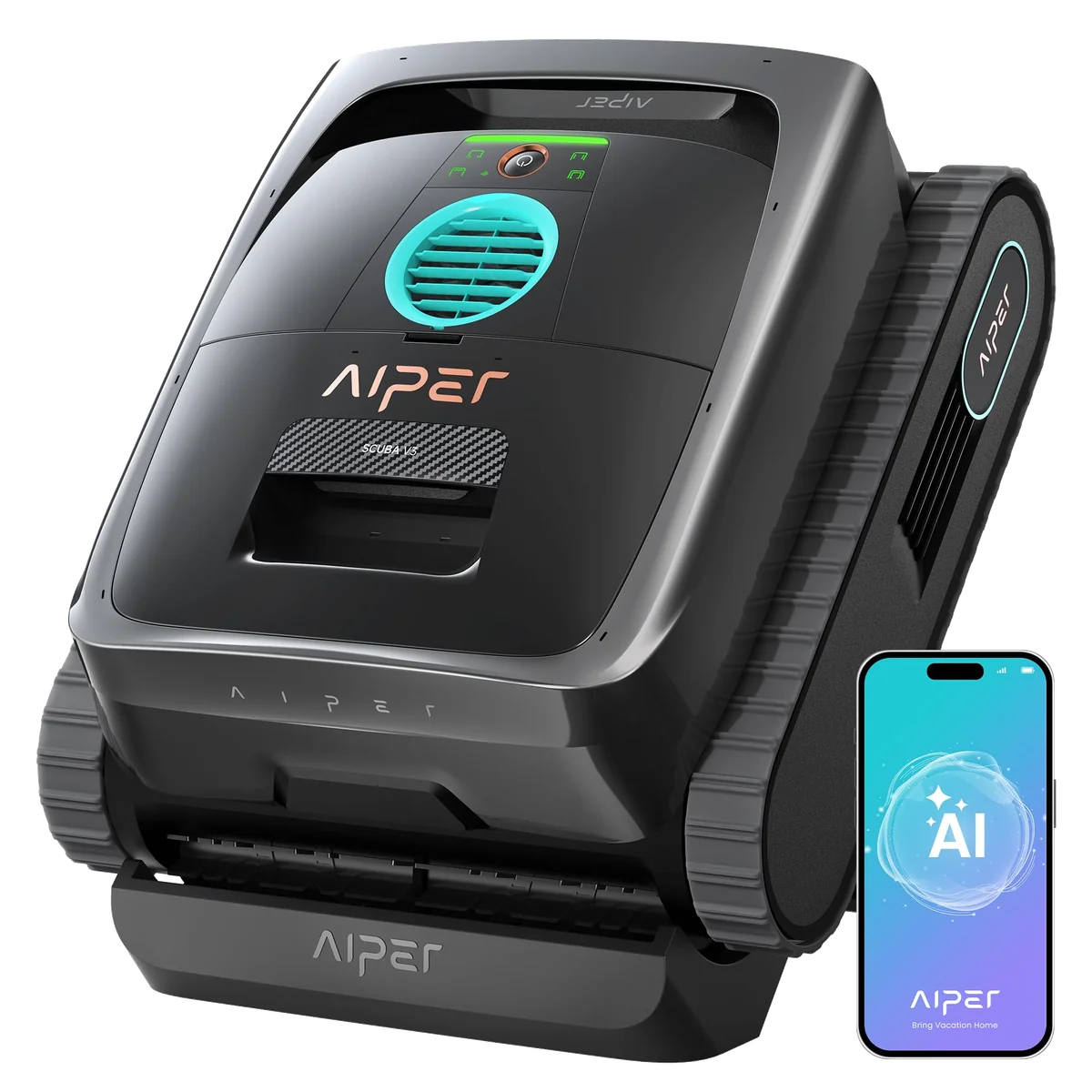
Buy the Aiper Scuba V3 for quick, camera-guided leaf hunting and strong horizontal waterline work, but choose a simpler cleaner if fine sediment, dependable step coverage or true hands-off scheduling matters more.
The pool matters more than the acronym
The Scuba V3 is easiest to recommend for a leaf-prone pool with a broad main floor, conventional walls, an accessible edge and an owner who wants a quick cordless cleanup before swimming. In that setting, the camera has a visible job and the horizontal waterline mode adds a second credible strength.
It is much harder to recommend for narrow steps, elaborate benches, troublesome vinyl slopes or a floor dominated by fine sand and silt. Those weaknesses are not small footnotes if they describe the parts of your pool that are hardest to clean manually.
Buy it because you want a robot that can see the obvious mess and go after it, not because “AI” promises that every surface, particle and maintenance chore has been solved. The Aiper Scuba V3 is a genuinely clever debris hunter wrapped around a merely good pool cleaner, and that narrower achievement is still worthwhile for the right pool.
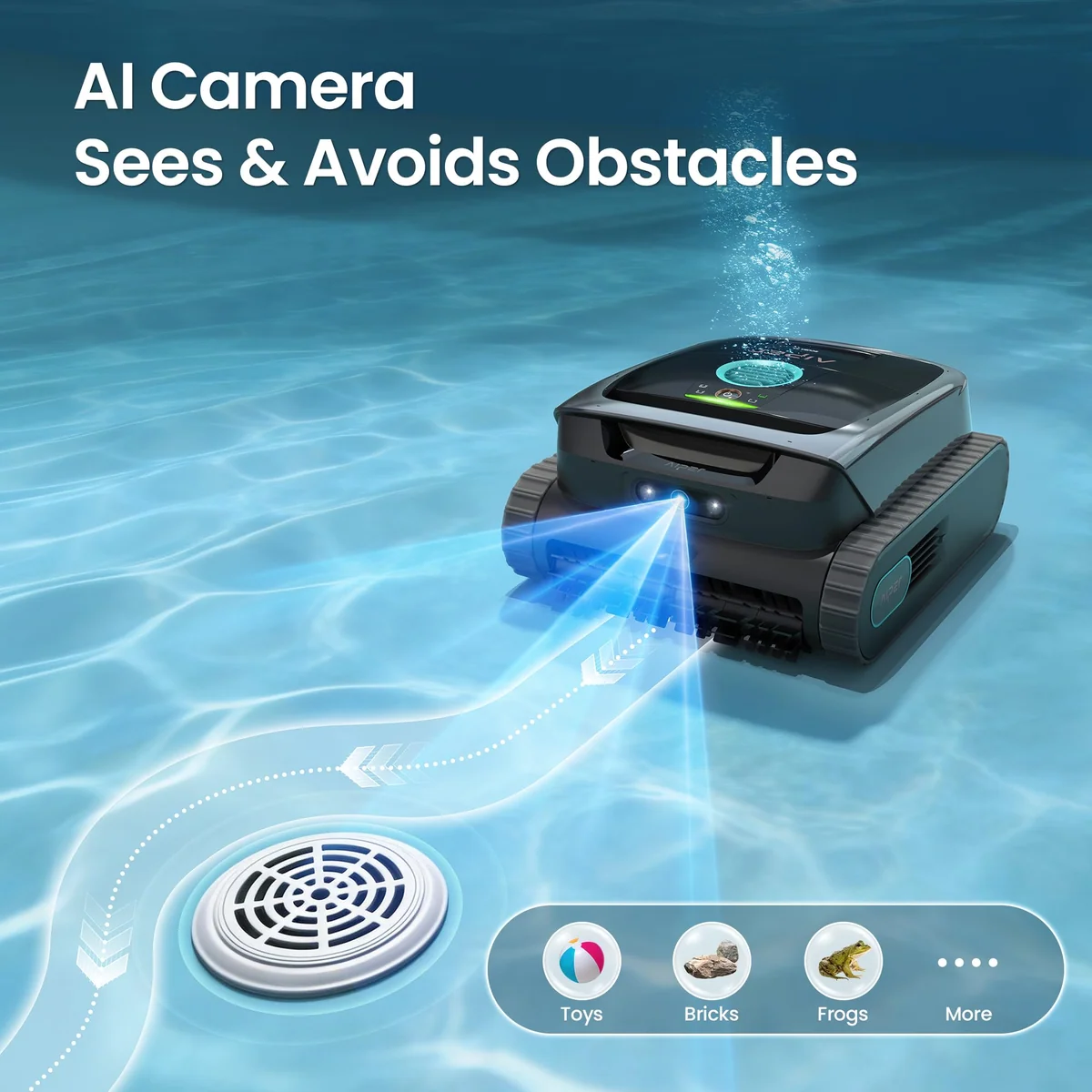
The Scuba V3 earns its camera. In a standardized comparison, it scanned for a set of deliberately placed leaves and collected every one in eight minutes. That is not decorative “AI,” and it gives this robot a real purpose: drop it in shortly before a swim, let it seek the conspicuous mess, and retrieve it without waiting for a blind cleaner to wander across the right patch.
The harder question is whether that talent makes it a better whole-pool cleaner. The same comparison recorded 99% floor coverage, 69% wall coverage and only 10% coverage of the test pool’s stairs and bench. Those numbers describe a machine that can find a leaf pile more intelligently than it can understand every elevated surface in a complex pool.
That distinction shapes this review. The V3 is not a bad cleaner with a camera bolted on, nor is it an autonomous pool keeper that makes every other design obsolete. It is a capable cordless floor, wall and waterline robot with one unusually effective shortcut, several ordinary compromises, and settings that can determine whether its intelligence helps or gets in the way.
Buy it for
Visible leaves, storm debris, scheduled maintenance passes, cordless deployment and deliberate horizontal waterline scrubbing.
Skip it for
Fine-silt-first cleaning, reliable stair and bench coverage, live underwater app control or a maintenance routine with no lifting and charging.
Key Specifications
The daily routine is less automatic than the app
Four cleaning choices are available on the robot: automatic, floor, wall and waterline. The camera-guided debris mode and scheduling depend on the app, so the physical controls can run a normal clean but do not expose the product’s defining feature. Set that feature before putting the V3 in the water.
The connection ends at the water
Ordinary Wi-Fi and Bluetooth communication disappear after submersion. You cannot rely on the app to show live remaining time, switch modes, stop a troubled run or summon the robot while it is working underwater. If it becomes fixated on an obstacle, the practical choices are to wait, intercept it with the hook or lift it out and restart.
This limitation is common enough to deserve a plain distinction: app configuration is not underwater remote control. The V3 can store a selected mode and execute it beneath the surface, but the phone does not maintain a conversational link with it there. Our explanation of why pool-cleaner apps lose contact underwater covers the physics and the workarounds without treating an app icon as proof of live control.
“Seven days” means scheduled maintenance, not seven full cleans
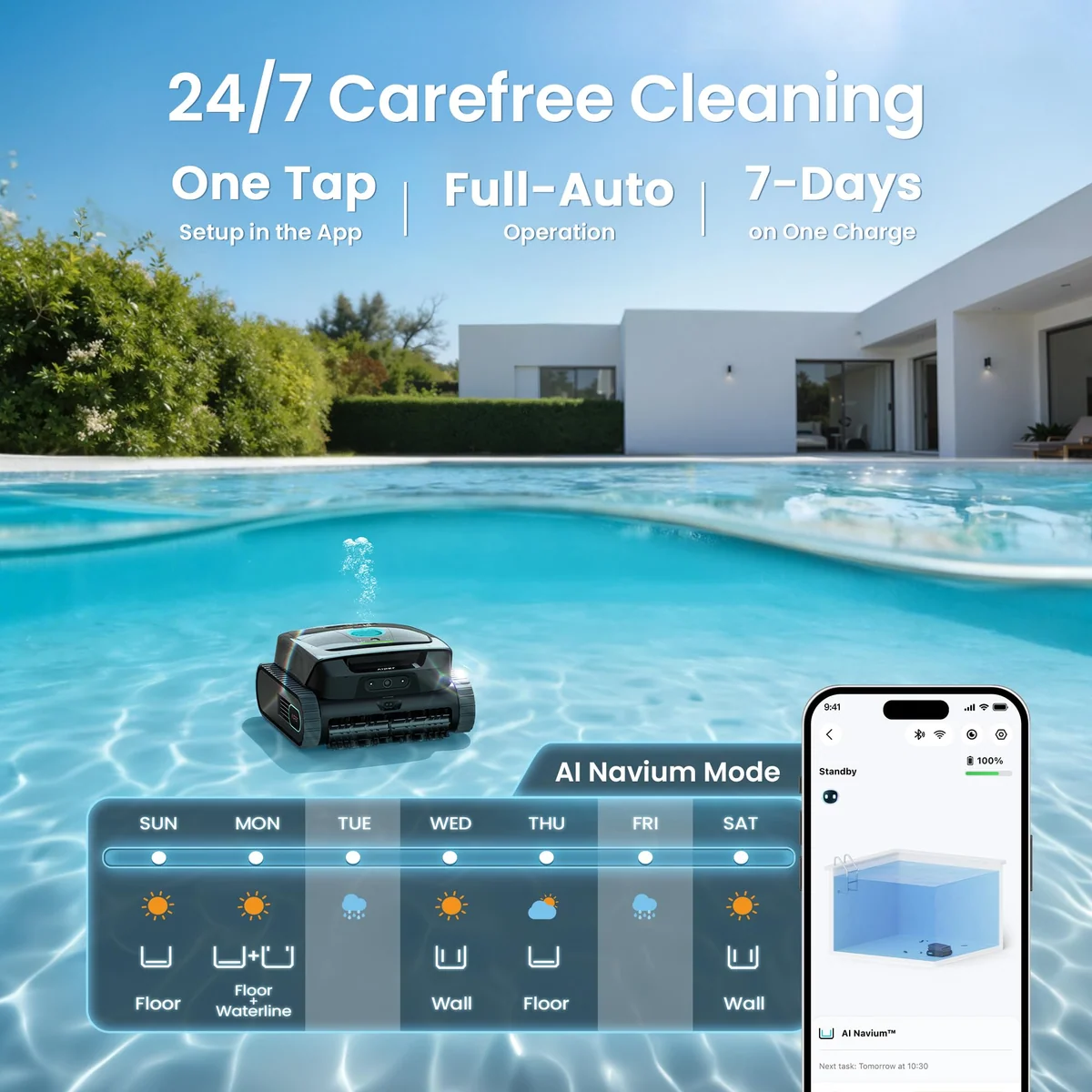
Aiper describes its Navium feature as a weekly plan based on pool size, weather and cleaning history, and the listing promotes seven days of care on one charge. An app demonstration showed up to four short 45-minute runs within a week, which is a much more plausible interpretation than seven consecutive full-length cycles.
Those short runs may suit a pool that begins clean and receives a modest daily debris load. They do not empty the basket, rinse the filter or restore suction after the fine insert clogs. Weekly scheduling also means leaving the cleaner submerged between planned cycles, so it is not equivalent to a corded cleaner that remains available without rationing a battery.
The dock is plug-free, not contactless
Aiper’s listing describes wireless charging with no exposed connectors and no drying requirement. The manual-based owner record and a close inspection show two metal contact surfaces on the underside, with instructions to dry both the robot and dock before charging. The stand saves you from opening a port and inserting a cable into the robot, but it is not inductive phone-style charging.
A safer dock routine
- Switch the robot off and let it drain before carrying it.
- Rinse the basket and remove debris from the brushes and tracks.
- Dry the underside contacts and the matching dock surfaces.
- Charge on a flat, ventilated surface out of direct sunlight and away from the pool edge.
- Store the robot away from freezing conditions.
Waterline parking saves a search, not the lift
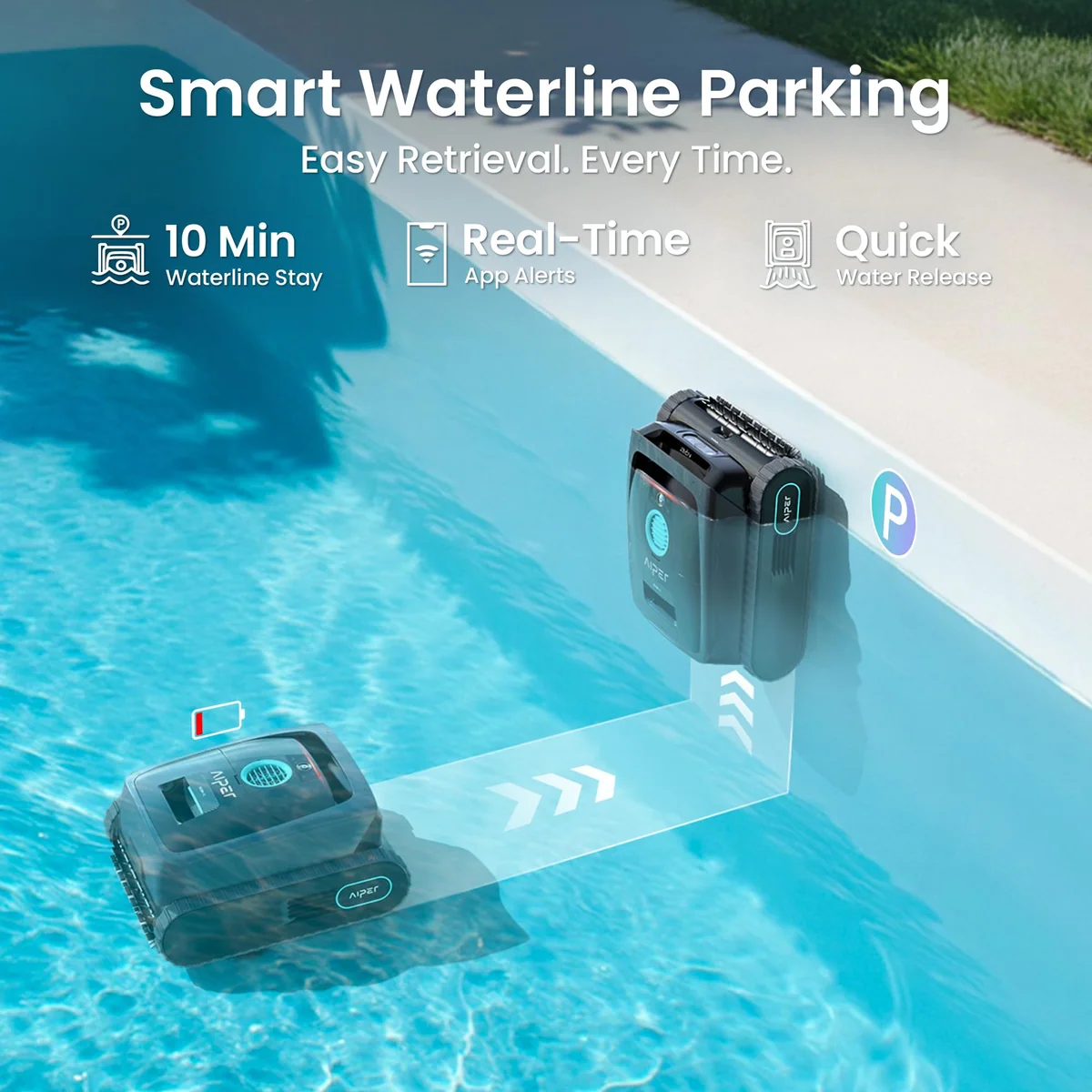
At the end of a cycle or on low battery, the V3 is intended to rise and wait near the waterline for about ten minutes before descending to the floor. It does not climb out, dock itself or reliably return to the place where it entered. Owners have found it waiting in inconvenient sections of the pool, so the included retrieval hook still matters.
The 18-pound dry figure is light relative to some large full-zone robots, but the first part of a wet lift includes retained water and drag. People with shoulder, grip, balance or back limitations should keep the hook on a dedicated pole and judge the lift from the least accessible pool edge, not from the specification sheet.
The basket favors access over rinsing speed
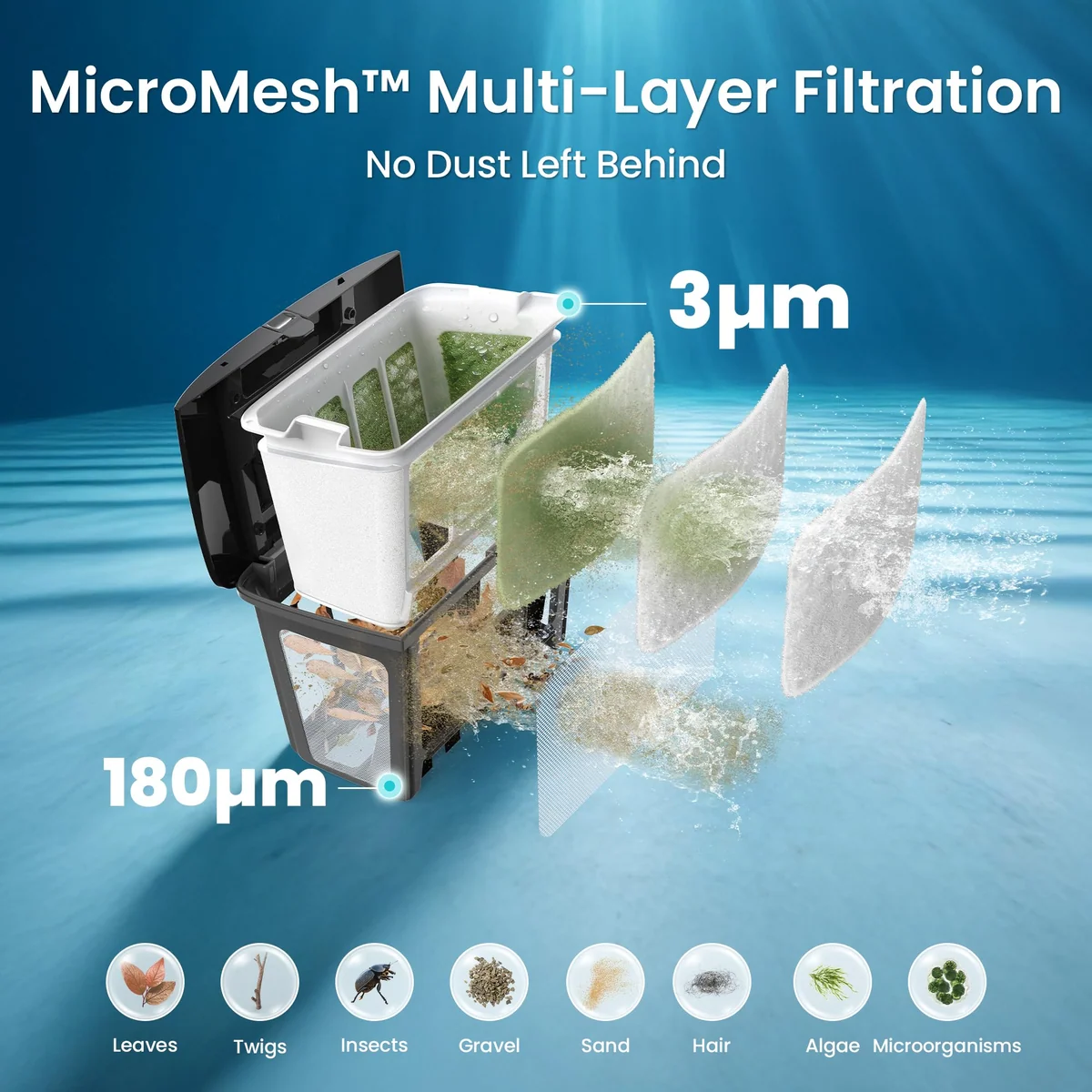
The top-loading assembly lifts out without opening a separate body panel, which makes initial access simple. Emptying it is less graceful because the basket lacks a bottom-release path, and the secondary insert adds another wet layer to separate and rinse. The V3 received one of the weakest basket-cleaning scores in the standardized comparison despite retaining debris reasonably well during removal.
It also does not skim the surface. Leaves must sink before the V3 can hunt them, and owners in tree-heavy settings still hand-skim or use a separate surface robot. If floating debris is the main nuisance, first decide whether you need a vacuum or a skimmer with our pool skimmer versus pool vacuum guide.
Strengths & Limitations
Strengths
- The camera can find and collect deliberately placed leaves much faster than a blind coverage route.
- Floor coverage can be excellent in a conventional pool area.
- Dedicated horizontal waterline travel gives the tile band more attention than occasional vertical contact.
- The included fine insert gives owners a useful second-stage filter for follow-up cleaning.
- The 18-pound dry body is lighter than many premium full-zone cordless robots.
- Physical controls preserve ordinary automatic, floor, wall and waterline cleaning without requiring the app for every cycle.
Limitations
- AI can waste time scanning or produce worse routine coverage until firmware and navigation settings are adjusted.
- Steps, benches, narrow platforms and awkward transitions remain inconsistent.
- Independent testing found sand and silt recirculation despite the secondary fine filter.
- The app loses its ordinary connection underwater, so live control and battery monitoring disappear during a run.
- The dock uses contacts that must be dry even though the charging language can sound contactless.
- Waterline parking lasts only briefly and may occur at an inconvenient edge.
- The top-loading basket is slower to rinse than a true bottom-opening design.
- The robot still requires wet lifting, filter cleaning, drying, charging and redeployment.
The camera solves one narrow problem brilliantly
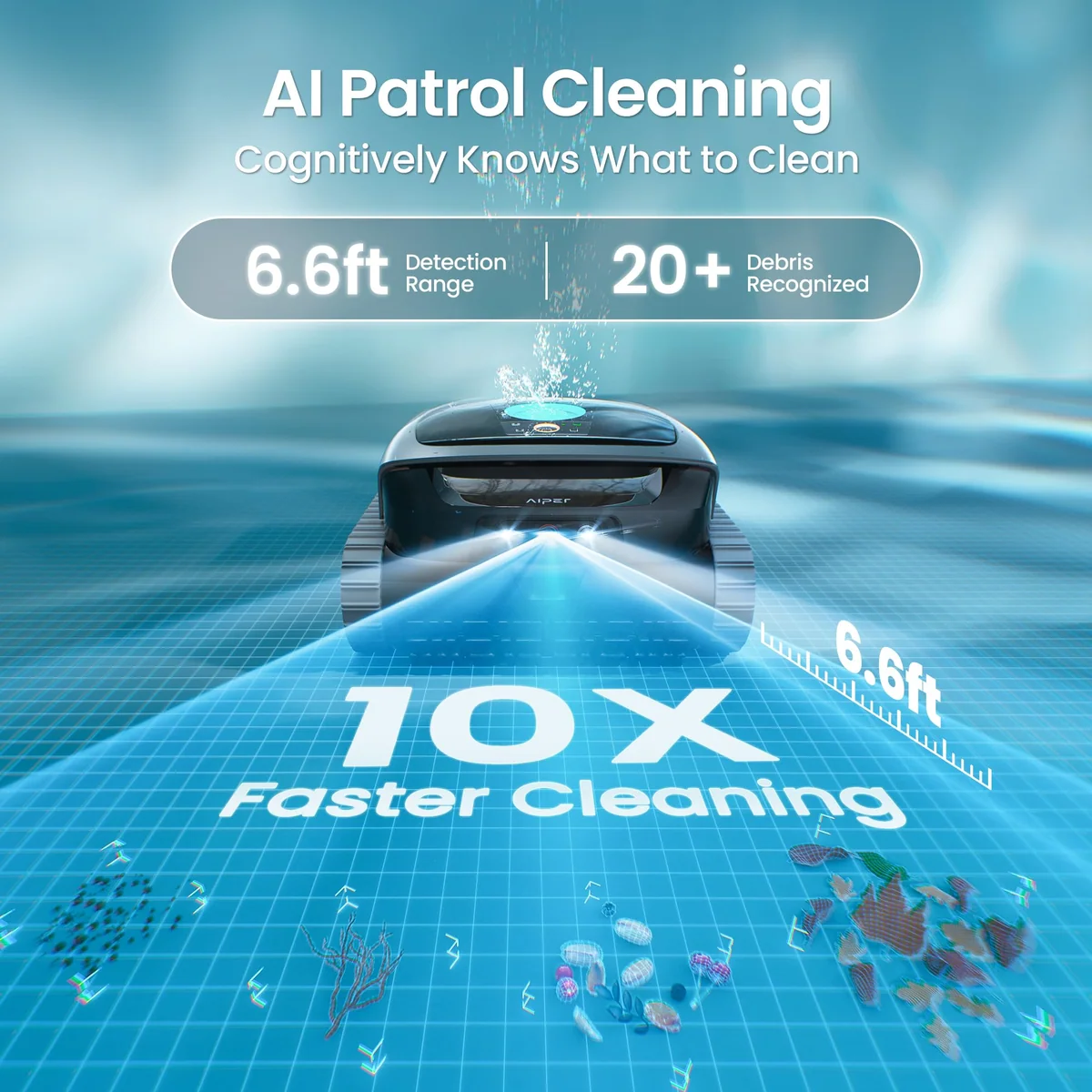
AI Patrol begins by looking for recognizable debris instead of committing immediately to a fixed coverage route. Multiple demonstrations show the V3 turning toward visible dirt or leaf piles, and the independent eight-minute leaf test is the clearest proof that the behavior can save time. Another longer-term reviewer saw it head directly toward a heavy debris patch rather than merely crossing it by chance.
That makes the camera most valuable when the pool has a few obvious targets. A traditional grid is efficient when everything needs an even pass; a debris hunter is efficient when one corner has collected yesterday’s leaves and the rest of the floor is already presentable. The V3 can perform both jobs, but buyers should not confuse targeted recognition with complete mapping.
| Test | Result | What it means |
|---|---|---|
| Deliberate leaf hunt | All leaves in eight minutes | The camera can shorten an on-demand cleanup. |
| Floor coverage | 99% | The main floor is not the weak point. |
| Wall coverage | 69% | Climbing ability does not guarantee complete wall coverage. |
| Stairs and bench | 10% | Complex elevated zones remain highly pool-dependent. |
| Total run | 3 hours 14 minutes | Runtime can reach the claimed neighborhood, but mode and pool conditions matter. |
Sometimes the smartest setting is less AI
Owner reports reveal a setup problem that no headline specification captures. One early buyer saw repeated scanning and missed debris until a firmware update and a switch from a shaped route to Adaptive mode materially improved the clean. Another obtained a better grid pattern, cleaner pool and better battery behavior by disabling the AI functions while leaving the camera active. A third found that camera-assisted cleaning consistently skipped two areas of a simple rectangular pool, while ordinary patterned cleaning covered them.
These accounts do not cancel the successful debris tests. They show that the V3 has two different kinds of intelligence: recognizing a visible object and choosing an efficient route through the whole pool. The first is convincing; the second still depends on firmware, mode selection, geometry and sometimes trial and error.
Start with the job, not the most impressive mode name
- Leaves concentrated in a few places
- Enable AI Patrol before submersion and let the camera hunt.
- Routine full-floor maintenance
- Use a conventional pattern if AI spends too much time rotating or revisiting obstacles.
- Walls and current waterline
- Select the dedicated zones rather than assuming one automatic cycle will give each equal attention.
- Steps, benches and narrow shelves
- Expect incomplete coverage and plan to brush missed debris onto the main floor.
Strong on the floor, conditional everywhere else
The V3 can climb walls and travel horizontally along the waterline, which is more useful than a robot that merely touches the tile during a vertical pass. One test measured cleaning roughly 1.5 inches above the current water level, while the standardized comparison praised its horizontal travel and scrubbing but found that it did not reach high enough to erase a fluctuating waterline mark.
Steps are a sharper limitation. A separate pool test found that 25 cm-wide steps were simply narrower than the robot and could not be cleaned, while a platform received only partial attention and dirt remained in a corner its routes did not reach. If shallow-zone coverage decides the purchase, consult our guide to robots for steps, ledges and tanning shelves rather than treating “floor to waterline” as a promise that every surface between those points will be covered.
Freeform pools, sloped deep ends and main drains produced successful reports, but other owners encountered a pop-up head, a vinyl liner transition or a 45-degree slope that confused the route. The included buoyancy foam can improve traction, and one owner found that it unexpectedly improved floor pickup too, but it cannot make a narrow ledge wider or guarantee recovery from every obstacle.
Leaves are the easy recommendation; silt is not
Large visible debris is where suction and vision reinforce each other. The V3 can notice a leaf, turn toward it and maintain enough intake flow to collect it rather than blowing it away. The basket also retained most of its load during retrieval in the standardized test, leaking only a few particles as the robot drained.
Fine material produces a split result. Owners have pulled impressive dust, calcium residue and fine storm debris from the included inner filter, so the micromesh layer is not merely theoretical. For a heavily littered pool, however, the coarse outer basket should be used first because the fine insert can load quickly and reduce flow; fit it for the follow-up pass when cloudiness, dust or very small particles are the target.
The difficult finding is that the V3 still kicked sand and silt into the water column during an independent comparison, even with its secondary insert fitted, and the older Scuba S1 performed better in that specific test. Filter fineness cannot compensate for turbulence, imperfect sealing or material the intake moves before capturing. Pools dominated by sand, pollen or powdery sediment should start with our fine-debris recommendations, not with the smallest micron number on a listing.
Is the camera worth paying for?
The answer depends less on how futuristic the camera sounds than on how your pool gets dirty. A few visible leaf piles create the strongest case because the V3 can shorten the wait between deployment and swimming. Uniform dust across the floor, narrow steps, a changing waterline stain or very fine sediment gives the camera less leverage.
The V3 premium makes sense when
Your pool receives identifiable leaves or clumps, you value a cordless drop-in routine, and you will use targeted hunting often enough to avoid unnecessary full cycles.
The premium is harder to defend when
Your normal task is predictable grid coverage, the pool needs strong fine-sediment retention, or you expect the phone to control the cleaner beneath the surface.
The closest sibling decision is not “smart versus dumb.” It is camera-guided intervention versus a less complicated version of the same cleaning idea. Our Scuba V3 and Scuba S3 comparison isolates what the camera changes, while the Scuba S1 and V3 comparison shows how the newer model fits against Aiper’s established cordless line.
A corded alternative poses a different bargain. Constant power and a weekly timer can provide more genuine automation because there is no battery to ration or dock between cycles, but the buyer accepts a cable on the deck and in the pool. An editorial market comparison places the V3 as a lighter cordless value choice while still favoring a corded Dolphin for many buyers who prioritize cleaning and scheduling over cable-free handling. The exact trade is examined in our Scuba V3 versus Dolphin Nautilus CC Plus comparison.
If cordless operation is non-negotiable, compare the V3 with the wider field of cordless robotic pool cleaners. The V3 belongs near the front for rapid visible-debris hunting, but that is a use-case win rather than a universal cleaning crown.
The durability verdict has not arrived yet
Current evidence is much stronger on cleaning behavior than on multi-season ownership. The exact V3 record contains launch-period and early-use reports, including one owner using it almost daily for a couple of months, but that cannot establish how the battery, seals, motors, camera or dock will behave after repeated seasons.
Some serviceable pieces look promising. The treads are described as owner-replaceable, and one new unit’s app showed 2,169 hours of estimated life for the micromesh insert. Both benefits depend on replacement parts actually being stocked when needed, and neither proves that the traction battery itself is user-replaceable.
Aiper advertises two years of product care with advance replacement and round-the-clock support. Exact V3 buyers repeatedly describe proactive troubleshooting, firmware advice, setting changes and offers of replacement or refund, which is encouraging. Several reviews rose sharply after support intervened, however, so the star improvement sometimes reflects good service as much as better cleaning.
The broader Aiper ownership record is less comfortable. Reports across other models include batteries that stopped charging, water ingress, motor or drive failures, parts difficulties and slow repair logistics, alongside owners who received successful repairs or continued using their machines beyond a season. Those are brand-level warning signals, not a V3 failure rate, and importing them directly into this model would be unfair.
Protect the purchase record
- Register the exact PRN31 model and retain the retailer receipt, serial number and support correspondence.
- Install firmware updates before judging navigation from the first few cycles.
- Photograph persistent routing, charging or climbing faults while the return window remains open.
- Ask whether the battery, dock, micromesh insert, brushes and tracks are available separately in your region.
- Follow the manual’s drying, ventilation, temperature and water-chemistry limits rather than the shortest marketing version of the charging routine.
For the maintenance that applies regardless of brand, our robotic pool cleaner care guide explains filter rinsing, brush inspection, storage and the habits that reduce avoidable wear.
Frequently Asked Questions
Does the Aiper Scuba V3 really use AI to find debris?
Yes, its camera-guided mode has deliberately scanned for and collected visible leaves, although that does not guarantee superior whole-pool coverage.
Can the app control the Scuba V3 while it is underwater?
No, ordinary Wi-Fi and Bluetooth contact is lost after submersion, so modes should be configured before the robot enters the pool.
Does the Scuba V3 charge without metal contacts?
No, the dock avoids inserting a plug into the robot but still uses underside contact surfaces that the manual-based instructions say must be dry.
How long does the Aiper Scuba V3 run?
Aiper specifies up to 180 minutes, while exact-model observations have ranged from 159 minutes to 3 hours 14 minutes depending on the mode and conditions.
Is the Scuba V3 good for sand and fine silt?
Its inner filter can capture fine residue, but independent testing found that some sand and silt was still stirred back into the water.
Will the Scuba V3 clean pool steps and benches?
It may reach some shallow areas, but measured stair and bench coverage was poor and narrow steps can be physically inaccessible.
Does the Scuba V3 clean the pool surface?
No, it cleans submerged floors, walls and the waterline rather than collecting floating leaves from the surface.
Does the Scuba V3 return to the charging dock by itself?
No, it waits near the waterline for about ten minutes and still has to be lifted out, drained and placed manually on the dock.
Should the ultra-fine insert stay fitted for every clean?
No, the coarse basket is better for a heavy visible debris load, while the fine insert is more useful during a later dust or cloudiness pass.
Is the Scuba V3 better than the Scuba S1 or S3?
The V3 is the stronger choice for camera-guided leaf hunting, while an S1 or S3 may offer better value when a conventional cleaning route is enough.
Sources (4)
- Amazon listings and customer reviews — Aiper Scuba V3
- Owner and reviewer video, 4 channels
- Smartifiers — Article — smartifiers.com
- Au — Article — www.productreview.com.au