The Beatbot Sora 30 is the rare robot we would buy for a real tanning ledge
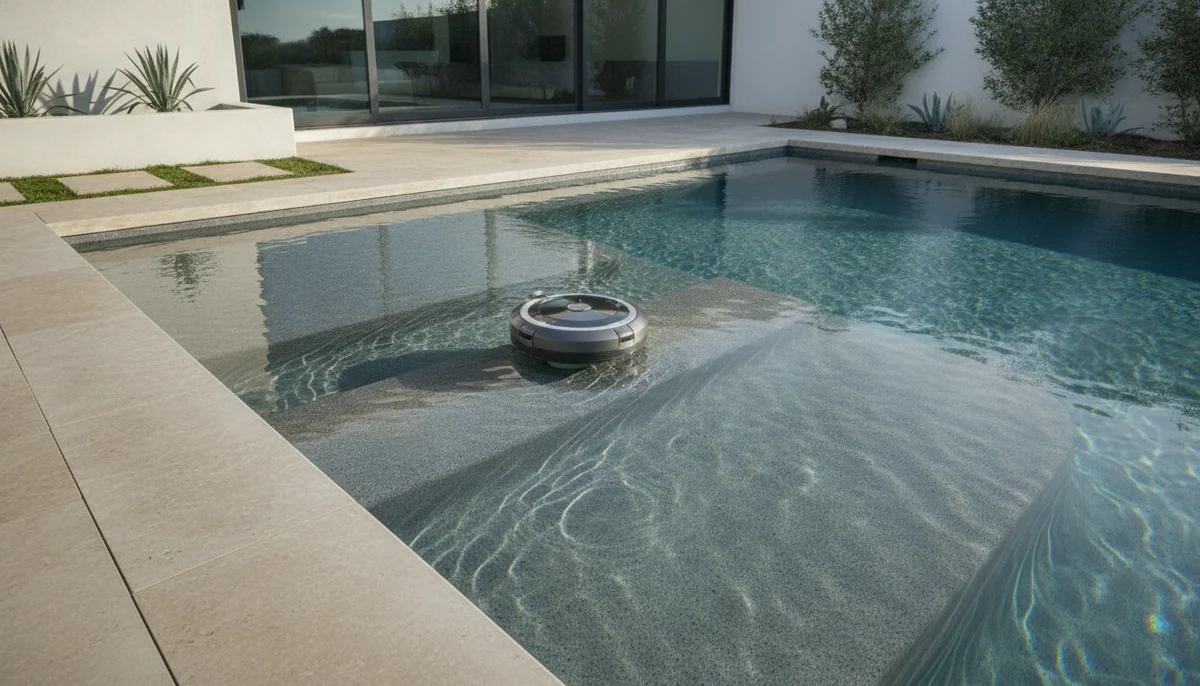
Most robotic pool cleaners sold as wall climbers are being asked the wrong question here. Vertical grip may get a machine up a pool wall, but a step or tanning ledge asks it to mount a horizontal surface, keep both tracks planted, recognize the outer edge, turn without falling off, and maintain enough submersion for its pump to work. A robot can be excellent on the floor and waterline while remaining hopeless on the shelf where everyone puts a chair.
The Beatbot Sora 30 stands apart because the evidence reaches beyond a feature list. It has been shown climbing onto a broad submerged platform, continuing to clean there, detecting the drop at the shelf edge, and reversing safely when an awkward curved approach left only one track supported. That is not proof that it will conquer every staircase, but it is the most persuasive demonstration of the exact job this page is about.
Buy it for a shelf, not for a miracle
The ideal target is a wide sun shelf or submerged bench with roughly eight inches or more of water above the surface, space for the whole chassis, and a straight approach free of bubblers, rails, and raised fittings. Pools with that geometry give the Sora 30 room to establish traction and correct its route.
Walk away when the top tread is non-negotiable
A very shallow top step, a narrow curved tread, or a bull-nosed ledge can still leave the shell supported while the tracks spin without useful contact. If every stair must be brushed on every cycle, no cleaner in this group has evidence strong enough to replace a manual step brush.
For the engineering behind these misses, read why wall climbing does not guarantee useful step, ledge, or drain coverage.
Your pool’s measurements matter more than the robot’s adjectives
“Shallow cleaning,” “AI navigation,” and “wall climbing” sound reassuring until the chassis reaches a curved six-inch tread with a bubbler in the middle. Before choosing any cleaner, sketch the route it must take from the main floor onto each built-in feature. A single bad lip can matter more than hours of extra battery.
Measure the water above the surface
Measure vertically from the ledge or step to the current waterline while the pool is operating normally. Do not rely on the construction depth written on a plan, because evaporation and operating level can move an apparently compatible shelf below the cleaner’s threshold.
Measure usable space, not total width
Subtract bubblers, rails, returns, raised drains, and tight corners from the platform’s dimensions. The cleaner needs enough room to place both tracks on the surface and enough remaining space to turn, reverse, or correct its route without immediately dropping back into the pool.
Inspect the approach from the floor
A broad straight transition is easier than a curved corner, bull nose, abrupt lip, or angle that lets only one track make contact. Watch the first approach from several directions because a robot may succeed head-on and fail whenever it arrives diagonally.
Judge each stair separately
A deeply submerged lower tread may be cleaned while the upper tread remains unreachable. “Cleans steps” should never be interpreted as equal brushing of every level, particularly when the top step has the least water and the shortest landing.
| Pool feature | Promising geometry | Warning geometry | What to test first |
|---|---|---|---|
| Tanning ledge | Broad, submerged, straight approach, room to turn | Very shallow water, bubblers, curved lip, tight corners | Whether both tracks mount and stay planted |
| Lower step | Deep tread with chassis-length landing | Short tread or steep riser transition | Whether the brush contacts the horizontal surface |
| Upper step | Unusually deep water and generous tread width | Low water, exposed shell, narrow landing | Whether the pump remains submerged and tracks retain grip |
| Submerged bench | Long, level seat with an open approach | Rounded edge, narrow seat, rails, protruding fittings | Whether the shell bridges the seat and lifts the tracks |
| Beach entry | Gradual, wet slope with a clear reversal point | Water becomes shallower than the operating threshold | Whether the robot reverses before losing suction or traction |
Runtime cannot repair a bad approach
Seven hours of floor-only operation may be valuable in a large pool, but it cannot shorten a stair tread or move a bubbler. Productive access, stable brush contact, edge detection, and recovery behavior deserve more weight here than the maximum battery figure. Our cordless pool-cleaner guide is the better place to compare endurance once the geometry question is settled.
Filtration and ledge access are separate decisions
The Sora 30 has the strongest shallow-platform case but ships with a comparatively coarse basket. The C2 Vision and Scuba S1 offer much finer secondary filtration but are less dependable on built-in architecture. If sand, pollen, dead algae, or powdery silt is the real complaint, start with our guide to robots for fine debris and accept that a separate ledge brush may still be the honest solution.
Use the return window as a geometry trial
Run deliberate tests before ordinary floor cleaning makes the machine look successful. Send it toward every shelf approach, the highest submerged step, curved corners, drains, rails, and bubblers; then repeat the cycle to see whether success was repeatable or merely lucky. Return a cleaner that consistently misses a non-negotiable feature, even if its floor looks excellent.
Cordless still creates a maintenance loop
A cordless robot eliminates the floating cable but still needs to be deployed, retrieved, drained, carried, opened, rinsed, dried around the charging connection, charged, and placed back in the pool. Scheduled or Eco modes ration one stored charge; they do not empty the basket or create a self-charging system. The broader ownership routine is covered in our robotic pool cleaner maintenance guide.
The shortlist, with the geometry catches left in
These are not twelve interchangeable cordless vacuums. The Sora models have the clearest case for qualifying shallow platforms, while several lower entries are better understood as ordinary floor-and-wall cleaners that may touch a lower step by chance. The two Sora 30 listings are color variants of the same cleaner, so choose between them on color and seller terms rather than imagined performance differences.
The Beatbot Sora 30 in Vibrant Orange is the best-supported choice for a true tanning ledge.
Its edge sensing, platform-specific cleaning, long floor runtime, and surface parking make it the strongest match for a broad and adequately submerged shelf.
The included 150-micron basket is not a fine-silt specialist, and narrow or curved steps can still deny the tracks enough room to work.
Beatbot states a shallow-water threshold of about eight inches, platform cleaning, a 5-liter top basket, up to five hours in floor-only operation, and surface parking that lets the robot drain before retrieval. Treat eight inches as the entrance exam, not the diploma: measure from the ledge surface to the operating waterline, then check the usable width and approach.
Owner reports include large irregular pools, curved entry ledges, conventional stairs, walls, and waterlines, but they also include weak step coverage and app trouble. Those accounts can all be true because a long submerged ledge gives the robot a working platform while a short upper tread barely gives it somewhere to land. Its standard basket is well suited to leaves, insects, grass, seed pods, and visible dirt; settled powder, pollen, and dead algae are a different filtration job.
Choose this model when the ledge is the reason for buying and your pool already has a satisfactory way to handle floating debris. Its “surface” feature is parking for retrieval, not active skimming; readers who need leaves removed before they sink should compare the Sora 70 below or visit our guide to the best robotic pool skimmers.
The Lodoba SAT20 Pro is a lower-cost gamble for simple pools with forgiving lower steps.
It can collect ordinary debris and climb compatible walls, but its strongest step result still stopped short of the highest tread.
Rounded stairs, raised drains, uncertain edge parking, and random-looking routes make it a poor purchase when shelf coverage is the main requirement.
One owner reported cleaning everything except the top step, while another described occasional sticking on rounded stairs. Raised drains also caused hang-ups, and some owners found retrieval difficult when the cleaner stopped in the deep end instead of parking reliably near an edge. That is a tolerable compromise for an open pool whose steps are a bonus target, not for a pool bought around a prominent sun shelf.
The listing promotes floor, wall, waterline, drain, and skimmer cleaning with a long claimed cycle, but the retained evidence does not establish active surface-leaf collection or systematic coverage of shallow architecture. Its useful case is straightforward cordless cleaning of leaves, bugs, ordinary dirt, and some sand in uncomplicated geometry.
The Beatbot Sora 30 in Deep Blue is the same winning cleaner in a different color.
Choose this listing instead of the orange version only when its color, seller, warranty documentation, and return terms suit you better.
It carries the same eight-inch threshold, coarse standard filtration, and uncertainty on narrow upper steps as the orange Sora 30.
The Deep Blue listing specifies the same Sora 30 platform-cleaning package: a 5-liter basket, the same headline flow claim, long floor-only operation, and smart parking. Nothing in the supplied record supports treating blue as a stronger or weaker cleaner.
The retained customer text is also duplicated across the two colors rather than representing an independent body of ownership evidence. Compare the actual return policy and written warranty attached to the offer in front of you, then select the color you prefer.
The Beatbot Sora 70 is the upgrade for a qualifying ledge plus floating leaves.
It preserves credible shallow-platform ability while adding active surface skimming, a larger basket, and useful pre-swim debris collection.
It is bulky, weak on powdery fine debris with its standard filter, and no more certain than the Sora 30 on narrow stair treads.
Direct and owner evidence supports travel across submerged seating and broad tanning ledges when the water is deep enough. One owner reported successful coverage of a large ledge around the official threshold, then lost that coverage as the water level fell; a five-inch shelf was essentially out of reach. That sensitivity is exactly why the water depth must be measured under normal operating conditions rather than taken from a pool builder’s plan.
The meaningful upgrade is surface skimming. The Sora 70 can rise, open its surface intake, and collect bugs and leaves, although broad debris can be pushed away or obstruct flow before the nominal basket volume is used. It is better considered an underwater cleaner with a useful burst-skimming mode than a replacement for a dedicated robot that lives on the surface.
Buy the Sora 70 over the Sora 30 only when floating debris creates enough extra work to justify the larger machine. For a shelf-focused pool with an effective built-in skimmer, the simpler Sora 30 remains the sharper choice.
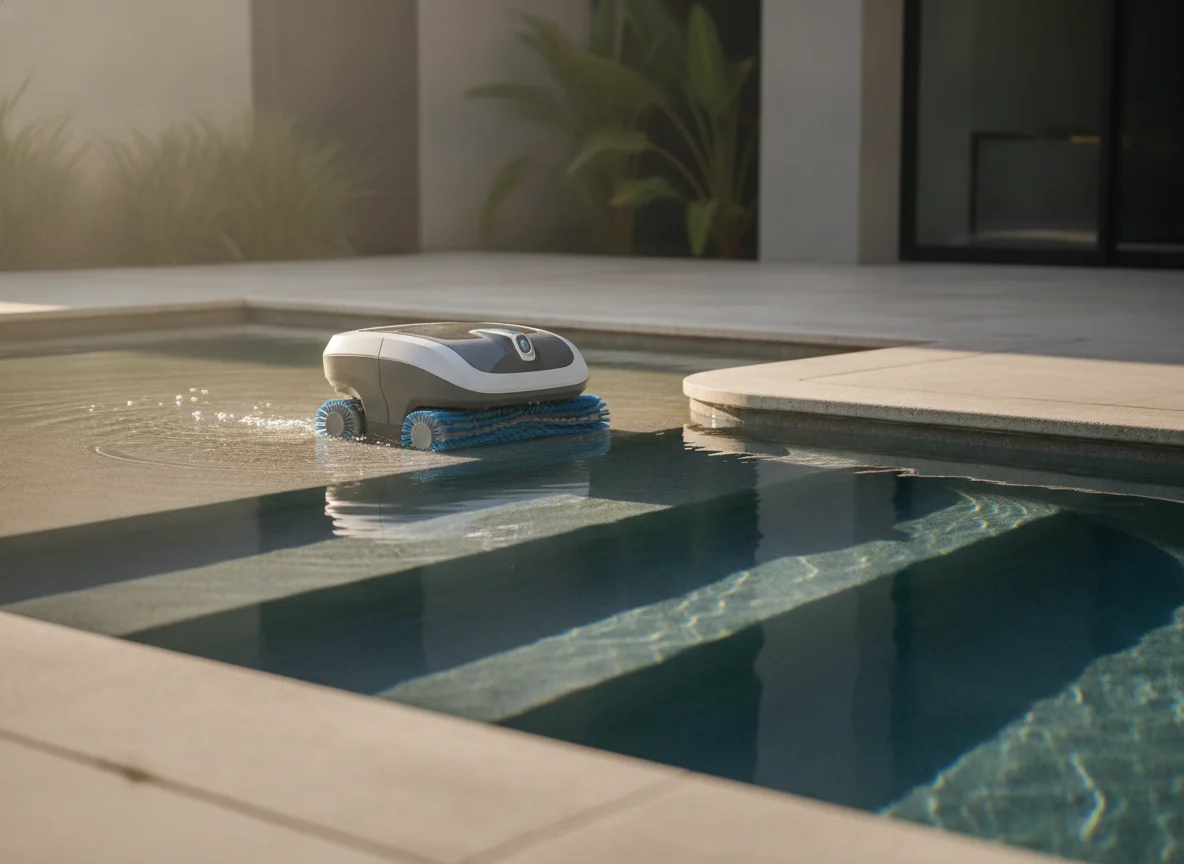
The WYBOT C2 Vision is the fine-filter choice for a visually simple pool.
Its included 10-micron insert gives it a stronger case for settled dust and silt than its camera gives it for tanning ledges.
Very shallow shelves and upper steps remain unreliable, while multicolored finishes and app complexity can undermine the camera-led pitch.
The useful hardware pairing is a 180-micron basket with a 10-micron insert. That insert has credible evidence for fine dust, pollen, sand, and silt, especially when coarse leaves are removed first and the cleaner is given a focused floor cycle. The insert can load quickly, so it should not be asked to swallow a heavy leaf fall and polish fine sediment at the same time.
Its camera can revisit obvious debris piles in a clean, visually uniform pool, but contrasting drains, stains, and multiple shades of finish can confuse that targeting. One fiberglass-pool owner reported improved routing around seating and a tanning ledge after several complete runs, yet the wider evidence still leaves upper steps and very shallow shelves conditional. Buy it when filtration matters more than guaranteed platform access.
The iGarden K70 is the endurance pick for a large open floor, not a ledge specialist.
Its unusually long floor-only operation suits sprawling conventional pools where battery headroom matters more than shallow-platform precision.
Heavy hook retrieval, an 8.2-foot published depth ceiling, and weak exact-model evidence on upper steps make it a risky geometry-first purchase.
The advertised seven-hour figure belongs to standard floor-only operation. Full floor, wall, and waterline coverage has a shorter stated ceiling, and Turbo modes shorten it again. That is still impressive cordless endurance, but a machine that cannot mount a shelf will not gain access by repeating the same approach for several extra hours.
The K70 record supports battery strength, useful storm-cleanup modes, conventional wall cleaning, and edge parking near a wall. It does not provide an equally persuasive exact-model case for narrow steps, rounded bull noses, or the shallowest ledges. Some of the detailed ownership evidence comes from related K-series machines, so it should not be silently transferred to this model.
Check the published pool-depth limit before considering it for a diving pool, and confirm the exact filter bundle because the available records disagree. The cleaner is also heavy enough that retrieval technique matters as much as its headline runtime.
The renewed Beatbot AquaSense 2 Ultra is an expensive mismatch for this particular job.
Its cameras and sensors can deliver impressive floor, wall, waterline, and visible-leaf cleaning, but they do not establish dependable stair or Baja-shelf coverage.
Direct shelf misses, substantial lifting weight, and an undocumented renewed battery make this offer difficult to justify.
A reviewed test found dirt remaining on the stairs and Baja shelf even though the machine cleaned the floor and sides well. That result matters more here than the number of sensors or the sophistication of its mapping language. Advanced perception can improve route planning, but it cannot keep tracks planted on a surface that is too narrow, too shallow, or badly approached.
The exact listing is renewed, so new-unit performance cannot certify the remaining capacity of its battery, the clarity of its sensor windows, its accessory completeness, or its prior account status. The offer also concerns a machine around 29 pounds dry that can be much heavier during its first wet lift. Surface parking helps it drain and locates it near the user, but it does not turn it into a light cleaner.
Consider the new-product family only if its strong visible-debris hunting and broader feature set matter more than the shelf. For this renewed unit, written battery protection, a complete accessory inventory, and generous return terms are prerequisites rather than nice extras.
The TALOSBO C1 is the budget cleaner for a predictable pool with ordinary walls.
It combines credible debris pickup, dual-layer filtration, and conventional wall traction without pretending to be the safe answer for a complex sun shelf.
Preset route logic can repeat cleaned lanes, miss the deep end, or stall on small obstacles without recognizing that progress has stopped.
Owners report useful pickup of sand, silt, construction debris, leaves, insects, grass, pollen, and pet hair. Its secondary foam layer strengthens the fine-debris case, although the manufacturer suggests removing that layer if wall traction suffers. Maximum filtration and maximum climbing may therefore work better as separate cycles.
The geometry evidence is less reassuring. A bowed oval wall and a small raised ladder pad disrupted coverage in one demonstration, while an irregular-pool owner found the programmed patterns failed to clean the deep end. The manufacturer itself acknowledges that the cleaner may climb steps without cleaning narrow step surfaces well.
This is the sensible lower-cost candidate for a rectangular or round pool whose floor and conventional walls matter most. Readers weighing it directly against the WYBOT can use our TALOSBO C1 versus WYBOT C1 comparison.
The BUBLUE Bubot 800P Gen2 trades charging for a cord without proving its shallow-area claim.
Continuous power and large twin baskets suit repeated floor-and-wall cycles when battery downtime is the problem.
Its cable can knot, app pairing can fail, warranty language conflicts, and exact evidence for difficult ledges is thin.
The corded design removes battery fade and recharge waits, but “continuous” does not mean the cleaner runs indefinitely or needs no handling. Its programs still have set durations, and the cable must be deployed, straightened, drained, coiled, and stored. One owner found tangling manageable; another reported recurring knots that changed the route during longer use.
Floor, wall, waterline, and shallow-area cleaning appear in the marketing, yet direct proof for abrupt shelves, narrow steps, beach entries, and raised-spa transitions is notably weak. Exact owner evidence also includes unsuccessful Bluetooth pairing and incomplete coverage, while several retained review texts appear to concern an accessory rather than the cleaner itself.
The physical control box preserves basic operation if the app fails, but the records disagree about whether coverage lasts one or two years. Written warranty confirmation is essential before accepting the cable and support risk.
The WYBOT C1 is a competent open-pool cleaner whose step claim outruns its evidence.
It can collect sand and larger leaves while covering floors, walls, and waterlines in simple pools at an accessible tier.
Seats, angled stairs, shelves, circular edges, and pronounced depth changes are recurring weak points across the C1 family.
The exact record is tiny, with only four retained customer texts, so its positive cleaning reports cannot settle durability or difficult-feature performance. One owner found the available battery insufficient for the whole pool, and another practical snag was the app’s 2.4 GHz network requirement.
Earlier C1 evidence is mixed: some owners praise wall climbing and ordinary debris collection, while stairs, sun shelves, shallow sections, and deep-end seating are credible misses. Heavy leaves can also fill the basket and interfere with the intake flap. The safe formulation is that it may reach lower steps in a favorable pool, not that it is a tanning-ledge cleaner.
If WYBOT remains the preferred brand, the WYBOT C1 versus C2 Vision comparison explains when the C2’s fine filter and camera are worth the added complexity.
The renewed Aiper Scuba N1 is the bargain-shaped offer we would skip for steps and shelves.
Its base design can clean ordinary floors and climb compatible walls, but the exact renewed offer does not resolve its shallow-feature weaknesses.
The seller does not document remaining battery capacity, renewal work, accessory completeness, or a dependable route across curved stairs and benches.
In a relevant demonstration, curved stairs repeatedly diverted the cleaner away from a shallow shelf even while it could climb ordinary walls. Wider ownership evidence gives the N1 credit for open-floor coverage, leaves, dirt, pollen, hair, and some sand, but shelves, benches, curved transitions, and steps remain credible misses.
The listing itself contains identity conflicts, including references to the Scuba S1, and does not say who renewed the unit or how its battery was tested. A shortened battery directly reduces coverage and adds more retrieval, draining, charging, and redeployment. The model’s original runtime claim is not a capacity certificate for an individual renewed unit.
Buyers interested in Aiper should start with our broader guide to the best Aiper pool cleaners rather than treating this renewed N1 as a shortcut to reliable shelf cleaning.
The 2026 Aiper Scuba S1 is a fine-filter floor cleaner with incidental step coverage.
Its strong open-floor performance, long healthy-unit operation, and 3-micron secondary layer make sense when settled debris matters more than the ledge.
It can bridge wide steps on its center shell, lose track contact, and leave a substantial share of stairs and benches untouched.
The clearest comparison result tells the whole story: the S1 covered 99% of the floor but only 62% of the stairs and bench in that test pool. That is good evidence for a floor-first cleaner and poor evidence for retiring the step brush. The same comparison also showed that a long cycle does not guarantee complete feature coverage.
The current listing pairs a 180-micron basket with a replaceable 3-micron fine layer and distinguishes its longer Eco-maintenance claim from the shorter stated ceiling for Auto, Floor, Wall, and Scheduled modes. The fine layer can retain material that coarse baskets recirculate, but it loads more quickly and adds another filter surface to rinse.
An owner with wide steps and a deep-end swim-out described the shell resting on a feature while the tracks lost contact; changing the configured pool shape improved routing elsewhere but did not alter the underlying clearance problem. Current and older versions also appear mixed in the review record, particularly around app support and runtime, so the exact listing and firmware matter.
Buy it for a mostly open floor, useful fine filtration, and occasional shallow-area contact. The full Aiper Scuba S1 review covers its version confusion, filtration trade-offs, and reliability record in more detail.
Frequently Asked Questions
Will any robotic pool cleaner scrub every step in my pool?
No, because upper-step water depth, tread width, edge shape, track contact, and the approach angle can defeat even a capable platform cleaner.
Is eight inches of water enough for the Beatbot Sora 30?
About eight inches is the stated minimum threshold, but the ledge must also be wide, unobstructed, and reachable with both tracks planted.
Does waterline cleaning include a nearby tanning ledge?
No, because waterline cleaning describes scrubbing the wall at the surface while a tanning ledge requires the robot to mount and navigate a horizontal platform.
Can I steer a cordless pool robot onto a missed step with its app?
Usually not while it is submerged, because ordinary Wi-Fi and Bluetooth communication fades underwater and most apps configure modes before launch.
Is the Beatbot Sora 70 better on steps than the Sora 30?
Not necessarily, because its decisive advantage is active surface skimming rather than a guarantee of better performance on narrow or shallow steps.
Which cleaner is better when fine silt collects on the ledge?
The WYBOT C2 Vision or Aiper Scuba S1 has the stronger fine-filter case, but neither is as convincing as the Sora 30 at physically reaching a qualifying ledge.
Should I leave a cordless cleaner in Eco mode all week?
Only if the manufacturer permits that use and the pool conditions are suitable, since the robot still cannot empty its filter, recharge itself, or correct a consistently missed shelf.
Our Top Recommendation
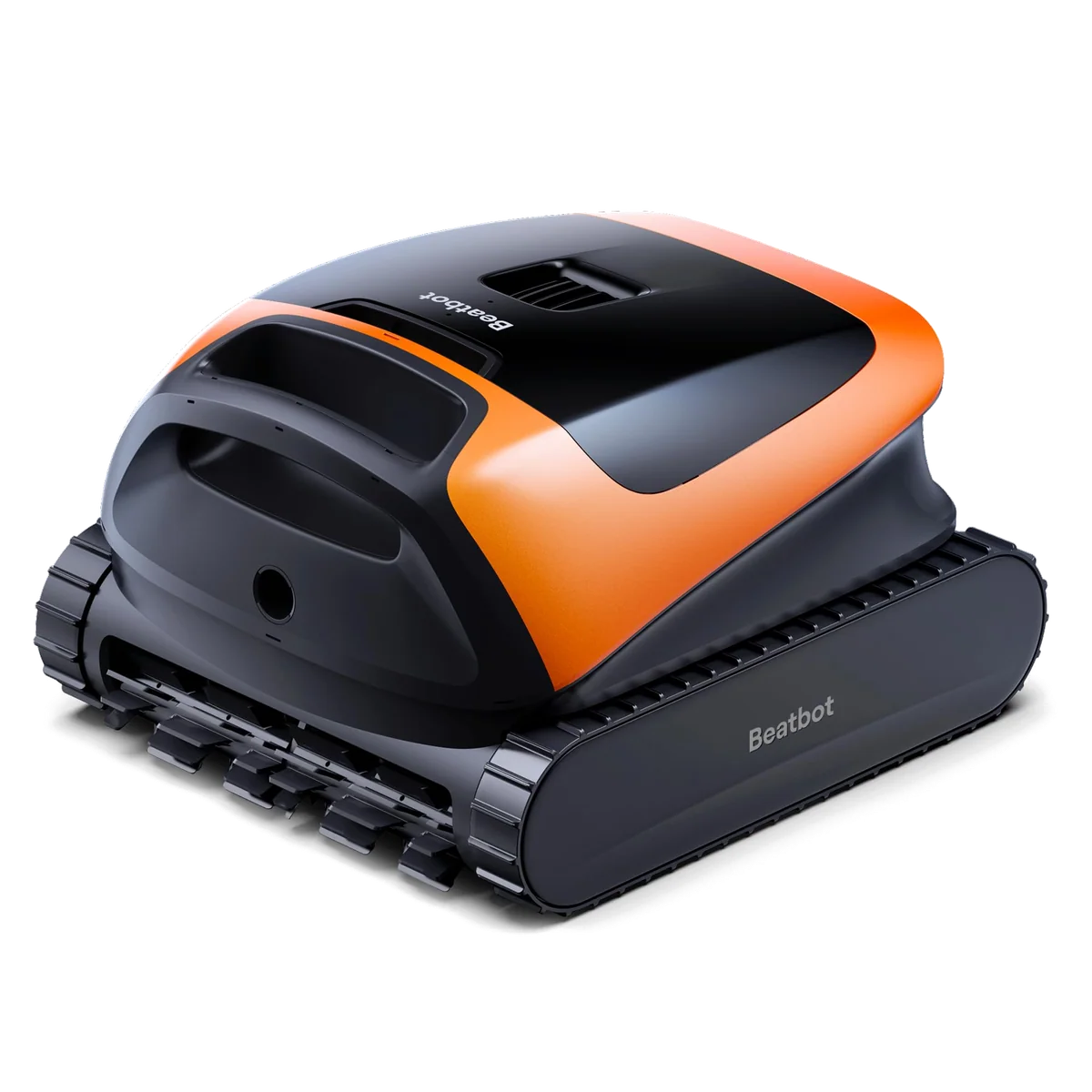
Based on our research, the Beatbot Sora 30 is our top pick — walls and waterline.
Sources (5)
- Amazon listings and customer reviews
- Owner and reviewer video, 8 channels
- Reviewed — Article — www.reviewed.com
- TALOSBO — Article — talosbo.com
- BUBLUE — Article — www.bublue.com