The iGarden K70 wins on battery and loses on polish
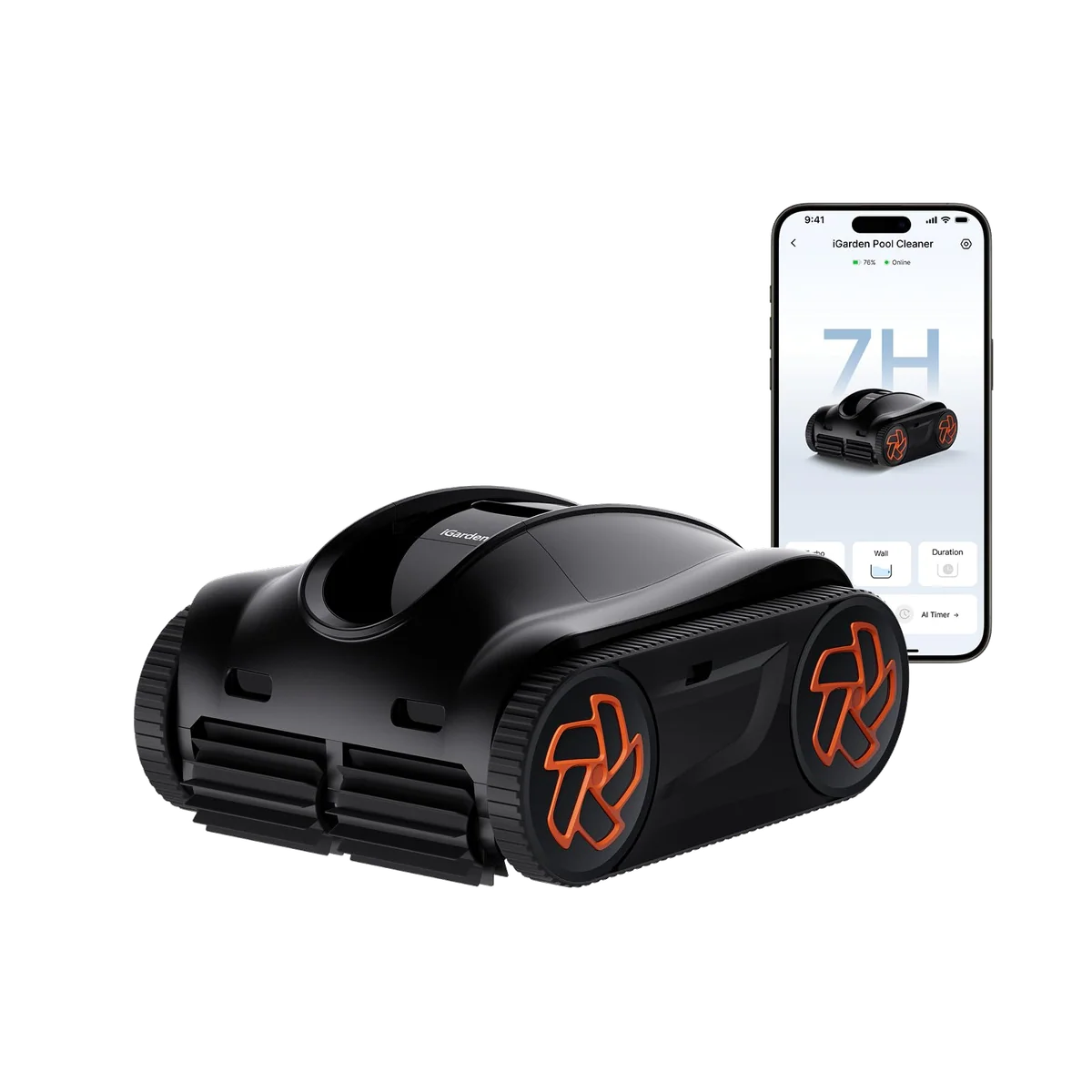
Buy the iGarden K70 if cordless endurance matters more than elegant controls and you can safely retrieve a heavy wet robot; skip it for deep diving pools, dependable step coverage, fine-silt-first cleaning or meaningful underwater app control.
A strong cleaner with the wrong kind of ambition
The K70 does not need hypercar styling, a fivefold efficiency claim or a repeat timer dressed as intelligence to justify itself. Its defensible proposition is better: a large battery drives a capable tracked cleaner through long floor sessions or substantial wall and waterline cycles without a cable crossing the pool.
That proposition comes with physical and practical conditions. The pool must stay within the published depth range, the owner must be able to retrieve the wet robot, the included filters must match the debris, and the charging recess must be inspected and dried rather than trusted blindly. Complex shallow geometry and ultra-fine haze still need a different priority.
Settle these points while the return option is straightforward
- Confirm that the package contains every advertised filter, especially the 50-micron layer if fine debris matters.
- Charge the robot fully and verify that the underside master switch and top-panel start sequence are understood.
- Run a standard floor cycle and inspect whether the route leaves persistent strips around drains, curves or corners.
- Run full coverage and watch its approach to walls, steps, shelves and the waterline.
- Pair the correct app, install available firmware and confirm that dry-land-only control is acceptable.
- Check self-parking and practice catching the structural handle without pulling on the basket handle.
- Inspect the charging recess after retrieval and establish a safe drying and charging location away from the pool.
- Use support promptly if the cleaner fails to start, loses abnormal runtime, flips repeatedly or cannot collect ordinary loose debris.
The final verdict is a qualified buy. Choose the iGarden K70 for battery-backed cordless cleaning in a compatible pool, but walk away if the app, automation language or 16-day headline is doing more work in the decision than the actual floor, wall and waterline machinery.
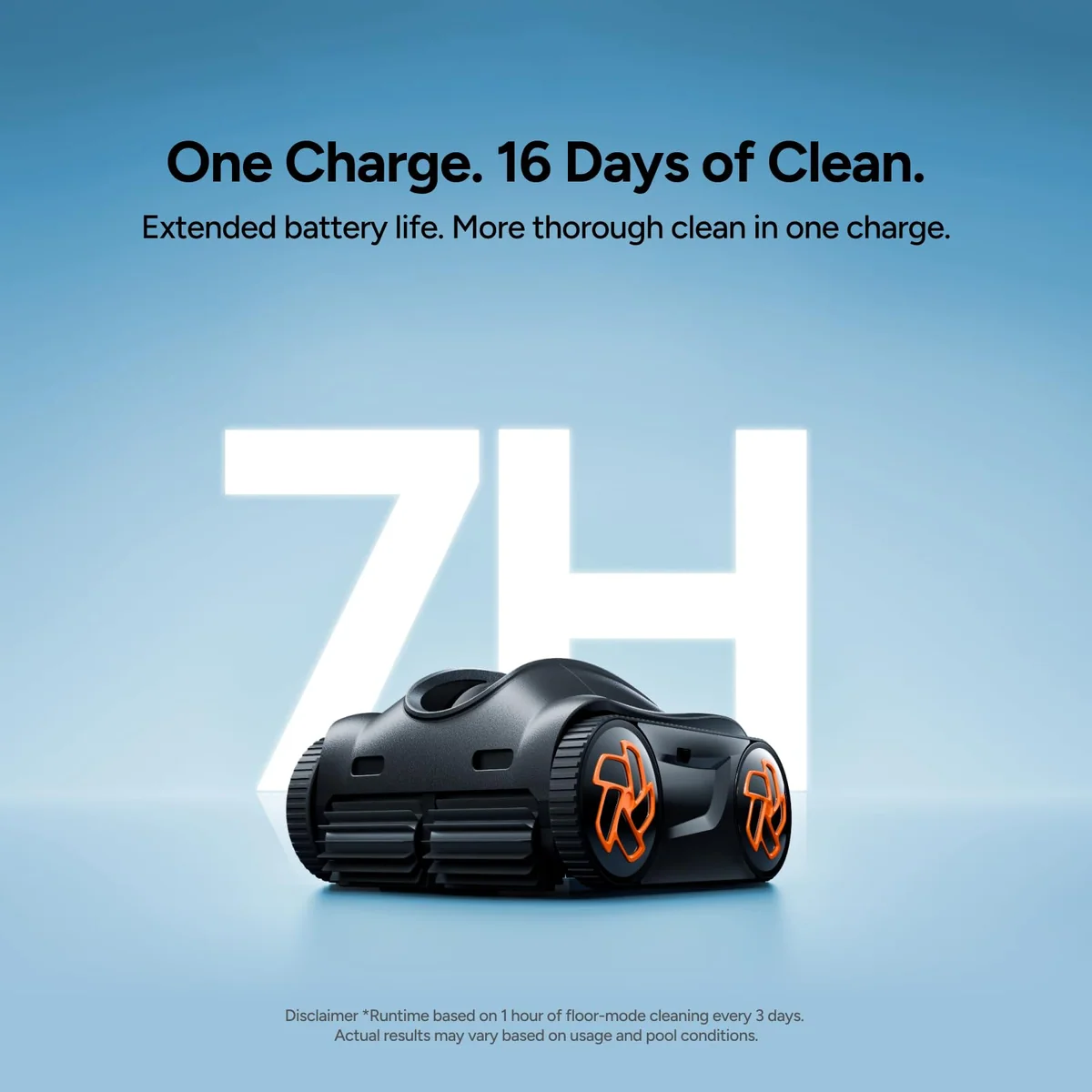
The K70’s best specification is also its most abused one. Seven hours is the rated maximum for floor-only cleaning. Select floors, walls and the waterline and the official figure falls to 3.75 hours; add Turbo and full coverage drops again to 2.75 hours.
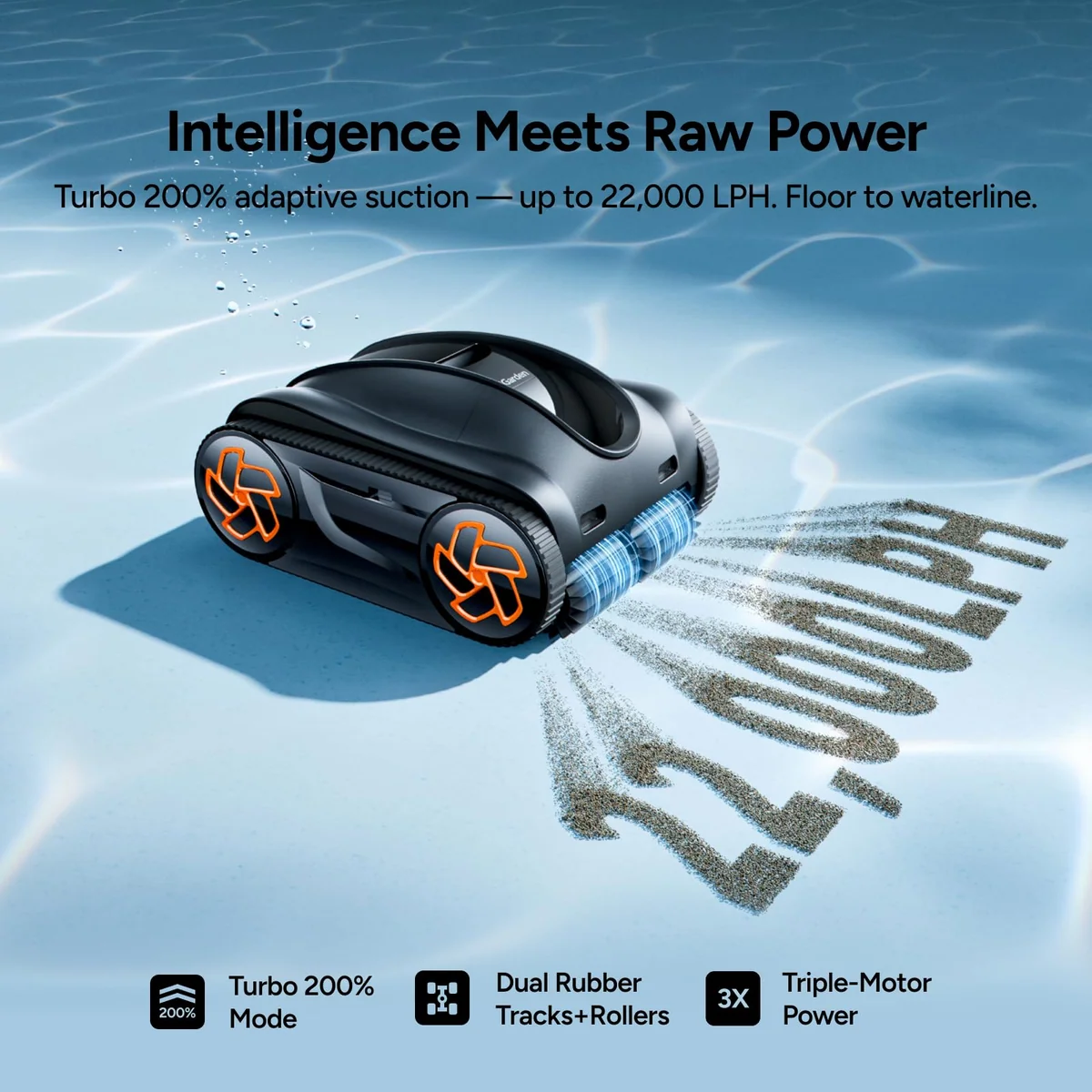
That is still substantial cordless endurance. The K70 combines a 4-liter basket, dual active brushes, tracked drive, three brushless motors and a claimed flow range reaching 22,000 liters per hour. Closely related K-series machines have collected leaves, bugs, grass, hair, sand and small pebbles while climbing conventional walls and crossing drains. The cleaning hardware deserves more confidence than the language wrapped around it.
The ownership experience is less convincing. The phone connection disappears after submersion, the touchscreen can be difficult in sun or with wet fingers, the underside master switch is easy to overlook, and retrieval still involves finding a dark handle with a pole hook before lifting 21.6 pounds plus retained water. Reports from K60, GT60 and K Pro versions also repeatedly found water around the covered charging pins.
So the useful reading is simple: the K70 is a big-battery pool cleaner with credible conventional machinery, not an autonomous pool custodian. It can remove a great deal of recurring underwater work, but somebody still has to choose the mode, deploy it promptly, empty the basket, retrieve the slippery chassis, dry the connector and connect the charger.
Key Specifications
The intelligence is mostly a timer with good route planning
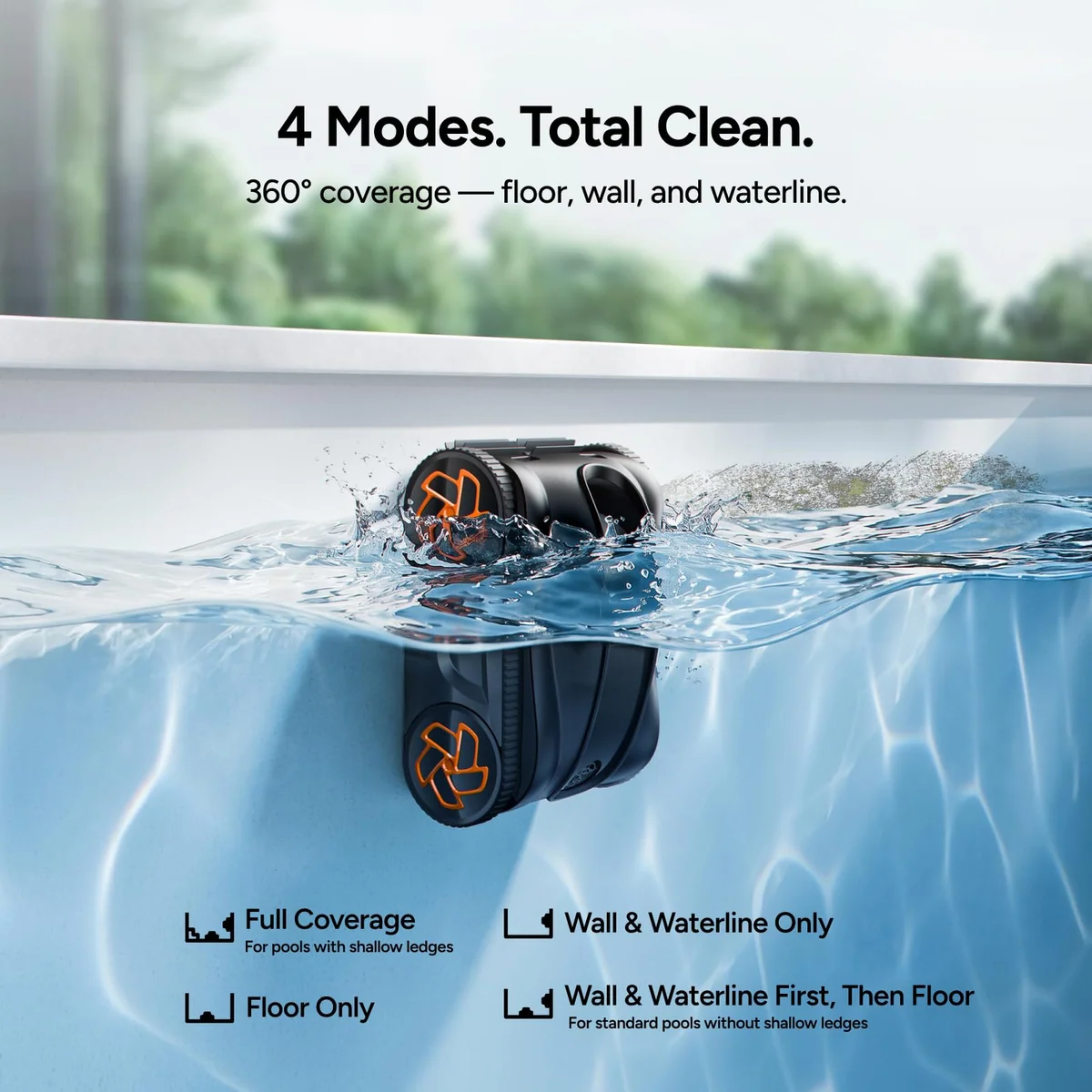
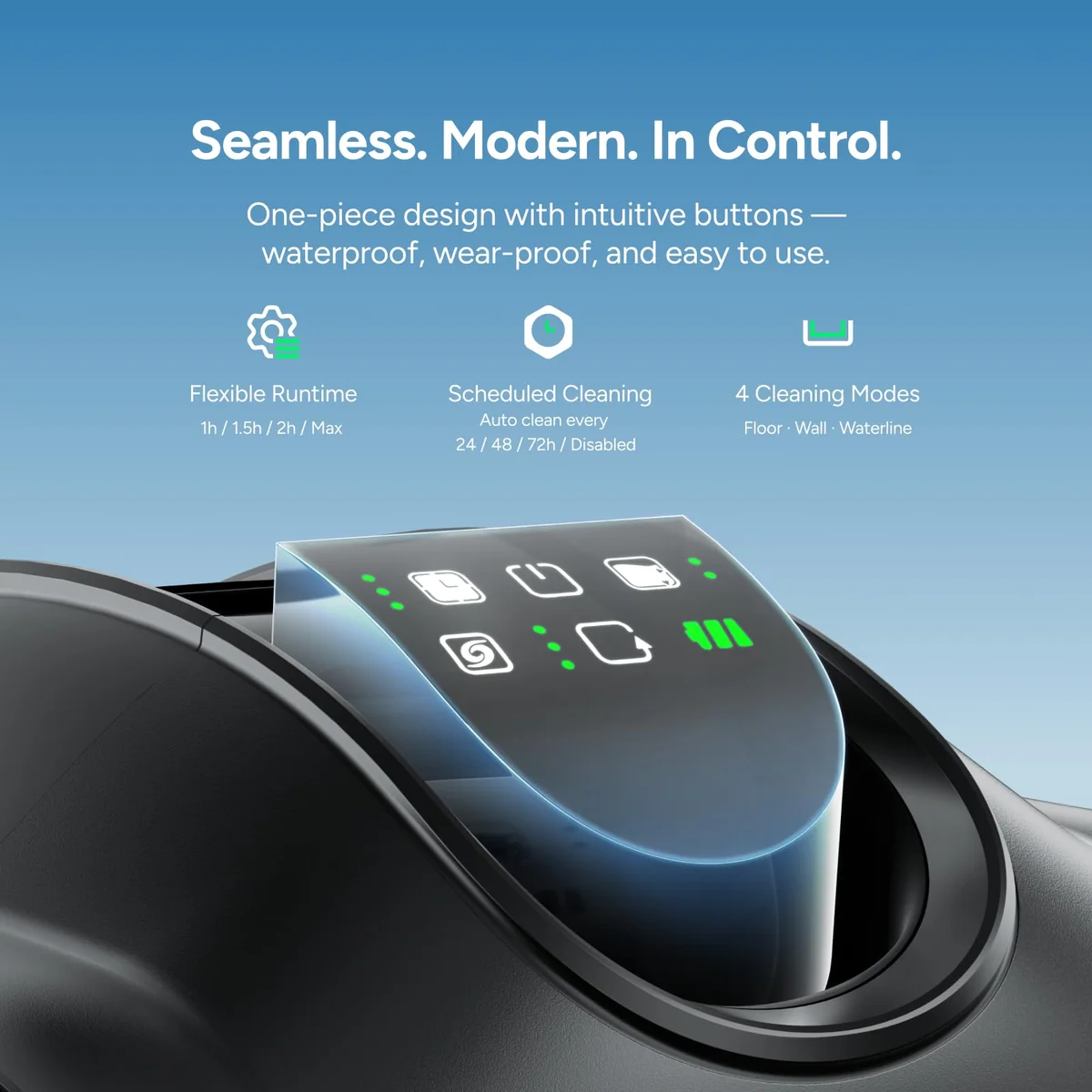
The K70 offers four useful cleaning choices: floor only, wall and waterline only, walls first followed by the floor, and full coverage. Cycles can run for one hour, 1.5 hours, 2 hours or until the selected mode reaches its battery limit. Those controls make the large battery practical because a routine clean does not need to consume the entire charge.
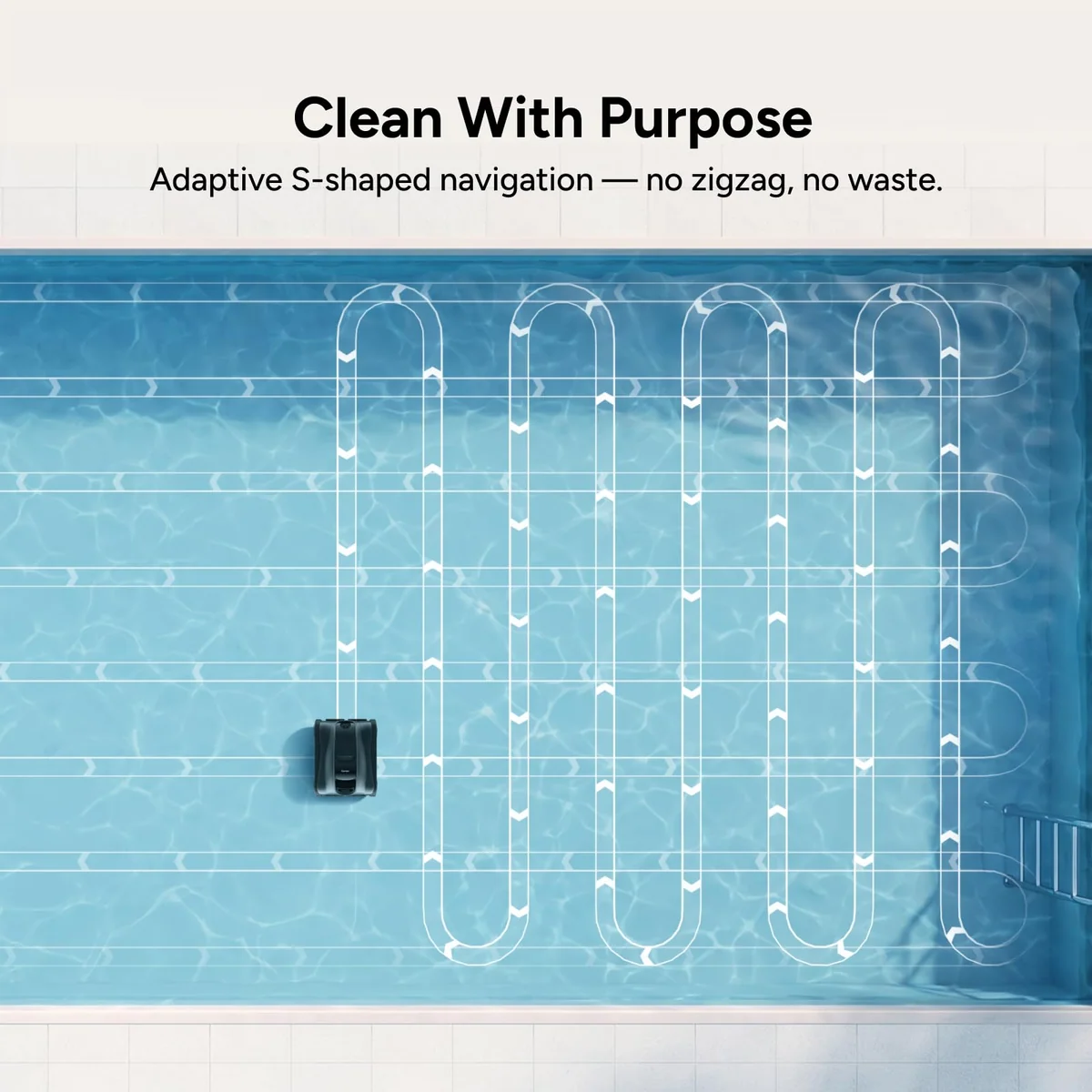
The systematic S-shaped route is more persuasive than the advertised fivefold efficiency claim. Closely related machines have crossed pools in orderly lines, turned near opposite walls and resumed coverage instead of relying solely on random impacts. They have also missed corners, approached walls at unhelpful angles and shifted debris outside the next pass, so no supplied benchmark validates a fivefold advantage over a named competitor.
What the label says
“AI” scheduling, dynamic path optimization, smart control and self-parking.
What the owner gets
Repeat intervals, onboard route calculations, dry-land settings and a stop near the pool edge.
The app hands the job off at the water
The app can configure the cleaning area, duration, Turbo setting, repeat schedule, time zone, network and firmware while the cleaner is out of the pool. The official material explicitly says communication is lost underwater and that internet setup uses 2.4 GHz Wi-Fi. Once submerged, the K70 follows the stored program without live phone steering.
Related K-series app reports found little beyond the controls already available on the robot. There was no detailed pool map, route display, cleaning history, useful area statistic or precise countdown worth buying the machine for. One GT60 reviewer initially downloaded the wrong similarly named app; the correct iGarden Robot app paired, but still exposed few meaningful extras.
Firmware still matters even when the interface is basic. An official-store owner reported materially better pickup after an update, while a K25 owner described failed Wi-Fi and Bluetooth connections before the unit was replaced. That does not prove a K70 software defect, but it makes update access and seller support more important than the brochure’s smart-home tone suggests.
The physical controls have a learning curve
Related K-series evaluators consistently found the touchscreen difficult to read in bright sunlight, and wet fingers could make the buttons finicky. The underlying options are sensible; their presentation is not. Dry the panel, shade it with your body and confirm the selected program before carrying the machine to the water.
The more consequential trap is underneath. A padlock-marked rotary switch acts as the master power control, even though it does not obviously read as one. After waking the cleaner and selecting a program, the owner must confirm the start and place it in the water within roughly three minutes before standby intervenes. Missing either step can make a charged machine look dead at the bottom of the pool.
That sequence becomes routine, but it should not have needed interpretation. A robot marketed around low-effort automation ought to make “on” and “start” unmistakable.
Strengths & Limitations
Strengths
- The seven-hour floor-only rating gives routine maintenance far more headroom than a typical short-cycle cordless cleaner.
- The 4-liter top-loading basket suits leaves, bugs, hair, sand and other common residential-pool debris.
- Four cleaning modes let owners spend battery on floors, walls or the waterline instead of treating every run alike.
- Tracked drive and active brushes provide credible wall climbing and waterline scrubbing on conventional pool geometry.
- One-hour to two-hour cycle choices make several maintenance runs per charge practical in a lightly soiled pool.
- Replaceable brushes, removable tracks and an accessible impeller improve the routine maintenance story.
- Brand-level support reports show a strong pattern of responsive troubleshooting and replacement handling.
Limitations
- Full-coverage runtime is only 3.75 hours, and Turbo full coverage reduces it to 2.75 hours.
- The app loses communication underwater and offers little mapping, history or live operational detail.
- The touchscreen, master switch and three-minute deployment sequence are less intuitive than the marketing implies.
- Retrieval requires a pole hook and a careful manual lift of a dark, slippery, 21.6-pound dry chassis.
- Related K-series reviewers repeatedly found water around the charging pins despite the rubber cover.
- Shallow ledges, rounded steps, tight corners and complex transitions can remain unfinished.
- The exhaust can disturb fine debris, and the exact Amazon package may include only the 180-micron filter.
- The published 8.2-ft depth ceiling rules out deeper diving pools.
Seven hours is one mode, not the whole machine
Runtime changes sharply with the work assigned. Floor-only operation avoids the energy cost of climbing, holding the waterline and repeatedly changing orientation. Turbo raises flow for heavier debris but spends the battery much faster. The mode table is therefore more useful than the large number printed in the product name.
| Cleaning setup | Rated maximum | Best use |
|---|---|---|
| Standard, floor only | 7 hours | Long routine passes and several short maintenance cycles. |
| Standard, full coverage | 3.75 hours | Floors, walls and waterline without maximum flow. |
| Turbo, floor only | 3.25 hours | Leaves, twigs and heavier settled debris after a storm. |
| Turbo, full coverage | 2.75 hours | Maximum cleaning effort across the whole supported surface set. |
The advertised 16-day scenario is arithmetic, not continuous operation. Amazon describes one standard one-hour floor cycle every three days, which can place short runs on days 1, 4, 7, 10, 13 and 16. That schedule may suit a pool that begins clean and receives a light debris load, but it does not expand seven battery-hours into two weeks of active cleaning.
Nor does battery capacity expand the basket. iGarden’s own care guidance calls for cleaning the filter after use, while a heavy leaf load can clog the 4-liter basket before the charge is close to exhausted. Scheduled restarts are useful because they ration a large battery; they do not empty debris, rinse the screen or decide that yesterday’s storm requires intervention.
Capable pickup with a messy exhaust
The shared K-series cleaning mechanism makes a strong case on visible maintenance debris. Demonstrations of related models show leaves disappearing quickly, ordinary sediment collecting in the basket and enough traction to climb pool walls. A K60 reviewer found Turbo particularly useful for leaves, grass, small rocks and pebbles, while warning that larger stones exceeded the cleaner’s useful intake.
The intake does not capture everything it disturbs on the first encounter. Two sibling demonstrations observed debris being shifted or blown by the exhaust, sometimes leaving material suspended until a later pass approached from a better direction. That makes a long cycle valuable, but it also means the robot can leave a pool temporarily cloudier when powdery sediment is the main problem.
Do not translate “Turbo 200%” into 200% more cleaning. The listing supports a maximum claimed flow of 22,000 liters per hour, not a controlled finding that the robot collects twice as much debris or cleans twice as fast. Turbo is the high-output setting, and the direct K70 runtime penalty is the honest measure of what it costs.
Walls are credible, steps remain conditional
Wall and waterline cleaning are real functions rather than category labels. Related K-series units have climbed conventional vertical walls, moved across benches and reached the waterline, although angled climbs sometimes left persistent marks until the robot approached straight. One GT60 evaluation found winter tidemarks removed, while another K60 run recovered substantial algae after a better-centered climb.
Step coverage depends on geometry and water depth. The chassis crossed drains and some deeply submerged features, but shallow steps can leave too little water for the turbine, and rounded bull-nosed edges can stop the tracks from getting purchase. A broad underwater bench may receive a pass; a narrow tanning ledge or upper step should remain on the manual-cleaning list.
Waterline cleaning also has a precise meaning. The robot scrubs the vertical boundary where the pool wall meets the surface. It does not patrol above the water or collect floating leaves, so tree-heavy pools may still need a hand net or one of the site’s recommended surface skimmers.
The filter bundle needs checking
The exact Amazon offer describes a 4-liter basket with 180-micron mesh. The current iGarden store page instead describes a dual-layer combination of 50 and 180 microns, assigning the coarser layer to leaves, twigs, pebbles and visible debris and the finer layer to dust, sand and small particles. The records do not establish that every K70 sold through Amazon includes both.
Verify the package before buying if fine debris is the reason for the purchase. A 180-micron K60 basket captured ordinary sand and even visible Saharan dust in one related-machine evaluation, but another assessment found that this standard filter was less convincing against ultra-fine silt than a multistage system. The newer 50-micron layer should improve retention, yet it still is not a promise of water polishing when the exhaust is disturbing the same material.
Buy the battery only if the pool can use it
The K70 fits a medium or large residential pool within the published 6 × 12 m size and 8.2-ft depth limits. Its ideal pool has an open floor, conventional walls and a recurring mixture of leaves, bugs, hair, sand and ordinary settled dirt. Its ideal owner wants to avoid a cable, likes the option of several short cycles per charge and can comfortably handle the retrieval routine.
It is a weak fit for a 9-ft or 10-ft diving pool regardless of a K90 owner’s anecdotal success beyond the specification. It is also a poor match when narrow steps, shallow shelves or bull-nosed ledges must be cleaned perfectly, when powdery haze is the main problem, or when the intended owner cannot safely lift the machine.
The app should not decide the purchase. Buyers who want maps, detailed history, remaining-time information or underwater steering will find the smart layer thin. Buyers who merely want to select a mode, schedule a repeat interval and let the robot follow an organized route may find it sufficient.
If endurance is the priority, compare the K70 with the models in Smart Pool Bots’ cordless robotic pool cleaner guide. If the pool’s problem is silt, pollen or cloudy fine debris, start with the fine-debris recommendations rather than paying for unused battery capacity. Pools dominated by steps and tanning shelves need the more geometry-focused advice in our guide to shallow-feature cleaning.
A corded alternative changes the inconvenience rather than removing it. The Dolphin Nautilus CC gives up the K70’s cable-free deployment and much of its wall-to-waterline remit, but it is lighter and comes from a more established pool-robot lineage. The broader corded versus cordless guide is useful if lifting, charging and battery aging sound more troublesome than managing a floating cable.
Within iGarden’s own range, the K70 earns its place only when its battery tier is genuinely useful. The smaller K36 and K40 share much of the chassis and control philosophy with shorter runtimes, while the K90 stretches the floor-only maximum farther without making the cleaner lighter or the app more capable. Our iGarden lineup guide separates those battery tiers without pretending that the largest number is automatically the best buy.
The hard part begins when the cycle ends
Self-parking brings the cleaner near an edge as the battery runs down. It does not climb to a deck, rise into an easy carrying position or find a charging station. Retrieval still requires the supplied hook attached to a telescopic pole, followed by a manual lift while water drains from the chassis. Amazon owners describe the near-wall stop as useful, but it solves the search rather than the extraction.
The dry machine weighs about 21.6 pounds. In related-machine evaluations, the black lifting point was difficult to distinguish underwater, the removable basket handle was easy to mistake for the structural carry handle, and the wet chassis felt slippery. One large reviewer still considered the lift heavy enough to require deliberate body mechanics.
Judge the lift before the battery
A cleaner that runs for seven hours is poor value if the intended owner cannot safely hook, drain and lift it from the pool’s least accessible edge.
The charging port deserves caution
The K70 uses direct cable charging behind a rubber cover rather than a dock. Several close sibling models shared an uncomfortable pattern: reviewers found water around the charging pins after runs even when the plug had been fitted. None established the long-term electrical consequence, but the repetition across K60, GT60 and K Pro chassis makes careful drying a sensible ownership requirement.
Move the cleaner away from the pool, open the cover, inspect the recess and let it dry before connecting power. Charge it in a covered, ventilated location on a stable surface rather than beside the water. The Amazon and iGarden recharge figures differ slightly at 4.5 hours versus approximately 5 hours, so the charger’s completed state matters more than a kitchen timer.
The basket becomes easy once rinsed backward
The top-loading basket is accessible without turning the cleaner over, and the brushes, tracks and impeller are presented as replaceable or serviceable components. The impeller cover can be removed with ordinary screws to clear lodged debris, which is a better maintenance story than a completely sealed cleaning path.
Dense organic debris can make the basket tedious to clean. One K-series evaluator found that spraying from inside merely moved material around the compartments, while directing the hose through the outer screen released it more effectively. Rinse after substantial runs, clear hair from moving parts and do not let the 4-liter capacity become permission to leave damp debris in place.
Support looks stronger than the durability record
iGarden’s K Series page advertises a three-year warranty, although the wording and eligibility should be checked for the exact seller and order channel. Brand-level owners repeatedly describe quick troubleshooting and replacement handling for tread, switch and startup faults. The company also responded to every captured negative Trustpilot review, typically within two weeks.
That is valuable recovery evidence, not proof that the hardware will age well. The brand’s pool-cleaner history is shorter than the established corded competition, and some of the strongest support praise exists because a machine needed replacement. Preserve the receipt, inspect the package immediately, run every important mode early and treat a prompt replacement process as protection rather than a feature of normal ownership.
Frequently Asked Questions
Will the iGarden K70 run for seven hours?
Seven hours is the official floor-only maximum, while full coverage is rated for 3.75 hours and Turbo full coverage for 2.75 hours.
Can the app control the K70 while it is underwater?
No, the connection is lost after submersion, so the app configures a program on land rather than steering or monitoring the cleaner live.
Does the K70 clean walls and the waterline?
Yes, it has dedicated wall and waterline modes, although angled climbs, shallow features and difficult transitions can leave sections unfinished.
Will it clean pool steps and tanning ledges?
It may cross broad submerged steps or benches, but shallow water, narrow surfaces and rounded edges make complete coverage unreliable.
Is the K70 suitable for a 10-ft diving pool?
No, its published operating depth stops at 8.2 feet, so a 10-ft pool lies outside the specified range.
Does the K70 include a fine-particle filter?
The Amazon record specifies 180-micron mesh while iGarden’s store describes 50-micron and 180-micron layers, so buyers should verify the exact package contents.
Can the K70 stay in the pool for 16 days?
The claim describes intermittent one-hour floor cycles every three days, not continuous cleaning or freedom from basket rinsing and other maintenance.
Does self-parking lift the K70 to the waterline?
No, it stops near an edge but still requires a pole hook and a manual lift of the heavy wet cleaner.
Is the three-year warranty a reason to buy?
The warranty and responsive replacement reports add useful protection, but seller eligibility, exclusions and return handling should be verified before relying on them.