The iGarden KN35 is the best bet in a lineup with sharp limits
iGarden’s three cleaners look close enough to invite a battery-size comparison, but that shortcut misses the decision. Pool geometry, debris type, retrieval effort and confidence in the first unit matter more than the largest runtime printed in a title.
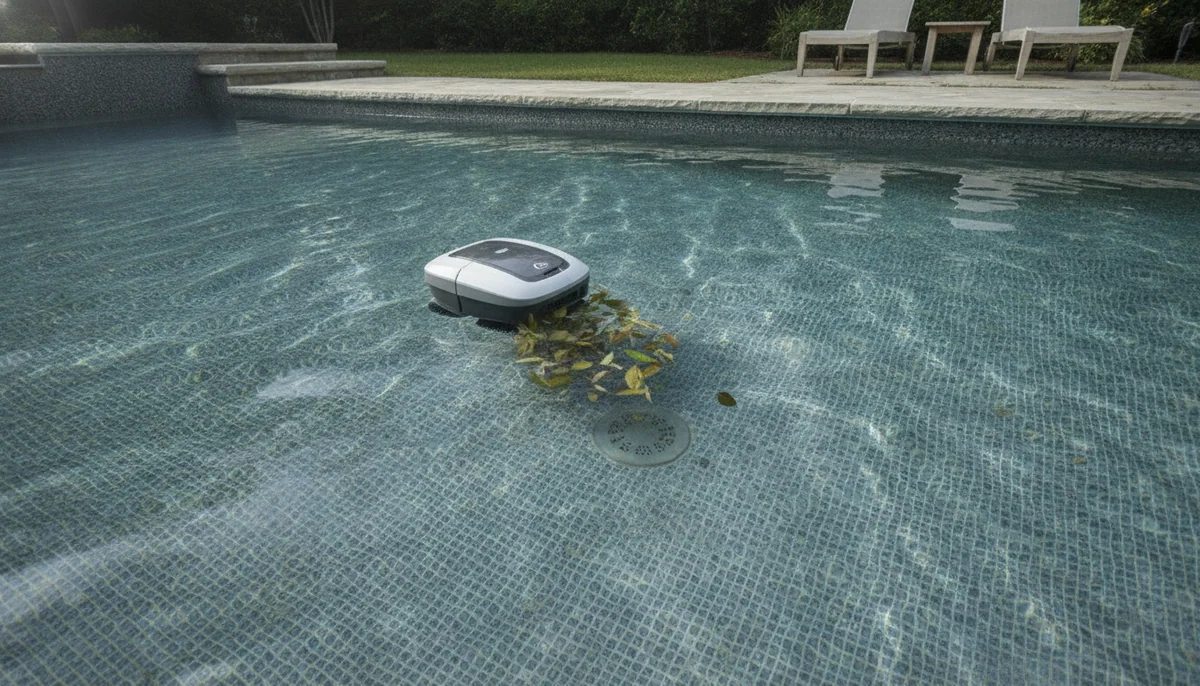
The KN35 wins because it offers the most balanced version of the iGarden idea: drop-in cordless cleaning, selectable cycles, a practical top basket and enough endurance for routine work without pushing the owner into the largest battery tier. Its limits are ordinary but important. Steps, tight corners, ladder gaps and raised floor fixtures can still defeat it.
The K70 is the specialist. Its long floor-only rating gives a large or frequently cleaned pool far more battery headroom, although the robot remains heavy to retrieve and its app still stops communicating underwater. The K36 sits last because useful pickup and wall climbing cannot erase reports of flipping, shortened runtime, wheelies and early failure.
Buy first
KN35: the best fit for routine cleaning in an open, uncomplicated residential pool.
Buy for endurance
K70: the stronger choice when repeated cordless floor cycles justify a much larger battery.
Buy only with an exit
K36: capable when healthy, but too inconsistent to recommend without an easy return path.
At a Glance: All iGarden Pool cleaners Compared
| Feature | Editor's Pick IGarden KN35 | IGarden K36 | IGarden K70 |
|---|---|---|---|
| Price Range | $200–$500 | Under $200 | $500–$1,000 |
| Claimed runtime | Up to 210 minutes | Up to 220 minutes for the floor, with materially less time in full-coverage mode | Up to 7 hours on the floor or 3.75 hours in full coverage |
| Check Price on Amazon | Check Price on Amazon | Check Price on Amazon |
Three similar cleaners, three different bets
The ranking favors the machine most likely to remove routine work without creating a new supervision problem, not the model with the loudest battery claim.
1. IGarden KN35 — The iGarden KN35 is the sensible first choice for a simple pool.
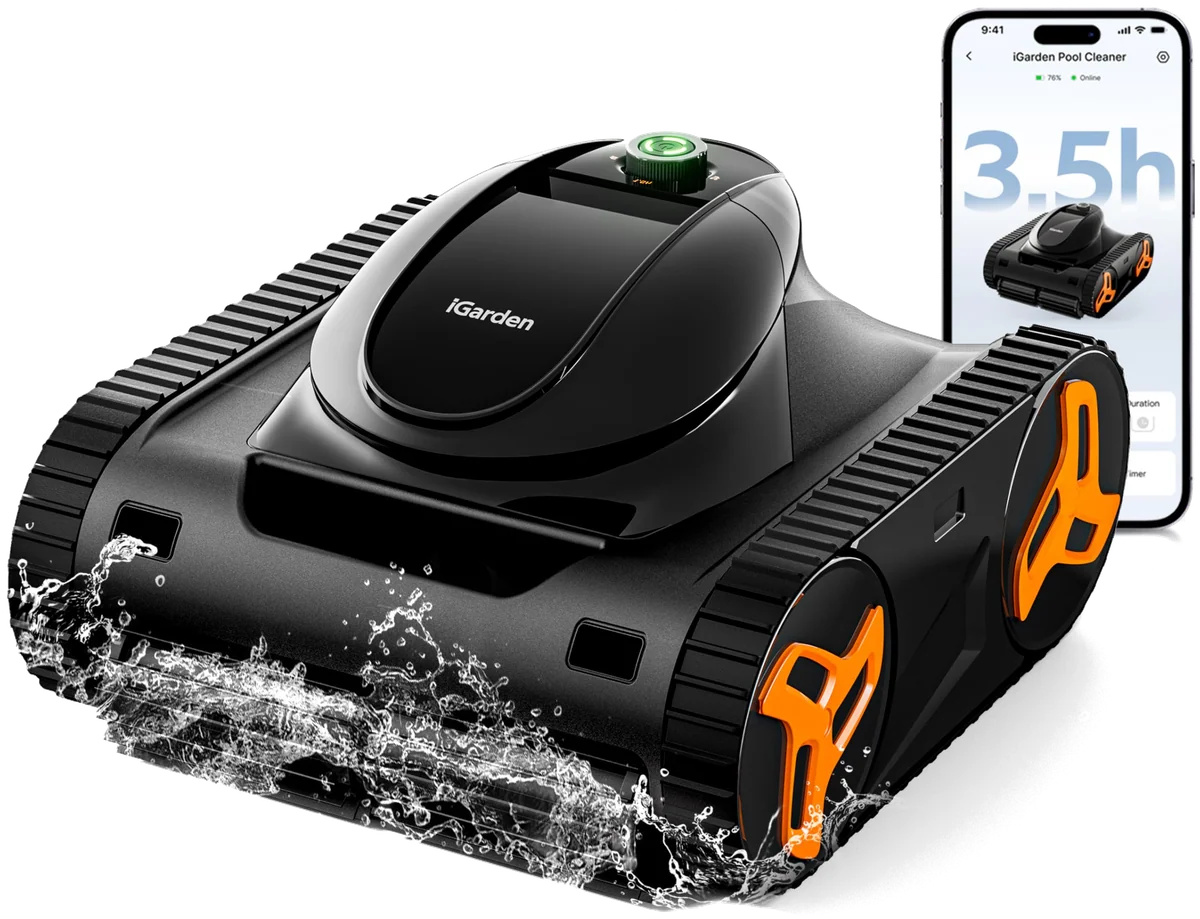
Its 210-minute maximum, selectable cycle lengths and 3.2-liter basket make it the most balanced cleaner in this group.
Steps, tight corners, ladder gaps and raised floor fixtures can remain dirty or trap the robot.
The KN35 gives owners one-hour, 90-minute, two-hour and maximum cycle choices rather than forcing the battery to be spent in one long outing. Its three modes divide the work between the floor, broader floor-to-waterline coverage and a walls-first sequence, while the 180-micron top basket is sized for ordinary maintenance debris. The advertised 210 minutes is a maximum, not proof that every mode will run that long.
Its strongest evidence concerns open surfaces. Owners report useful pickup of loose dirt, sand, insects, hair and smaller leaves, along with credible wall and waterline reach in pools that give the tracks room to work. That makes the KN35 a good replacement for the ritual of priming a vacuum hose and routing debris through the pool filter.
The same owner record sets the boundary. A narrow ladder gap trapped one unit, raised floor fixtures repeatedly stranded another, and an irregular pool still kept its steps and tight corners. Larger debris could be pushed rather than collected, while adhered silt sometimes needed brushing before the intake could capture it.
Buy this model for recurring loose debris in a conventional above-ground or inground pool. Do not buy it because “smart navigation” sounds like mapping; the available record supports organized movement, not a stored floor plan, live route display or guarantee that every feature will be reached.
Best assignment
Frequent floor cleaning with occasional wall and waterline cycles.
Friendly debris
Loose dirt, sand, insects, hair and modest amounts of smaller leaves.
Pool warning
Closely spaced ladders, prominent drains, steps and complicated transitions.
Strengths
- Cordless deployment eliminates the hose and floating power cable from routine cleaning.
- The selectable cycle lengths make the large advertised battery capacity useful for both quick and extended maintenance.
- Owner reports support capable floor, wall and waterline cleaning in pools without troublesome geometry.
- The 3.2-liter top basket is large enough for ordinary maintenance loads and easy to rinse.
- Floor-only and broader coverage modes let the owner match energy use to the actual chore.
Limitations
- Steps, tight corners, ladder gaps and raised floor fixtures can remain dirty or trap the robot.
- Large leaves and adhered fine silt are less dependable targets than loose dirt and smaller debris.
- The app disconnects underwater, so it cannot steer, recall or reconfigure the robot during a cycle.
- Wet retrieval can demand real effort, and a little collected material may fall back during draining.
- The exact KN35 lacks a convincing long-term record for battery life, repairability and replacement-part access.
2. IGarden K36 — The iGarden K36 has useful hardware trapped inside an uneven reliability record.
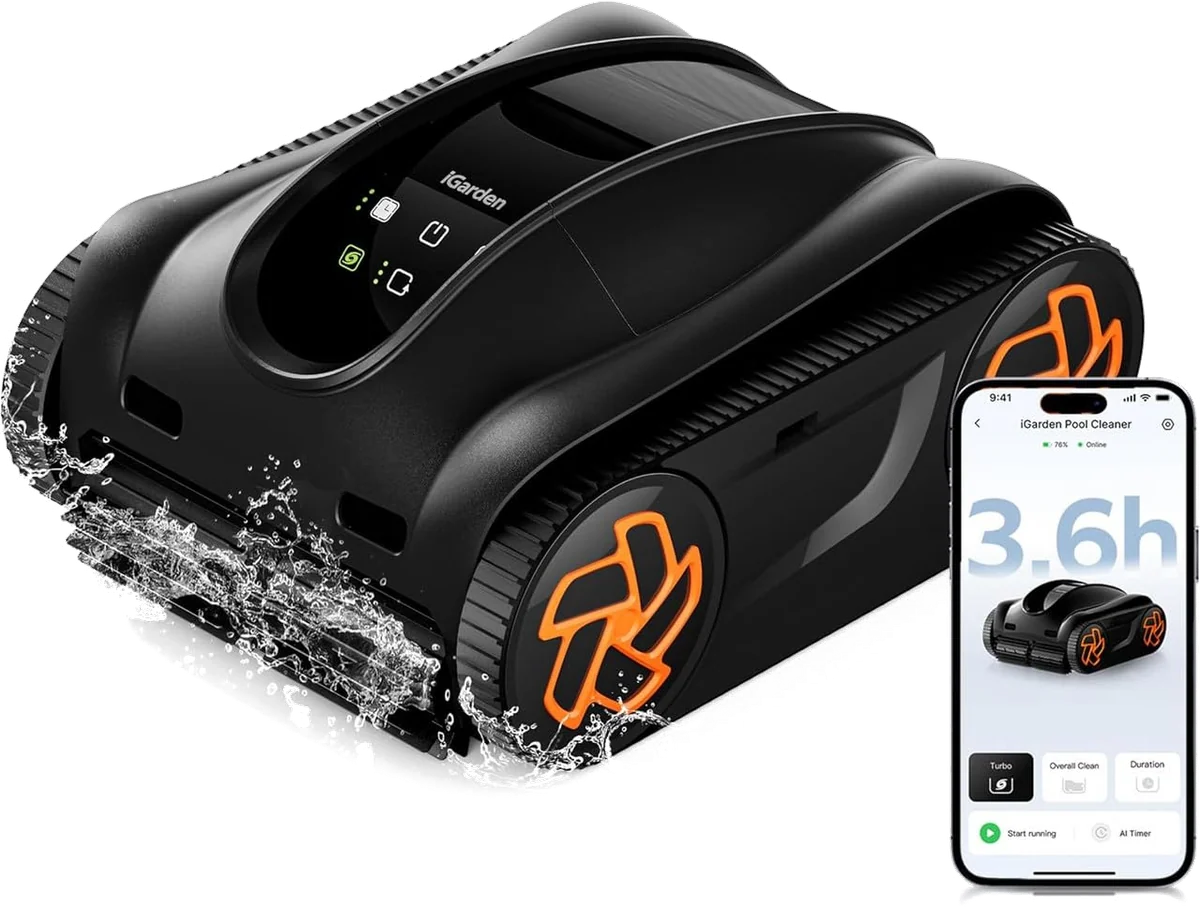
Choose it only when the 4-liter basket and long floor-only cycle matter enough to justify testing the exact unit aggressively.
Direct owners report wheelies, flipping, weak pickup, one-hour runtime and an Error 3 failure after minimal use.
A healthy K36 can perform the job its specification suggests. The listing gives it a floor-only ceiling of 220 minutes, a 4-liter top-loading basket with 180-micron mesh, floor and full-coverage modes, physical controls and automatic parking near a wall. Its broader cycle is much shorter, and the same listing conflicts between 135 and 150 minutes for floor, wall and waterline coverage.
The cleaning mechanism is not the problem in every sample. Owners describe successful pickup of leaves and sand, long floor cycles and convenient basket rinsing. The robot can also climb suitable walls and reach the waterline when charge, filtration and traction cooperate.
Consistency is the disqualifier. One owner watched the K36 pass over debris while spending long stretches with its front wheels raised, another reported flipping and roughly one hour of battery life, and a third encountered an Error 3 failure on the second attempted use. Responsive support can replace a bad machine, but it cannot return the time lost discovering that the first one was bad.
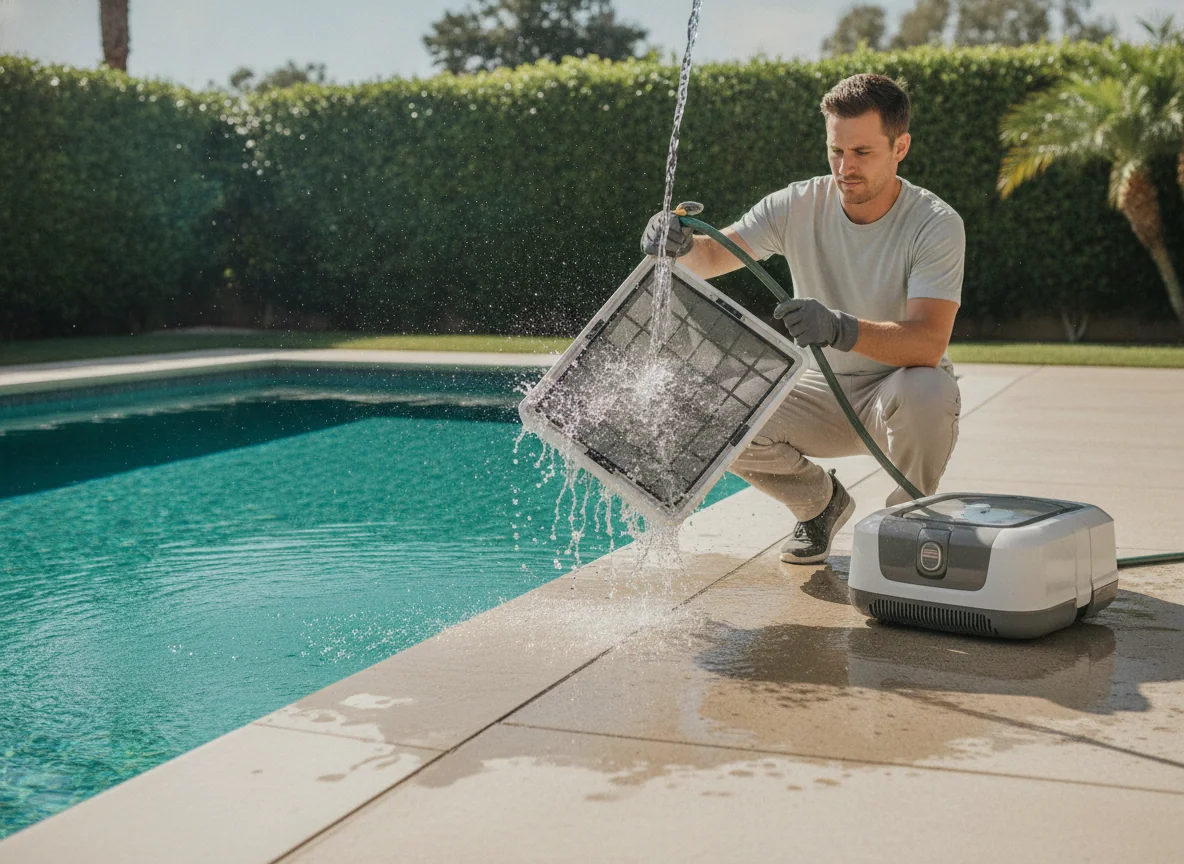
The K36 belongs with a buyer who can lift a substantial wet cleaner, inspect every important pool surface and use the return process without hesitation. Run floor-only and full-coverage cycles early, check for repeated missed strips, and reject chronic flipping, wheelies, errors or a large runtime shortfall instead of explaining them away as smart navigation.
Best assignment
Long floor maintenance where a large basket is more important than precise route coverage.
Friendly debris
Leaves, bugs, hair, sand and ordinary settled dirt.
Ownership warning
First-unit faults are serious enough to make the return window part of the product.
Strengths
- Healthy units provide unusually long floor-only endurance for a cordless cleaner.
- The 4-liter top-loading basket handles routine leaves, insects, hair, sand and settled dirt well.
- Physical controls keep normal cleaning available without an app account.
- The robot can climb suitable walls and reach the waterline when traction and flow are favorable.
- Cordless operation removes the floating cable and external power supply from the cleaning cycle.
- Customer support has a documented pattern of responding with troubleshooting, refunds and replacements.
Limitations
- Direct owners report serious first-unit faults, including flipping, wheelies, short runtime and an Error 3 failure.
- Its organized navigation can still leave wide strips, corners, steps and ledges untouched.
- Full-coverage runtime is much shorter than the headline floor-only maximum, and iGarden publishes conflicting figures.
- The app cannot steer, recall or meaningfully monitor the robot underwater.
- Retrieval is awkward because the cleaner is heavy, dark underwater and easy to catch in the wrong place.
- The charging port requires careful drying, and one tested power brick became hot enough to damage a table finish.
3. IGarden K70 — The iGarden K70 is the endurance pick for owners who will use its battery.
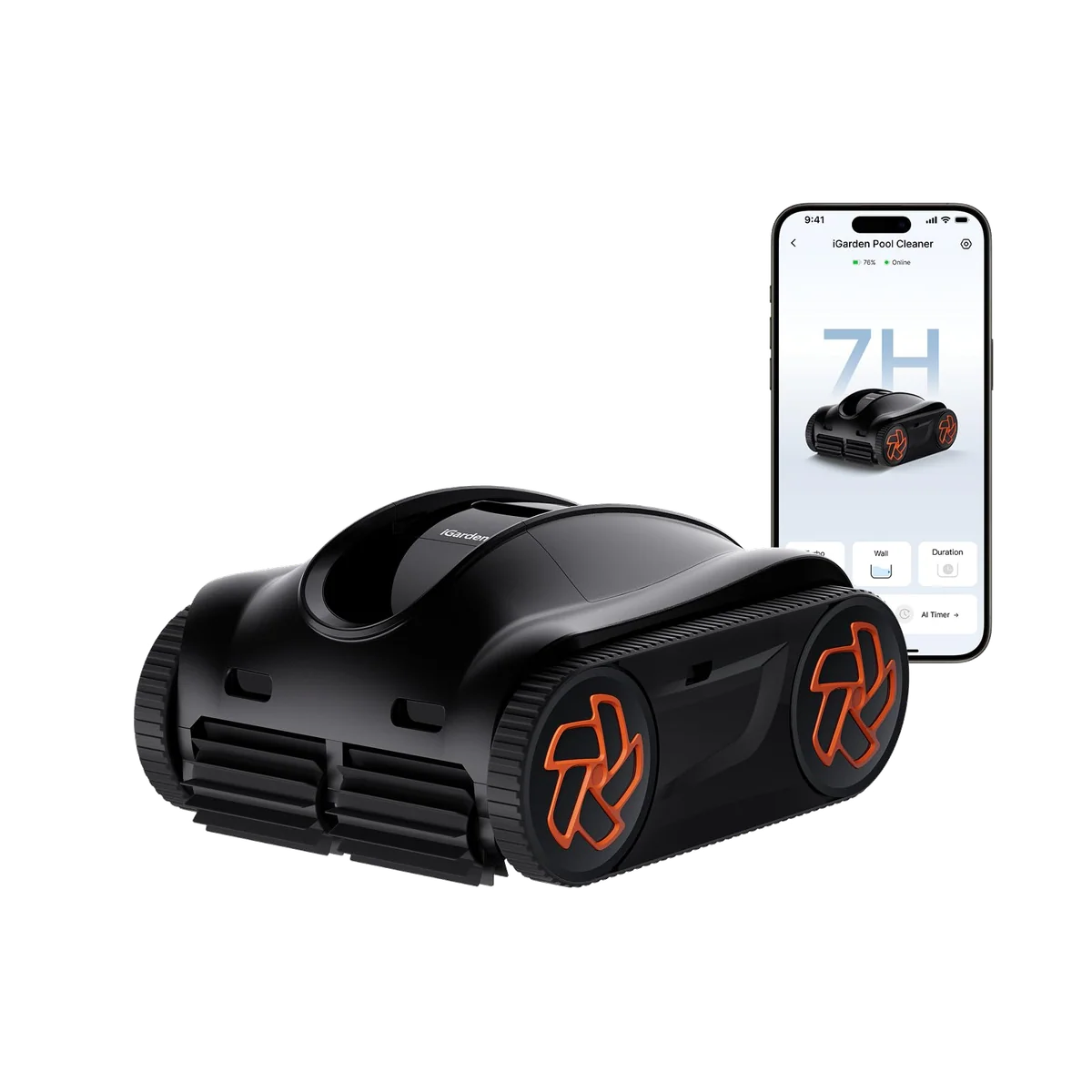
Its seven-hour floor-only rating makes sense for repeated maintenance cycles or substantial open-floor cleaning without a cord.
The large battery does not improve underwater app control, difficult retrieval, shallow-feature coverage or fine-silt handling.
The seven-hour number is real only in its narrow context. It is the rated maximum for standard floor-only cleaning; full coverage falls to 3.75 hours, and the exact listing says the app works only on land. The K70 also carries a 4-liter, 180-micron basket and offers dedicated floor, wall, waterline and broader coverage choices.
That battery capacity can be valuable without running one seven-hour marathon. Short scheduled floor cycles let a lightly soiled pool receive several outings before recharging, while Turbo spends more energy when leaves, twigs or other heavier material demand greater flow. The advertised multi-day scenario is a schedule of intermittent cycles, not continuous cleaning and not freedom from emptying the basket.
The physical cleaner remains more persuasive than its smart language. Tracked drive, active brushes and a long runtime suit conventional floors and walls, but the owner still selects a program on land, lowers the machine, finds it near an edge afterward, lets it drain and lifts it out. The official model record puts its dry weight at about 21.6 pounds and limits specified depth to 8.2 feet.
Choose the K70 only when ordinary cordless cleaners run out of battery before completing the work you actually assign. If the pool is modest, the debris load is light or the machine will usually run for an hour, unused battery capacity buys little besides a more expensive object to retrieve.
Best assignment
Repeated floor maintenance in a larger conventional pool within the published depth limit.
Friendly debris
Recurring leaves, bugs, hair, sand and ordinary settled material.
Ownership warning
The intended user must be comfortable hooking, draining and lifting a heavy wet robot.
Strengths
- The seven-hour floor-only rating gives routine maintenance far more headroom than a typical short-cycle cordless cleaner.
- The 4-liter top-loading basket suits leaves, bugs, hair, sand and other common residential-pool debris.
- Four cleaning modes let owners spend battery on floors, walls or the waterline instead of treating every run alike.
- Tracked drive and active brushes provide credible wall climbing and waterline scrubbing on conventional pool geometry.
- One-hour to two-hour cycle choices make several maintenance runs per charge practical in a lightly soiled pool.
- Replaceable brushes, removable tracks and an accessible impeller improve the routine maintenance story.
- Brand-level support reports show a strong pattern of responsive troubleshooting and replacement handling.
Limitations
- Full-coverage runtime is only 3.75 hours, and Turbo full coverage reduces it to 2.75 hours.
- The app loses communication underwater and offers little mapping, history or live operational detail.
- The touchscreen, master switch and three-minute deployment sequence are less intuitive than the marketing implies.
- Retrieval requires a pole hook and a careful manual lift of a dark, slippery, 21.6-pound dry chassis.
- Related K-series reviewers repeatedly found water around the charging pins despite the rubber cover.
- Shallow ledges, rounded steps, tight corners and complex transitions can remain unfinished.
- The exhaust can disturb fine debris, and the exact Amazon package may include only the 180-micron filter.
- The published 8.2-ft depth ceiling rules out deeper diving pools.
Our #1 Pick: IGarden KN35
Check Price on Amazon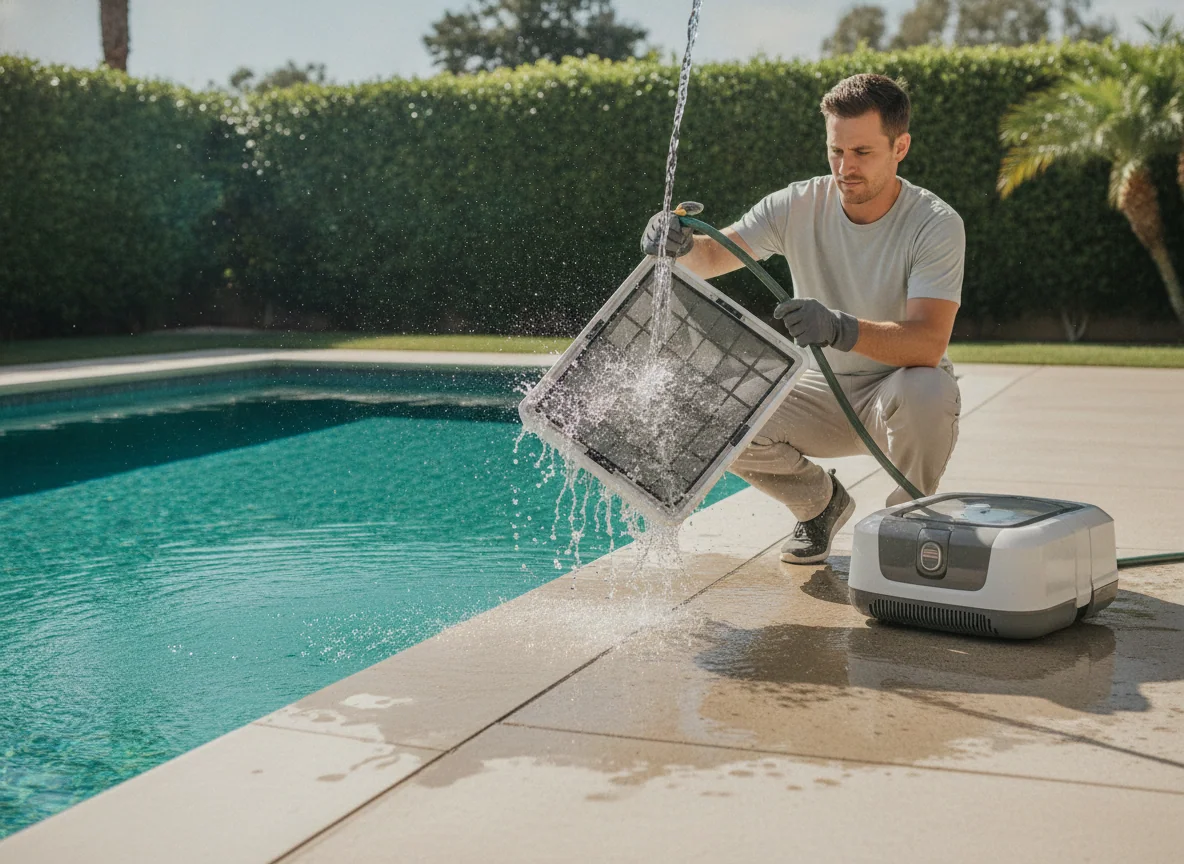
How Smart Pool Bots ranked the iGarden lineup
Smart Pool Bots treated each ASIN as a separate machine. Similar black shells and overlapping K-series names do not justify moving a battery figure, filter specification, runtime or owner outcome from one listing to another.
Manufacturer listings established what each exact model promises. Retained owner reports then showed where those promises meet real pool geometry, debris and handling. Concrete accounts of a cleaner becoming trapped, leaving silt, lifting awkwardly or failing early carried more weight than general praise without an identifiable pool or task.
| Buying question | What counted | What did not count |
|---|---|---|
| Will it remove routine work? | Supported pickup of ordinary debris, useful cycle choices and manageable basket care. | Broad promises to clean every inch or make the pool spotless. |
| Can it cover this pool? | Open-floor behavior, wall reach and documented responses to ladders, drains, steps and ledges. | Navigation labels without evidence of mapping or complete coverage. |
| Is the runtime useful? | Mode-specific endurance and whether several shorter cycles make sense for the likely owner. | The largest floor-only number treated as an all-surface result. |
| What happens after cleaning? | Retrieval, draining, filter rinsing, connector drying and recharging. | Self-parking described as docking, surfacing or automatic charging. |
| How much risk is hidden? | Specific early faults, model contamination in reviews and unsupported package assumptions. | A high rating used as a substitute for reading the underlying record. |
The KN35 came first because its capability and compromise are aligned with the largest group of likely buyers. The K70 earned second place as a genuine endurance specialist. The K36 fell to third because its strongest attributes are available only after the buyer accepts a materially rougher first-unit record.
The model number matters more than the styling
All three cleaners sell the same appealing story: no floating power cable, an onboard basket, programmed movement and automatic stopping near an edge. The buying decision begins where that story ends.
Start with the obstacles, not the pool’s label
“Above-ground” and “inground” say less about robot compatibility than the shape under the water. A broad open floor is easy territory. Narrow ladder gaps, raised drains, sharp steps, rounded transitions and shallow ledges can create missed zones or traps even when the cleaner is officially suitable for the pool type.
Watch the first cycles from several angles. A robot that repeatedly rescues itself from one drain may be acceptable; a robot that spends its battery perched on that drain is not. Owners whose priority is shallow geometry should begin with the site’s guide to steps, ledges and tanning shelves rather than assuming more runtime will solve a traction problem.
Runtime is capacity, not cleaning quality
A longer battery allows more passes, but it does not tighten route spacing, enlarge a full basket or make the intake retain finer material. Compare like with like: floor-only runtime against floor-only runtime, and full-coverage runtime against full-coverage runtime.
Short selectable cycles are often more valuable than one maximum session. A maintained pool may need an hour on the floor after wind or rain, while walls can be assigned a separate cycle when growth appears. The K70’s battery earns its keep only if that extra capacity reduces charging or completes work that a smaller model leaves unfinished.
Match filtration to the debris you can actually see
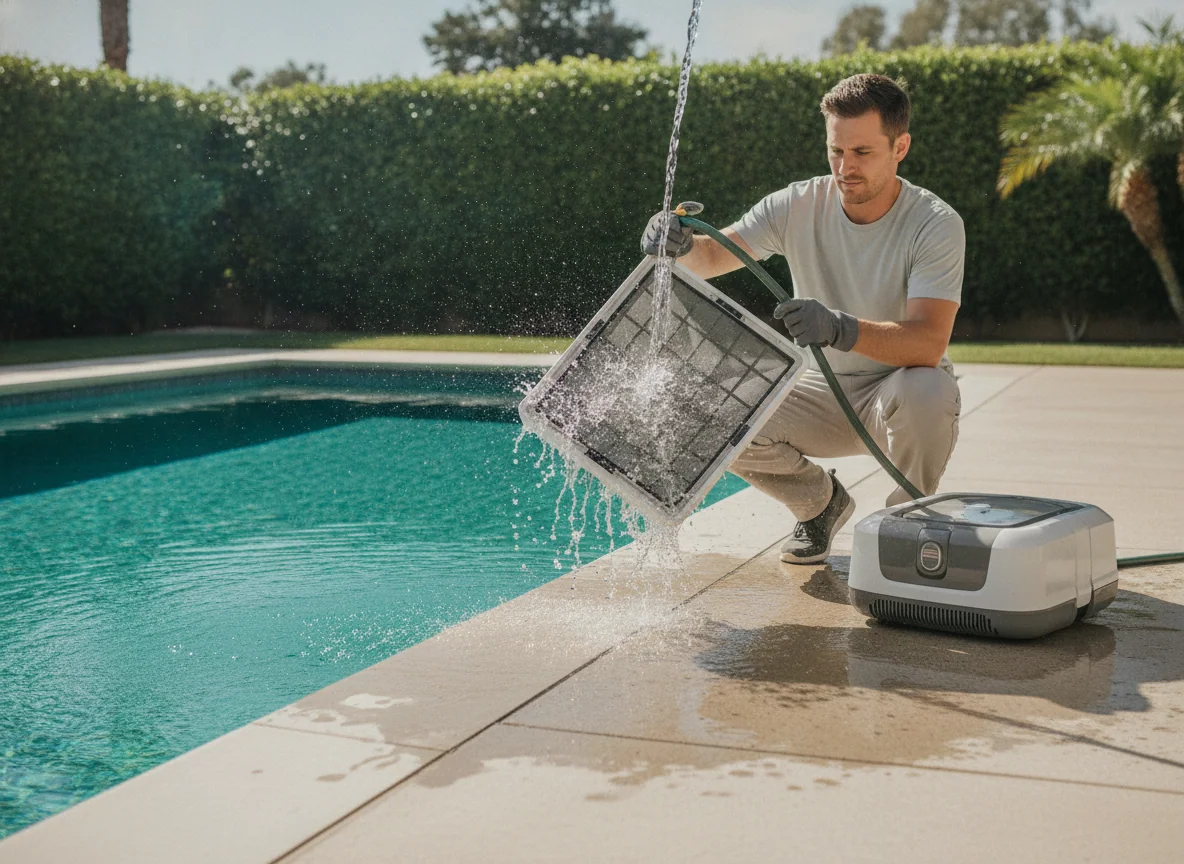
Standard 180-micron baskets suit leaves, insects, hair, visible sand and ordinary settled dirt better than powdery haze or adhered silt. Fine material may pass through, be stirred by the exhaust or remain attached until brushed loose. If sand, pollen and silt are the main complaint, use the fine-debris cleaner guide before choosing an iGarden model for its battery alone.
Tree-heavy pools pose a second distinction. A submerged vacuum can collect leaves after they sink, but it does not patrol the surface. The site’s explanation of pool skimmers versus underwater vacuums separates those two jobs, while the leaf-cleaner guide focuses on baskets, intakes and heavier debris loads.
The app is a launch panel, not an underwater remote
Radio communication does not travel usefully through pool water, so these apps configure the cleaner before launch rather than steering it through a missed corner. Expect mode selection, battery checks or firmware work on land. Do not expect live routing, underwater recall or a dependable mid-cycle change.
Physical controls matter more because they remain the reliable way to choose the job. Our guide to how pool-cleaner apps behave underwater explains why a phone icon on the box should not decide the purchase.
Self-parking removes the search, not the lift
Parking near a wall can save the owner from reaching into the middle of the pool, but the robot still stays underwater. Retrieval means attaching a hook to a pole, catching the correct handle, raising the chassis to the surface, waiting for water to drain and completing the lift without pulling on the removable basket.
That sequence should be treated as a fit test. Limited grip, shoulder mobility or safe access to the pool edge can make a technically capable cleaner the wrong appliance. A long-running machine is not useful if its intended owner cannot retrieve it confidently.
Choose which inconvenience you prefer
Cordless cleaners remove a cable during the cycle, then add charging, battery aging and a heavier self-contained body. Corded cleaners retain their cable and external power supply, but they avoid waiting for a battery and can come from product families with longer service histories.
The corded versus cordless guide makes that trade explicit. If first-unit confidence matters more than cable-free deployment, the established alternative in the Dolphin Nautilus CC review deserves consideration before accepting the K36’s gamble or buying K70 battery capacity you may never use.
Frequently Asked Questions
Which iGarden pool cleaner is best for most buyers?
The KN35 is the best overall choice for a straightforward residential pool because its useful endurance and routine cleaning ability come with fewer reasons to overbuy.
Are the KN35 and K36 the same cleaner?
No, they are separate ASINs with different baskets, mode details, listings and owner records, so their specifications should not be combined.
Does the K70 really run for seven hours?
Seven hours is its rated floor-only maximum, while full coverage is rated for 3.75 hours.
Can an iGarden app steer the cleaner underwater?
No, the connection is lost underwater, so the cleaner follows the program selected before submersion.
Will these cleaners handle pool steps and tanning ledges?
They may reach broad, sufficiently submerged features, but none of the three has evidence strong enough to promise dependable coverage of narrow steps, shallow shelves or difficult transitions.
Do iGarden cleaners skim floating leaves?
No, these are submerged vacuums that collect material from underwater surfaces rather than patrolling the pool’s surface.
Are robotic pool cleaners worth buying?
They are worth considering when recurring floor cleaning is the chore you want to transfer, but they do not replace chemistry, surface skimming, filter care or occasional manual brushing.
Should the cleaner stay in the pool between scheduled cycles?
Regular retrieval is the safer ownership routine because the basket needs rinsing, the charging area needs drying and prolonged chemical exposure adds no cleaning benefit.
Our Top Pick
The IGarden KN35 earns the top spot. The iGarden KN35 is the sensible first choice for a simple pool.