The Beatbot Sora 70 is the best Beatbot pool cleaner for most leafy pools.
Beatbot’s lineup looks like a staircase, with each higher step promising more sensors, more cleaning zones and more intelligence. That is the wrong way to shop it. The useful distinction is not basic, pro or ultra; it is whether the machine solves the layer of the pool that keeps getting dirty.
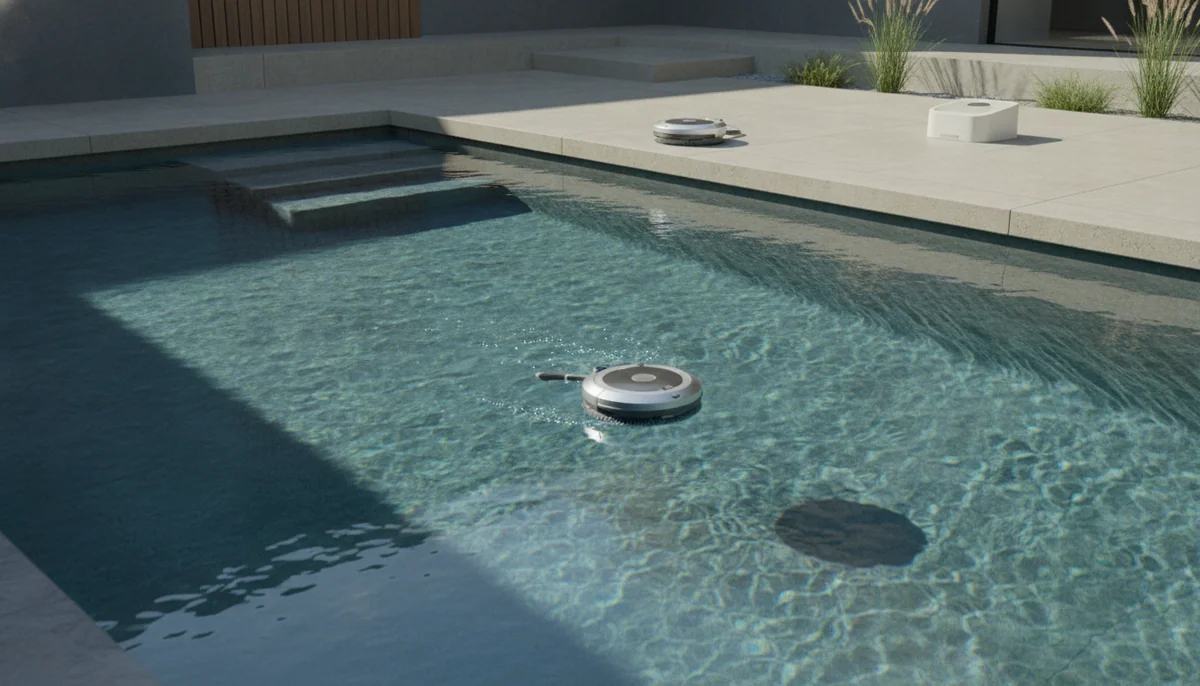
The Sora 70 wins because it combines the strongest parts of the range without asking the buyer to believe every software flourish. It vacuums below the surface, reaches compatible shallow areas, collects floating debris during a chosen cycle and returns to the edge for retrieval. Its limitation is equally clear: the standard filtration record is much stronger for leaves and ordinary grit than for cloud-forming dust.
That caveat changes the ranking rather than merely decorating it. A huge basket does not compensate for filter media that cannot retain the particles passing through it, and an app cannot rescue a robot that loses connectivity after diving. Pool geometry, debris size and the owner’s tolerance for charging matter more than the number printed after the product name.
Choose the Sora 70 for mixed debris
It is the most persuasive single-machine option here when leaves collect on both the floor and the water surface.
Choose the Sora 30 for a real ledge
Its best reason to exist is a broad, adequately submerged tanning ledge that simpler robots leave for the brush.
Leave the range for fine silt
Persistent pollen, ash, dead algae and powdery dust call for a cleaner selected around finer filtration rather than a longer feature list.
At a Glance: All Beatbot Pool cleaners Compared
| Feature | Editor's Pick Beatbot Sora 70 | Beatbot Sora 30 Pool Vacuum | Beatbot AquaSense 2 Pro | Beatbot Sora 30 | Beatbot A100 Pro | Beatbot AquaSense 2 Ultra |
|---|---|---|---|---|---|---|
| Price Range | $1,000–$1,500 | $500–$1,000 | Under $200 | $500–$1,000 | Under $200 | $1,500–$3,000 |
| Claimed runtime | Up to five hours on the floor and seven hours on the surface | — | Up to 5 hours underwater or 11 hours in surface mode | Up to 300 minutes of floor cleaning from a 10,000 mAh battery | — | About five hours on the floor or up to ten hours skimming |
| Check Price on Amazon | Check Price on Amazon | Check Price on Amazon | Check Price on Amazon | Check Price on Amazon | Check Price on Amazon |
The ranking: buy the machine for its strongest job
Six listings do not represent six distinct answers. Two are color versions of the same Sora 30, one is renewed stock, and two premium all-in-one models carry compromises that make their larger feature lists harder to recommend. The order below puts the broadest defensible winner first, then preserves the remaining listing order while explaining where a lower-ranked machine can still be the correct choice.
1. Beatbot Sora 70 — The Sora 70 is the best all-round Beatbot for leaves and mixed-zone cleaning.
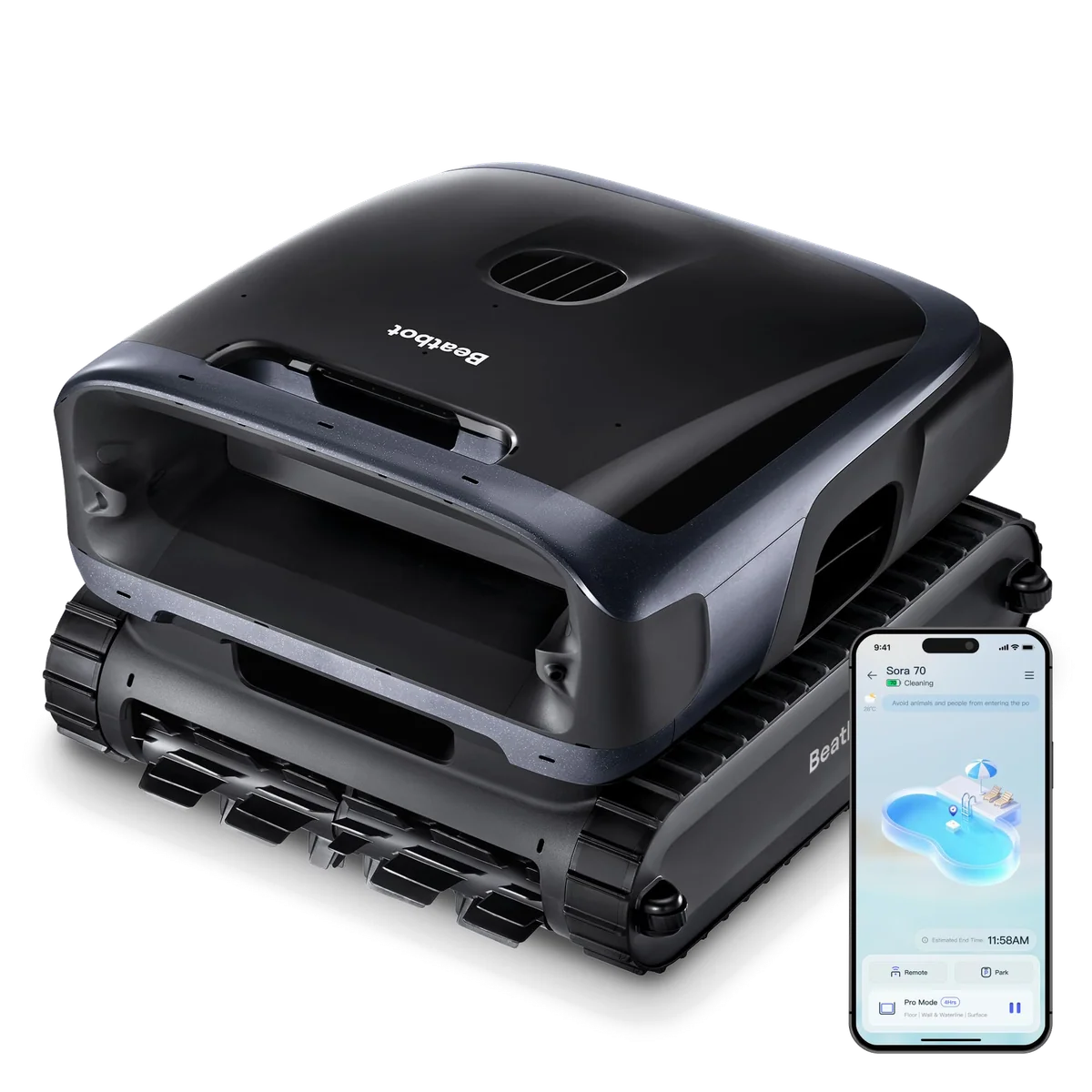
Its large basket, credible floor and wall work, shallow-area reach and active surface mode form the most useful combination in Beatbot’s current range.
The standard basket is an uncertain answer to powdery silt, and every serious cycle still ends with manual retrieval, rinsing and charging.
Why it wins
The Sora 70 is not the most elaborate Beatbot, which is part of its appeal. It concentrates on physical jobs a pool owner can see: floor vacuuming, wall and waterline contact, access to sufficiently deep shallow zones, surface collection and edge parking. Beatbot states a 10,000 mAh battery, up to five hours of floor operation, coverage up to 3,200 square feet and 6,800 gallons per hour of rated flow. Those are manufacturer claims rather than guarantees of complete coverage, but they describe a machine intended for large residential pools and long cleaning routes.
The owner record gives the hardware claim some substance. Exact-model reports describe pickup of leaves, grass, insects, palm nuts, small sticks, stones, sand and ordinary dirt. Owners also praise the six-liter basket, wall climbing, waterline work and end-of-cycle surfacing. One complex-pool account reported successful travel over a swimout, steps and a tanning ledge when the water remained close to the stated eight-inch threshold.
Surface mode is the decisive addition over the Sora 30. It can collect bugs and leaves that would otherwise remain above an underwater robot, and app steering becomes useful while the machine is floating. This is burst skimming, not continuous patrol: the same battery serves every cleaning zone, and the robot must eventually leave the pool for basket care and charging.
What should stop the sale
Fine material divides the record. Some owners report strong sand and small-particle collection, while another watched the machine recirculate fine debris and cloud the water after cleaning. The difference between visible sand and dust-like silt matters more than the word “debris” on a specification sheet. Buyers dealing with storm dust, pollen haze or dead algae should begin with the site’s cleaners chosen for fine debris instead.
The app also needs a realistic job description. It can configure cycles and control the robot while it is at the surface, but ordinary Wi-Fi and Bluetooth do not provide dependable underwater steering. The Sora 70 is a sensor-guided autonomous cleaner after it sinks, not a remote-control submarine.
Owners deciding whether active skimming is worth the extra complexity can use the site’s Sora 30 and Sora 70 comparison after measuring the shallowest area they expect either machine to clean.
Strengths
- The six-liter top-access basket holds substantial coarse debris and rinses quickly.
- Floor, wall, waterline, shallow-area, and surface functions all have direct supporting evidence.
- Real-world reports support long cycles, including at least four hours in one demanding mixed-mode test.
- Automatic surfacing, edge parking, and drainage make retrieval less frustrating.
- JetPulse skimming is genuinely useful for bugs, leaves, and fast pre-swim cleanup.
Limitations
- The standard basket is an uncertain choice for powdery silt, pollen, and very fine settled dust.
- The app loses its connection underwater and cannot provide dependable live control.
- Very shallow shelves, narrow steps, coves, and awkward transitions can remain untreated.
- Cordless ownership still requires deployment, retrieval, basket rinsing, charging-port care, and redeployment.
- The large wet body may be difficult for smaller or mobility-limited owners to lift safely.
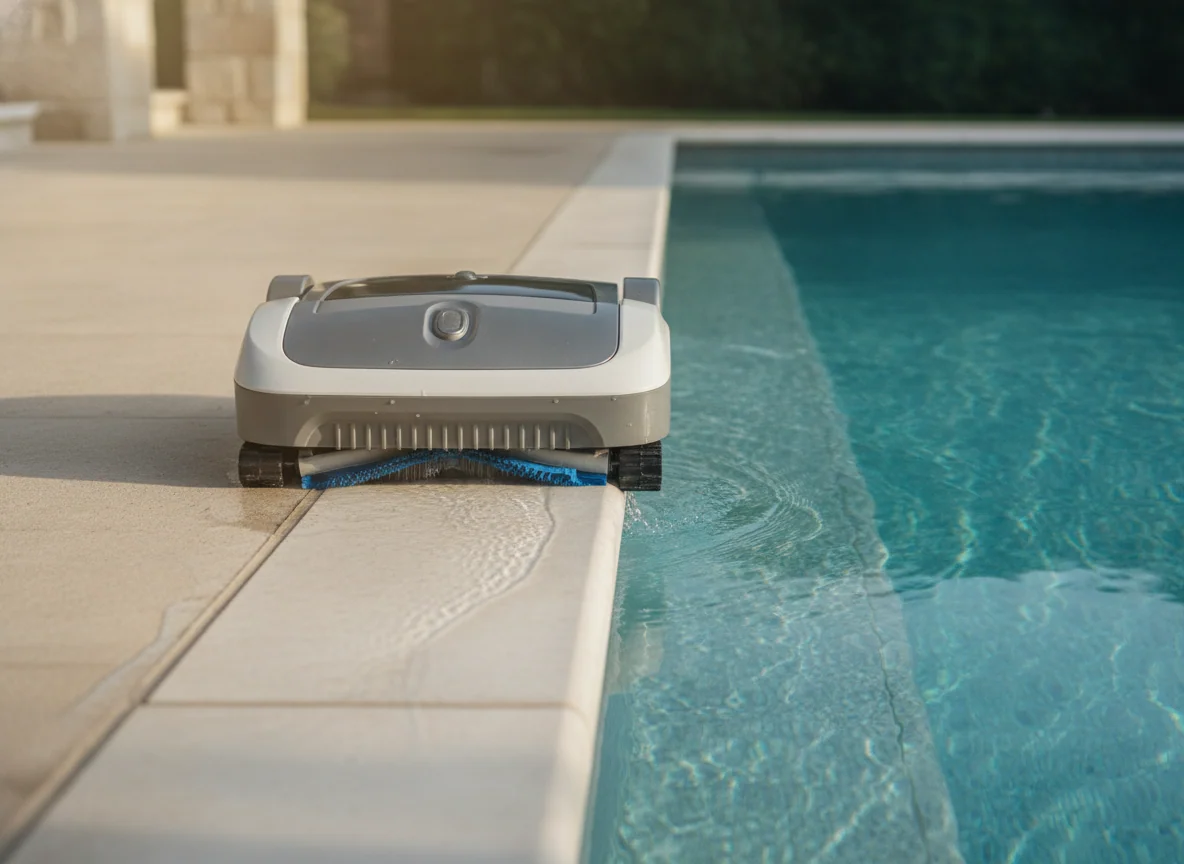
2. Beatbot Sora 30 Pool Vacuum — The deep-blue Sora 30 is the smarter specialist for a broad tanning ledge.
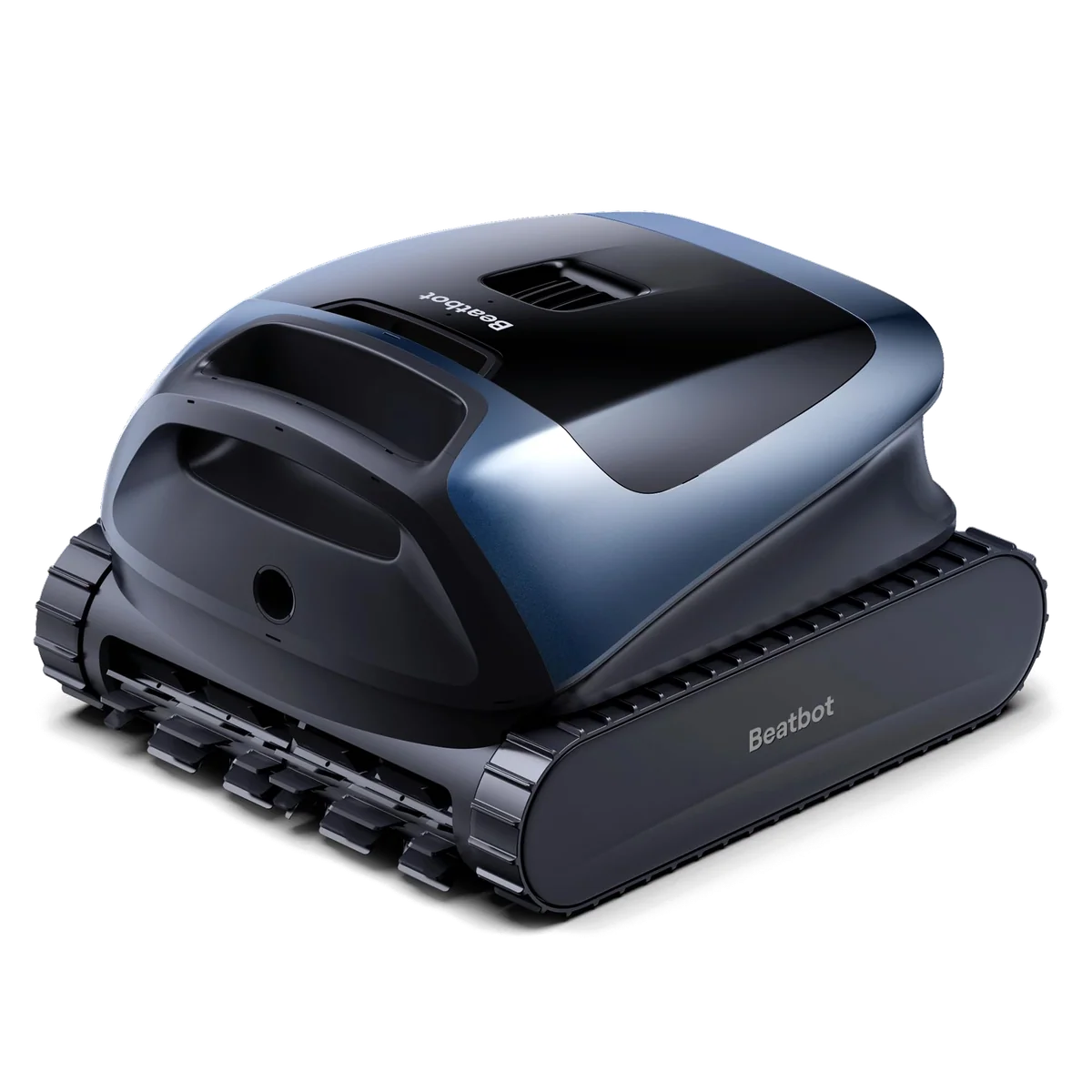
It earns second place by solving shallow-platform cleaning more credibly than the premium AquaSense models while retaining strong routine floor, wall and waterline ability.
It does not skim the water surface, and its included 150-micron basket is a poor foundation for a pool dominated by the finest silt.
The ledge justifies the machine
The Sora 30 has a cleaner reason to exist than most midrange pool robots. A downward-facing sensor and front and rear brush groups support travel onto qualifying platforms, with Beatbot claiming operation in shallow water down to about eight inches. The listing also specifies a five-liter basket, a 10,000 mAh battery, up to 300 minutes of floor runtime and coverage up to 3,229 square feet.
Eight inches is a threshold, not a promise about every stair tread. The robot needs room for both tracks to mount the transition, remain submerged and turn without colliding with bubblers, fittings or a nearby drop. A broad Baja shelf with ten or fourteen inches of water is a much stronger candidate than a narrow curved step that merely reaches the advertised depth.
Exact-model owners describe good pickup of leaves, grass, insects, seed pods, petals and visible dirt, along with convincing wall climbing and useful waterline contact. Several large-pool accounts also report substantial charge remaining after long mixed-zone cycles. Those reports support endurance and routine maintenance, but they do not prove that every corner of every freeform pool will receive a complete pass.
The filter and app set the ceiling
The included 150-micron basket suits everyday debris better than dust-like contamination. One owner reported that a separately purchased ultra-fine filter caused the rear of the robot to lift, repeat failed movement attempts and shut down. That isolated failure does not establish a fleet-wide defect, but it makes the Sora 30 difficult to recommend when fine filtration is the main reason for buying.
App experiences also range from smooth pairing and useful notifications to repeated resets just to find or change a mode. None of that erases the cleaner’s physical talent on a suitable ledge, but software polish should not be counted among the reasons to choose it.
Buyers with a simple floor and no meaningful shelf should compare the Sora 30 with the Sora 10, because paying for platform sensors only makes sense when the pool contains a platform worth cleaning.
3. Beatbot AquaSense 2 Pro — The AquaSense 2 Pro is a polished generalist that asks too much trust of its weaker jobs.
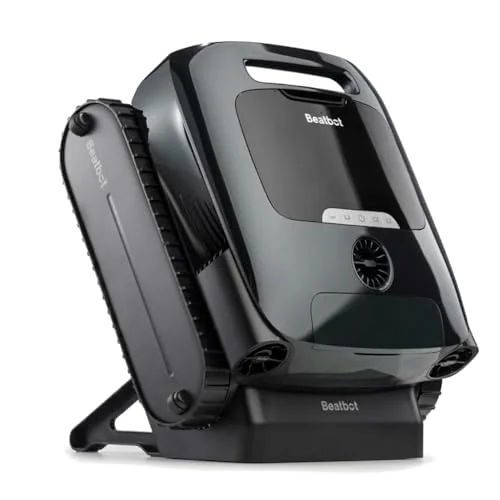
Consider it only when one cordless machine must handle ordinary underwater debris and occasional surface leaves in a mostly conventional pool.
Coverage, fine filtration and skimming are too inconsistent for this feature-heavy model to displace the Sora 70 as the default Beatbot choice.
Its floor cleaning is the persuasive part
The AquaSense 2 Pro combines floor, wall, waterline and surface cleaning with clarifier dispensing. Beatbot claims coverage up to 3,875 square feet, as much as five hours of underwater operation, up to eleven hours in surface mode and a dual-layer 150-micron basket. Directional app control is explicitly limited to surface cleaning.
When the machine crosses ordinary debris, exact-model owners report strong pickup of leaves, acorns, bugs, pollen and visible floor dirt. Several also praise its wall contact, long runtime and edge parking. One tree-heavy pool reportedly went from repeatedly clogged equipment and pounds of acorns to a manageable floor and surface, which is the kind of debris load that makes a large cordless cleaner feel worthwhile.
Coverage is the unresolved objection
Other owners watched the robot revisit the same areas, leave sections untouched, slip before reaching the waterline and struggle around small steps. A replacement machine in a straightforward 20-by-40-foot vinyl pool reportedly repeated the original unit’s missed coverage. Some buyers saw improvement after several cycles, but waiting for a robot to learn is not a sound reason to ignore persistent misses.
Surface performance is similarly divided. The machine can collect visible floating leaves and bugs, yet exact owners range from satisfied to openly dismissive of its skimming. The 150-micron filter also produces mixed reports on fine dirt, and the clarifier remains a consumable aid rather than a replacement for sanitation, balanced chemistry or the main circulation filter.
The relevant decision is not whether the 2 Pro has more functions than a conventional cleaner; it is whether combining those functions is more valuable than giving the floor and surface to separate specialists. The site’s Sora 70 and AquaSense 2 Pro comparison isolates that choice.
Strengths
- Floor cleaning can be excellent on leaves, acorns, insects and ordinary visible debris.
- Cordless operation removes cable tangles, a deck transformer and an underwater tether.
- Wall climbing and double-pass waterline scrubbing work well in compatible pool geometry.
- Surface parking and SmartDrain make retrieval easier than lifting a water-filled robot from the pool floor.
- Surface steering helps target visible floating leaves and move the robot toward an accessible edge.
- Long claimed runtimes give the robot a plausible chance to cover a large residential pool in one mode-specific cycle.
Limitations
- Coverage can remain incomplete even after repeated cycles and apparent mapping.
- The 150-micron mesh is a weak fit for pools dominated by fine sand, silt, ash or dead algae.
- Surface skimming may miss pollen, lose captured debris during reversals or neglect shallow edges.
- App steering does not work while the robot is performing its underwater cleaning.
- Shallow steps, tanning ledges, benches, jets and unusual transitions can require manual cleanup or rescue.
- The robot remains a substantial lift after drainage, especially with a full basket.
- Every depleted cycle ends with manual removal, basket rinsing and several hours on the charging dock.
- The clarifier adds a consumable without replacing water testing, sanitation or the main pool filter.
4. Beatbot Sora 30 — The orange Sora 30 is a color choice rather than a different cleaning decision.
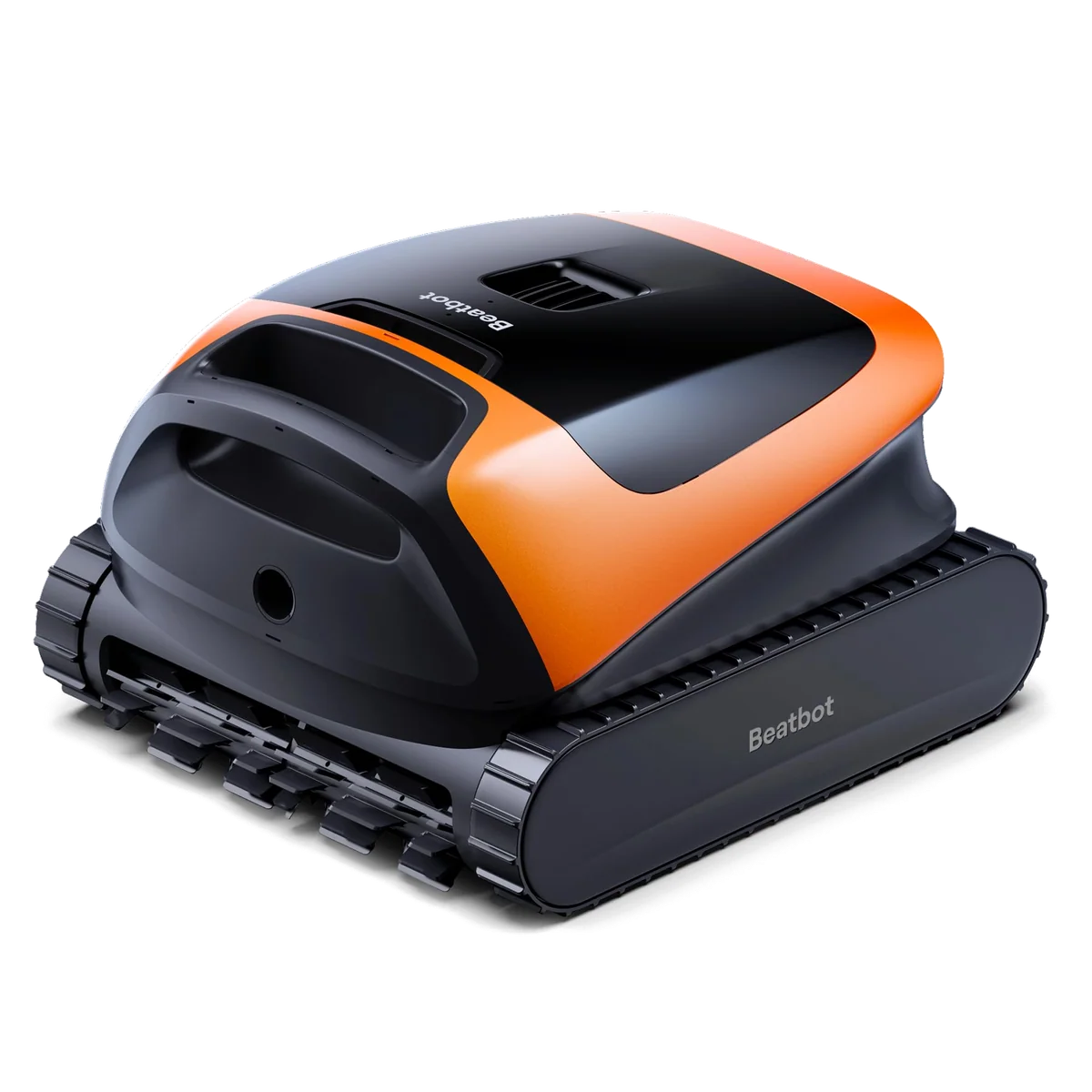
Choose this listing when the Sora 30’s ledge-focused design fits the pool and the vibrant shell is preferable to deep blue.
It carries the same lack of active surface skimming, the same 150-micron filtration limit and the same geometry dependence as the higher-ranked blue listing.
Same purpose, brighter shell
The orange listing carries the same Sora 30 model designation and the same central specification set: shallow-platform cleaning down to about eight inches, 6,800 gallons per hour of claimed flow, a 10,000 mAh battery, a five-liter basket and 150-micron filtration. The color does not add a cleaning mode, a finer filter or a different navigation system.
Its retained owner record repeats the same mix of strengths and warnings found with the blue version. Routine leaves and visible dirt are a good match, broad ledges can receive useful attention, and surface parking often eases retrieval. Fine silt, narrow steps, unreliable app behavior and an unresolved ultra-fine-filter failure remain the reasons to hesitate.
This listing appears lower only because the page must rank every supplied product listing after the winner. It should not be interpreted as a slower or less capable Sora 30. Compare the terms and choose one color listing, not both.
Strengths
- Qualifying tanning ledges and broad shallow platforms receive unusually credible cleaning coverage.
- Floor, wall and waterline performance is convincing for routine leaves, bugs and ordinary dirt.
- The 10,000 mAh battery has substantial reserves in several large-pool owner reports.
- The 5-liter top-access basket is spacious and simpler to rinse than many multi-part filter assemblies.
- Surface parking and drainage can make retrieval much easier than pulling a water-filled robot from the bottom.
- Cordless operation removes the cable without sacrificing credible wall climbing or long runtime.
Limitations
- The included 150-micron filter is a poor match for persistent pollen, storm dust, dead algae and the finest silt.
- The optional ultra-fine filter is separate, and one owner reported a severe mobility failure after installing it.
- The app cannot provide dependable live communication while the cleaner is submerged.
- Narrow steps, curved approaches and shallow shelves below about eight inches remain uncertain territory.
- Parking can fail or leave the floating robot out of reach, so the retrieval hook is still necessary.
- The detachable cover, unusual toggle and proprietary plug expose cost-cutting in daily use.
- Long-term battery durability and owner-serviceable replacement economics are not established.
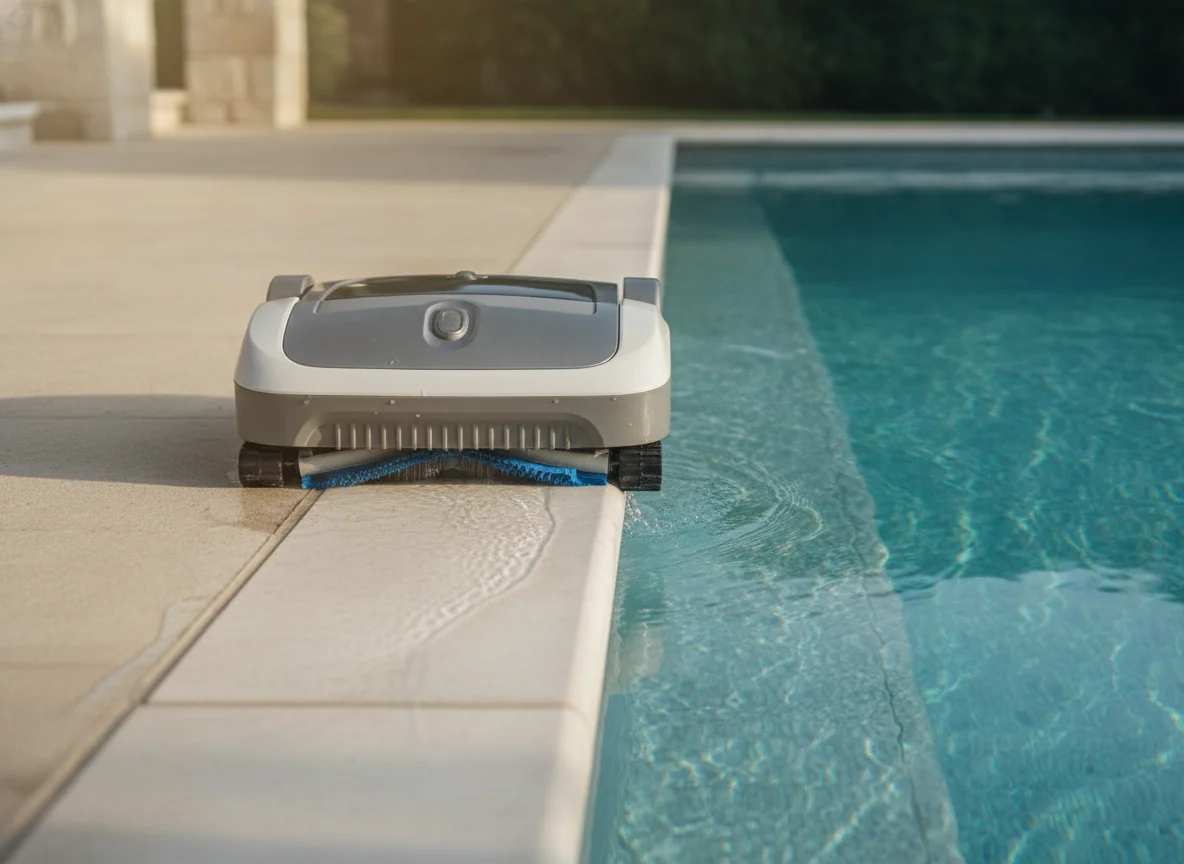
5. Beatbot A100 Pro — The A100 Pro is an older all-in-one proposition with too little exact-model reassurance.
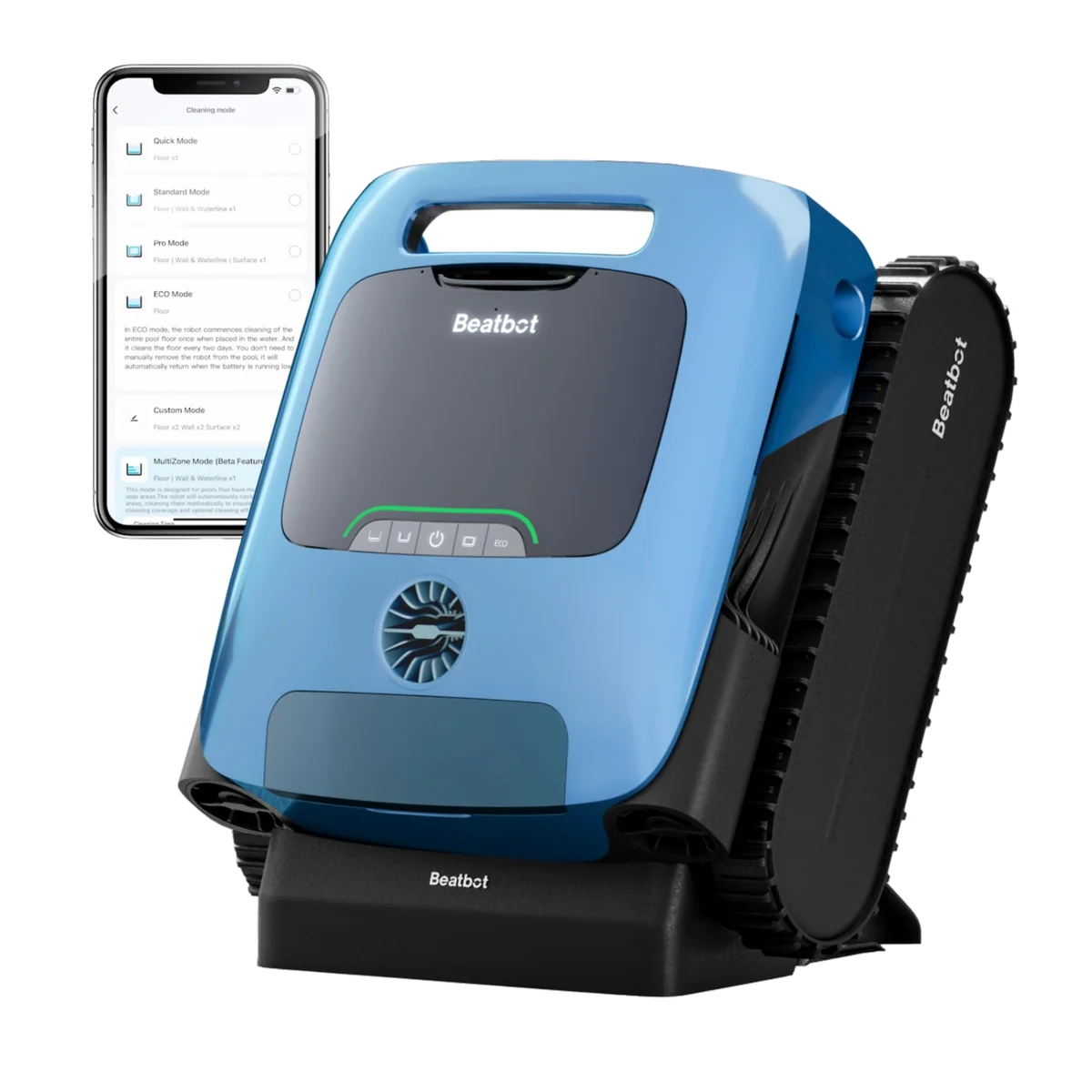
Skip it unless freedom from a deck cable outweighs the need for dependable skimming, easy handling and a well-established durability record.
The tiny and sharply divided exact-model review base includes a debris-retention failure after only a few months.
The identity problem arrives before the cleaning test
Amazon titles this product the Beatbot 92055 A100 Pro while displaying HTH in the brand field, and the listing promotes five cleaning functions, 5,500 gallons per hour of rated flow, 150-micron filtration, a charging dock and claimed coverage up to 3,299 square feet. The specification package resembles Beatbot’s original AquaSense Pro platform, but resemblance is not proof that every component and firmware behavior is identical.
The concept is attractive. It combines conventional floor, wall and waterline cleaning with surface collection, clarifier dispensing, a large battery and end-of-cycle retrieval assistance. The problem is that the extra functions are the least dependable parts of this product family. Surface debris must reach the intake cleanly, shallow shelves and curved steps remain difficult, and app control becomes limited after the machine submerges.
Two reviews leave no room for complacency
The retained exact-model record contains only two written owner reviews. One praises floor, wall, tile-line and surface cleaning, particularly the strain reduction from surfacing at the end of a cycle. The other says the cleaner initially worked well, then stopped retaining debris and became difficult to resolve through customer service after a few months. That split cannot establish a failure rate, but the reported fault attacks the product’s essential function.
A favorable return route and written warranty terms are therefore part of the decision, not paperwork to consider later. Buyers still weighing this platform against the newer middle tier should use the A100 Pro and AquaSense 2 Pro comparison before accepting the older model’s uncertainties.
Strengths
- Open-floor, wall, and waterline cleaning are the strongest and best-supported parts of the platform.
- The large battery can support unusually long custom routines when navigation and obstacles cooperate.
- Cordless operation removes the deck cable and avoids dependence on the pool’s pump or pressure line.
- Surface parking can spare the owner from fishing the cleaner off the deep floor.
- The nested basket can capture leaves, visible grit, and fine sand under favorable conditions.
Limitations
- Surface skimming is too situational to replace a dedicated pool skimmer.
- Steps, curved corners, coves, and shallow tanning shelves remain unreliable cleaning zones.
- The app cannot provide dependable live control while the robot is submerged.
- A roughly 24-pound dry platform remains a demanding wet lift despite surface parking.
- Repeated saltwater reports identify corrosion at the exposed charging contacts.
- Exact-model accounts include debris-retention failure after months and replacement by the next season.
6. Beatbot AquaSense 2 Ultra — The renewed AquaSense 2 Ultra is a condition gamble wrapped around impressive navigation.
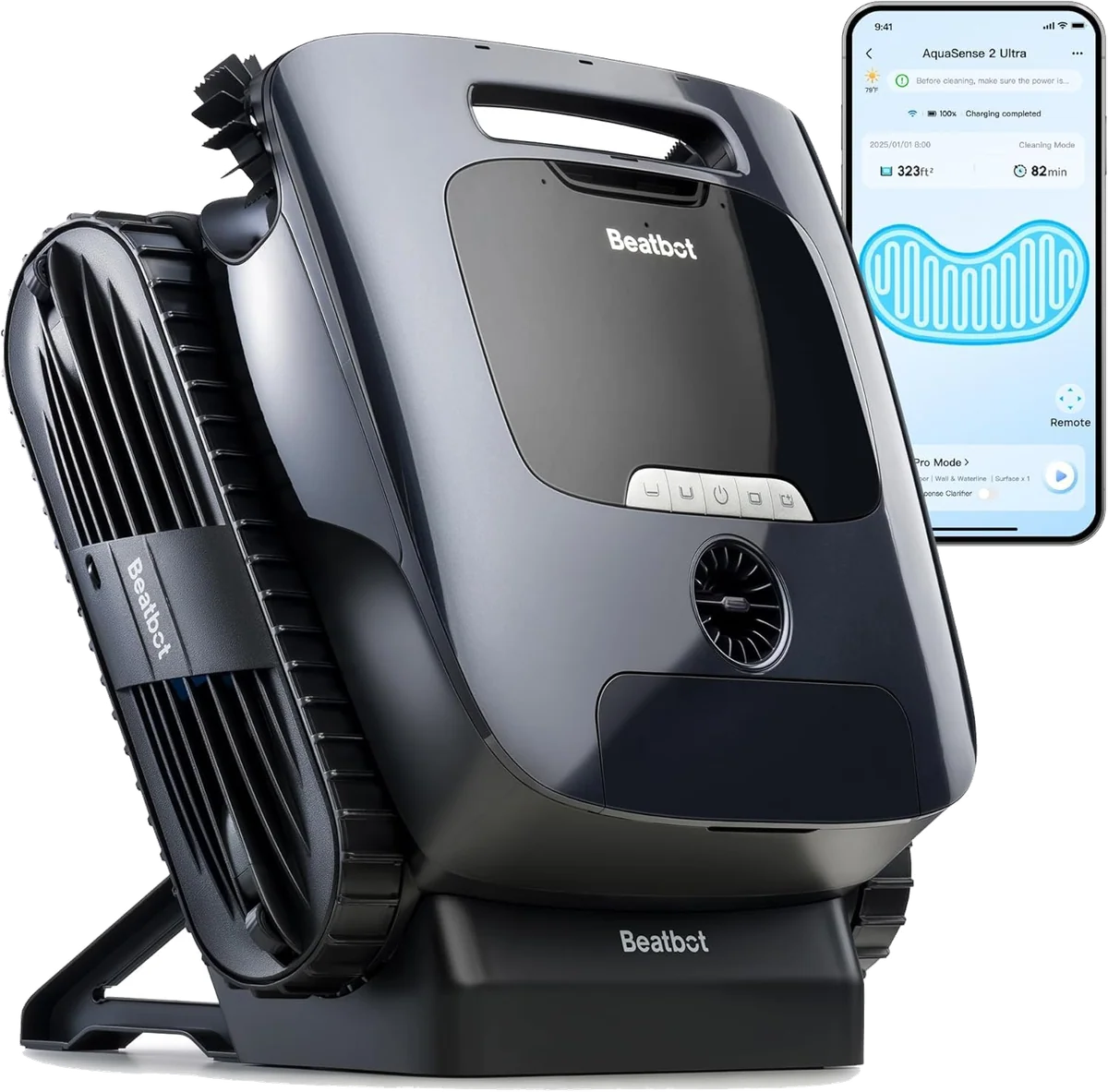
Consider it only for a large or irregular pool when cable-free operation and camera-guided leaf hunting justify a careful battery, accessory and warranty inspection.
The heavy lift, inconsistent skimming and unknown refurbishment history make this the hardest Beatbot here to recommend without conditions.
Sound hardware can clean impressively
The AquaSense 2 Ultra adds a front camera, a four-core processor and a larger sensor package to Beatbot’s all-in-one concept. The renewed listing promises floor, wall, waterline and surface cleaning, clarifier dispensing, AI mapping, surface parking and three-year full-replacement protection. Those statements describe the offered feature set, but they do not establish the remaining battery capacity or condition of a particular renewed unit.
PCWorld’s testing of a new example found strong floor cleaning and observed the camera returning for visible leaves missed during the first route. That is meaningful evidence that the debris-detection system can alter behavior rather than merely draw an attractive map. The same test exposed the weaker half of the package: surface mode captured only about 40 percent of staged floating debris, and the machine weighed about 29 pounds before retained water complicated retrieval.
Reviewed likewise found persuasive floor and wall work but reported remaining dirt on stairs and a Baja shelf, along with the physical burden of repeatedly moving the machine. Surface parking brings the robot to a reachable place and releases water; it does not make a large wet chassis light.
Renewed condition changes the whole verdict
A renewed battery may begin ownership with less usable capacity than the nominal specification suggests, while cloudy sensor windows, worn brushes, incomplete accessories or prior account binding could undermine the very features that justify the Ultra. Confirm the refurbishment standard, battery coverage, accessory inventory, app eligibility, return window and applicability of the replacement policy in writing.
The Ultra becomes rational only when its camera-led debris search solves a real problem in a complex pool. Buyers with conventional geometry should compare the AquaSense 2 Ultra and AquaSense 2 Pro before assuming the camera, mapping and renewed uncertainty belong in the same purchase.
Strengths
- Floor cleaning has strong evidence across visible leaves, sand and ordinary pool debris.
- Camera-guided debris hunting can recover material missed during the first planned pass.
- Long nominal runtime suits large pools when the renewed battery is healthy.
- Cordless operation removes the deck cable, power supply and in-water tether.
- Surface parking and draining make retrieval better than fishing a dead robot from the floor.
- Filter access and routine rinsing are straightforward once the heavy machine is out of the water.
Limitations
- The roughly 29-pound dry weight rules it out for buyers with back, shoulder or lifting limitations.
- Surface skimming is too inconsistent to replace a dedicated skimmer in a leaf-heavy pool.
- Stairs, Baja shelves, rounded transitions and tight corners remain geometry-dependent.
- The app cannot provide dependable live control while the robot is submerged.
- The mesh filtration is less persuasive for ultra-fine silt than systems offering pleated fine-filter media.
- A renewed unit adds uncertainty about battery capacity, sensor condition, accessories and warranty eligibility.
Our #1 Pick: Beatbot Sora 70
Check Price on Amazon
How Smart Pool Bots separated the machines from the marketing
Smart Pool Bots treated exact-model owner reports as evidence about outcomes and manufacturer listings as evidence about intended specifications. A stated runtime, flow rate or coverage area establishes what the product claims; it does not prove that every pool receives complete cleaning or that every particle reaching the intake remains in the basket.
Conflicts were kept when pool geometry, debris size or cycle choice could plausibly explain them. A report of strong sand pickup can coexist with a failed dust test because grains and powder ask different things of filter media. A successful tanning-ledge report can coexist with failed stair cleaning because width, water depth and approach geometry differ.
The two Sora 30 listings were recognized as color variants rather than treated as independent designs. Their retained customer-review sets repeat the same accounts, so duplicated praise and criticism were not counted as additional corroboration.
The renewed AquaSense 2 Ultra was judged as a separate purchase condition. Evidence from new units establishes what healthy hardware can accomplish, while the buying verdict also accounts for battery history, sensor condition, accessory completeness, account binding and the exact replacement protection attached to renewed inventory.
The ranking ultimately rewards a useful physical advantage and penalizes a weakness that defeats the stated job. That is why the Sora 70 wins for mixed visible debris, the Sora 30 rises when a real ledge changes the pool, and the premium all-in-one models fall when skimming, fine filtration or handling cannot support their broader pitch.
Start with the dirt, then measure the pool
Beatbot divides products by feature tier; a buyer should divide the problem by debris layer and particle size. A leaf floating at the surface, a twig sitting on the floor and a film of windblown silt are three different filtration jobs. Asking one robot to excel at all of them is how the most expensive machine becomes the wrong one.
| What keeps getting dirty | Best starting point | The deal-breaker to check |
|---|---|---|
| Floor, walls and floating leaves | Sora 70 | Confirm that dust-like silt is not the dominant debris. |
| A broad tanning ledge | Sora 30 | Measure actual water depth, usable width and the approach angle. |
| Ordinary floor debris with occasional skimming | AquaSense 2 Pro | Accept that one generalist may cover less consistently than two specialists. |
| Visible leaves in a complex pool | AquaSense 2 Ultra Renewed | Verify battery health, lifting tolerance and renewed replacement terms. |
| Pollen, ash, dead algae or powdery silt | Leave this shortlist | Choose around proven fine-filter media rather than basket size or flow claims. |
| Continuous surface fallout | Use a dedicated skimmer | A shared cordless battery cannot patrol the surface while the robot cleans below or charges. |
An eight-inch claim is not an eight-inch step guarantee
Shallow cleaning requires enough water to keep the chassis working, enough tread area for both tracks and enough space to turn. Measure from the water surface to the shelf, not from the coping or construction plan. Then look for bubblers, rails, curved edges and sharp drops that can interrupt the approach.
Broad platforms are the strongest case for a Sora model. Narrow stair treads remain uncertain even when their water depth appears compatible, because a robot can reach a step without having enough room to settle and scrub it. Readers whose main frustration is a collection of shelves and steps should use the site’s guide to cleaners for steps and tanning ledges before treating one depth number as the whole answer.
Surface mode is not a second robot hiding inside the first
An all-in-one Beatbot can collect floating material during a chosen surface cycle, which is useful before swimming or after a burst of falling leaves. A dedicated skimmer can remain on that layer while an underwater cleaner works elsewhere or charges. Under constant tree fallout, the two-machine arrangement is less elegant on the deck and more logical in the water.
The site’s guide to surface skimmers versus underwater vacuums explains the division of labor, while the Betta SE review covers an honest dedicated alternative for buyers who care more about persistent surface interception than one-body simplicity.
Cordless removes the cable, not the ownership cycle
A normal Beatbot routine still includes deployment, retrieval, drainage, basket rinsing, drying the charging area and reconnecting the battery to its charger or dock. Surface parking makes one part of that routine easier. It does not empty the basket, cross the deck or recharge the machine.
A corded cleaner creates the opposite compromise. It brings a cable into the pool but remains ready for another powered cycle without waiting for a battery. Buyers who value repeatable underwater cleaning over surface mode should compare the broader trade in the corded and cordless cleaner guide, then consider the Dolphin Nautilus CC as the simpler alternative.
Do not buy the app as though it were underwater steering
Beatbot apps are useful for pairing, firmware, pre-run configuration, cleaning records, notifications and surface controls. Connectivity becomes unreliable once the robot dives because ordinary wireless signals do not travel effectively through pool water. A missed patch at the bottom cannot be treated like a missed spot under a living-room vacuum.
Anyone placing app control near the top of the decision should read why pool-cleaner apps lose contact underwater before deciding how much that feature is worth.
Frequently Asked Questions
Which Beatbot pool cleaner is the best overall choice?
The Sora 70 is the strongest overall choice for a leafy pool because it combines credible underwater maintenance, a large basket, compatible shallow-zone cleaning and useful surface collection, provided fine silt is not the main problem.
Should I choose the Sora 30 or the Sora 70?
Choose the Sora 30 when a qualifying tanning ledge is the priority and choose the Sora 70 when active collection of floating leaves is worth the larger all-in-one design.
Can a Beatbot be controlled from the app while it is underwater?
No, Beatbot apps can configure runs and control compatible surface functions, but dependable live steering is unavailable after these robots submerge.
Which of these Beatbot cleaners is best for fine silt?
None is the safest default for powdery silt because the supplied records contain meaningful filtration failures or conflicts, so a cleaner selected specifically for fine media is the stronger choice.
Does the Sora 30 clean every step and shallow shelf?
No, its shallow-water ability is most credible on a broad platform with roughly eight inches or more of water and enough space for both tracks to mount and turn.
Is the AquaSense 2 Pro a better buy than the Sora 70?
The AquaSense 2 Pro makes sense only when its clarifier system and longer claimed mode runtimes matter more than the Sora 70’s stronger case for coarse debris, shallow zones and practical burst skimming.
Is a renewed AquaSense 2 Ultra worth considering?
It is worth considering only for a strong owner with a complex, leaf-prone pool who can verify battery condition, included accessories, return rights and replacement eligibility before accepting the renewed unit.
Can a Beatbot replace professional pool service?
No, a Beatbot can reduce routine vacuuming, brushing and net work but does not balance water chemistry, service circulation equipment, diagnose leaks or repair the pool.
Our Top Pick
The Beatbot Sora 70 earns the top spot. The Sora 70 is the best all-round Beatbot for leaves and mixed-zone cleaning.