Beatbot AquaSense 2 Ultra Renewed Review: A Brilliant Cleaner With One Expensive Catch
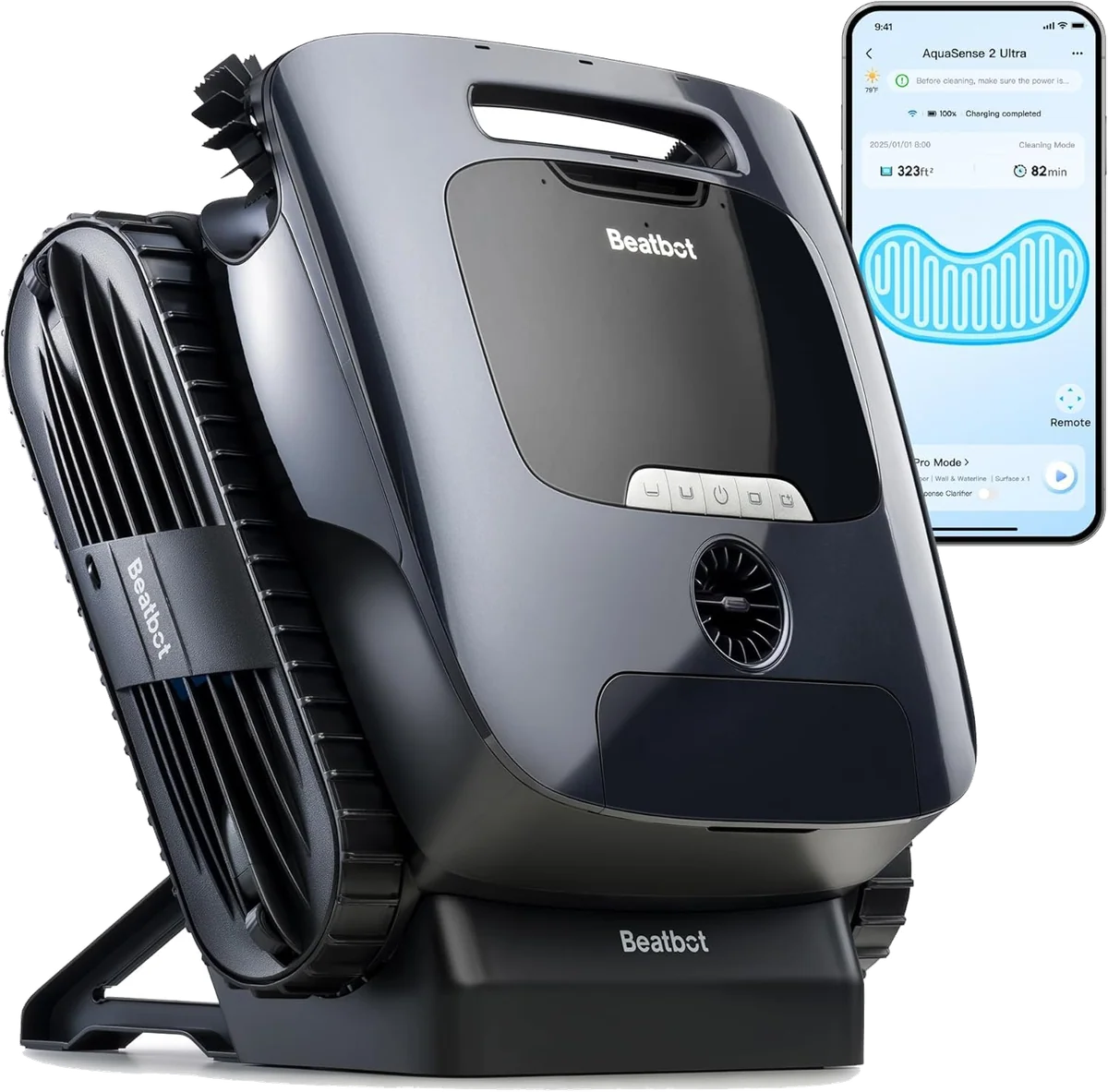
Most pool owners should skip the renewed AquaSense 2 Ultra unless they need cordless cleaning for a difficult pool and can verify the battery, accessories and replacement protection before buying.
The name of this listing matters as much as the machine: this is the renewed AquaSense 2 Ultra, not a discounted new unit. The strongest cleaning evidence concerns new examples of the same model, so it tells us what sound hardware can do. It does not establish how much capacity remains in a particular renewed battery, whether its sensor windows are clear or whether every original accessory is present.
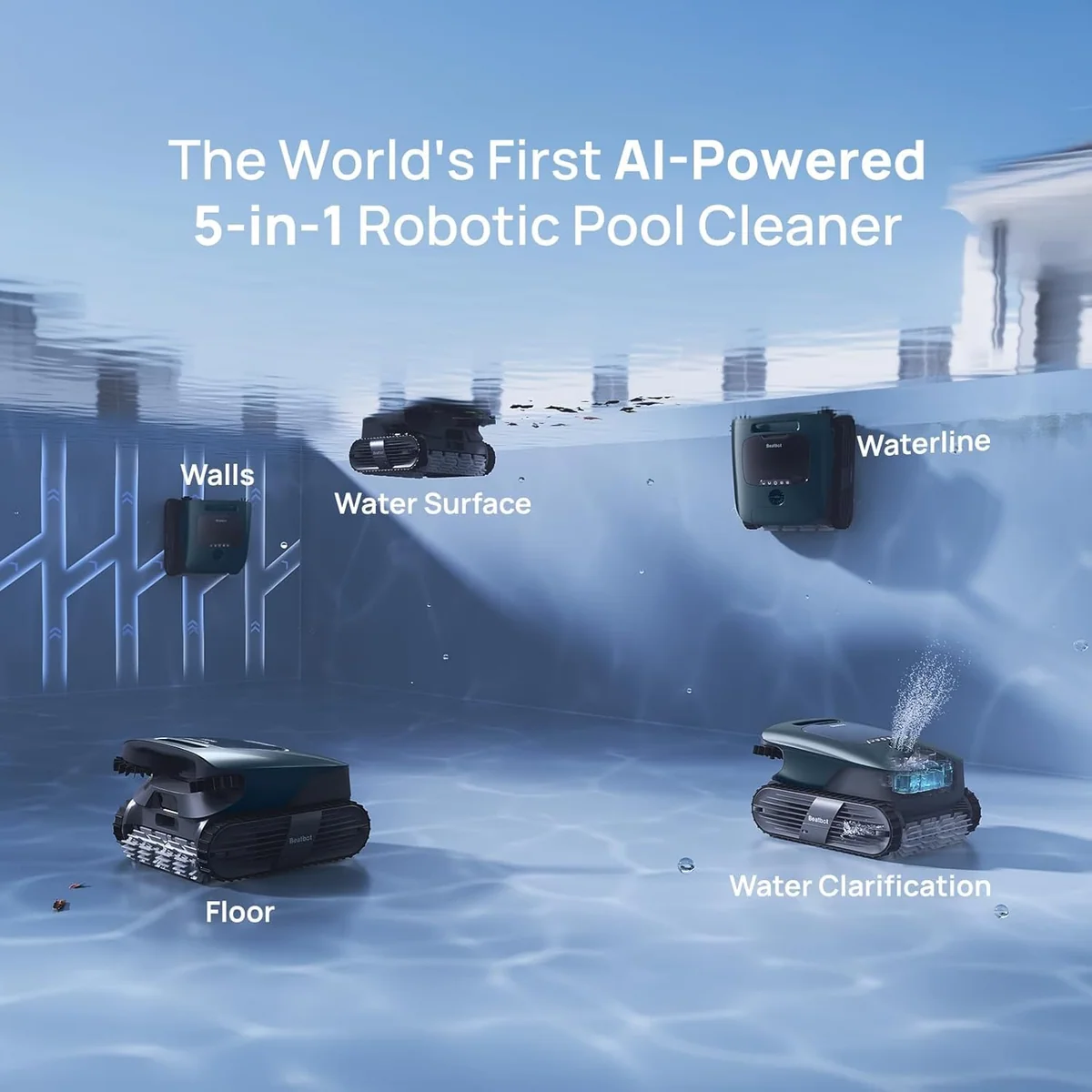
At its best, the Ultra is a formidable cordless floor cleaner. Independent testing found that it cleared a deliberately debris-laden pool floor, ran for hours and used its camera to return for leaves missed during the initial route. Its wall and waterline results are also persuasive. The trouble starts when “five-in-one” is read as five equally accomplished jobs, because the surface skimmer is inconsistent and the clarifier is an optional consumable rather than a substitute for normal pool care.
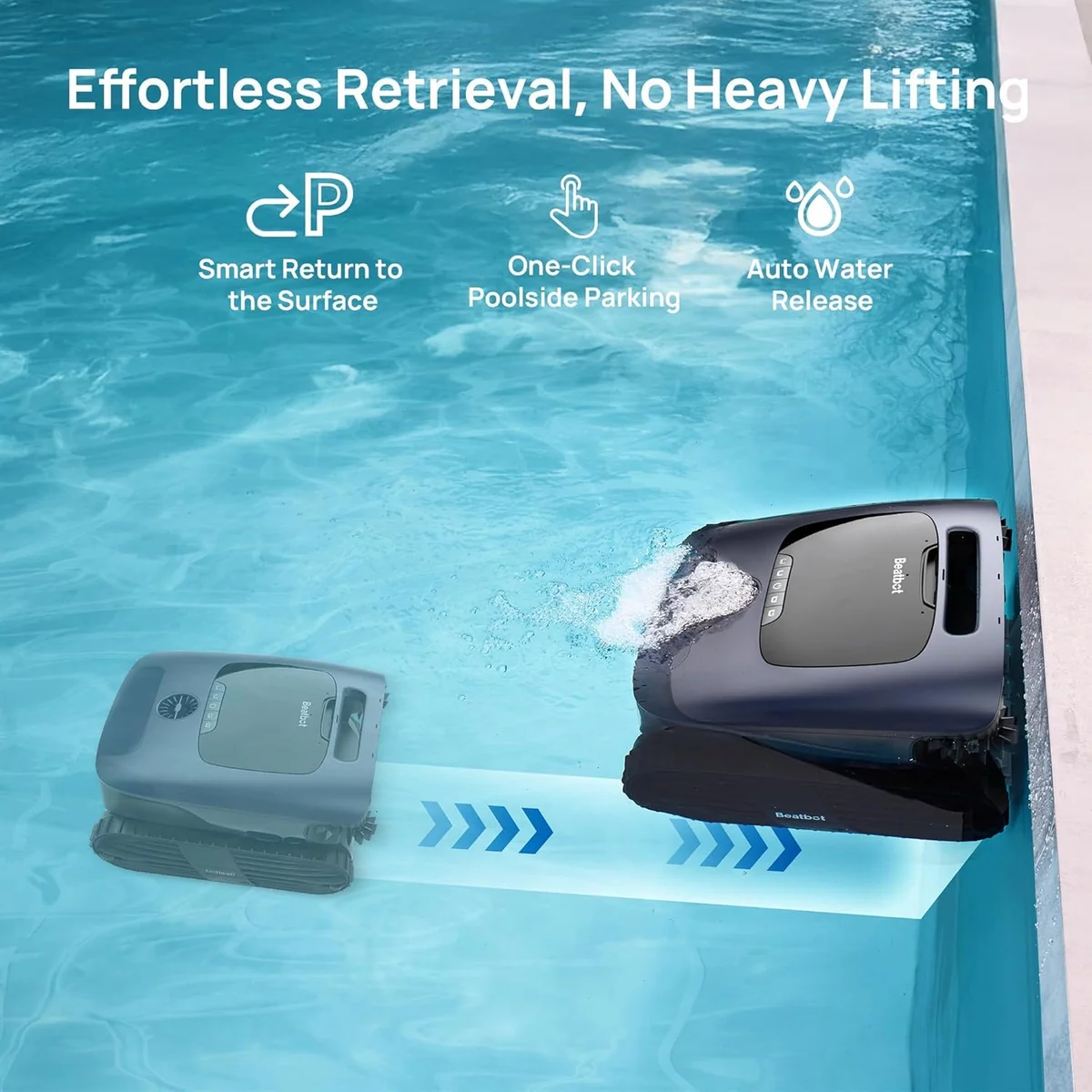
The other catch is physical rather than digital. A machine that weighs about 29 pounds before it enters the water can approach 45 pounds while draining, and one reviewer injured her back after repeatedly carrying it across a yard and up deck stairs. Surface parking helps bring the robot within reach, but it does not make the remaining dry mass disappear.
That combination creates an unusually narrow recommendation. The renewed Ultra is compelling when a cable is unacceptable, visible leaves are the principal problem and the pool is complicated enough to benefit from camera-guided navigation. A simpler pool, a shallow shelf that gathers dirt, a need for very fine filtration or any lifting limitation points elsewhere, including the broader choices in our guide to the best cordless robotic pool cleaners.
Key Specifications
The AI is real, while “total control” is not
Mapping can improve coverage without making the map useful
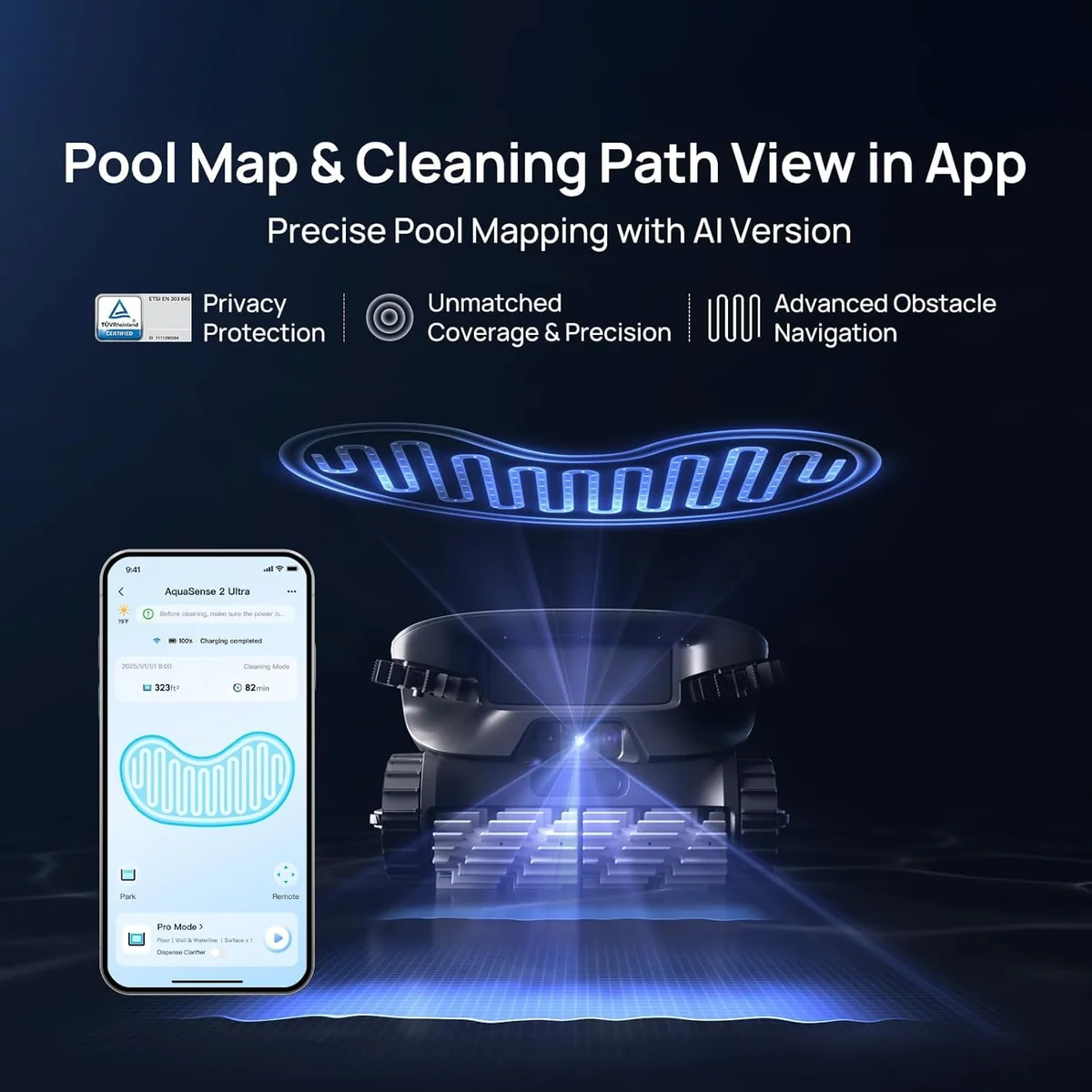
The Ultra combines a front camera with ultrasonic, infrared and time-of-flight sensing. Its routes are more deliberate than those of a simple bump-and-turn cleaner, and its post-pass search for visible leaves has been observed directly. The resulting app map is less impressive as a homeowner tool: PCWorld found that it mostly resembled the pool but changed orientation between runs and did not add much practical value.
Complex geometry remains the dividing line. An owner with rounded floor-to-wall transitions described repeated edge corrections that looked like a zigzagging dance, although cleaning quality remained good and later firmware produced a better-looking map. Active firmware development can improve such behavior, but it also means an expensive machine may depend on updates to settle edge cases.
The app loses the robot underwater
The app is useful before and after a run. It can configure cleaning combinations, install firmware, show completed-run information and display route maps; when the robot is floating, it can also steer the machine and call it toward an edge. Once the Ultra submerges, normal Wi-Fi and Bluetooth communication falls away, so there is no dependable live steering, midcycle mode change, recall or progress view.
That physical limitation turns “app control” into configuration rather than underwater remote control. It also separates the Ultra from true scheduled automation: a person still has to deploy the robot, retrieve it, rinse the filter and return it to the charging dock. Our guide to underwater pool-cleaner connectivity explains why this limitation appears across cordless machines rather than belonging to Beatbot alone.
The clarifier is optional, not transformational
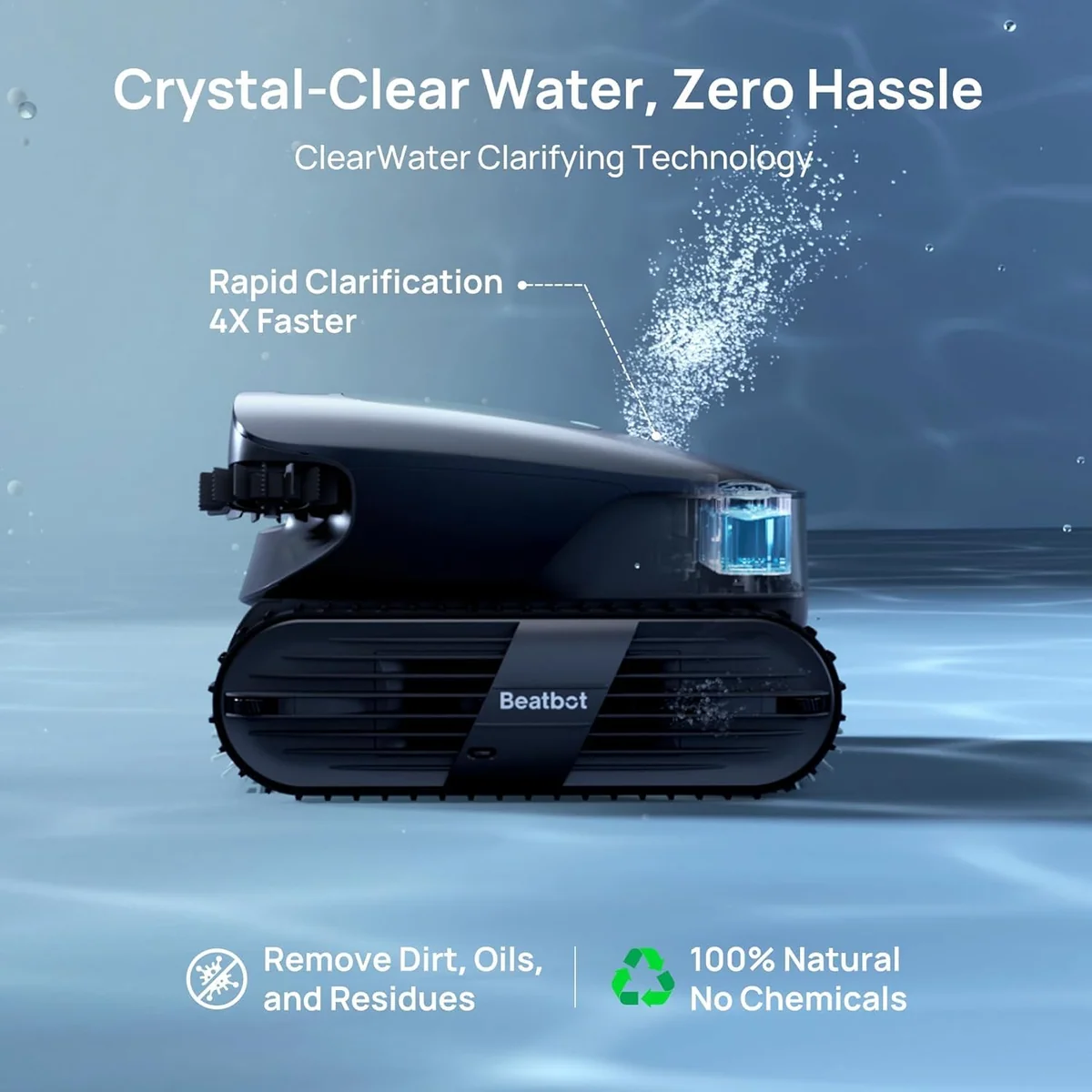
Beatbot’s ClearWater system dispenses an agent intended to bind fine suspended particles so that they can settle or become easier to filter. The mechanism is plausible, but the supplied evidence does not show that it sanitizes water or replaces filtration, balanced chemistry and an approved sanitizer. A reviewer who used it for about six weeks saw no obvious improvement in an already-clean pool and would not recommend the consumable on that experience.
The exact renewed listing says a clarifying-agent kit is included, which makes package completeness worth checking immediately. A missing or opened consumable is not a reason to reject an otherwise sound robot, but it is a reason not to accept a renewed box as complete without inspecting it.
Strengths & Limitations
Strengths
- Floor cleaning has strong evidence across visible leaves, sand and ordinary pool debris.
- Camera-guided debris hunting can recover material missed during the first planned pass.
- Long nominal runtime suits large pools when the renewed battery is healthy.
- Cordless operation removes the deck cable, power supply and in-water tether.
- Surface parking and draining make retrieval better than fishing a dead robot from the floor.
- Filter access and routine rinsing are straightforward once the heavy machine is out of the water.
Limitations
- The roughly 29-pound dry weight rules it out for buyers with back, shoulder or lifting limitations.
- Surface skimming is too inconsistent to replace a dedicated skimmer in a leaf-heavy pool.
- Stairs, Baja shelves, rounded transitions and tight corners remain geometry-dependent.
- The app cannot provide dependable live control while the robot is submerged.
- The mesh filtration is less persuasive for ultra-fine silt than systems offering pleated fine-filter media.
- A renewed unit adds uncertainty about battery capacity, sensor condition, accessories and warranty eligibility.
The floor cleaner is better than the five-in-one pitch
Leaves are where the camera earns its keep
PCWorld reported complete removal of the original organic and synthetic debris after three hours, then added ten more leaves while the robot continued running. The Ultra found nine before its battery was depleted, with the final leaf narrowly missed when the robot veered aside. That is useful evidence of something more intelligent than random bump-and-turn movement: the camera can spot remaining visible debris, change course and make a deliberate collection attempt.
An owner of a roughly 6 by 12 metre pool also reported that a combined floor, wall and waterline run completed with about eight percent battery remaining and left the pool immaculate. That is one owner’s result rather than a guarantee for every pool, but it shows that the nominal battery can support a substantial cleaning route when the battery is healthy and the filter is not overwhelmed.
The disagreement among reviewers is still worth respecting. The Pool Nerd found the route planning technically impressive but considered the suction and fine-filtration system disappointing for the product’s position, especially beside corded cleaners with pleated media. The fairest reading is not that the Ultra lacks cleaning power; it is that excellent visible-debris collection does not prove class-leading capture of the smallest silt and suspended material.
Walls are credible, but shelves remain pool-dependent
The Ultra has convincing reports of wall climbing and waterline cleaning, yet those vertical results should not be stretched into a promise that every horizontal ledge will be reached. Reviewed found that its test machine left dirt on the pool stairs and Baja shelf even though it cleaned the floor and sides well. Rounded transitions, narrow steps, shallow water and unusual ledge geometry can all frustrate a robot that looks capable on a conventional wall.
Occasional corner trouble is also possible. A six-week reviewer saw the robot free itself from corners without human intervention, but some escapes took roughly 20 minutes. That is better than remaining stranded, although it spends time and battery that could have been used for cleaning.
Surface skimming is the weak job
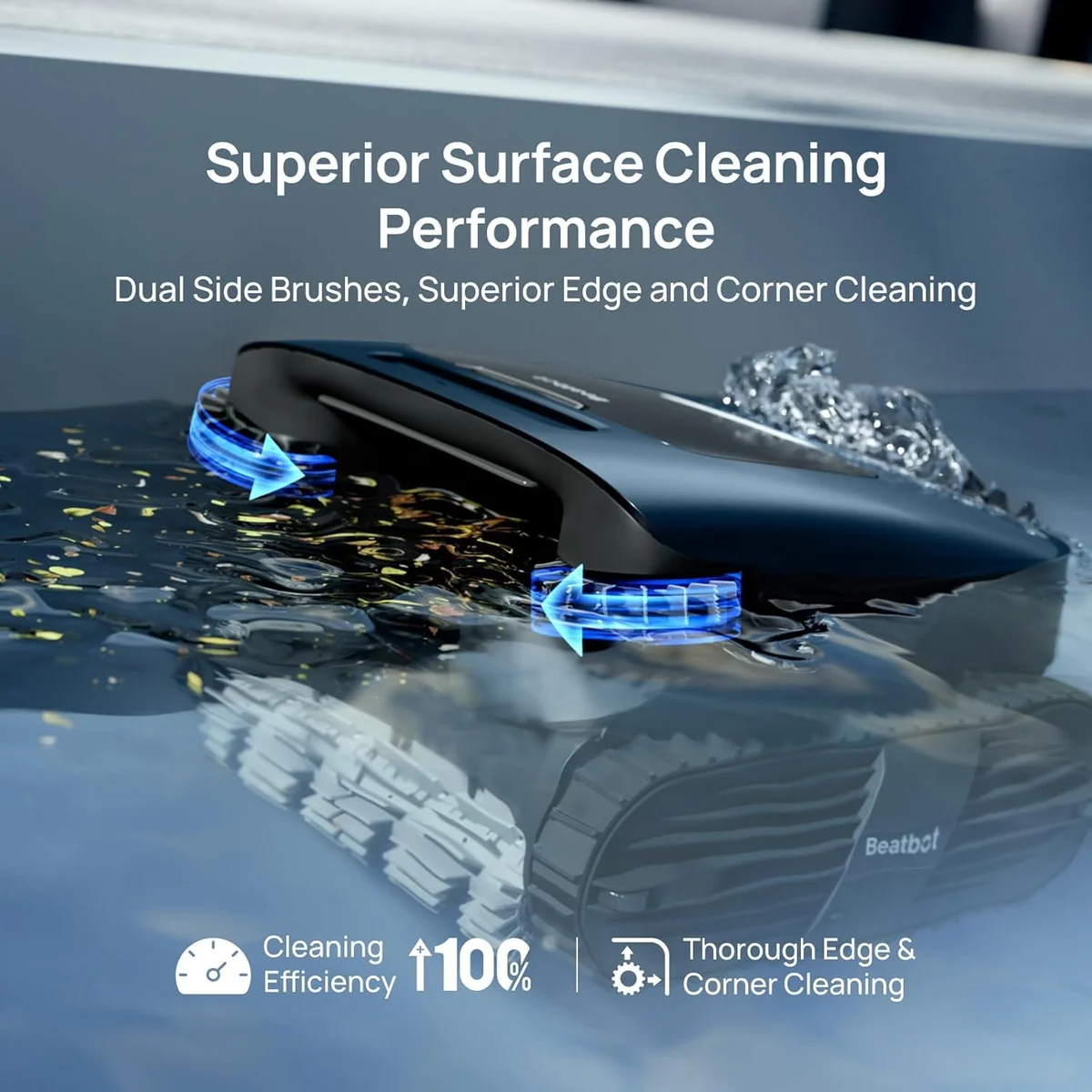
PCWorld’s controlled surface test produced the most useful number in the skimming record: the Ultra captured only about 40 percent of the floating debris. Its bow wave pushed material away from the intake, and the side brushes did not recover enough of it. Other reviewers found surface mode more useful along edges and confirmed close to ten hours of operation, but even the positive six-week assessment preferred a separate floor robot and dedicated solar skimmer.
Treat surface mode as a convenient extra for a light scattering of leaves, not as a dependable replacement for a robot that remains on the surface throughout the day. Tree-heavy pools may be better served by pairing a floor cleaner with one of the site’s dedicated robotic skimmers, particularly when stopping leaves before they sink matters more than owning a single machine.
The renewed offer is a condition test, not an automatic bargain
Reviews written around the new Ultra’s flagship positioning make its value look punishing, but a renewed listing changes the arithmetic without changing the robot’s limitations. The buyer may obtain the camera, long nominal runtime and cable-free design for less than a typical new example, yet accepts uncertainty in the components most likely to affect daily satisfaction. Battery health, clear sensor windows, reliable docking and a genuinely applicable replacement policy matter more here than a marginal specification victory.
The AquaSense 2 Pro is the obvious one-machine alternative within Beatbot’s range. It shares the same nominal 13,400 mAh battery, rated 5,500-gallon-per-hour flow, dual-layer filtration, surface mode, clarifier system and parking concept, while the Ultra adds its camera-guided debris search, broader sensor package, side brushes, lights and SmartDrain refinements. Buyers with a conventional pool and moderate debris should read the direct AquaSense 2 Ultra versus AquaSense 2 Pro comparison before paying for intelligence that their pool may not need.
| Route | What it does best | What you accept |
|---|---|---|
| Renewed AquaSense 2 Ultra | Cable-free floor, wall and waterline cleaning with camera-guided leaf hunting | Heavy manual handling, weak surface capture and condition uncertainty |
| AquaSense 2 Pro | Most of the core all-in-one cleaning concept without paying specifically for the Ultra’s camera system | Less sophisticated navigation and no camera-guided missed-debris search |
| Corded cleaner plus solar skimmer | Continuous floor power and a separate surface robot that can intercept leaves independently | A cable in the pool, two machines to maintain and more storage space |
A corded cleaner and separate skimmer remain the stronger functional split for owners who prioritize fine filtration and continuous leaf interception. The trade is obvious: two devices take more room, and the floor robot brings a cable back into the pool. Buyers still deciding which compromise is less irritating can start with our corded versus cordless guide.
Buy only after these answers are written down
- Confirm who refurbished the machine and what battery-capacity standard was applied.
- Confirm that the three-year full-replacement language applies to this renewed purchase and includes battery degradation.
- Confirm that the dock, cover, retrieval hook, side brushes, fasteners, screwdriver, manuals and advertised clarifier kit are present.
- Confirm that the device has been removed from any previous app account and remains eligible for firmware updates.
- Confirm the return window for weak runtime, failed diving, unreliable surface mode or mapping faults.
The renewed AquaSense 2 Ultra makes sense when cordless operation matters more than simplicity.
Consider it for a large, irregular or tree-heavy pool only after the battery and replacement coverage are verified.
The heavy lift, inconsistent skimming and unknown refurbishment history remain the price of admission.
A renewed Ultra needs an acceptance test
The long-term record is too thin to calculate a meaningful failure rate, but it contains two specific warnings that matter more for renewed inventory than for a sealed new unit. One owner reported that protective windows over front and side sensors had become cloudy, yellowed and opaque after two summers, potentially obstructing the sensors that make the mapping system valuable. The report does not establish how common the problem is or what storage and water conditions contributed to it, so it should be used as an inspection point rather than proof of a model-wide defect.
A separate AquaSense 2 Ultra owner reported that a 1.5-year-old machine remained floating in standby despite a full charge and repeated resets, while another commenter described similar behavior at ten months. No resolution or diagnosis was available in the supplied record. These reports are anecdotal, but they justify testing startup, diving, mode selection, charging and surface parking immediately rather than waiting until the return window is nearly over.
Run this check while a return is still easy
- Inspect every camera and sensor window in daylight for haze, yellowing, scratches or mineral deposits.
- Check the handle, retrieval point, SmartDrain outlets and dock contacts for wear or corrosion.
- Pair the app, install available firmware and verify that no previous account binding blocks setup.
- Start with a full charge and record whether a complete floor cycle finishes with plausible remaining capacity.
- Test wall climbing, surface mode, parking, call-over and charging rather than assuming one successful floor pass proves every system works.
- Open and rinse both filter sections, then inspect the seals, mesh, brushes, tracks and side-brush attachments.
- Register the product and retain written evidence of the exact replacement terms that apply to the renewed serial number.
The Amazon listing advertises three-year full-machine replacement protection, an unusually reassuring promise if it applies exactly as written to the renewed purchase. The unresolved questions are the important ones: when coverage begins, whether it transfers to renewed inventory, whether battery deterioration qualifies and what documentation is required. Treat a seller’s verbal assurance as incomplete until the written offer terms identify this condition and serial number.
Normal ownership is not passive even when everything works. Each outing requires carrying the robot to the pool, deploying it, retrieving it before or after the parking window, letting it drain, rinsing the filter and redocking it. Store it under the supplied cover and out of punishing direct sun where practical, and follow the maintenance routine in our robotic pool-cleaner care guide.
Final verdict
The AquaSense 2 Ultra is a highly capable cordless floor, wall and waterline cleaner whose camera-guided leaf hunting is more than marketing. It is not an equally accomplished skimmer, it cannot be controlled live underwater, and it demands regular handling of a machine that remains heavy after draining.
The renewed version deserves a conditional buy only for the owner who needs its particular strengths: no cable, long healthy-battery runtime, visible-debris detection and navigation suited to a large or irregular pool. Everyone else should choose the less glamorous arrangement that better matches the actual work, whether that is an AquaSense 2 Pro, a corded cleaner with stronger fine filtration or a separate surface skimmer.
Sources (8)
- Amazon listings and customer reviews — Beatbot Aquasense 2 Ultra
- Owner reports across r/Beatbot_Tech threads
- Owner and reviewer video, 1 channel
- Pcworld — Article — www.pcworld.com
- Reviewed — Article — www.reviewed.com
- Thepoolnerd — Article — www.thepoolnerd.com
- Robotreviewdesk — Article — robotreviewdesk.com
- Facebook — Article — www.facebook.com
Frequently Asked Questions
Is a renewed AquaSense 2 Ultra worth buying?
It can be worthwhile for a strong owner with a complex, leaf-prone pool, provided the battery, accessories, return rights and three-year replacement eligibility are verified before purchase.
Can the AquaSense 2 Ultra replace a dedicated pool skimmer?
No, its surface mode is best treated as supplemental because one controlled test captured only about 40 percent of floating debris.
Can the app control the robot while it is underwater?
No, the app can configure runs and show completed information, but dependable live steering and mode changes are unavailable once the robot submerges.
Will the AquaSense 2 Ultra clean stairs and tanning ledges?
It may clean some broad submerged platforms, but stairs and shallow Baja shelves remain unreliable because access depends on water depth, width and transition geometry.
Can the AquaSense 2 Ultra stay in the pool between cycles?
It should be retrieved, rinsed, recharged and stored after use rather than treated as a permanently deployed cleaner, as explained in our guide to leaving robotic cleaners in the pool .