The iGarden KN35 earns its keep in simple pools, not complicated ones
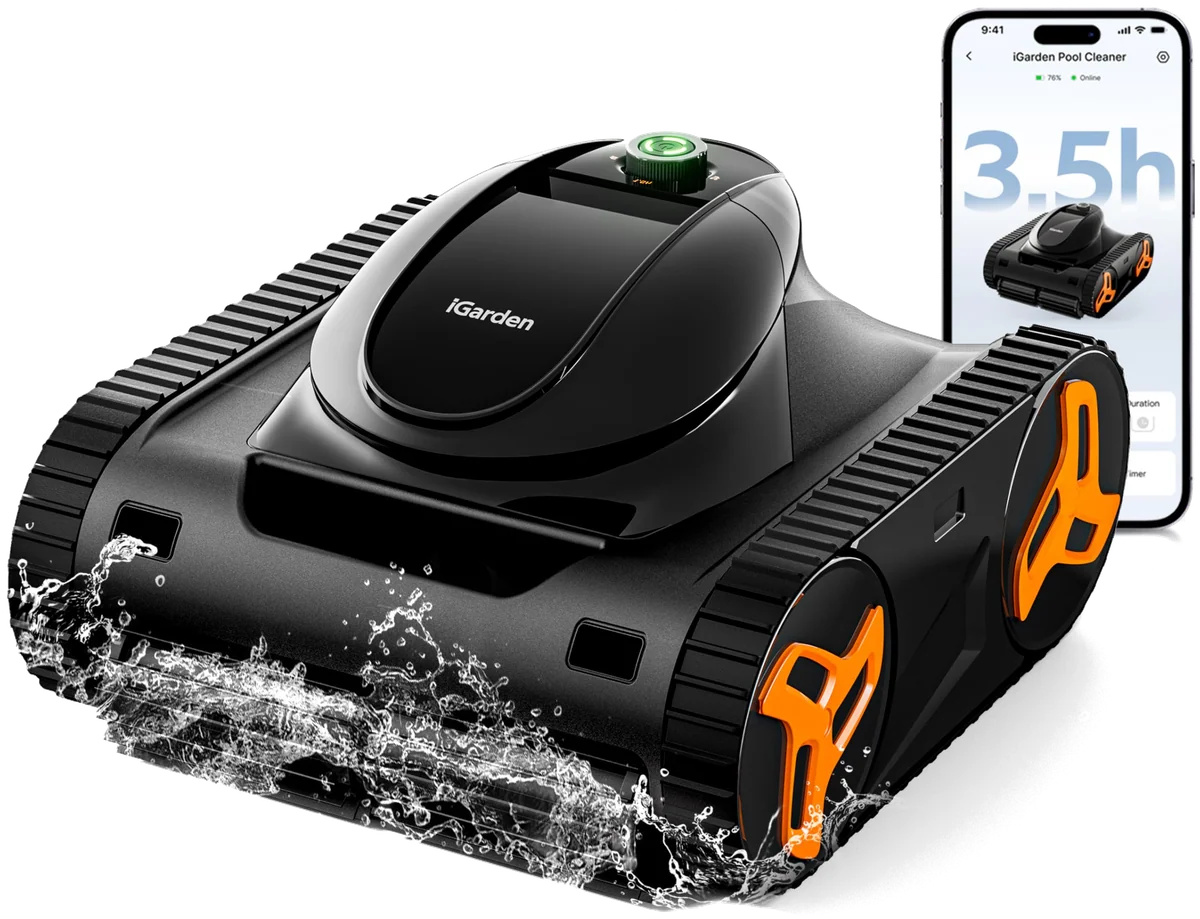
Buy the iGarden KN35 for routine cordless cleaning in a straightforward pool, but skip it if steps, ladder gaps, prominent drains or heavy leaf loads are the chores you most need a robot to solve.
Final verdict
The iGarden KN35 is a credible cordless maintenance cleaner with a sensible basket, useful cycle choices and enough claimed battery capacity to make frequent charging less intrusive. Its strongest buyers have an open pool floor, manageable amounts of loose dirt or small leaves, and a deep dislike of hoses and cables.
It is not the right robot to buy on the strength of “smart 3D navigation” alone. Steps, tight corners, ladder gaps and raised floor fixtures remain capable of winning, while large leaves and adhered silt weaken the case for total automation. Buy it to make routine cleaning easier, not to make every other pool chore vanish.
Model checked: This review covers ASIN B0GK1C1LZX, the matte-black KN Series cleaner identified by Best Buy as the KN35 and advertised with a 210-minute maximum runtime; it does not cover the K25, K36, K60, K70, K Pro or M1-AI models whose specifications are often mixed into iGarden discussions.
The KN35’s real achievement is not making pool care disappear; it is removing the hoses, power cable and filter-system setup from routine vacuuming. Charge it, choose a mode, release the trapped air, lower it into the water and let its onboard basket collect the mess. Owners repeatedly valued that simpler routine, especially compared with assembling manual-vacuum equipment and sending debris through the pool’s main filtration system.
That convenience is substantial, but the word “automatic” needs boundaries. The owner still retrieves a water-heavy machine, empties and rinses the basket, dries the charging area and recharges the battery. The robot can reduce vacuuming without replacing surface skimming, chemistry, occasional brushing or touch-ups on steps and awkward corners.
Cleaning evidence points to a useful maintenance machine rather than a one-pass rescue crew. Loose dirt, sand, insects and small leaves are its friendliest workload. A storm’s worth of broad leaves, adhered silt and debris tucked where the floor meets the wall are less dependable propositions.
Key Specifications
The 210-minute headline is a ceiling, not a schedule
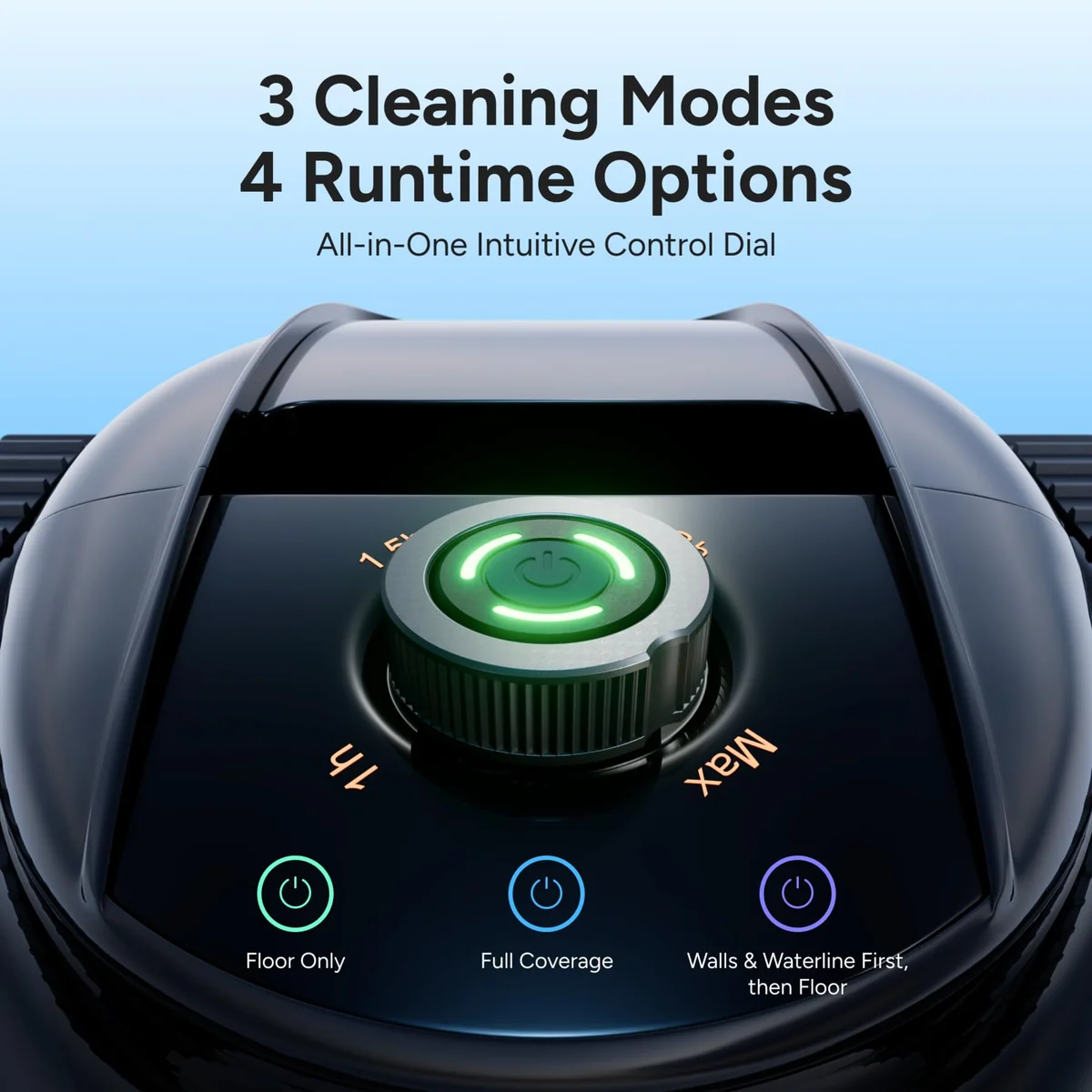
The exact listing calls 210 minutes the maximum runtime but does not establish that every cleaning mode runs for that long. It also lets the owner select one-hour, 90-minute, two-hour or maximum cycles, which is more useful than forcing the longest possible outing every time.
One owner who explicitly bought the 210-minute version said the capacity was more than enough for a not-huge pool, but did not report a stopwatch test of the maximum. Another ran floor mode for 90 minutes and estimated that the cycle used about two-thirds of the battery. Those accounts support useful endurance, not an independently measured 210-minute result across floors, walls and the waterline.
Three modes divide the work sensibly
Green restricts the robot to the floor. Blue covers the floor, walls and waterline while adding tanning ledges and shallow areas where the water is deeper than 40 centimeters. Purple prioritizes the walls and waterline before cleaning the floor, but excludes shallow areas. These distinctions matter because “full coverage” does not mean every step, every ledge or the floating debris on the surface.
Floor-only mode is the sensible default for frequent maintenance in an above-ground pool or a simple rectangular basin. The broader modes make more sense when wall growth and the waterline need attention, provided the pool’s slopes and ledges give the tracks enough purchase.
The app stops being a remote when the robot submerges
The app can help choose settings, check the battery and install firmware updates while the KN35 is reachable by radio. It cannot maintain that connection underwater, a limitation stated by iGarden and confirmed by the owner who initially wondered whether the disconnection was a setup fault.
That makes the app a configuration and maintenance companion, not an underwater steering wheel. There is no supported basis for expecting a live pool map, mid-cycle mode changes, a recall command or manual guidance toward a missed patch. Fortunately, the physical controls cover the decision that matters before launch: what to clean and for how long.
Retrieval is easier than searching, not necessarily easy
Auto-parking means moving toward a wall when the cycle ends or the battery runs low. It does not mean returning to the original drop point or docking at a predictable station. Owners describe finding it leaning against a side wall, sometimes in a random position, which is still more convenient than hunting for it in the middle of the floor.
The body drains as it is lifted, yet several owners still found the wet retrieval substantial. One relatively strong owner questioned how comfortable it would be for someone with less upper-body strength, and another called the included retrieval hook too small. A separate report noted that a little debris escaped while the unit drained, making a prompt, steady lift preferable to pausing at the waterline.
Deployment has its own small ritual. An owner needed to rotate the KN35 in the water to release trapped air before allowing it to sink, then wait roughly a minute for movement to begin. That delay is normal enough to know about before mistaking a quiet robot for a dead one.
Strengths & Limitations
Strengths
- Cordless deployment eliminates the hose and floating power cable from routine cleaning.
- The selectable cycle lengths make the large advertised battery capacity useful for both quick and extended maintenance.
- Owner reports support capable floor, wall and waterline cleaning in pools without troublesome geometry.
- The 3.2-liter top basket is large enough for ordinary maintenance loads and easy to rinse.
- Floor-only and broader coverage modes let the owner match energy use to the actual chore.
Limitations
- Steps, tight corners, ladder gaps and raised floor fixtures can remain dirty or trap the robot.
- Large leaves and adhered fine silt are less dependable targets than loose dirt and smaller debris.
- The app disconnects underwater, so it cannot steer, recall or reconfigure the robot during a cycle.
- Wet retrieval can demand real effort, and a little collected material may fall back during draining.
- The exact KN35 lacks a convincing long-term record for battery life, repairability and replacement-part access.

Pool geometry gets the final vote
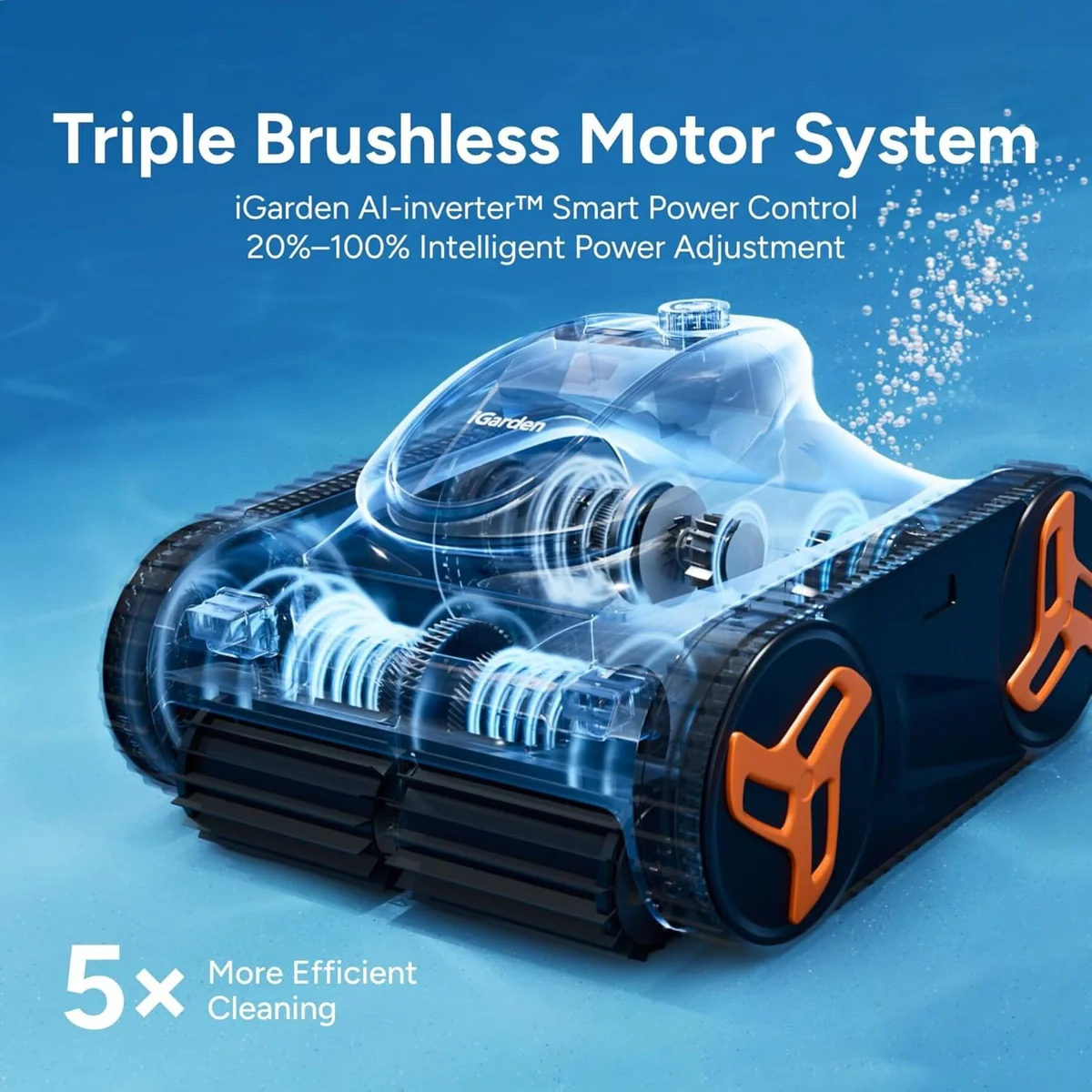
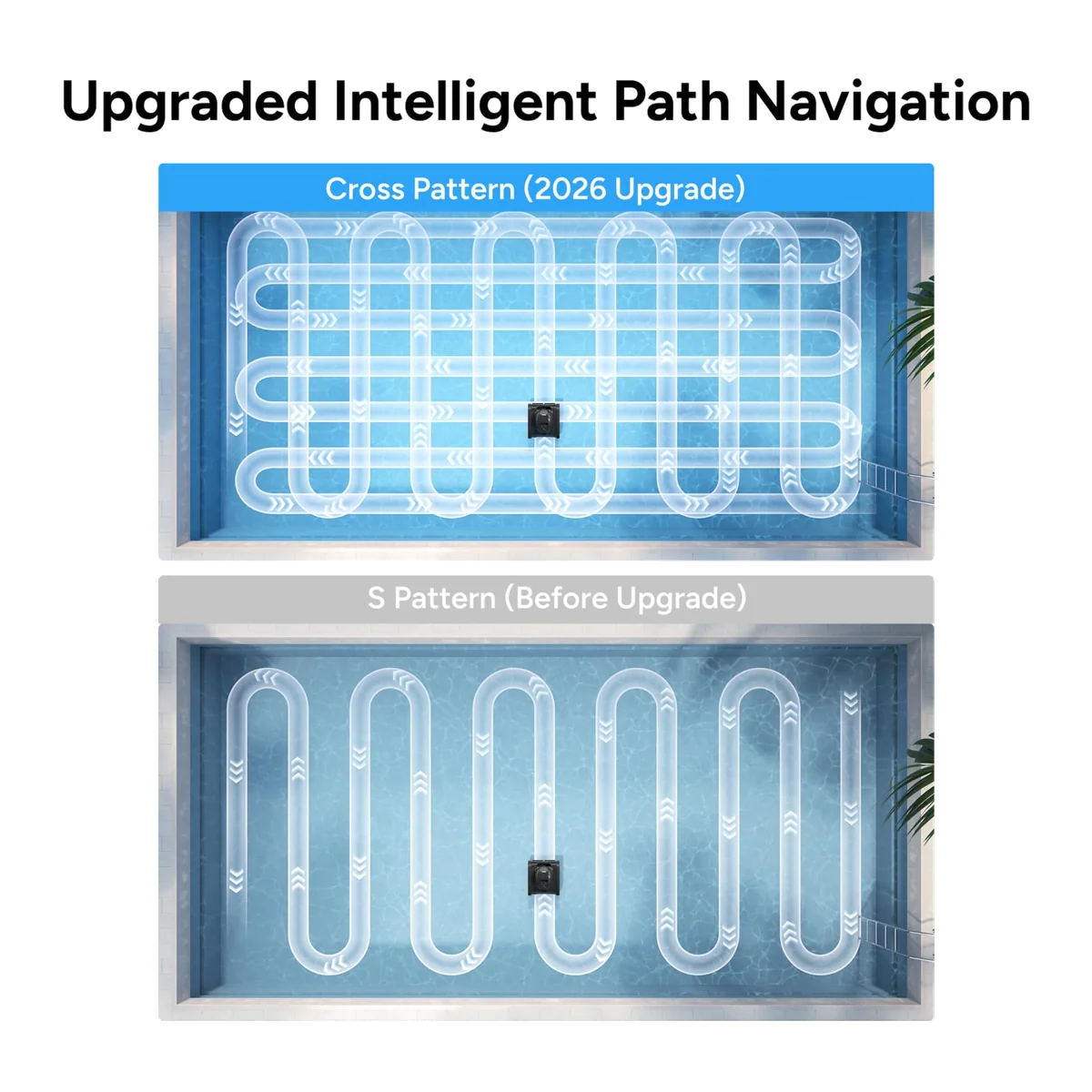
iGarden says multiple sensors guide the KN35 through an organized S-shaped path and improve coverage compared with random movement. That is a navigation claim, not evidence that the robot maps a pool, remembers a floor plan or reaches every surface.
Owner reports are more informative than the navigation vocabulary. A cleaner can look orderly across an open floor and still be defeated by a narrow ladder gap, a raised drain or the transition into a step. One KN owner with an irregular pool reported broad floor, wall and waterline cleaning but still had to accept missed steps and tight corners. Another watched the robot wedge vertically between an A-ladder and the pool wall, then freed it with a net. A third returned the cleaner after bottom fixtures repeatedly trapped it and consumed the battery.
| Pool task | Reasonable expectation | Important limit |
|---|---|---|
| Open floor | Its strongest and most consistent assignment | Material can remain in the floor-to-wall seam |
| Walls and waterline | Supported by the available owner reports | Grip and geometry still determine which areas it reaches |
| Steps and ledges | Some qualifying shallow areas are included in one mode | Ordinary steps remain a documented miss |
| Ladder areas | Open space beneath a movable ladder may be cleaned | A narrow ladder-wall gap can trap the robot |
| Raised drains or floor fixtures | Results depend on the shape and height of the obstacle | An owner reported repeated stranding on bottom fixtures |
| Water surface | No cleaning should be expected | The KN35 is a submerged vacuum, not a robotic skimmer |
Small debris suits it better than a leaf dump
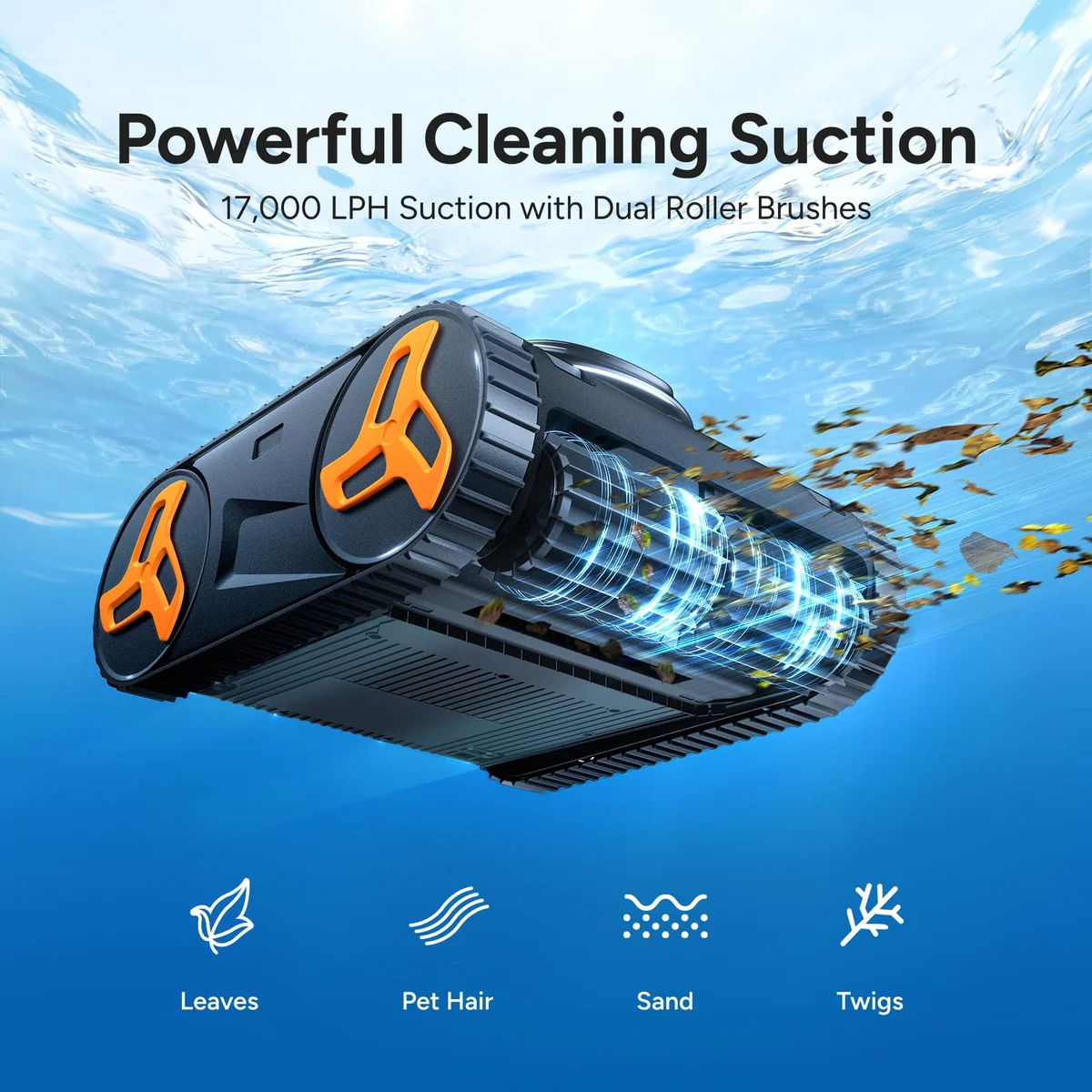
The most persuasive positive reports describe routine debris: dirt, sand, insects, hair and smaller leaves distributed around the pool. The 3.2-liter top basket also earns practical praise for holding a normal run’s collection and being straightforward to detach and rinse.
Large debris is the important counterexample. An owner who used a corded Maytronics cleaner as the reference point found that the KN35 collected smaller material but pushed larger debris ahead of itself. That does not mean it cannot pick up leaves; other owners say it can. It means “leaf pickup” is too broad a promise unless leaf size, load and position are considered.
Loose sand and adhered silt are different jobs
Reports that the KN35 picks up sand can coexist with a report that fine silt remained on the floor. A vacuum can collect loose particles that pass beneath its intake while failing to remove material stuck to the surface. In the latter case, the brushes passed over the silt and the owner still had to loosen it manually.
The advertised 180-micron basket should therefore be understood as the primary debris filter, not as a promise to capture microscopic algae or polish cloudy water. The KN35 is better judged by how much routine debris it removes from surfaces than by the visual clarity claims sometimes attached to “fine filtration.”
Its value is time saved before the cleaning starts
The best case for the KN35 is not that it performs every pool chore better than every corded cleaner. It is that routine vacuuming becomes less annoying. There is no cable to lay out, no suction hose to prime and no need to route the collected debris through the pool’s main filter. Owners who dislike that setup work have a rational reason to accept charging and retrieval instead.
That trade only works if the pool cooperates. A simple floor with dispersed grit can turn the KN35 into a genuine labor saver. A pool dominated by steps, complex ledges, a ladder pocket or prominent floor fixtures may replace vacuuming time with robot-rescue time, which defeats the point.
Cordless is therefore a preference, not an automatic upgrade. A direct comparison with a corded Dolphin framed the decision cleanly: the Dolphin proposition is continuous power without a battery cycle, while the iGarden proposition is freedom from the cable and faster drop-in setup. If charging sounds more irritating than managing a cord, read the Dolphin Nautilus CC review before committing to battery power.
Buyers still deciding which compromise fits their routine can use the site’s guide to corded and cordless pool cleaners. Those committed to a battery model can compare the KN35 with the broader field in our cordless robotic pool cleaner guide, while the iGarden lineup guide keeps the company’s easily confused models separate.
Are pool robots worth buying at all? They can be when the recurring floor-cleaning labor is worth transferring to a machine, but they do not erase pool ownership. Our full guide to whether robotic pool cleaners are worth it covers the broader calculation; for this model, the answer depends primarily on pool geometry and debris size.
The unanswered question is the battery’s third season
The collected record does not establish how an exact KN35 battery, motor or track system performs after years of regular use. Several retained reviews concern early ownership, and some reviews attached to the listing explicitly discuss other iGarden models. A new cleaner can feel sturdy and work impressively for a few cycles without answering the durability question.
iGarden’s exact listing promises two-year full-replacement protection, 30-day returns and continuous product assistance. That coverage reduces short-term risk, but a warranty is not evidence that the battery will retain its capacity or that ordinary wear parts will be easy to obtain after the protection ends.
One owner who returned the KN35 after repeated problems with bottom fixtures reported that customer support followed up and was helpful. That is encouraging as a service anecdote, although the eventual solution was a different iGarden model rather than proof that this cleaner suited the pool.
A sensible ownership routine
- Retrieve the cleaner after its cycle rather than treating it as permanent pool equipment.
- Empty and rinse the basket before debris dries into the mesh.
- Rinse the exterior with fresh water and let the charging area dry fully.
- Store the robot and charger in a cool, dry place away from direct sun and temperature extremes.
- Inspect the intake, tracks and brushes when coverage or suction changes.
Those habits match general repair guidance for battery pool robots and are more useful than trying to predict an exact lifespan from a young review record. Anyone planning around several seasons of service should also read our guide to robotic pool cleaner lifespan and our maintenance checklist.
Frequently Asked Questions
Is the iGarden KN35 the same cleaner as the K36?
No, this review covers the KN35 configuration sold as ASIN B0GK1C1LZX, so K36 specifications and test results should not be assigned to it.
Does the KN35 really run for 210 minutes?
iGarden advertises up to 210 minutes as the maximum, but the available exact-model evidence does not independently establish that duration in every cleaning mode.
Can the KN35 clean walls and the waterline?
Yes, those areas are included in its broader modes and supported by owner reports, although steps, tight corners and difficult transitions can still be missed.
Will it clean tanning ledges and steps?
Blue mode includes qualifying shallow areas deeper than 40 centimeters, but owner evidence does not support treating ordinary steps as reliably covered.
Can the KN35 get stuck on pool obstacles?
Yes, retained owners reported trouble with a narrow ladder gap and raised bottom fixtures, so unusually shaped pools deserve close observation during the first cycles.
Does the KN35 skim floating leaves?
No, it cleans submerged floors, walls and the waterline rather than collecting debris floating across the surface.
Can the app control the robot underwater?
No, the app is useful for out-of-water configuration, battery checks and updates, but the listing explicitly says the connection is lost underwater.
Is the KN35 suitable for both above-ground and inground pools?
Yes, iGarden markets it for both pool types, but the shape of the floor, ladders, drains, steps and ledges matters more than the installation category alone.
Can it replace manual pool cleaning completely?
No, it can reduce routine vacuuming but still leaves the owner responsible for surface debris, chemistry, basket care, charging and occasional brushing or corner work.
Sources (3)
- Amazon listings and customer reviews — Igarden Kn35
- Owner and reviewer video, 2 channels
- Bestbuy — Article — www.bestbuy.com