The TALOSBO C1 Beats the WYBOT C1, but Only in the Right Pool
Choose the TALOSBO C1 for a conventional pool, but skip both cleaners if irregular geometry, dependable step coverage, or proven long-term support matters more than cordless convenience.
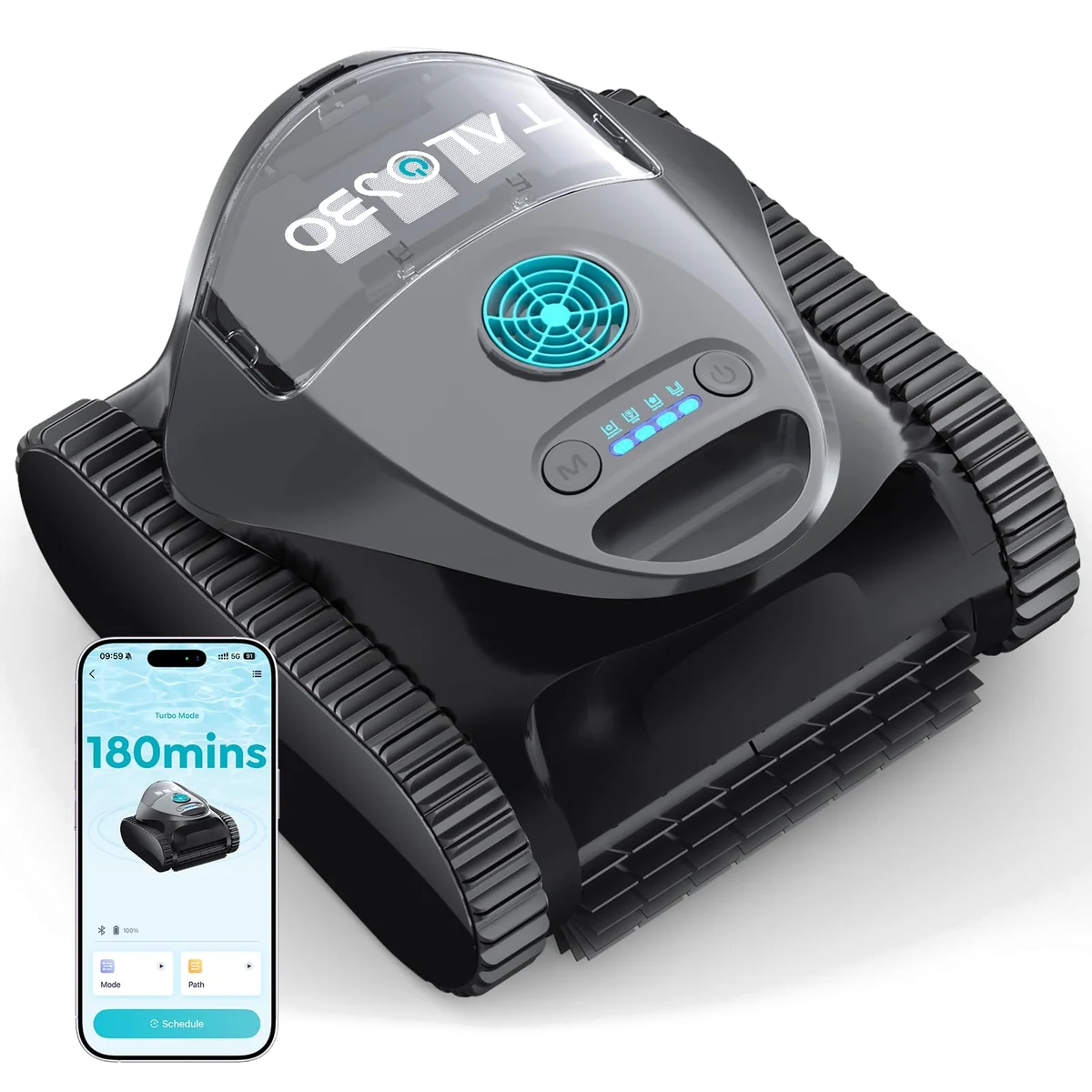
TALOSBO C1
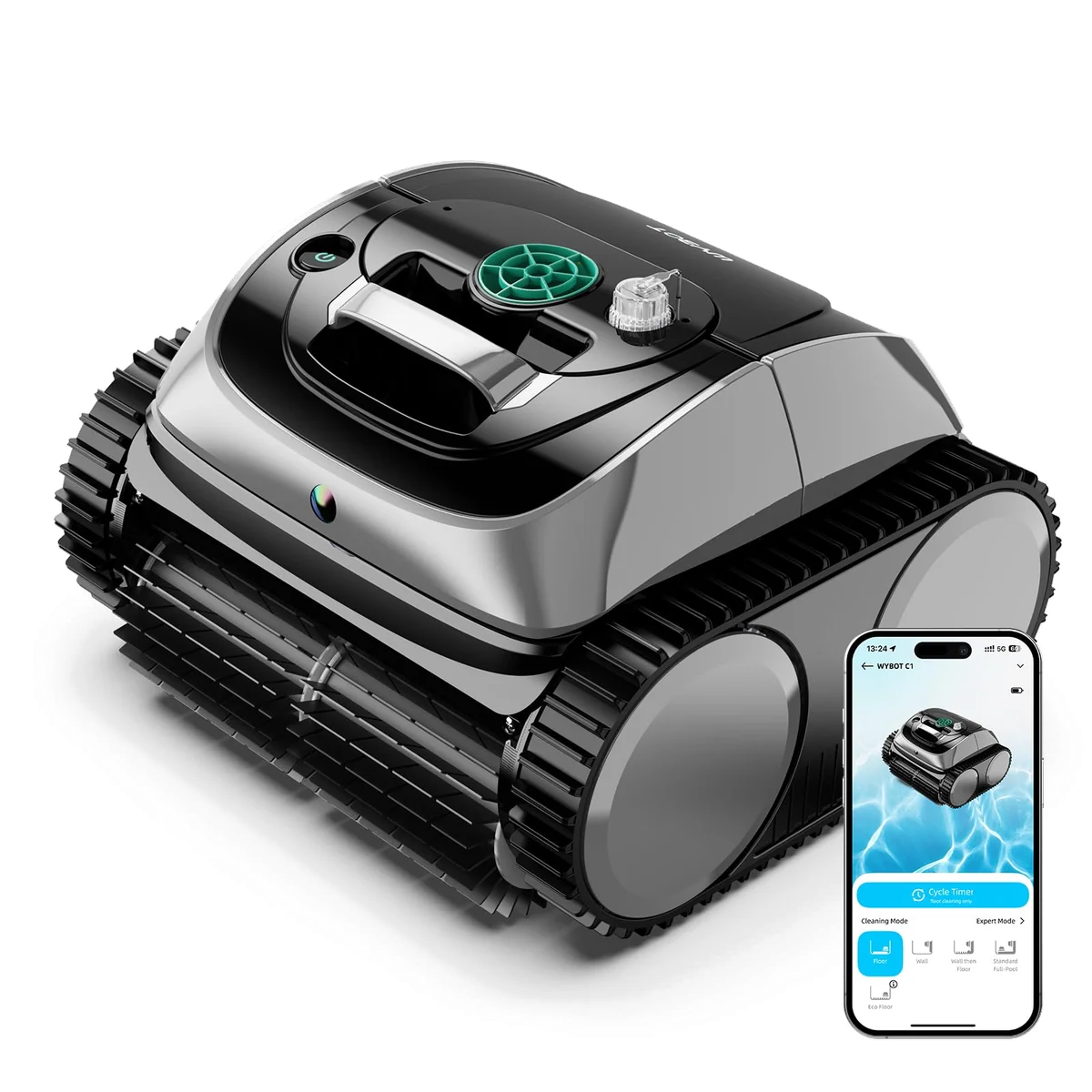
WYBOT C1
This is a narrow win with a large condition attached. The TALOSBO C1 has the stronger buying case because its two-stage filtration is better suited to mixed debris, its lighter cleaning mode can run longer, its stated recharge is substantially shorter, and its exact-model owner record is deep enough to reveal both real cleaning ability and recurring navigation faults. The WYBOT C1 may clean a simple pool very well, but four retained exact-product reviews cannot carry a confident durability verdict.
That does not make the TALOSBO a smart-mapping machine or the WYBOT a bad vacuum. Both are cordless tracked cleaners built around the same basic bargain: accept manual retrieval and charging in exchange for keeping a power cable out of the pool. Both target the floor, walls, and waterline, both use programmed routes rather than a demonstrated persistent map, and neither should be mistaken for a robot that understands every drain, shelf, step, curve, or deep-end transition.
The decision in thirty seconds
- Simple rectangular or round pool
- Pick the TALOSBO C1 for the more convincing combination of debris retention, charging speed, and documented owner experience.
- Oval, freeform, or obstacle-heavy pool
- Pick neither, because extra runtime cannot teach a preset route where it has already been or why its tracks have stopped moving.
- Steps, benches, or tanning ledges
- Treat both as floor-and-wall assistants rather than complete replacements for brushing and manual vacuuming.
- Set-and-forget ownership
- Look beyond this pair, since each cleaner still needs retrieval, filter rinsing, port drying, and manual charging after its work is done.
The distinction that matters is not the single extra advertised surface in WYBOT’s “4-in-1” language or the seventh selectable mode in TALOSBO’s app. It is whether the cleaner can finish the dirty parts of your particular pool before its route repetition consumes the charge. For an open, predictable layout, TALOSBO offers the better odds. For a pool whose shape already causes cleaners trouble, the correct answer is not to choose the slightly stronger claimant.
TALOSBO C1
WYBOT C1
At a Glance
| Feature | Editor's Pick TALOSBO C1 | WYBOT C1 |
|---|---|---|
| Price Range | $200–$500 | $200–$500 |
| Claimed runtime | Up to 180 minutes in Eco mode; approximately 90–100 minutes in Full Pool mode | Up to 160 minutes |
| Check Price on Amazon | Check Price on Amazon |
One wins the specification sheet, but geometry decides the pool
The TALOSBO’s published ceiling is 180 minutes in Eco mode, while its Full Pool setting is listed at approximately 90 to 100 minutes; the WYBOT advertises a maximum of 160 minutes, followed by a four-hour charge. TALOSBO lists roughly two and a half hours for charging, although its own product material has not always been perfectly consistent about the figure. These are useful planning limits, not promises that every square foot will receive one clean pass.
A robot can spend three hours repeating one successful lane and still leave the far end dirty. TALOSBO owners have documented that problem in larger oval and irregular pools, including routes that drifted away from their intended center, repeated already-cleaned areas, and failed to reach the deep end before the battery expired. The same cleaner can look confused in a small oval yet eventually leave the floor acceptably clean, which is why area ratings cannot stand in for shape.
Why the ranking is not a tie
WYBOT publishes the more systematic navigation story, describing gyroscope-guided N-shaped and S-shaped paths, while TALOSBO asks selectable patterns and long runtime to compensate for imperfect route logic. The problem is evidence depth. TALOSBO’s larger exact-model record shows where the machine succeeds and fails; WYBOT’s four retained exact-product reviews show promising cleaning but leave too much uncertainty around coverage, battery life, and later ownership.
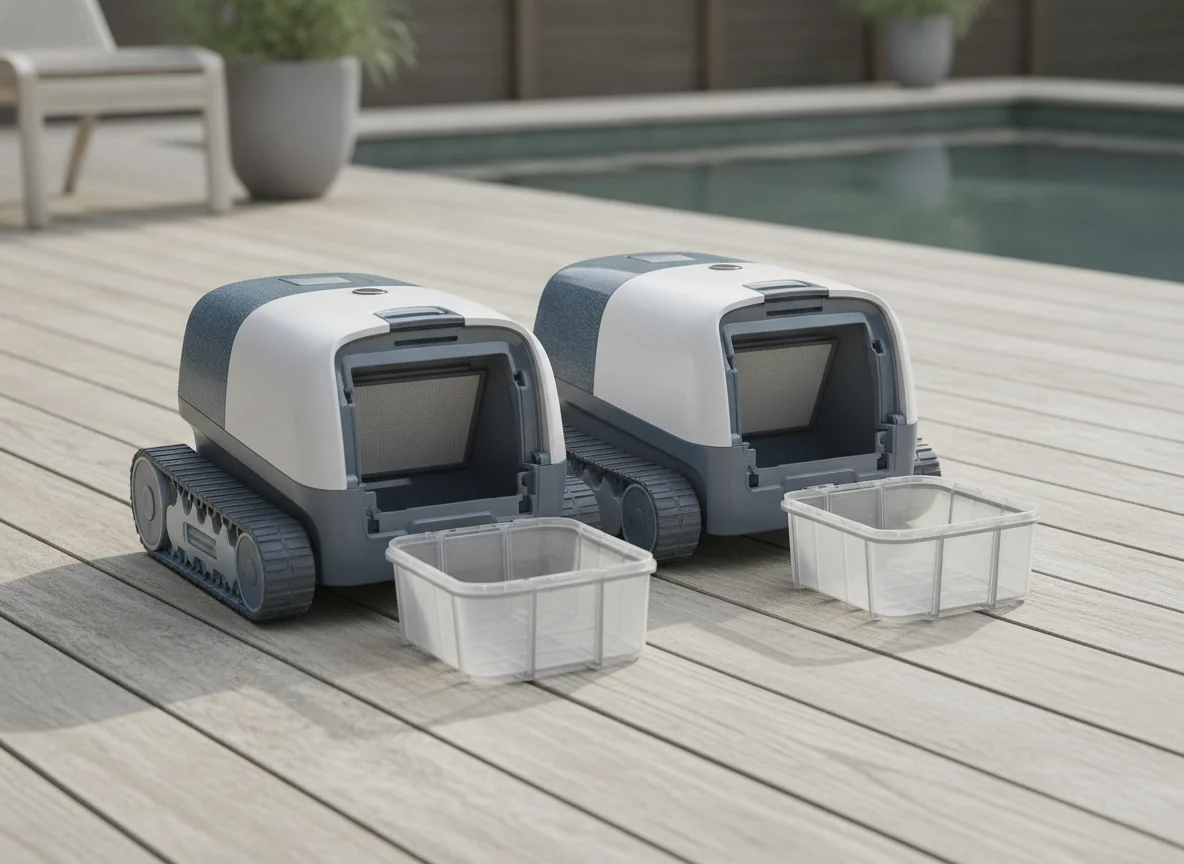
The TALOSBO C1 is the better bet for a simple pool.
It wins with credible sand and leaf pickup, a secondary foam filter, useful wall climbing, seven selectable cleaning choices, and a shorter stated recharge.
Its preset navigation can repeat clean areas, miss entire patches, or waste its charge when an oval, freeform edge, raised pad, drain, or bowed wall disrupts the expected route.
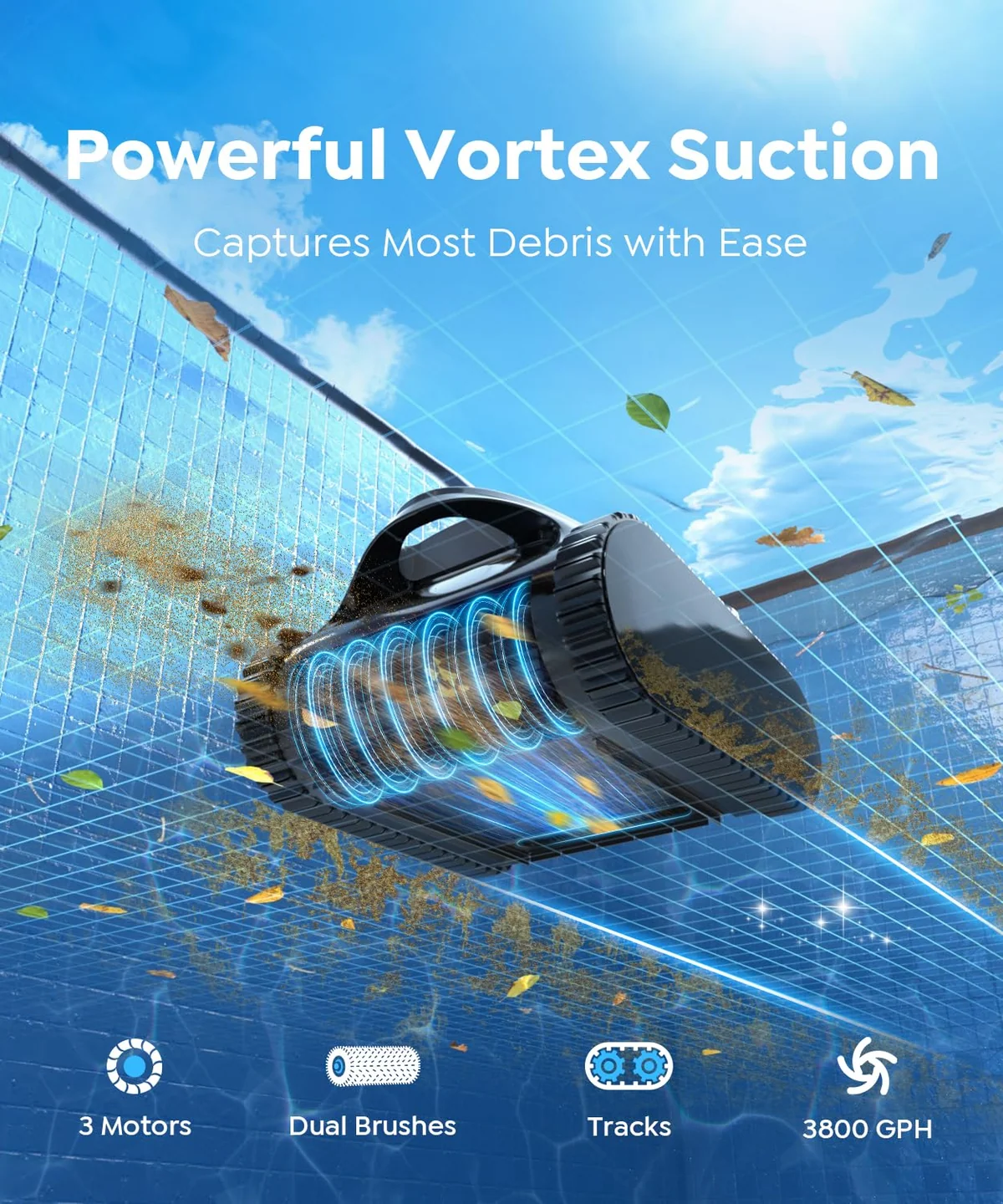
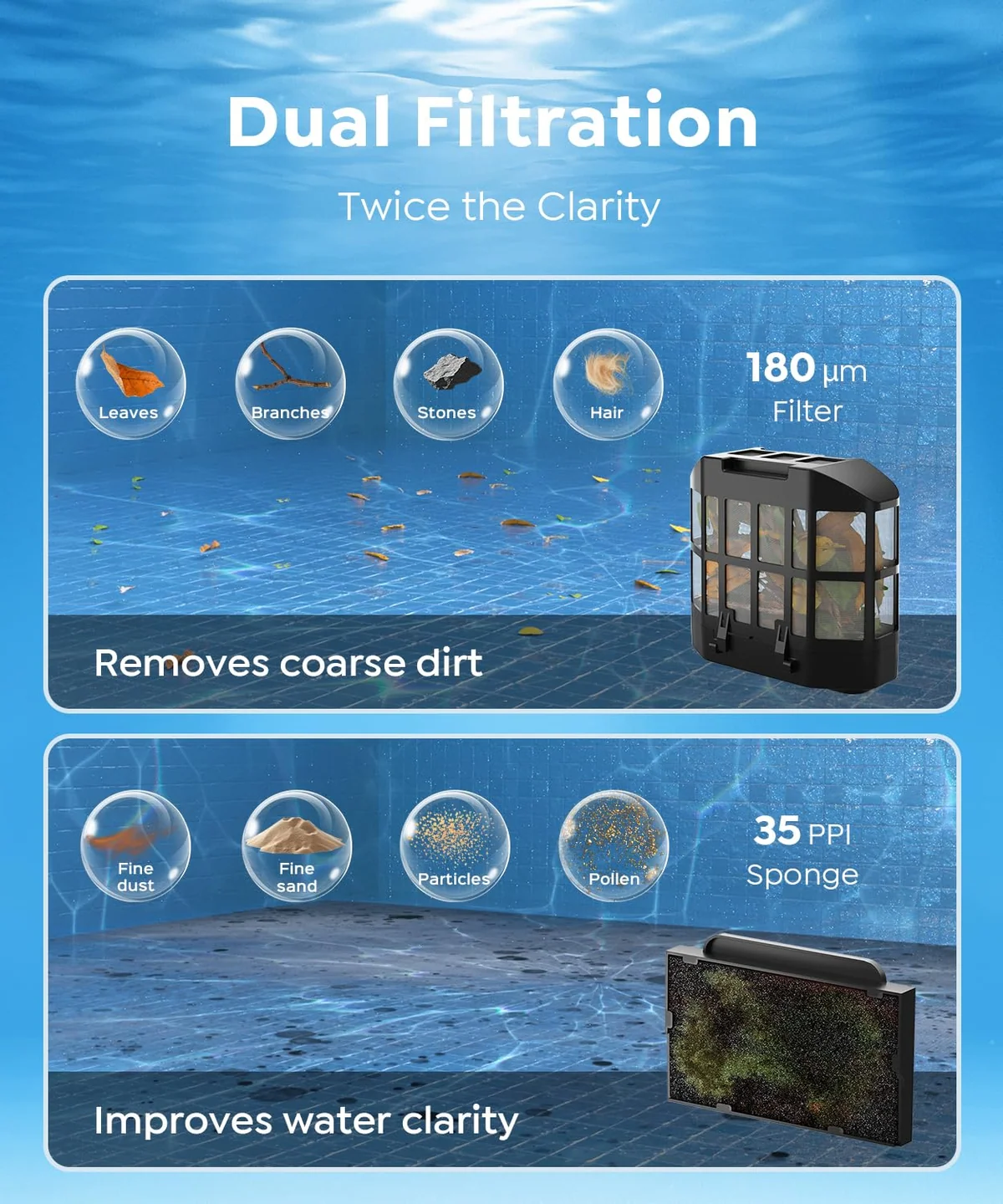
The hardware is the reason to choose it. TALOSBO specifies a 2.3-liter, 180-micron basket backed by a 40 PPI foam layer, and owners report collecting leaves, insects, dirt, grass, sand, silt, pet hair, and even small pool toys. The foam adds maintenance because both filter layers need rinsing, but it also gives fine material another barrier after it passes the basket.
Wall climbing is more than brochure decoration. Exact-model owners describe useful traction on ordinary vinyl and plaster walls, with the cleaner reaching and scrubbing portions of the waterline. The qualification matters: TALOSBO advises removing the foam for wall work if climbing weakens, so maximum fine-particle retention and maximum traction may require separate cycles.
The app is not a remote control for an active underwater machine. It can configure pool dimensions, route choices, modes, schedules, and firmware while the cleaner is reachable, but TALOSBO explicitly says the C1 has no underwater connection. Owner experiences range from successful updates and accessible controls to an unfinished-feeling tutorial that hides the useful settings until every introductory screen is cleared.
Why it takes first place
The C1 earns this ranking because its strengths survive skeptical reading. Its filtration has a practical advantage over a single 180-micron screen, its wall traction is supported by exact-product reports, and its documented weaknesses are specific enough to match against a real pool. A buyer can make a rational decision with that record: use it for an open floor and conventional walls, separate floor and wall cycles when necessary, and reject it when the layout depends on intelligent obstacle recognition.
What works
- The basket and foam combination can retain both bulky debris and useful amounts of sand or silt.
- Tracked drive provides credible climbing on uncomplicated walls and slopes.
- Eco mode can trade cleaning intensity for a longer opportunity to cover the floor.
- The stated charging interval is much shorter than WYBOT’s published four-hour figure.
What gets in the way
- Long runtime often compensates for repeated paths rather than reflecting genuinely intelligent coverage.
- The thin basket and secondary foam create a two-part cleaning ritual after every cycle.
- App configuration ends at the water’s edge because normal underwater communication is not supported.
- Warranty language and long-term replacement-part access remain less clear than they should be.
Read the full TALOSBO C1 assessment if your decision turns on its modes, app setup, oval-pool behavior, retrieval process, or conflicting warranty language.
The WYBOT C1 is the riskier second choice.
It remains credible for routine floor debris and straightforward walls, but its thin exact-model record does not justify choosing it over the better-documented TALOSBO.
The advertised maximum runtime may not finish a large or complicated pool, and related C1 reports create an unresolved risk around batteries, electronics, and after-sales support.
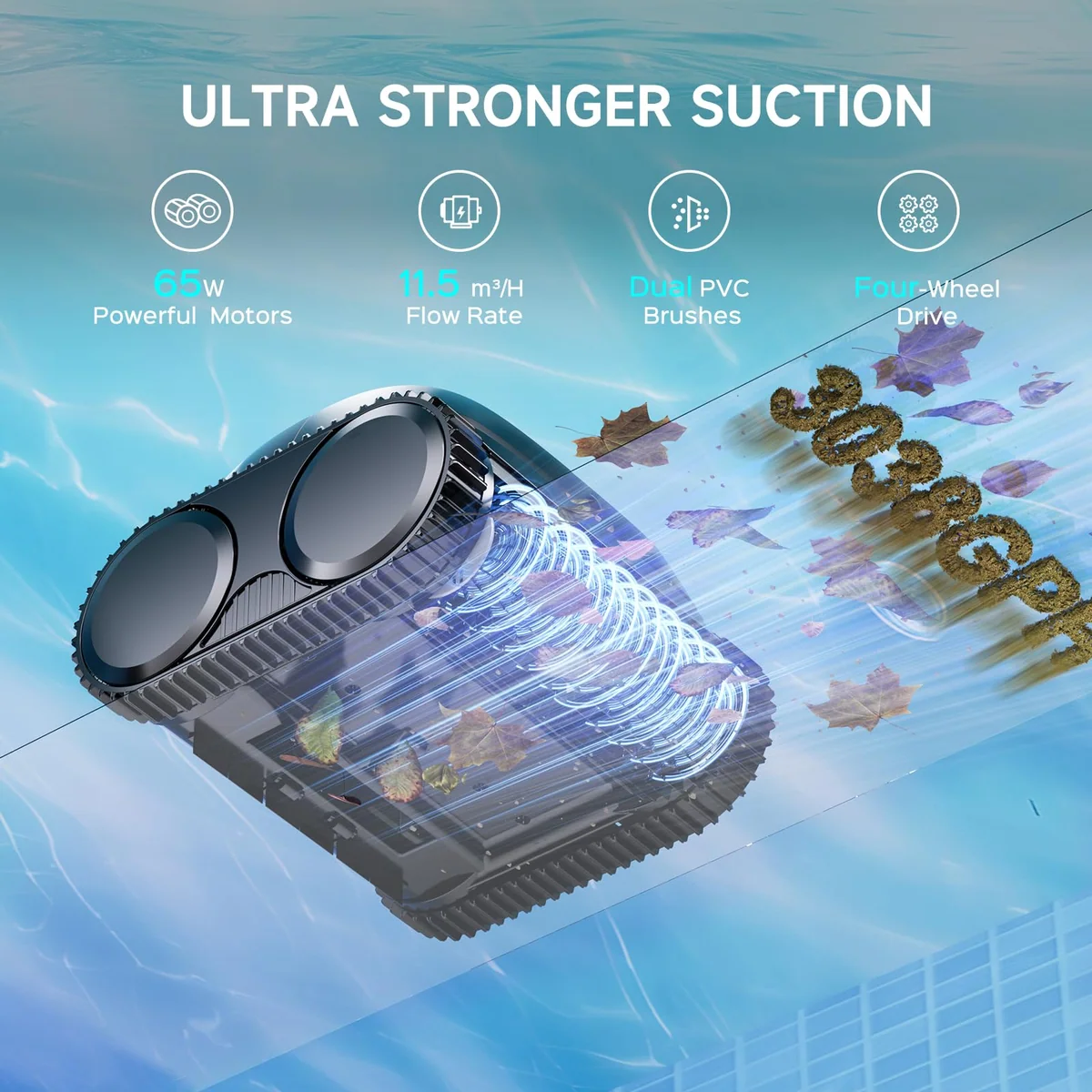
WYBOT’s specification sheet is competitive. The listing claims a 160-minute maximum, a 1,614-square-foot pool limit, a 180-micron filter, suction up to 3,038 gallons per hour, and programmed floor, wall, waterline, and step coverage. It also describes gyroscope-guided floor and wall patterns, although the evidence does not establish a persistent map that remembers completed areas.
The exact-product feedback is encouraging but much too small for comfort. Three retained owners gave strongly positive accounts, including pickup of fine sand and large leaves, while one reported that the battery could not cover the whole pool and that setup required a dedicated 2.4 GHz connection. Four reviews can show that the cleaner is capable; they cannot show how often it finishes difficult pools or survives several seasons.
Related C1 evidence makes that silence more important. One earlier unit was still cleaning effectively and maintaining useful runtime near the one-year mark, but other C1 owners describe machines that stopped charging, stopped turning on, or failed after limited use. These reports span more than one C1 specification generation, so they are a risk signal rather than a failure rate for this ASIN.
Why it stays in second place
The WYBOT could be the better cleaner in an individual pool, particularly if its N-shaped and S-shaped routes suit the floor better than TALOSBO’s selectable pattern. There is simply not enough exact-model evidence to promote that possibility into the main recommendation. Its longer charge also hurts when the first cycle misses a section, because the correction cannot begin immediately.
App language deserves restraint too. WYBOT promises scheduling, customized modes, progress tracking, and firmware updates, but related C1 and C1 Pro accounts support pre-launch configuration more strongly than dependable live communication after submersion. Scheduling still cannot lower the robot into the water, empty its filter, dry its charging port, or connect the charger.
What works
- Exact-model owners support useful pickup of routine dirt, sand, and at least some large leaves.
- The top-access filter keeps ordinary emptying and rinsing straightforward.
- Simple floors and continuous walls give its programmed routes the best chance to succeed.
- Cordless operation removes the floating cable and its handling problems from the pool.
What gets in the way
- The exact owner record is too small to establish dependable battery life or longevity.
- A four-hour charge makes incomplete first-pass coverage more costly in time.
- Steps, benches, shelves, and awkward transitions remain geometry-dependent despite the broad coverage claim.
- Related C1 reports raise a credible concern about failures and difficult support resolution.
The complete WYBOT C1 review separates exact-model findings from older C1-family evidence, including the reasons its reliability verdict remains unsettled.
What actually separates them
| Decision factor | TALOSBO C1 | WYBOT C1 | Editorial edge |
|---|---|---|---|
| Routine debris | Credible pickup of leaves, sand, silt, insects, grass, and ordinary dirt | Exact owners support sand and large-leaf pickup, but the sample is small | TALOSBO |
| Fine-debris retention | 180-micron basket plus a secondary foam layer | 180-micron filter screen | TALOSBO |
| Published runtime | Up to 180 minutes in Eco mode, with Full Pool listed around 90–100 minutes | Up to a maximum of 160 minutes | Conditional |
| Published charging time | Approximately 2.5 hours on the listing | Four hours on the listing | TALOSBO |
| Navigation evidence | Known to repeat paths and struggle with some oval or irregular layouts | Gyroscope and programmed paths sound stronger, but exact-model coverage evidence is thin | Unsettled |
| App expectations | Useful for setup above water, with no normal underwater connection | Useful for setup, while reliable underwater tracking remains unproven in this record | Neither |
| Ownership confidence | More exact-model evidence, but limited multi-season history and unclear warranty language | Very little exact-model history plus a credible related-model failure signal | TALOSBO |
Neither app changes the physics of cordless ownership
App control is the easiest feature to overvalue in this comparison. Radio communication through water is limited, and a menu of modes does not become live steering merely because it appears on a phone. TALOSBO explicitly draws that boundary; WYBOT advertises remote progress tracking, but the supplied evidence does not demonstrate dependable live underwater monitoring for this exact revision.
The useful app workflow happens before launch. Choose the intended job, confirm any pool-shape settings, install firmware while the robot is reachable, and then let the cleaner work autonomously. If the pool needs a precise spot cleaned now, neither machine offers evidence strong enough to replace a brush or manual vacuum with phone-based steering.
Both also return the chore after the cycle. The robot must be found near an edge, lifted while water drains, kept reasonably level so captured debris stays inside, opened, rinsed, dried around the charging port, and connected to a dry power supply. For a fuller account of that trade, the guide to corded and cordless robotic pool cleaners explains why removing a cable from the water does not remove owner involvement.
TALOSBO C1
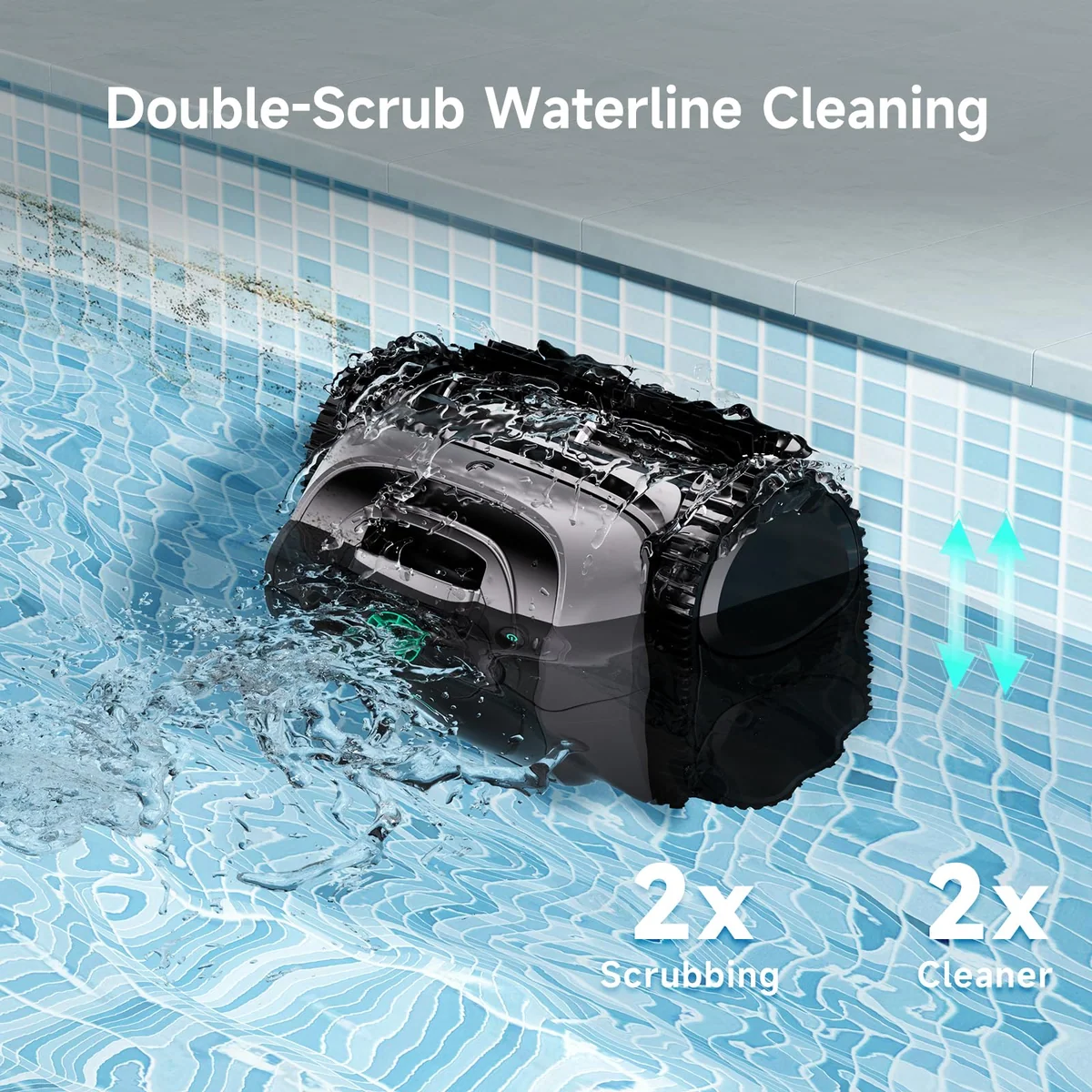
WYBOT C1
Buy for the pool you have, not the square footage you recognize
Choose the TALOSBO for a predictable layout
The favorable pool has a broad open floor, ordinary vertical walls, moderate settled debris, and few raised fittings or complex transitions. Its owner is willing to prioritize a floor-only cycle when debris is heavy, run walls separately when necessary, rinse two filter layers, and accept that an occasional missed corner still belongs to the brush.
Consider the WYBOT only with a strong exit route
The favorable WYBOT buyer values cordless handling, has simple geometry, can provide a compatible network during setup, and buys through a seller with a clear return or replacement process. That last condition matters because the exact revision is too new or too lightly reviewed to answer the long-term battery and electronics questions.
Reject both for a pool that behaves like an obstacle course
Prominent drains, ladder pads, bowed wall sections, compound slopes, full-width benches, narrow steps, tanning ledges, and sharply irregular deep ends all increase the chance that route logic and track movement part company. The guide to cleaners for steps, shelves, and shallow areas is the better comparison when those surfaces define the job.
Reject both if service history is the priority
Neither product arrives with enough exact-model, multi-season evidence to make longevity the reason to buy. If dependable operation and an established ownership record matter more than an empty water surface, compare the corded alternative in the Dolphin Nautilus CC review before accepting battery risk.
The final call
The TALOSBO C1 is the winner because it gives the buyer a stronger filter system, a faster route back to a full battery, and enough exact-product evidence to understand the gamble. Its cleaning hardware can save substantial work in a conventional pool, even when its wandering path looks less intelligent than the app suggests.
Do not stretch that recommendation into a promise of complete coverage. A robot that cannot locate a missed deep end, recognize a raised obstruction, or communicate normally underwater is still a supervised maintenance tool. Choose TALOSBO for a predictable pool, consider WYBOT only when the seller protects the downside, and leave both behind when pool geometry or ownership certainty is the harder problem.
Frequently Asked Questions
Which cleaner is the better overall choice?
The TALOSBO C1 is the better overall choice because its filtration, charging time, and larger exact-model evidence base outweigh WYBOT’s more ambitious navigation claims.
Which one is more likely to pick up sand and fine debris?
Both have evidence for sand pickup, but the TALOSBO’s 180-micron basket and secondary foam give it the more convincing retention system for mixed fine and bulky debris.
Does the TALOSBO really run longer than the WYBOT?
TALOSBO lists up to 180 minutes only in Eco mode and roughly 90–100 minutes in Full Pool mode, while WYBOT lists a maximum of 160 minutes.
Which cleaner charges faster?
TALOSBO lists approximately 2.5 hours and WYBOT lists four hours, so the TALOSBO has the clear published advantage between repeat cycles.
Will either cleaner map an oval or freeform pool reliably?
Neither has demonstrated persistent spatial mapping, and TALOSBO’s exact record includes repeated routes and incomplete coverage in larger oval or irregular pools.
Can either app control the cleaner while it is underwater?
TALOSBO explicitly says its C1 has no underwater connection, while the supplied WYBOT evidence supports pre-launch setup more strongly than dependable live underwater control.
Which one is better for steps and tanning ledges?
Neither deserves a confident recommendation for steps or ledges because success depends heavily on tread width, transition angle, depth, and whether the tracks can maintain contact.
Is the WYBOT C1 a good above-ground pool cleaner?
The listing title promotes above-ground use while its feature copy says the machine is designed specifically for inground pools, so compatibility should be confirmed for the exact pool construction and shape.
Where can I find the TALOSBO C1 manual?
The product evidence indicates that printed user material is included, but it does not establish a dependable public manual download address.
Can either cleaner stay in the pool between scheduled cycles?
Plan to retrieve, empty, rinse, dry, and manually recharge either cleaner rather than treating its schedule as an unattended charging system.
Ready to Choose?
Sources (4)
- Amazon listings and customer reviews — Talosbo C1 and Wybot C1
- Owner reports across r/swimmingpools, r/wootdaily threads
- Owner and reviewer video, 4 channels
- TALOSBO — Article — talosbo.com