The TALOSBO C1 Has the Muscles but Not the Map
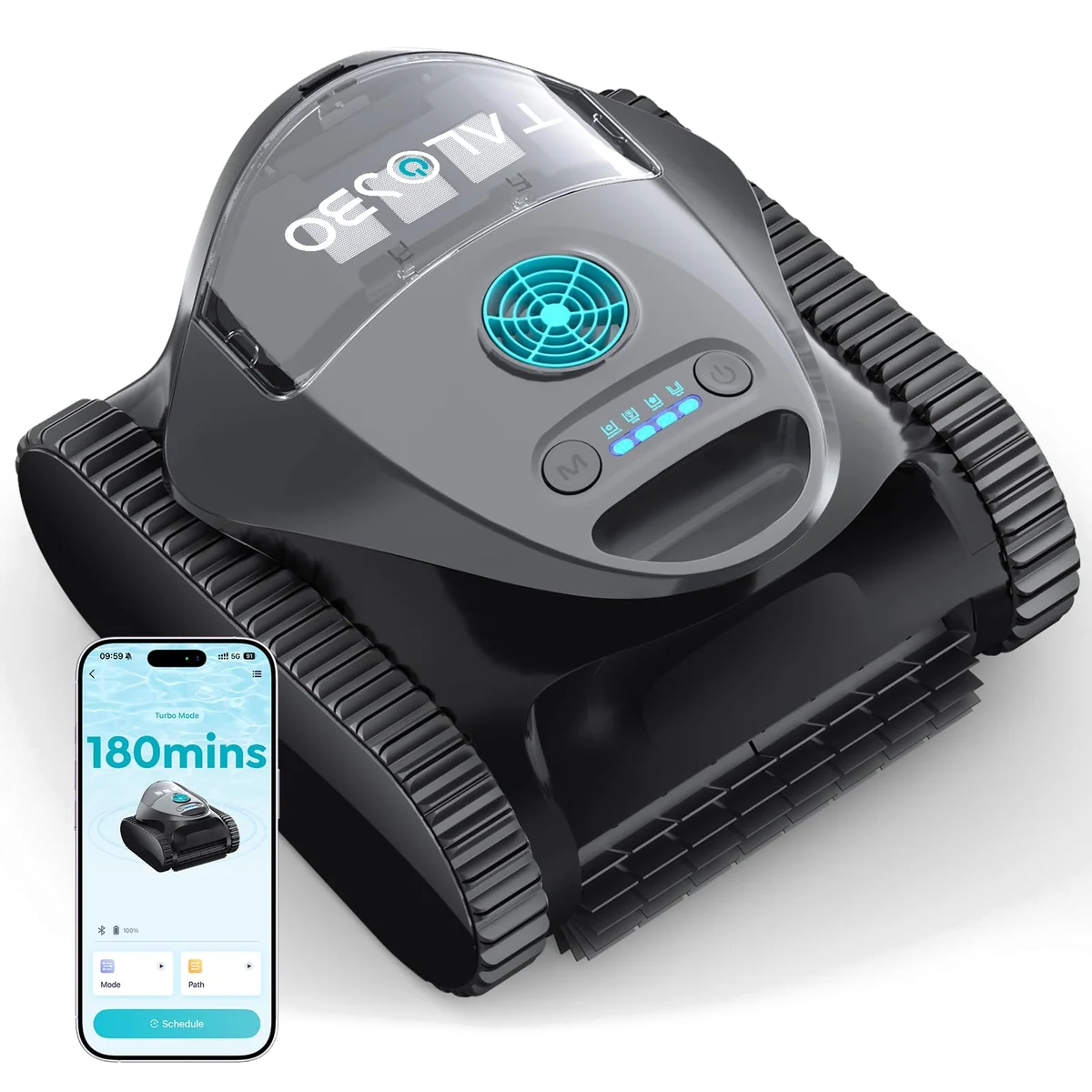
Buy the TALOSBO C1 for routine cleaning in a conventional pool, but skip it if complete coverage of an oval, freeform, or obstacle-heavy pool matters more than cordless convenience.
The final call
The TALOSBO C1 is a better cleaner than its software suggests. It can collect the debris that matters, climb conventional walls, reach portions of the waterline, and run long enough in Eco mode to maintain a sensible pool. For a straightforward layout, those abilities can outweigh odd-looking paths and a disappointing app.
They do not outweigh geometry. A robot that repeatedly cleans one area while ignoring another has not completed the job, however strong its suction may be. The C1 earns a qualified recommendation for regular pools and routine debris, not a universal one for every pool inside its advertised square-foot rating. Buy the hardware for a predictable pool; do not buy the promises for an unpredictable one.
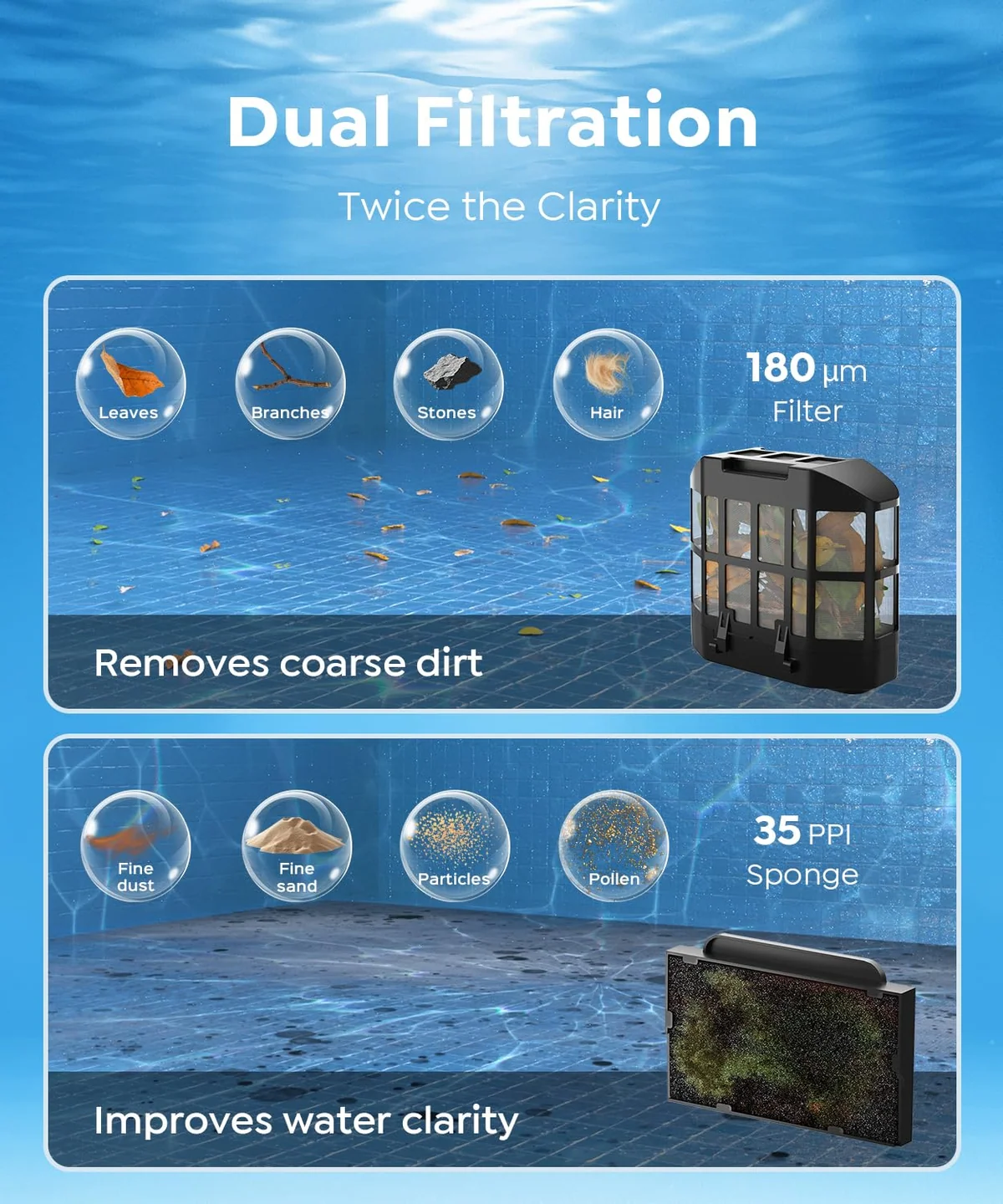
The C1’s hardware makes a convincing first case. Its tracks climb ordinary walls, its brushes disturb settled material, and its two-stage filter collects both bulky leaves and the sand that can pass through a coarse basket. Owners repeatedly describe meaningful pickup of dirt, insects, silt, grass, and small toys, while several report useful scrubbing at the waterline. Those are the jobs that determine whether a pool robot saves work, and the C1 can perform them well when it actually reaches the dirty area.
The hesitation begins with the word “when.” This robot does not appear to build a persistent map or remember which parts of the pool it has cleaned. It follows selectable patterns, estimates its movement, and relies on enough runtime to compensate for repeated tracks. That bargain can succeed in a rectangular pool with broad, uninterrupted surfaces. It can fail in an oval or irregular pool where the calculated center drifts, a curved wall breaks track contact, or a small raised obstacle leaves the robot spinning while its program assumes it is still traveling.
That makes this less a story about suction than geometry. The C1 is a capable cordless vacuum trapped inside navigation that can look arbitrary because it often is. Long Eco runtime gives those patterns time to converge on a clean result, but no battery can make a preset route understand a deep-end transition, ladder pad, drain, intake, bowed panel, or narrow tread. Buyers with simple pools can get substantial cleaning for the money; buyers with architectural flourishes are being asked to gamble.
Key Specifications
The app is a setup panel, not an underwater remote
The cleanest answer to the app question comes from Talosbo itself: the C1 does not support an underwater connection. Configure the pool dimensions, route, mode, schedule, and firmware while the robot is reachable, then treat the active cycle as autonomous. Do not buy it expecting to steer from a lounge chair, monitor dependable live progress, or issue an immediate underwater mode change.
Even within that narrower role, the software experience varies. Some owners reached firmware updates and the full set of cleaning choices after completing the initial tutorial. Others saw little beyond the model and pool-shape fields, or found the app unfinished and confusing. One easily missed detail is that the opening “Hints” screens must be swiped through and accepted before customization appears. Pairing trouble, tutorial ambiguity, and changing firmware may explain some of the disagreement, but they do not turn the app into a polished product.
The physical controls are the safer default when the desired job is simple. Set the mode before launch, lower the robot slowly so trapped air can escape, and give it time to settle before deciding something is wrong. Avoid repeatedly changing instructions while it is submerged. A mode change during one recorded run led to several minutes of apparent recalibration and erratic motion before cleaning resumed.
Wall climbing is real, with a filtration trade-off
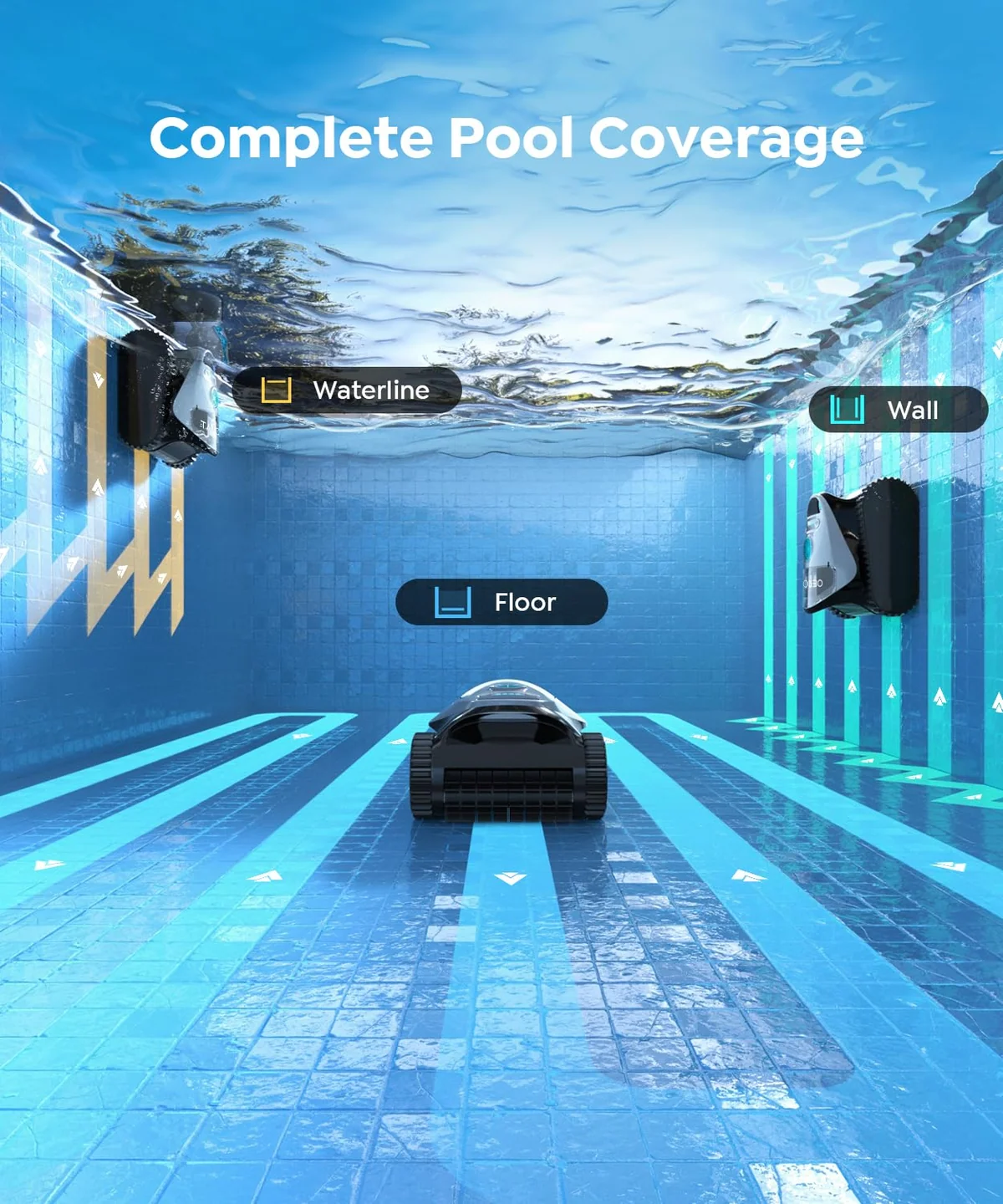
The C1’s tracked drive has enough grip to climb ordinary vinyl and plaster walls, and multiple owners watched it reach the surface. Waterline work is useful rather than complete: it can scrub sections that would otherwise require brushing, but it does not remove every mark or eliminate occasional hand wiping. Broad submerged steps may receive partial attention; narrow treads, corners, and complicated stair assemblies remain manual territory.
Talosbo’s troubleshooting advice exposes an important compromise. If climbing performance is weak, the company recommends removing the fine sponge during wall cleaning and reserving it for floor mode. A full or clogged basket can also reduce climbing performance. Maximum fine-particle filtration and maximum wall traction may therefore require separate cycles rather than happening together throughout one run.
Tracks reduce some snags, not every snag
The listing says the robot should reverse away from a drain or step within two to three minutes, but actual pools provide counterexamples. An intake, a shallow raised ladder pad, and bowed wall crests have all held it long enough to require concern or intervention. Tracks are helpful on slopes and walls; they are not evidence of obstacle recognition.
Watch the first few cycles long enough to identify repeat traps. If the C1 consistently mounts the same fitting or stalls at the same transition, a different cleaning mode may reduce the encounters, but software cannot redesign the pool. Buyers with known drain or step problems should read what pool robots can realistically do on walls, drains, slopes, and steps before treating wall-climbing language as obstacle-proofing.
Strengths & Limitations
Strengths
- It has credible pickup for leaves, sand, silt, insects, dirt, grass, pet hair, and other settled debris.
- Its tracks usually provide useful wall climbing on conventional vinyl and plaster surfaces.
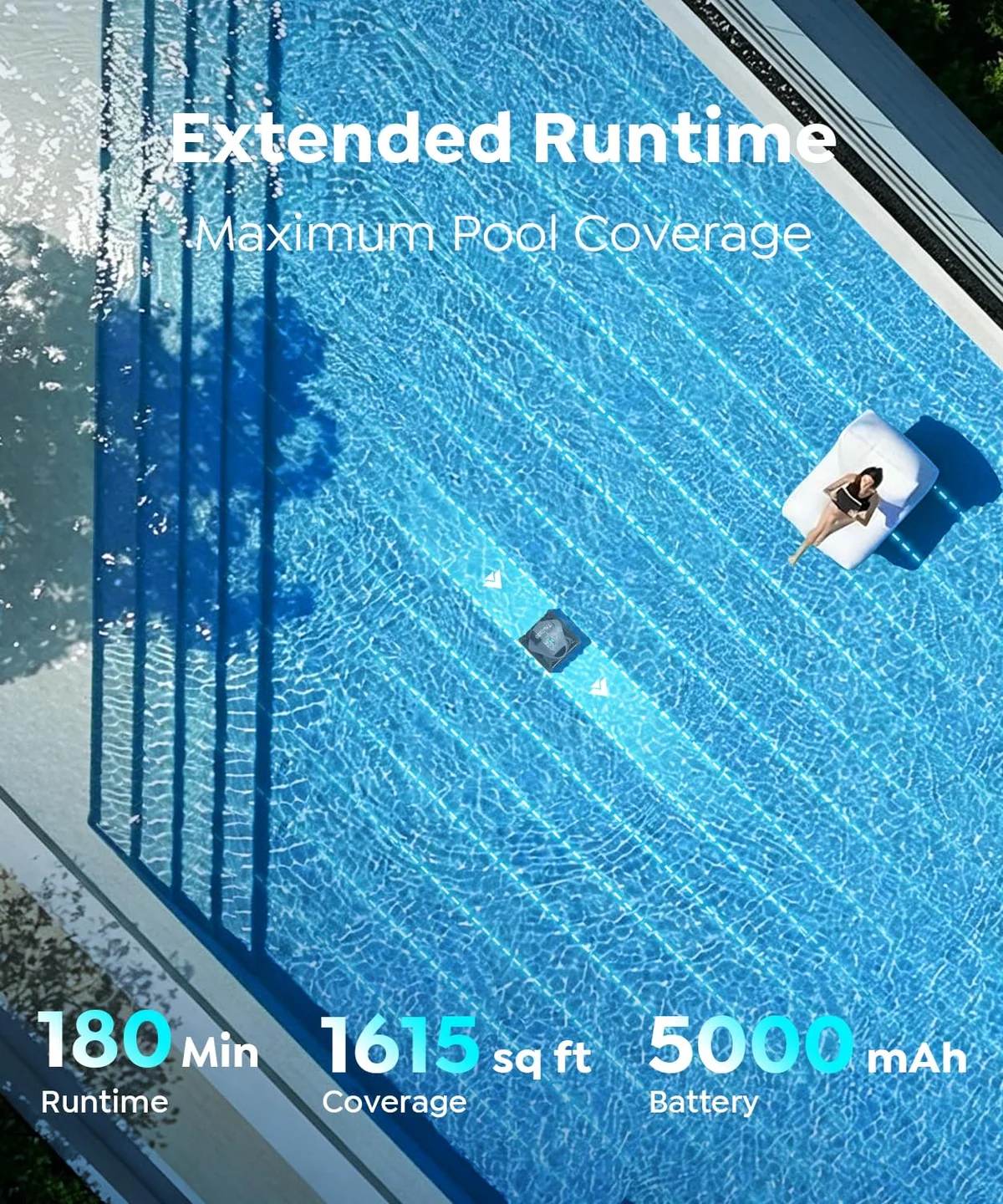
- Eco mode can approach three hours, giving the robot time to compensate for some repeated movement.
- The top-load basket and secondary foam are easy to reach without turning the robot over.
Limitations
- Preset routes can repeat cleaned areas, miss patches, and perform poorly in oval or irregular pools.
- The app does not maintain an underwater connection and feels unfinished to some owners.
- The thin basket and secondary foam can require careful alignment and two-part cleaning after every run.
- Long-term battery health, replacement-part access, and even the stated warranty term remain unclear.
It vacuums better than it navigates
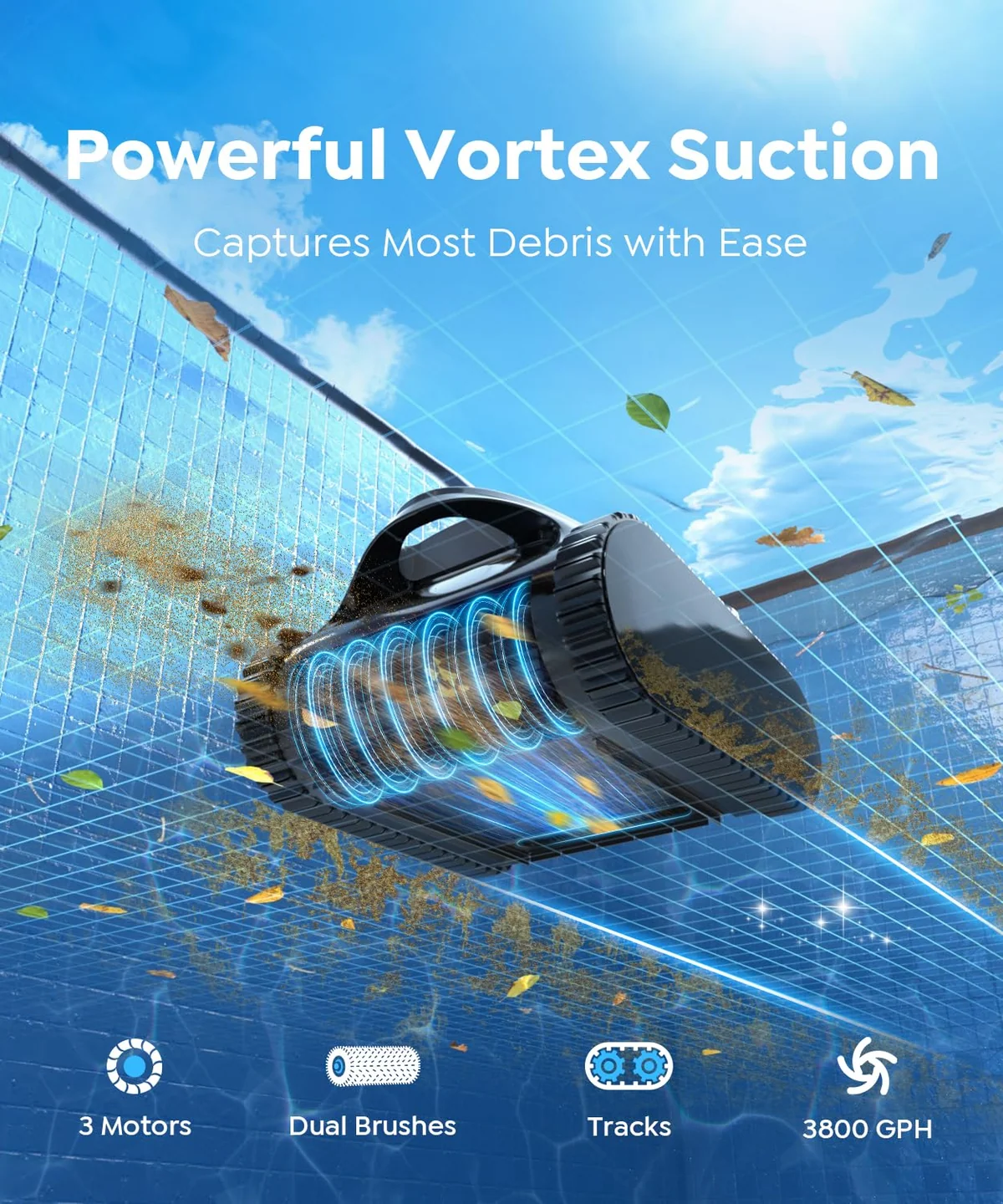
Sand pickup is the clearest strength in the owner record. One pool had been left with silt and sand after spa construction, material an older corded cleaner had failed to remove, and the C1 collected a substantial load on its first attempt. Other owners found fine white sand, ordinary dirt, leaves, pollen, and organic debris in the basket and foam. This is not merely a leaf collector with a flashy wall-climbing trick; the secondary filter gives it a credible fine-debris role.
The two filter layers divide the work rather than making the cleaner magical. The basket catches larger material, while fine particles and pet hair can reach the foam. That improves retention, but it also means rinsing two components instead of one. Some owners describe the basket as thin or flimsy, and one found that small debris slipped around it before becoming embedded in the sponge. The filter is effective enough to be useful and awkward enough to become part of the ownership decision.
Light, mobile debris presents another limit. Grass and insects can be pushed into suspension before the intake catches them, so the first pass may look worse before the floor looks better. A cleaner working underwater also cannot collect floating leaves at the surface. If that is the dominant problem in your pool, start with our guide to choosing between a robotic skimmer and a pool vacuum rather than expecting one machine to do both jobs. A demonstration in a windblown pool filled the C1’s basket, but the neglected conditions required repeated empty-and-restart cycles rather than one heroic run.
Long runtime can hide an inefficient route
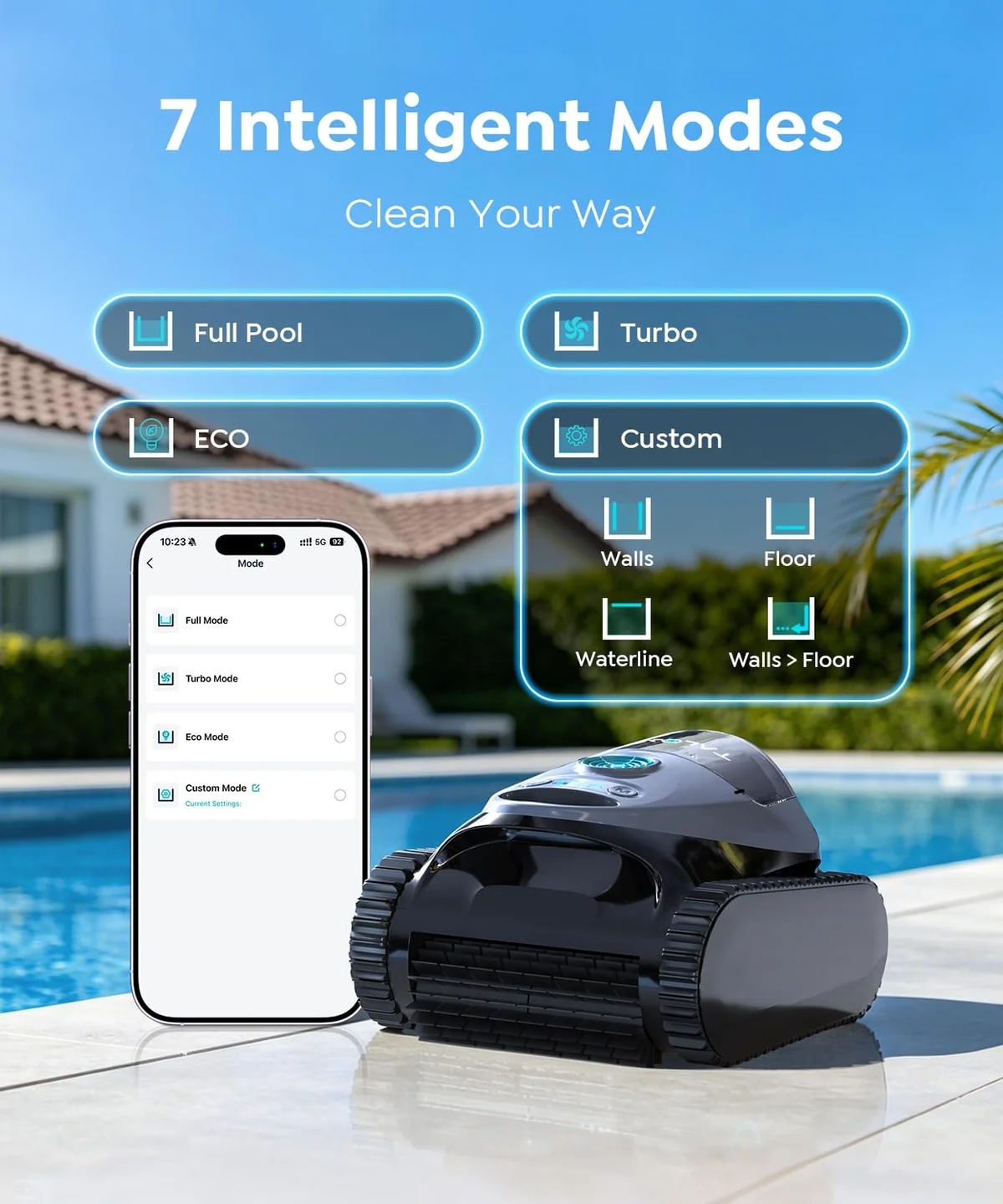
The advertised three-hour figure needs its mode label attached. It applies to Eco mode, while the listing puts Full Pool operation at roughly 90–100 minutes. Owner observations and a several-week editorial account support about two and a half to three hours under lighter settings, with shorter operation when the cleaner works harder.
That distinction changes how to configure a large pool. A long floor-only run may cover more useful area than a shorter cycle that repeatedly climbs every wall. One owner found that disabling wall cleaning allowed the C1 to finish the floor of a larger, debris-heavy pool on one charge. The sensible strategy is to prioritize the floor first, then schedule walls and the waterline separately if the all-surface cycle cannot finish.
| Choice | Best use | Important limitation |
|---|---|---|
| Eco | Maximizing operating time for a broad floor or lightly dirty pool | The three-hour claim belongs here, not to maximum-power full-pool cleaning |
| Full Pool | Combining floor, wall, and waterline work in a conventional layout | The listed 90–100-minute runtime may expire before an inefficient route covers a large or unusual pool |
| Floor | Finishing the main debris field before spending energy on walls | It does not address the waterline or compensate for untouched steps and corners |
| Wall or Waterline | Targeting vertical surfaces after the floor is acceptably clean | The route may still include transitions across other surfaces, and coverage is not perfectly literal |
| Turbo | Heavier settled debris where suction matters more than duration | Expect less runtime than in Eco mode |
The difficult pool is the real stress test
In a small oval above-ground pool, a recorded full cycle favored one side and repeatedly climbed the same wall. Switching to floor-only produced several minutes of confused starts, stops, bubbles, and circling, yet the final floor was visibly clean and the basket held the week’s debris. That is the C1 in miniature: inefficient behavior can still produce a good result when the pool is small enough for runtime to overwhelm the wasted movement.
A larger 36 by 24-foot oval was less forgiving. Its star-like pattern drifted away from the intended center, retraced cleaned areas, and exhausted the battery before covering the entire floor. Bowed wall sections caused lost track contact, while a one-inch ladder pad left the cleaner turning its tracks without recognizing that it had stopped moving. In a separate irregular pool, the owner reported that different programmed patterns still failed to clean the deep end and ultimately returned the machine.
“All shapes” should therefore be read as a compatibility claim, not a coverage guarantee. The C1 can physically operate in many pool forms, but it does not necessarily understand them. If your pool has a freeform deep end, prominent drains, a raised pad, compound slopes, or complex stairs, our broader guide to cleaners for steps, ledges, and shallow shelves is a safer place to compare designs built around those obstacles.
Who should take the chance
The C1 makes the most sense for an owner with a rectangular, round, or otherwise conventional residential pool who wants to remove routine floor debris and reduce wall brushing without putting a power cable in the water. Broad uninterrupted floors, ordinary vertical walls, manageable leaf loads, and the willingness to run separate floor and wall cycles all play to its strengths.
It is a much weaker bet for an oval, freeform, or sharply contoured pool where complete first-pass coverage is essential. The same applies when raised drains, ladder pads, bowed panels, tight corners, or complex stairs have already defeated other cleaners. In those installations, the obstacle is not motor power; it is the C1’s inability to know where it is or recognize reliably that it has stopped moving.
Buy it if your pool is predictable
Choose the C1 when settled sand and everyday debris are the main nuisance, wall assistance matters, and you are comfortable configuring the app above water. It is especially attractive when cordless operation matters more than elegant navigation and when a missed corner can wait for a brush rather than invalidate the whole purchase.
Walk away if your pool is the puzzle
Pass if your pool has an irregular deep end, elaborate steps, multiple obstructions, or a history of trapping cleaners. Also pass if live app monitoring, proven multi-season durability, or straightforward replacement-battery access is central to the decision. The TALOSBO C1 and WYBOT C1 comparison separates their actual specifications without pretending that similarly named products share performance or failure records.
Value is conditional because this model has appeared at widely different seller snapshots, and no stale number should decide today’s purchase. Compare the checkout price against cleaners with stronger service histories and more predictable navigation rather than anchoring on a crossed-out reference price. If the C1 sits near established corded alternatives, the Dolphin Nautilus CC review shows what trading cordless handling for a cable and a longer brand record looks like; if the C1 is positioned as a budget cordless option, compare it with the candidates in our cordless robotic pool cleaner guide.
Cordless does not mean choreless
The C1 removes the cable from the pool, along with its tangles and trip hazard, but shifts the work to the end of every cycle. The robot usually stops near a wall on the floor rather than surfacing or docking. You attach the included retrieval hook to your own telescoping pole, lift the unit while it drains, keep it level to avoid spilling debris, and place it somewhere suitable for cleaning and charging.
Routine cleanup is straightforward when performed promptly. Open the top, lift the basket, empty it, and rinse both the basket and foam. Ordinary cleaning has been estimated at three to five minutes, with longer work after a heavy leaf load. Tilting the robot can dump captured material back into the pool, and an object lodged under the basket’s inlet cover can also cause spillback.
Charging requires more care than the phrase “plug it in” suggests. The robot must be switched off, the charging port must be clean and thoroughly dry, and the waterproof cap must be resealed before the next launch. The power adapter is not meant to get wet, and one owner found its cord uncomfortably short for moving a wet machine to a dry charging point. The unit should not be covered while charging because trapped heat can damage the charging system or battery.
Scheduling does not eliminate that ritual. The app can preload delayed or multi-cycle programs, but the robot still carries a finite debris load and must eventually be retrieved, rinsed, dried, and manually charged. There is no evidence here that indefinite storage in treated water is advisable. Our guidance on leaving a robotic cleaner submerged between cycles explains why a schedule should not be mistaken for a charging dock.
The durability record is still too young
The available owner reports primarily describe first uses, a handful of cycles, or early satisfaction. A more detailed editorial account covers several weeks rather than several seasons. That is enough evidence to judge immediate cleaning behavior, but not battery fade, seal life, motor longevity, or the practical availability of replacement components.
The official product page adds uncertainty by presenting one warranty term in its promotional copy and a different term in its comparison table. Buyers should save the exact warranty shown by the seller at checkout and verify which party handles a claim. “Lifetime customer support” is a promise of contact, not evidence of successful repairs or readily available batteries.
The practical after-cycle checklist
- Retrieve the robot with the hook and keep its body level while lifting.
- Let it drain before carrying it away from the pool.
- Empty and rinse the basket, foam insert, and accessible debris passages.
- Inspect the basket inlet cover if debris leaked during removal.
- Switch the cleaner fully off and dry the charging port.
- Charge it in a ventilated, dry location with the power supply protected from water.
- Reseal the charging-port cap before the next cycle.
Frequently Asked Questions
Does the TALOSBO C1 really run for three hours?
It can approach three hours in Eco mode, while the listed Full Pool runtime is approximately 90–100 minutes.
Can the app control the cleaner while it is underwater?
No, Talosbo specifies that the C1 has no underwater connection, so modes, paths, schedules, and updates should be configured while the robot is reachable.
Does the C1 map the pool?
No evidence shows true spatial mapping, because the cleaner uses selectable pool shapes and preset paths that can repeat, drift, or miss areas.
Will it clean an oval or freeform pool?
It may clean a small or simple oval pool adequately, but larger ovals and irregular deep ends carry a meaningful risk of repeated routes and incomplete coverage.
Does it clean walls, the waterline, and steps?
It usually climbs conventional walls and scrubs portions of the waterline, while wide steps may receive partial cleaning and narrow treads or corners remain unreliable.
Can it get stuck on a drain or pool fitting?
Yes, despite its tracks and advertised recovery behavior, actual reports include stalls on an intake, a raised ladder pad, and bowed wall sections.
Where can I find the C1 manual?
A printed manual and quick-start guide are included, but the collected product evidence did not establish a dependable public download address.
Can the C1 stay in the pool for scheduled cleaning?
It can preload delayed repeat cycles, but it still needs retrieval for filter cleaning, port drying, and manual charging, and the evidence does not establish indefinite underwater storage as recommended.
How long is the warranty?
Verify the warranty at checkout because Talosbo’s own page presents conflicting one-year and two-year terms.
Does it replace a pool service?
No, it can reduce vacuuming and wall brushing but cannot manage chemistry, main filtration, surface skimming, stain treatment, or detailed corner and step work.
Sources (5)
- Amazon listings and customer reviews — Talosbo C1
- Owner reports across r/swimmingpools threads
- Owner and reviewer video, 2 channels
- TALOSBO — Article — talosbo.com
- Piscine Maison — Article — www.piscine-maison.com