The BUBLUE Bubot 300P is a capable vacuum trapped in an unreliable chassis.
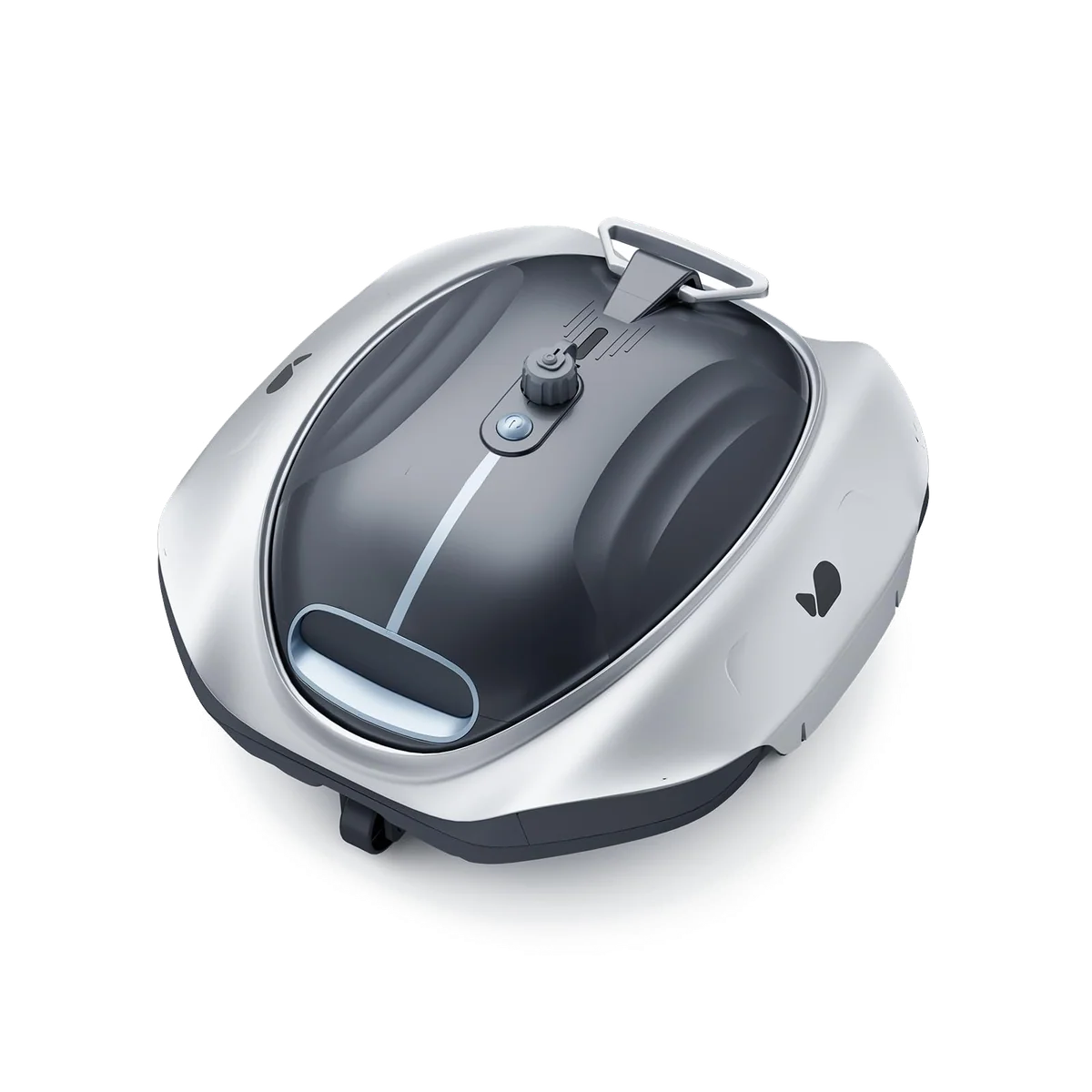
Skip the BUBLUE Bubot 300P unless your pool floor is genuinely smooth and flat and you can return a unit that stalls, because strong debris pickup does not offset repeated reports of premature stopping.
Who should take the chance
Consider it only when all of this is true
- Your pool is above ground with a smooth, genuinely flat floor and no slope.
- You want help with loose sand, dirt, insects and leaves rather than scrubbing.
- You accept random coverage, occasional touch-ups and cleaning the filters after every run.
- Your seller provides a clear return route if the cleaner repeatedly stops.
Walk away when any of this is true
- Your liner has wrinkles, seams, low spots or bumps that catch small wheels.
- You need walls, a waterline, steps or a sloped transition cleaned.
- You expect mapping, app controls, scheduling or dependable one-cycle coverage.
- You would resent monitoring a device purchased to remove manual work.
The BUBLUE Bubot 300P proves that good suction is only half a pool robot. Smart Pool Bots would not recommend it broadly because the mobility and stopping complaints strike at the machine’s core job, but a buyer with an unusually smooth floor, modest expectations and strong return protection may still find the narrow case in which it makes sense.
The decisive question is not whether the Bubot 300P can vacuum. It can. The question is whether its small wheeled chassis will keep crossing your pool floor long enough for that suction to matter.
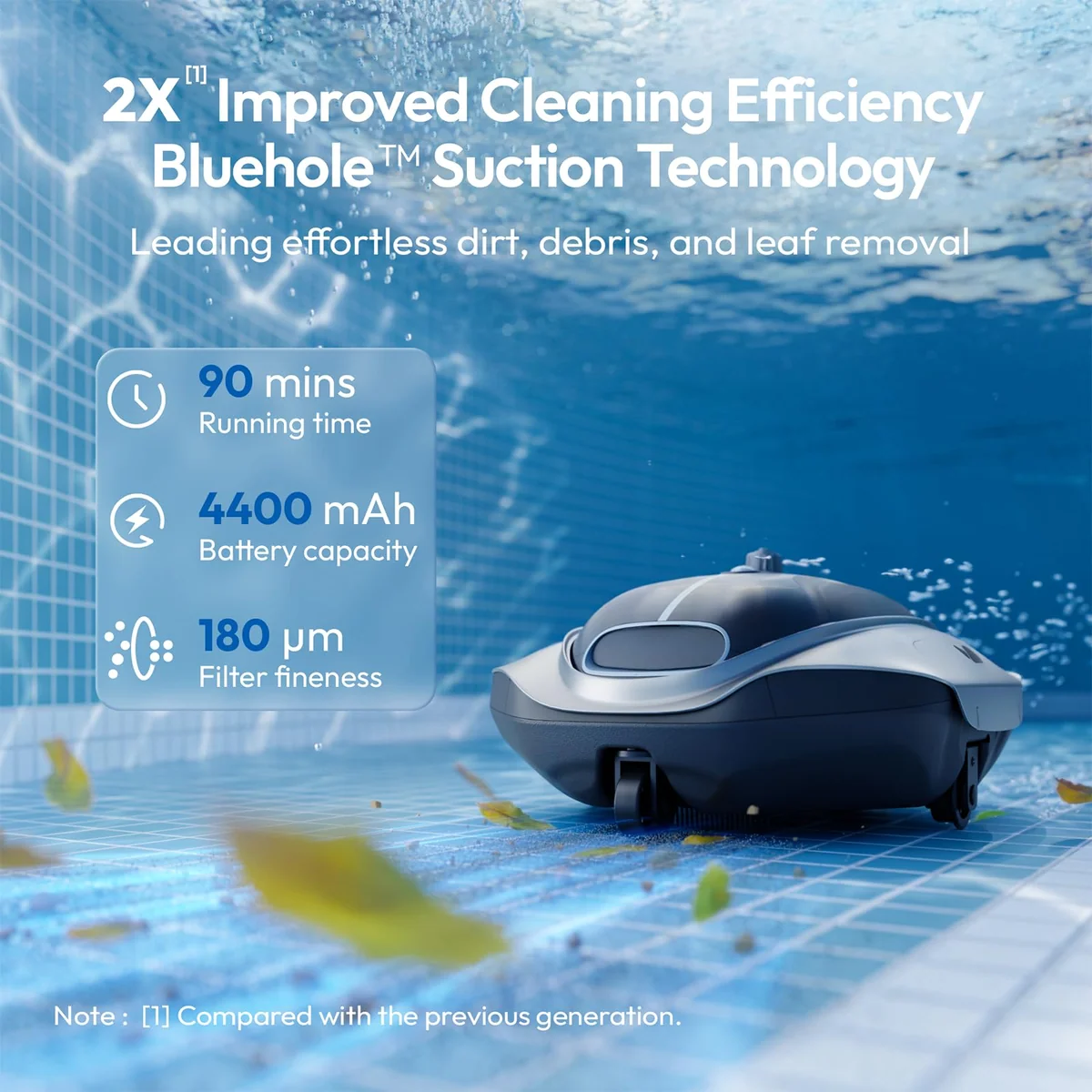
When it remains in motion, the 300P collects a useful range of settled debris: sand, fine dirt, insects, hair and leaves. Its cordless body is light to carry, the filter compartment opens for rinsing, and water drains rapidly during retrieval. Those are meaningful conveniences in an above-ground pool where manual sweeping has become a recurring chore.
The trouble is equally concrete. Exact-listing owners repeatedly describe the cleaner reaching an edge, stopping with charge remaining and refusing to continue without a push, tug or complete restart. Similar complaints appear in retailer reviews, BUBLUE’s own customer feedback and a concentrated owner troubleshooting thread. This is not the intended low-battery parking sequence; it is the failure that defines the purchase risk.
Bottom line: a smooth-floor owner with a forgiving return window may find an inexpensive maintenance helper here, but anyone with liner wrinkles, low spots, a slope or no patience for babysitting should choose another cleaner.
Key Specifications
“Flat bottom” is a stricter requirement than it sounds
The 300P is designed for flat-bottom above-ground pools without slopes. A nominally level soft-sided pool can still be a poor match because wrinkles, seams, shallow depressions and small bumps interrupt the wheels. Owners describe outcomes ranging from an occasional gentle tug to stalls every few minutes and a return for refund.
| Pool condition | What to expect |
|---|---|
| Smooth, truly flat floor | The best chance of useful unattended floor cleaning. |
| Wrinkled liner or low spots | A meaningful risk of repeated stalls and manual intervention. |
| Rough or uneven surface | Reduced mobility, especially with the removable bottom brushes fitted. |
| Sloped transition | Incomplete coverage because the robot is not designed to climb the slope. |
| Walls and waterline | No cleaning because the 300P is a floor-only vacuum. |
A flat, one-depth in-ground floor can be mechanically workable, and several demonstrations show the cleaner moving in that setting. A sloped in-ground pool is a different proposition: one unit remained largely in the deep end because it could not reliably cross the transition. Using it outside its stated above-ground application also leaves more room for disagreement if performance disappoints.
The brushes do not scrub
The two removable pieces beneath the cleaner are fixed guides or scrapers that direct debris toward the intake, not powered rotating scrub brushes. The manual advises removing them if they impede movement on an uneven or rough floor, so the sensible setup is to run the robot without them first and add them only when the surface is smooth enough to preserve mobility.
Simple means simple
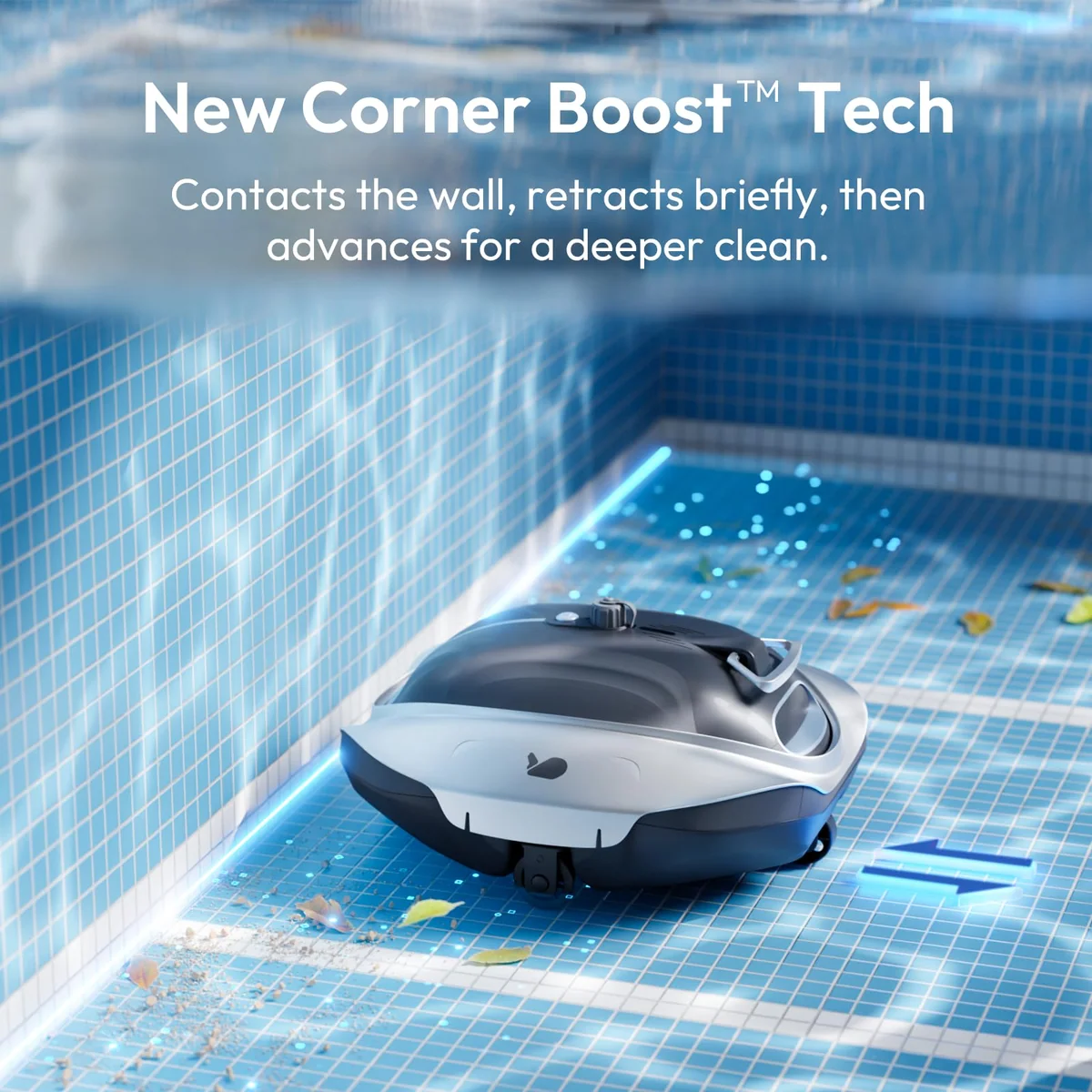
There is no established app control, mapping, scheduling or systematic navigation here. The cleaner reverses after wall contact, and two adjustable wheels alter the shape of its route, but it still depends on repeated reactive passes rather than knowing which areas it has cleaned. That simplicity removes pairing problems and underwater connectivity theater, yet it also removes the tools that might otherwise make coverage more predictable.
Strengths & Limitations
Strengths
- It collects sand, fine dirt, insects and leaves effectively when it remains in motion.
- Its cordless design avoids a power cable or vacuum hose in the pool during cleaning.
- The 7.72-pound dry body is relatively easy to carry and handle.
- The filter compartment opens for rinsing, and the body drains water quickly during retrieval.
Limitations
- Repeated owner reports describe premature stopping at walls or after only a short distance.
- Liner wrinkles, bumps and low spots can turn an unattended run into a babysitting job.
- It cleans only the floor and cannot handle walls, the waterline or sloped transitions.
- Random routing can revisit clean patches while leaving perimeter debris behind.
- Fine sediment may seep from the body seam if the cleaner is lifted vertically.
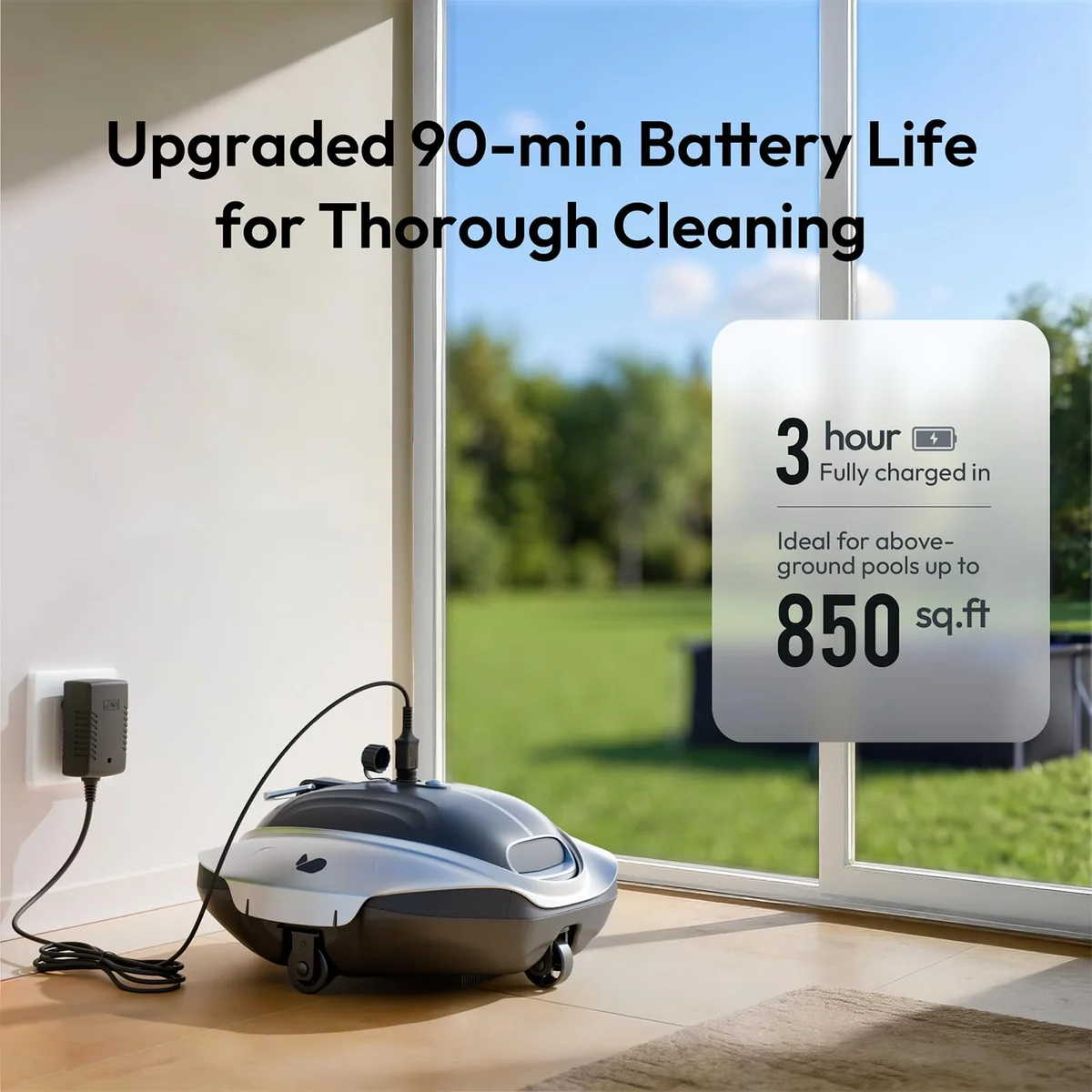
- Official materials conflict on charging time and warranty length.
The intake works; coverage is the gamble
The strongest evidence for the 300P is sitting inside its filter after a run. A heavy-debris demonstration recovered a substantial load of leaves, grit and sand from the portion of a pool the robot crossed, while another run in an already maintained pool still found a surprising amount of fine material. Household reports add bugs, dog hair and leaves of varied sizes to the list.
That does not establish perfect first-pass pickup, and it certainly does not prove complete coverage. One in-ground demonstration left a leaf and other material around the perimeter even though the center floor looked cleaner. The 300P follows a reactive path rather than mapping the pool, so revisiting one strip while missing another is an ordinary consequence of the design.
Fast drainage is credible, but “leak-proof” is too absolute
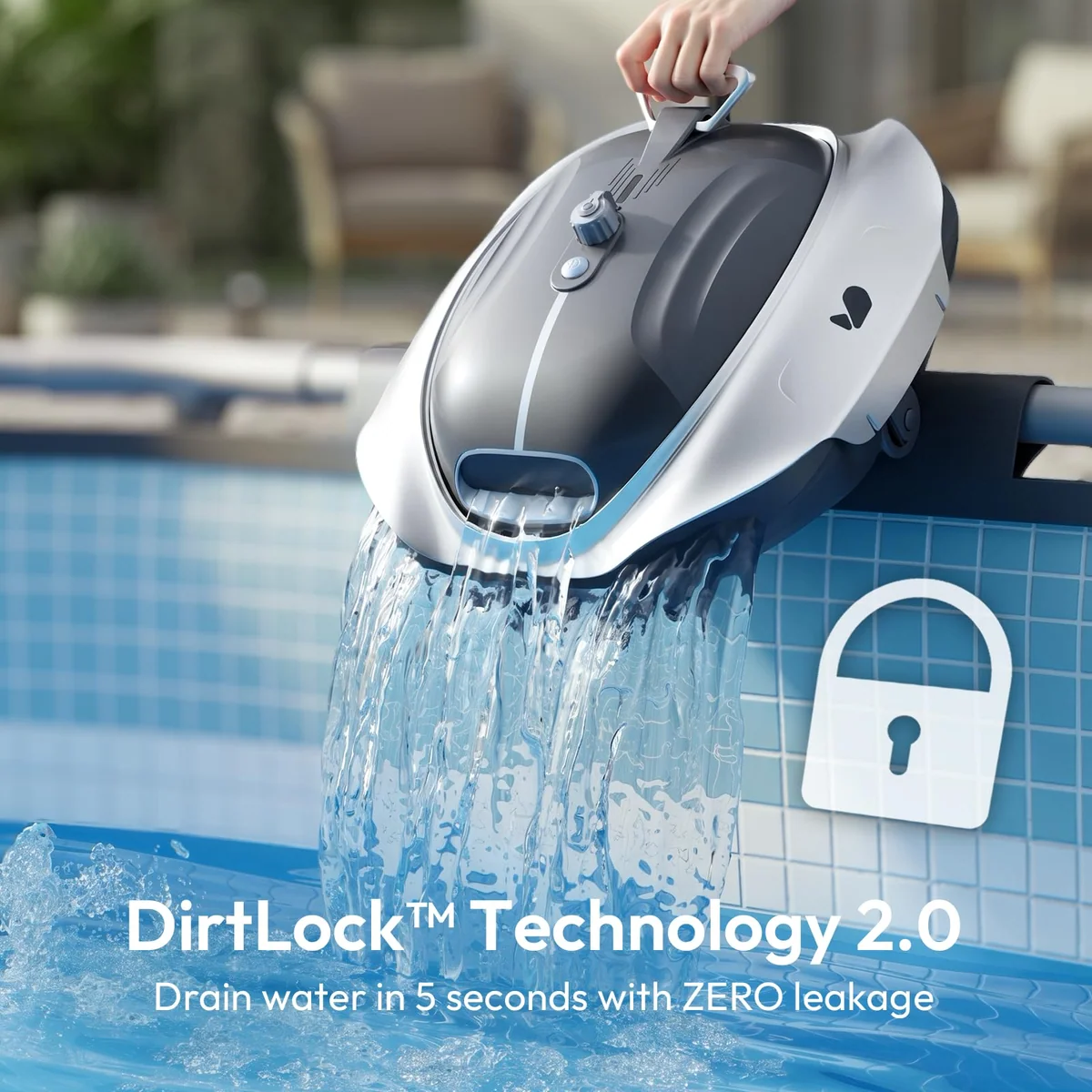
The water-release system appears genuinely useful. Visible demonstrations show the cleaner shedding its water quickly while retaining leaves and other larger material, which reduces the weight hanging from your hands during removal.
Fine sediment is less obedient. A detailed owner account reports seepage through the seam between the top and lower body when the cleaner was lifted vertically. The practical workaround is to use the leash only to bring the cleaner within reach, support the body horizontally while it clears the water, and turn it upright to drain only after it is outside the pool. Correctly aligning the directional lid and filter parts also matters.
Self-parking should not become an alibi
Normal self-parking begins when the battery is low: the indicator flashes yellow, the cleaner stops near a wall, and the light becomes solid yellow before eventually switching off. A cleaner that parks with a full battery and a clean filter is not performing that feature correctly, no matter how conveniently the marketing language describes stopping near an edge.
Cheap help becomes expensive babysitting
The 300P’s value proposition is easy to understand without quoting a live price: it delivers cordless floor pickup without the app, wall-climbing hardware and larger tracked chassis of more elaborate robots. In the right pool, that restraint is appealing. There is less equipment to deploy, and a maintenance run can remove the settled debris that would otherwise require hand vacuuming.
In the wrong pool, the arithmetic collapses. A robot that needs to be nudged away from every wrinkle is not saving labor, and a unit that stops at the wall with a full battery is not an economical substitute for a manual vacuum. Strong suction per dollar matters only when the machine travels far enough to use it.
If your pool has liner wrinkles or floor irregularities, compare the site’s better-matched above-ground pool cleaners before accepting this mobility risk.
If cordless operation remains essential, the cordless cleaner guide explains the alternatives and the compromises that come with battery-powered designs.
If walls and the waterline are part of the job, start with robots designed for vertical cleaning because the 300P cannot perform that work.
The ownership chores are small, but not optional
After every cycle, switch the cleaner off, open it, remove and rinse both filter layers, rinse the chassis, and reassemble the parts in their correct orientation. The supplied secondary filter is the appropriate option for finer debris; improvising with cotton-like filter media is a bad idea because an owner report describes loose material reaching and binding the motor.
Deployment also has an unintuitive step. The 300P should be submerged until the trapped air escapes, switched on while underwater, and then released upright with its wheels facing the floor. The charging-port plug must be seated during operation, and the port must be completely dry before the charger is connected.
One early-use demonstration found the charging-port flap trying to lift after a single cycle and noticed cosmetic wear around the lower edges. One observation cannot establish a model-wide defect, but a loose water seal deserves inspection after every run because the manual explicitly prohibits charging through a wet port.
Warranty language needs checking before purchase
The manual describes a 12-month warranty limited to the drive kit, battery and circuit board, while the official product page presents both one-year and two-year language in different places. Filters, brushes, wheels and water outlets are identified as wearable parts outside the manual’s coverage. Verify the written terms attached to the exact seller and ASIN rather than assuming the most generous headline applies.
Long-term evidence is thin. Initial-use demonstrations show what the robot can collect, but owner reports also include a unit that would not move after winter storage and examples that arrived unable to complete a normal run. For seasonal storage, the manual calls for thorough drying, indoor storage and a recharge every three months.
Frequently Asked Questions
Why does a Bubot 300P stop when its battery is still full?
Clean the filters, inspect the impeller, remove obstructive bottom brushes, check the wheel configuration and perform the manual’s one-minute charging reset, then return or service the unit promptly if premature stopping continues.
What does a flashing red light mean?
A red flash about once per second indicates the cleaner was switched on before prompt submersion or lifted while still powered, while faster red flashing indicates it is being charged without first being switched off.
Can the Bubot 300P be used in a saltwater pool?
The manual permits saltwater use up to 5,000 ppm NaCl and calls for rinsing the cleaner with fresh water afterward.
Can the cleaner run while swimmers or the pool filter are active?
No, the manual says not to operate it with people or animals in the water and advises against running it alongside the pool’s filtration system.
Is A10PS a different cleaner from the Bubot 300P?
A10PS is the model identifier used by the Bubot 300P manual, but buyers should still match the seller, color and ASIN because other 300P listings and revisions exist.
Sources (6)
- Amazon listings and customer reviews — Bublue Bubot 300p
- Owner and reviewer video, 4 channels
- Walmart listing
- Plus — Article — manuals.plus
- BUBLUE — Article — www.bublue.com
- Facebook — Article — www.facebook.com