The BUBLUE F10 is good at leaves, not at leaving you alone.
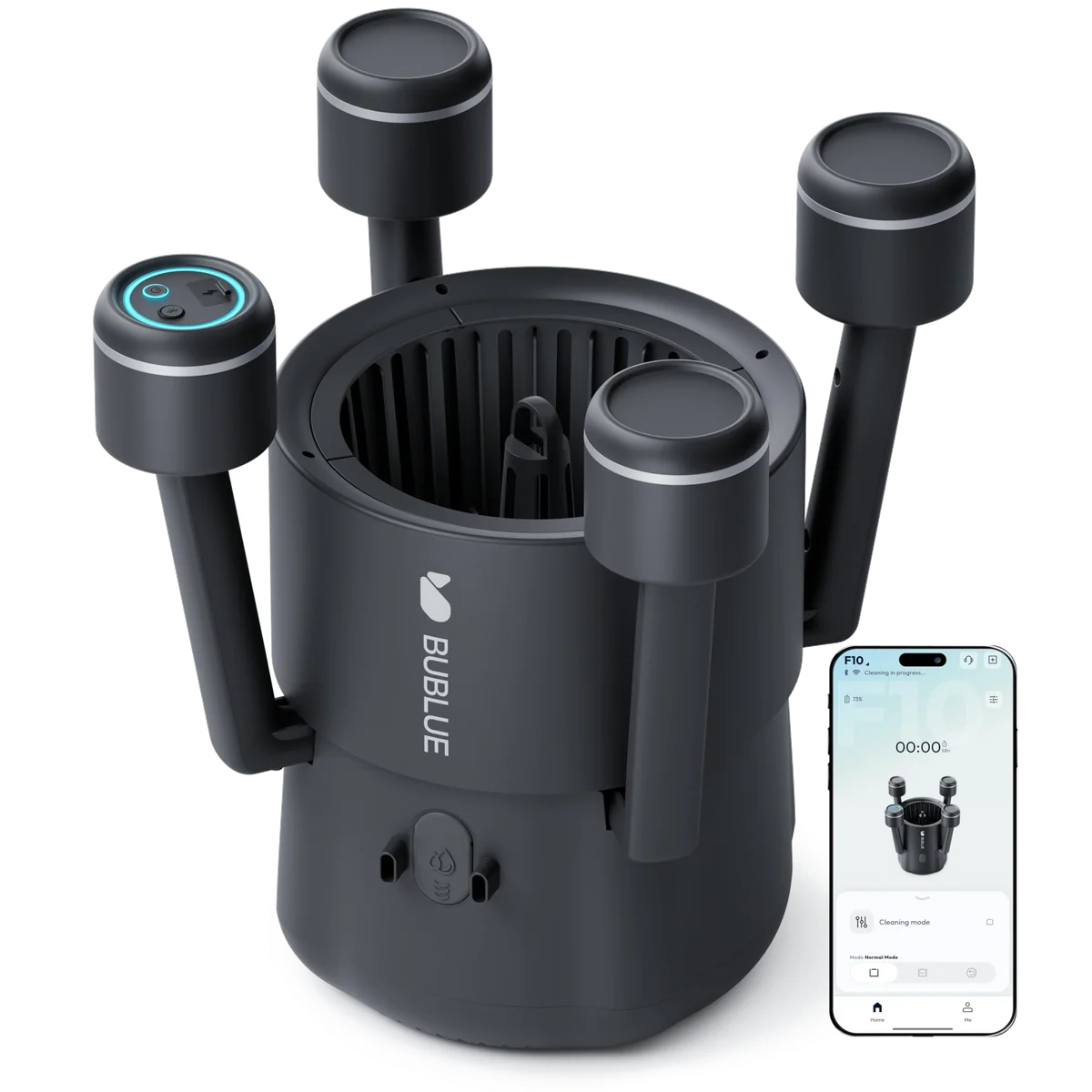
Buy the BUBLUE F10 for continuous leaves, insects and tree litter in a small or medium pool, but choose a solar skimmer or keep the net if you expect all-day autonomy, fine-debris perfection or effortless retrieval.
Should you buy the BUBLUE F10?
Yes, if your pool or skimmerless spa sits beneath plants, receives a steady drift of leaves and insects, fits comfortably within the stated coverage, and already has another answer for the floor. The F10 can remove enough surface debris to change a daily maintenance routine, especially when the alternative is returning with the net every few hours.
No, if you want a robot that lives in the pool, charges itself, handles fine film as convincingly as leaves, or never needs rescuing from awkward geometry. A small one-time debris load is also a poor reason to accept the charging and cleanup cycle.
The final judgment is deliberately narrower than the advertising: the F10 is a capable active skimmer with a useful basket and imperfect manners, not an autonomous pool-care system.
The F10 solves one narrow, irritating problem: debris that floats around while the fixed skimmer waits for circulation to deliver it. It patrols at the waterline, draws leaves and insects toward a central basket, and keeps working while you do something less repetitive than waving a net. That can be genuinely useful beneath flowering shrubs or mature trees.
It is equally important to understand what the machine is not. The F10 does not scrub the floor, climb walls, clean the waterline or remove settled sand. Owners with dirt below the surface still need a separate vacuum or floor robot, a distinction covered in our guide to choosing between a robotic skimmer and a pool vacuum. One direct demonstration put the limitation plainly: another cleaner is still required for the floor.
The case for buying one therefore depends less on whether it collects debris, because the evidence says it does, and more on whether its routine is easier than yours. In a pool receiving scattered leaves and bugs throughout the day, repeated unattended passes have an obvious advantage over repeated hand skimming. For one compact pile after a storm, the net may finish before the F10 has crossed the pool.
Key Specifications
The vortex is real, even if the intelligence is hard to prove
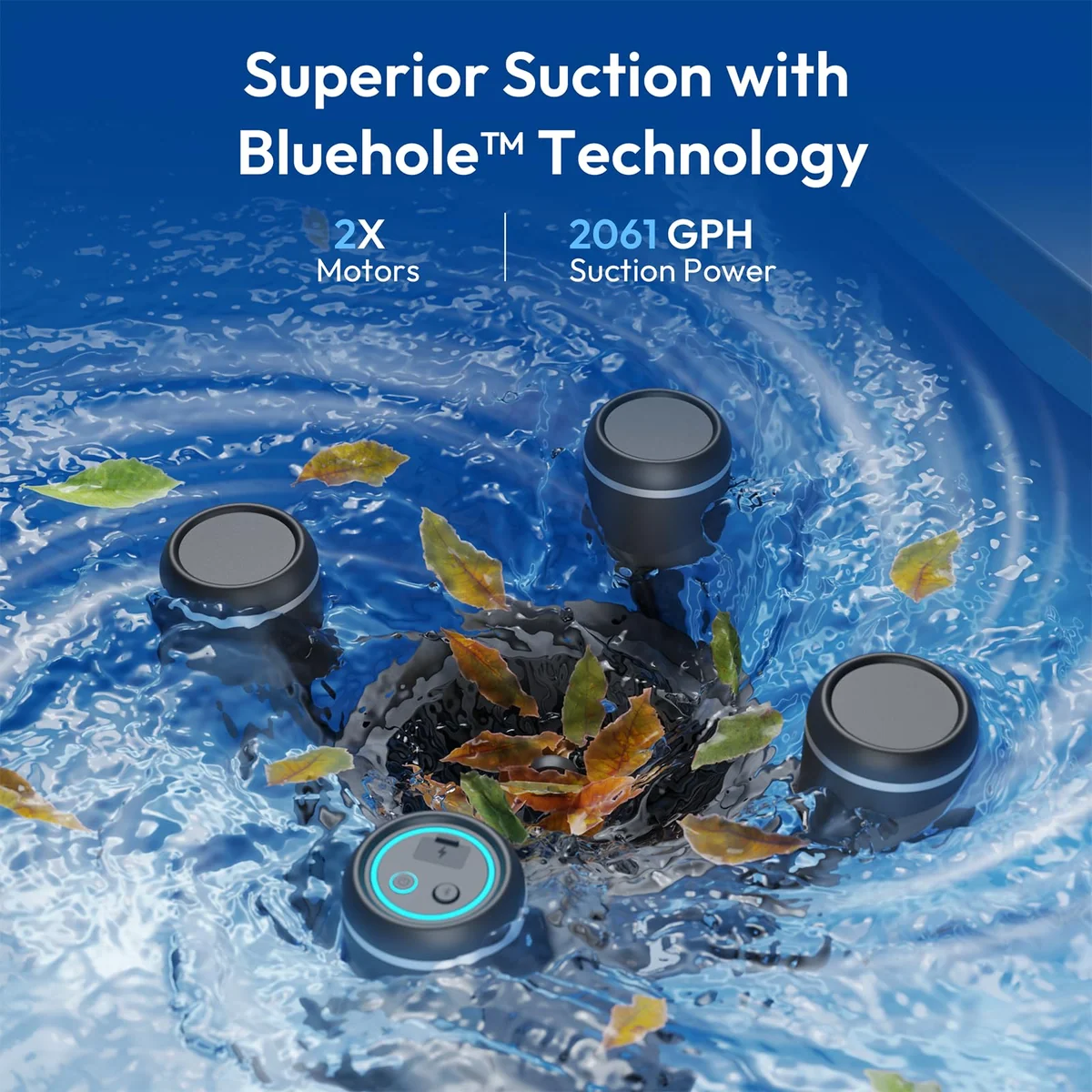
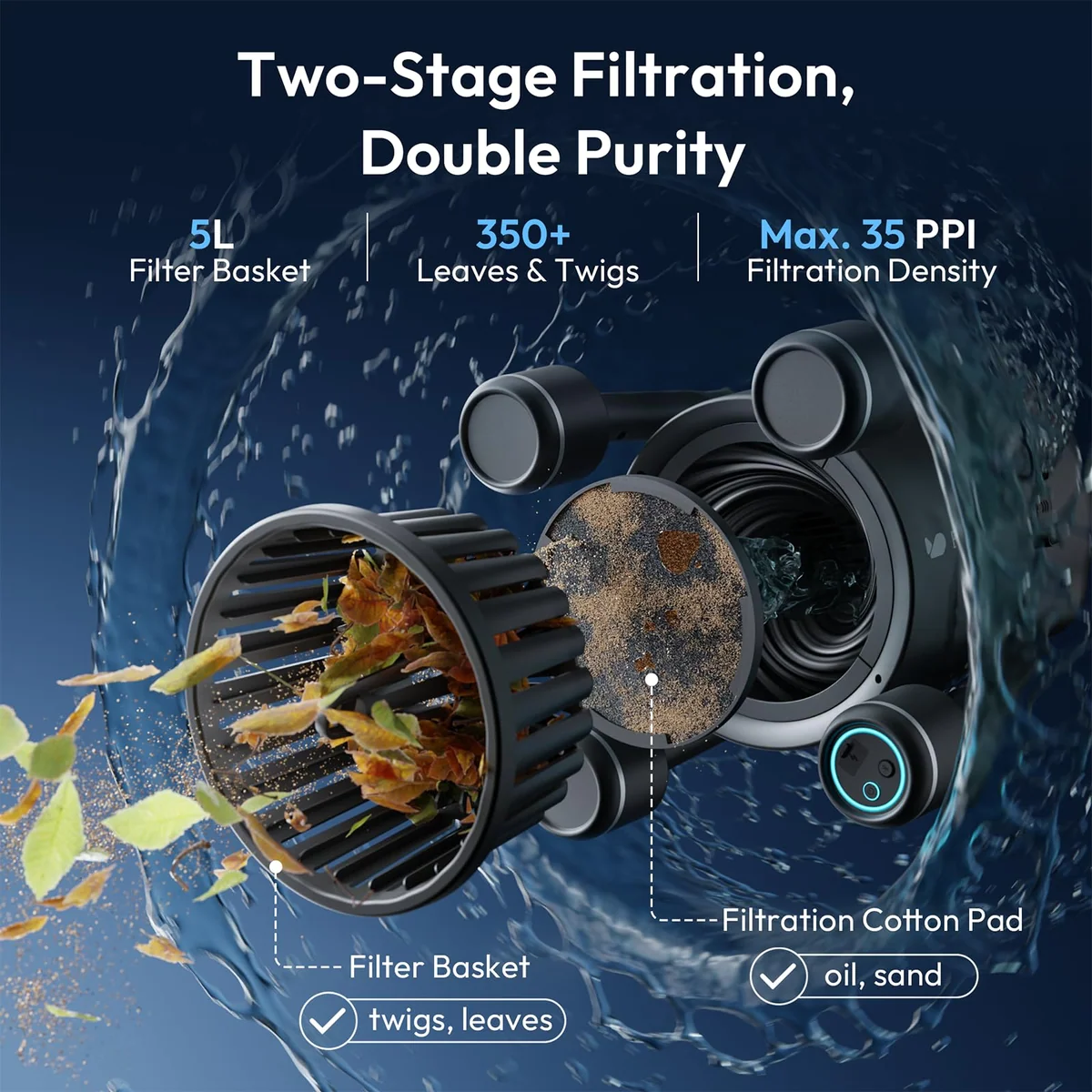
The unusual upright body is more than styling. Its outer sleeve floats at the waterline while two lower impeller assemblies move water through the center and propel the robot. Direct demonstrations show visible surface flow toward the basket, meaningful debris loads after operation and a lower foam pad catching material that passes through the coarser retention area.
BUBLUE calls its navigation “AI,” but there is no independent evidence here of a stored map, measured coverage percentage or learning system. The defensible observation is simpler: the F10 often appears purposeful, changes areas and reacts to edges. A comparatively restrained demonstration found that it did not avoid every obstacle perfectly, although it behaved deliberately enough that the operator stopped supervising it constantly.
Auto mode covers; Corner Boost lingers
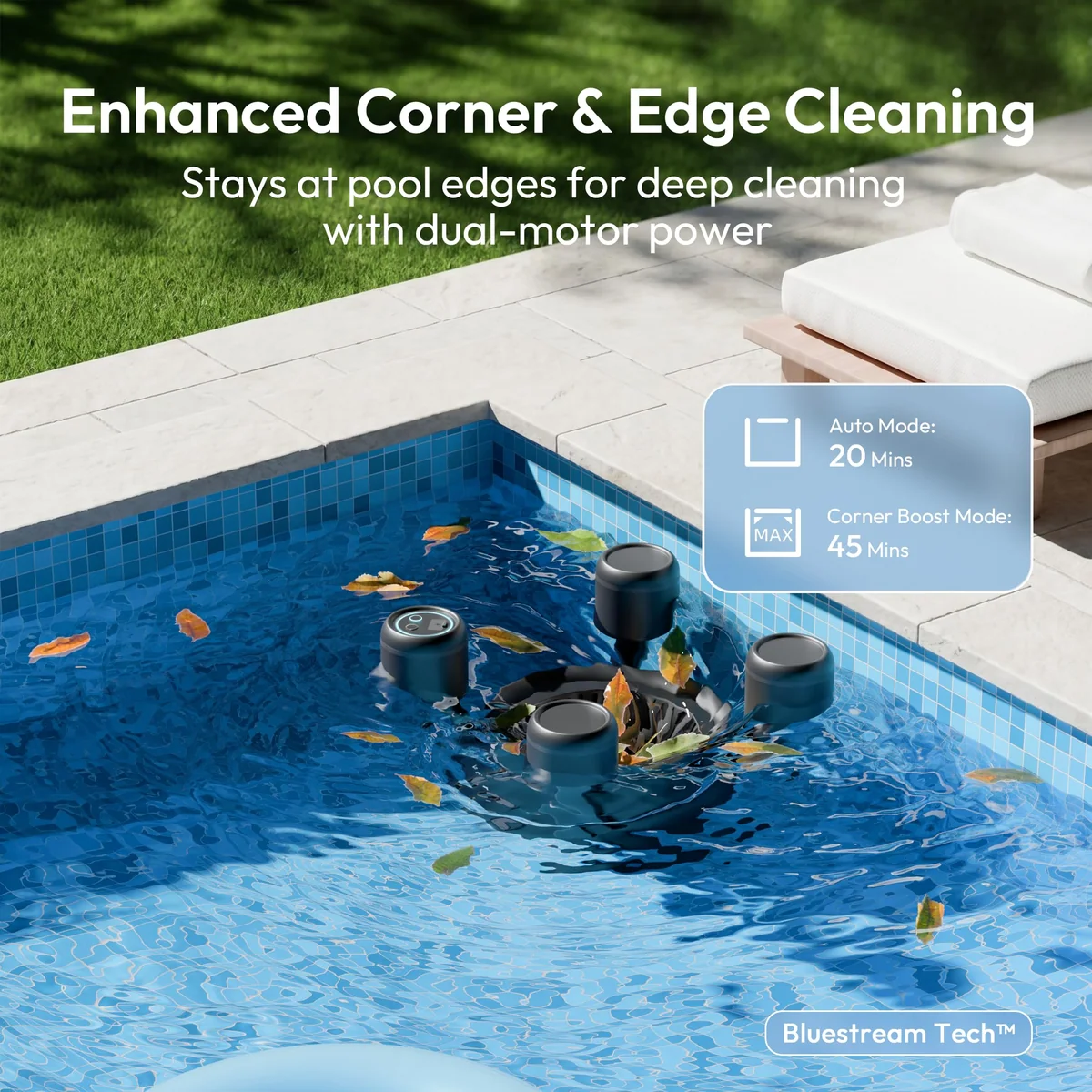
Auto mode is the general patrol setting. Corner Boost is meant to hold the robot near a wall or corner for 15 minutes, using active suction where floating material tends to collect. The mode exists and can be selected, but the supplied record does not include a controlled pickup comparison between it and Auto. Treat it as a useful behavior option rather than proof that every corner will be cleared.
The app is useful, not essential
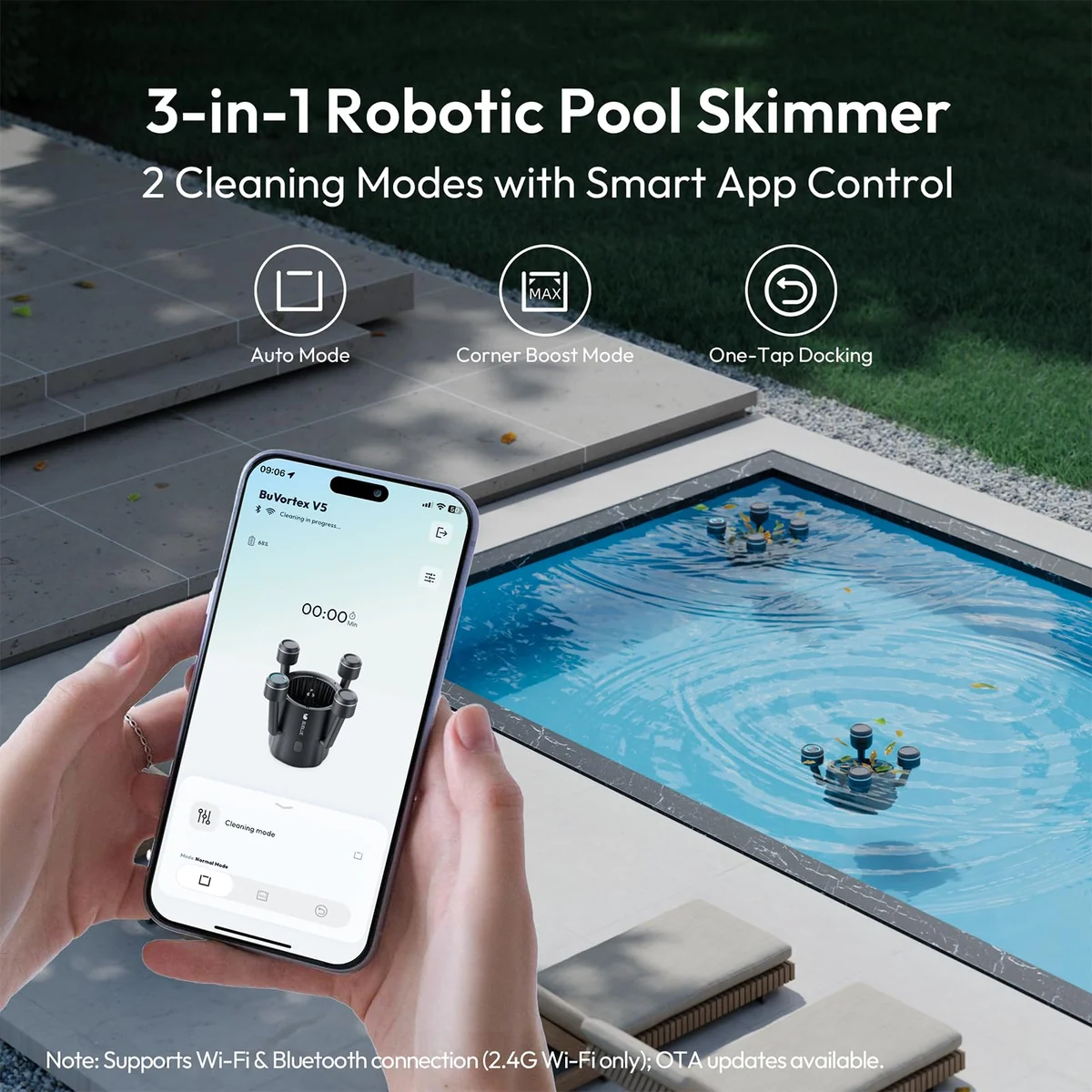
Physical controls handle basic operation, so a failed phone connection does not turn the F10 into a large ornament. The app adds the functions that matter at a distance: battery status, mode changes, alerts, firmware updates and a return command that brings the robot toward the side for retrieval. “Dock” does not mean a charging station; the machine still has to be lifted out and plugged in.
Connection quality is inconsistent. Several owners found setup simple, while another reported unreliable Bluetooth and a Vine reviewer called the app rudimentary. The battery readout is especially valuable because the body does not give a clear remaining percentage, but that advantage shrinks when the phone cannot maintain a connection.
Leaves stay in the basket more reliably than the tiny stuff
Ordinary leaves, insects, flowers and light tree litter are the F10’s strongest assignment. Owners also report success with thin spruce needles, and videos show baskets containing both recognizable foliage and smaller visible material after roughly an hour or an afternoon. An above-ground demonstration produced a substantial debris load by the following day.
| Debris | Reasonable expectation | Important limit |
|---|---|---|
| Leaves and flowers | Strong pickup over repeated passes | Heavy fall can fill the basket or require manual help |
| Insects and needles | Generally good capture | The smallest pieces may escape when the robot stops |
| Pollen and fine floating matter | Some can reach the secondary pad | A polished surface is not assured |
| Oil film | Unproven | Supported only by promotional claims |
| Settled sand | Outside this robot’s job | Use a floor vacuum or cleaner |
The secondary filter improves the design, but it does not settle the argument about fine debris. One owner said big leaves remained while bugs and small floating particles escaped when the robot shut down. Another still had to remove plenty of small material by hand. In contrast, a direct video test found that small items remained captured, and other owners praised pickup of needles and fine tree litter. The honest expectation is a visibly cleaner surface, not laboratory clarity.
Five liters is roomy, not bottomless
The basket is large enough to make the F10 useful under routine leaf fall, and several demonstrations show ample remaining space after a meaningful collection. BUBLUE’s claim that it holds more than 350 leaves was not independently counted, however, and one owner beneath two trees filled the basket sooner than expected. Capacity buys time between cleanouts; it does not eliminate them.
Escape behavior depends on the pool
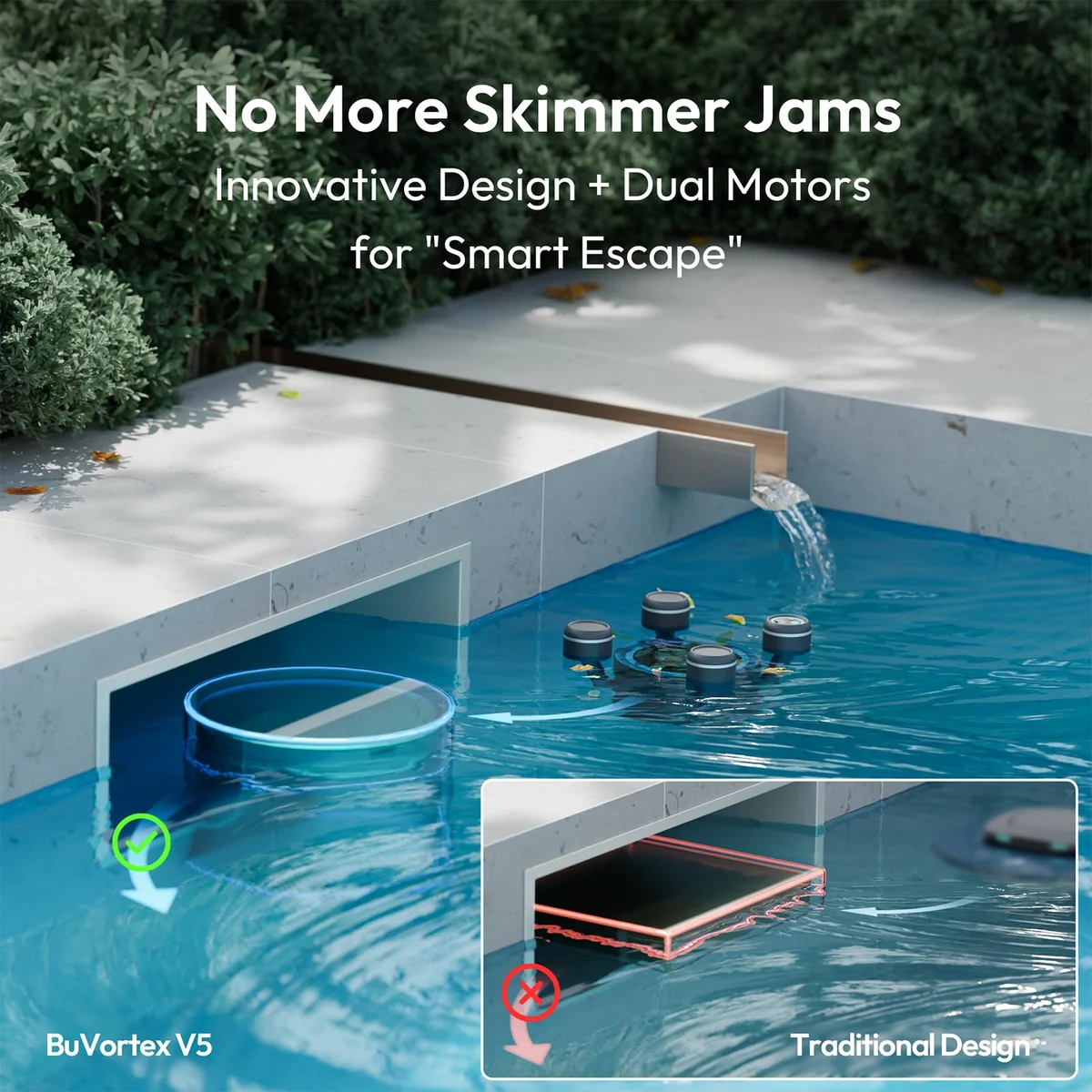
The rounded body and dual motors can work around many obstacles, but the listing’s claim that the robot will not become trapped is contradicted by exact-product owners. One reported repeated trouble against sloping walls until adding homemade standoffs. Another found the F10 running motionless at the side and stranded on a step until physically pushed away.
Water level, wall angle, shelf depth, return currents and the position of the fixed skimmer all matter. One owner cited a 15-inch minimum depth and added improvised flotation for a Baja shelf, which is a warning rather than a modification Smart Pool Bots recommends. The available evidence also does not establish that the F10 can always pull away from a strong operating intake.
Remove loose thermometer strings, ropes and cleaner cables before a run. One owner saw the robot ignore large floaters but ingest a thermometer cord, a useful reminder that obstacle avoidance is not entanglement immunity.
The real rival is your net, then the sun
The F10 earns its place when debris arrives continuously. A hydrangea owner said it kept pace with constant fine tree litter that had previously demanded endless hand skimming, and a spa owner reported several months of daily use around shedding landscaping. That same long-term owner considered it better suited to the spa or a smaller pool than to a 20,000-gallon pool, even though it could also help with the larger water surface.
The value collapses when the robot creates a second chore without removing the first. The least satisfied owners described a sequence of rescues, remaining fine debris, basket cleaning, lifting and charging that took longer than using a net. This split in owner opinion is coherent: the machine is best at maintaining a moving field of debris over time, not at winning a quick cleanup race.
Battery power is both the appeal and the tax
Promotional material describes up to 180 minutes of operation after roughly four hours of charging. Two exact-product owners instead reported about an hour or a little more from a charge, and another had the machine die during service without a dependable battery reading. Runtime may vary with mode, loading and pool geometry, but the record does not justify planning around three hours.
Every cycle eventually requires retrieval, drainage, a trip to a dry charging location and another launch. Solar competitors trade some dependence on conditions for much longer unattended presence at the surface. Readers deciding whether that difference is decisive can compare the F10 directly with the dual-charging alternative in our BUBLUE F10 and Betta SE Plus comparison, or see the broader field in our guide to the best robotic pool skimmers.
Retrieval is where convenience gets wet and heavy
Owner descriptions of the F10 range from manageable to very heavy. Both can be true because a freshly lifted skimmer carries water until it drains. The included hook makes it possible to draw the robot to the coping, but the safest practical routine is to retrieve from the center, use two hands, pause for drainage and avoid carrying it by one outer arm.
Technique also affects debris retention. A detailed BuVortex V5 demonstration spilled several leaves during one-handed retrieval, while other tests removed the basket without losing the load. The outer sleeve, basket and lower filter need to be seated carefully after rinsing. A loose lower foam ring and reports of the top separating suggest that assembly deserves attention rather than a hurried drop back into the pool.
Routine maintenance is otherwise straightforward: switch off, retrieve, let the water drain, remove the sleeve and basket, dump the debris, rinse the pad and netting, then reassemble. The package demonstrations show a retrieval hook, spare filter material and replacement netting, although replacement pricing and continuing availability are not established.
The warranty needs checking before purchase
The exact Amazon listing states a two-year warranty, while BUBLUE’s F10 Space Black page advertises one year. The color record is also untidy, with the listing and manufacturer describing black or Space Black while Amazon catalogue data elsewhere labels the same ASIN beige. Confirm the seller, finish and written warranty terms at checkout rather than assuming the most favorable version applies.
Durability remains the largest unanswered question. Only one retained exact-listing review describes several months of daily use, and even a highly positive owner under two trees made long service life a condition of the final judgment. There is not enough evidence to promise multi-season battery health, UV resistance or easy replacement of filters and charging hardware.
Frequently Asked Questions
Does the BUBLUE F10 clean the pool floor?
No, it collects floating surface debris and requires a separate floor or wall cleaner for material that sinks.
Is the BUBLUE F10 solar powered?
No, it uses a rechargeable battery and must be removed from the water for wired charging.
How long does the BUBLUE F10 run?
Promotional material claims up to 180 minutes, but two exact-product owners reported roughly an hour or a little more from a charge.
Can the F10 work without the app?
Yes, basic cleaning works through the physical controls, while the app adds battery status, remote mode changes, alerts, return control and firmware updates.
Will the F10 get stuck on steps or walls?
It can escape many ordinary contacts, but exact-product owners report stranding on steps, sloping walls and pool sides.
Can the F10 operate on a Baja shelf or shallow ledge?
Use caution because an owner cited a 15-inch minimum depth and had to improvise flotation for a Baja shelf.
Does the basket keep every particle inside?
No, leaves are retained more consistently than tiny bugs and fine floating debris, which some owners saw escape at shutdown or retrieval.
Sources (3)
- Amazon listings and customer reviews — Bublue F10
- Owner and reviewer video, 6 channels
- BUBLUE — Article — www.bublue.com