The Best WYBOT Pool Cleaner Is the C2 Vision, With One Big Catch
The best WYBOT is not the one with the longest feature list. It is the one whose useful hardware still matters after the app disconnects underwater, the route misses a corner, and the battery needs another trip to the charger. On that standard, the C2 Vision wins because its removable 10-micron filter addresses a difficult cleaning job that the other three models cannot match.
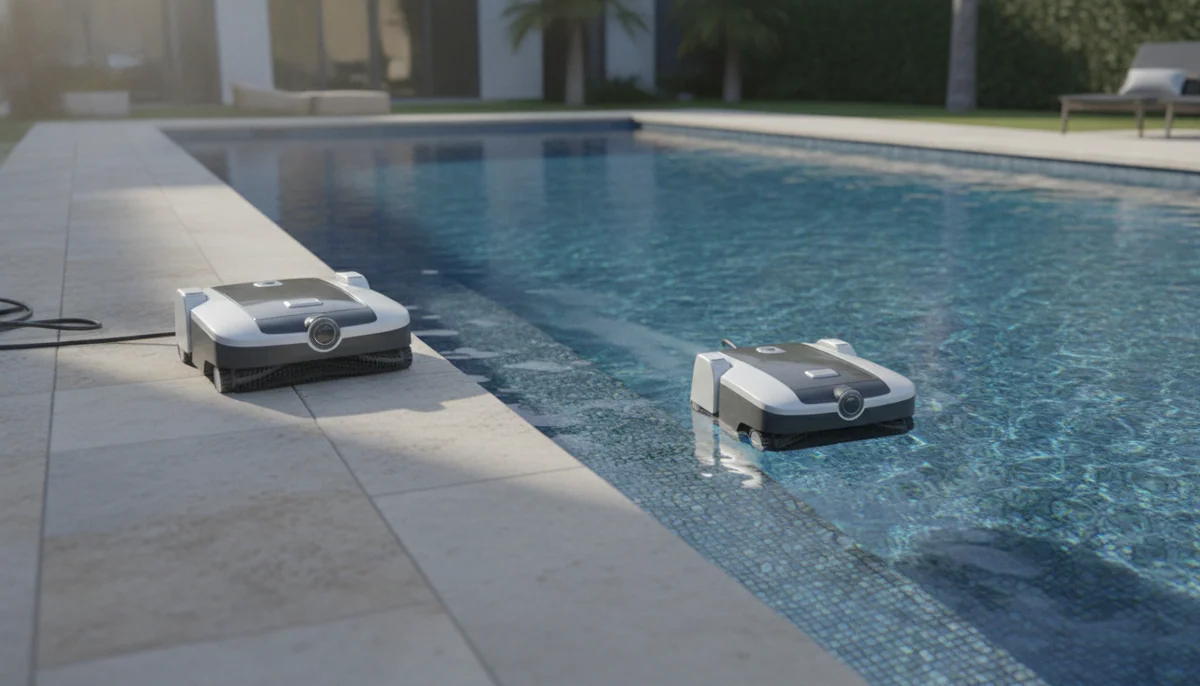
The camera is not why it wins. Exact-model owners report excellent fine-dust filtration and useful targeted cleaning in open pools, but they also describe missed coverage when stains, colored drains, or a multitone finish confuse the vision system. Smart Pool Bots would pay attention to the filter, wall modes, and route choices before assigning any value to the artificial-intelligence story.
The rest of the lineup is a ladder with missing rungs. The A1 is a floor-only sweeper for a flat, cooperative above-ground pool. The B1 attempts the floor, walls, and waterline, yet its coverage and ownership record make it difficult to trust. The C1 offers the most conventional full-pool alternative to the winner, but its thin exact-model history and wider family record do not support carefree ownership.
Buy the C2 Vision if
Your pool has a mostly uniform finish, fine settled debris is a recurring problem, and you accept retrieval, filter rinsing, and charging after each substantial run.
Walk away from this lineup if
You need dependable multi-season service, consecutive full-length cycles, strong shallow-ledge coverage, or automation that continues without a person handling the cleaner.
No model here is a surface skimmer, and none turns cordless operation into permanent autonomy. If floating leaves are the real nuisance, start with the site’s guide to robotic pool skimmers; if removing the cable is the non-negotiable requirement, compare WYBOT with the wider field of cordless robotic pool cleaners.
At a Glance: All WYBOT Pool cleaners Compared
| Feature | Editor's Pick WYBOT C2 Vision | WYBOT A1 | WYBOT B1 | WYBOT C1 |
|---|---|---|---|---|
| Price Range | $500–$1,000 | $200–$500 | Under $200 | $200–$500 |
| Claimed runtime | Up to three hours in Eco Floor mode, with standard cleaning reported at about two hours | — | Up to about 120 minutes in eco floor mode | Up to 160 minutes |
| Check Price on Amazon | Check Price on Amazon | Check Price on Amazon | Check Price on Amazon |
The four WYBOT cleaners, ranked
1. WYBOT C2 Vision — The C2 Vision is the WYBOT to buy for fine debris and a visually simple pool.
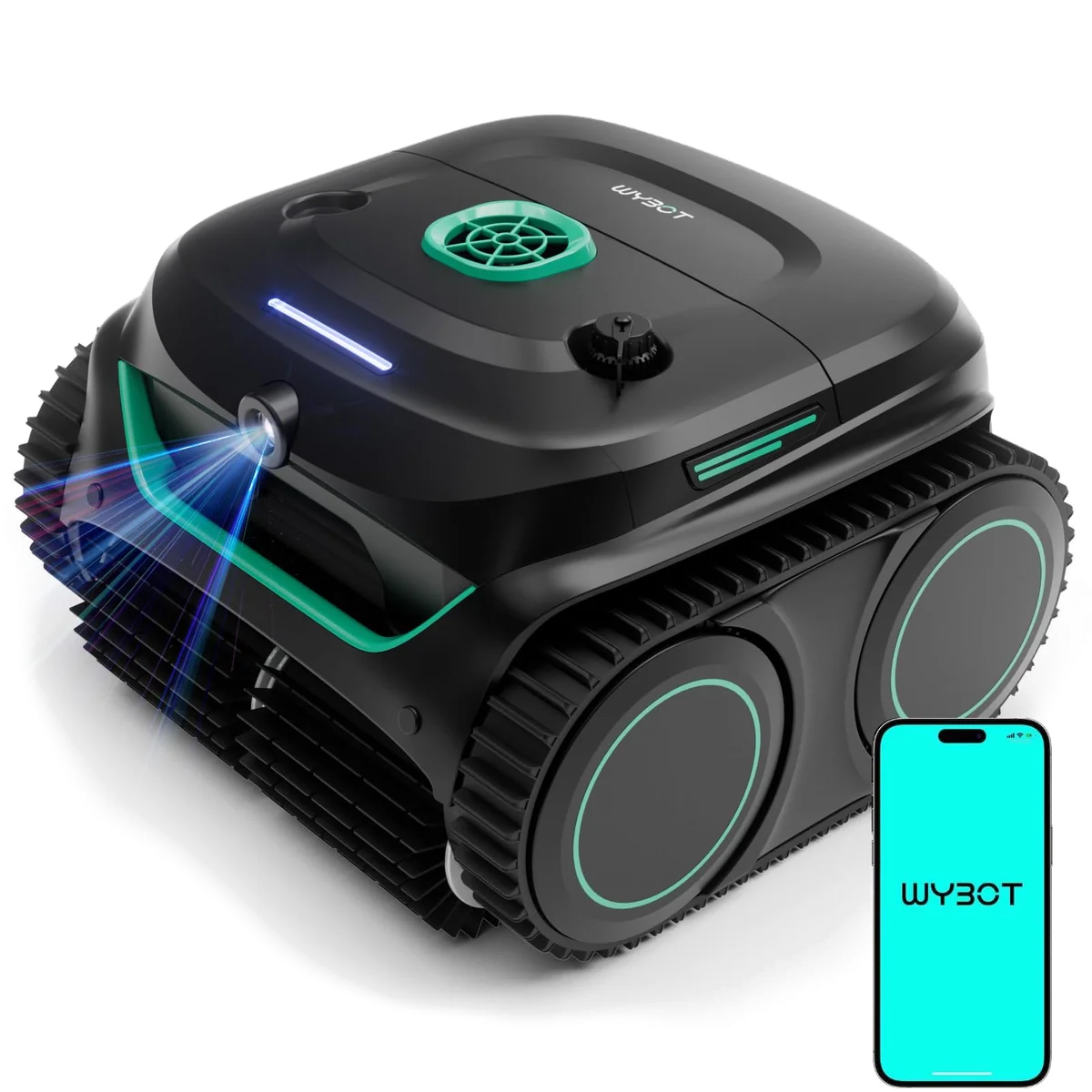
Its removable 10-micron insert, capable floor cleaning, dedicated wall and waterline modes, and configurable routes give it the most useful cleaning range in this lineup.
The camera can waste coverage on stains, contrasting fittings, and multicolored finishes, while shallow shelves and upper steps remain unreliable.
The filter closes this sale. The ordinary 180-micron basket handles leaves, seeds, and visible debris, while the finer insert targets the dust, pollen, sand, and silt that can slip through coarser baskets. Owners specifically praise its fine-dust pickup, although the insert can load quickly and is better used after the largest debris has been removed.
Vision mode is most useful when debris forms an obvious patch on a plain floor. The robot can return to conspicuous material instead of spending the whole charge on already-clean areas, but its optical judgment is not an understanding of the pool. A colored drain cover, stain, or changing finish can become a false signal, and the route may improve only after several complete cycles.
WYBOT advertises up to three hours in its floor-saving Eco mode, but ordinary full-pool use lands closer to two hours in the retained owner record. That is enough for many open pools, not a promise that 2,150 square feet of walls, waterline, ledges, and floor will all receive a satisfying pass.
What earns the recommendation
- The ultra-fine insert gives this model a genuine advantage on settled dust, sand, pollen, and silt.
- Separate floor, wall, waterline, full-pool, and targeted modes let the owner choose where the battery goes.
- The cordless body eliminates cable drag and deck-side transformer placement.
What keeps it qualified
- Vision becomes less useful when the pool finish itself creates visual noise.
- Scheduling divides a stored charge rather than creating automatic recharging or indefinite cleaning.
- The exact-model record includes an early no-movement failure, so the return window still matters.
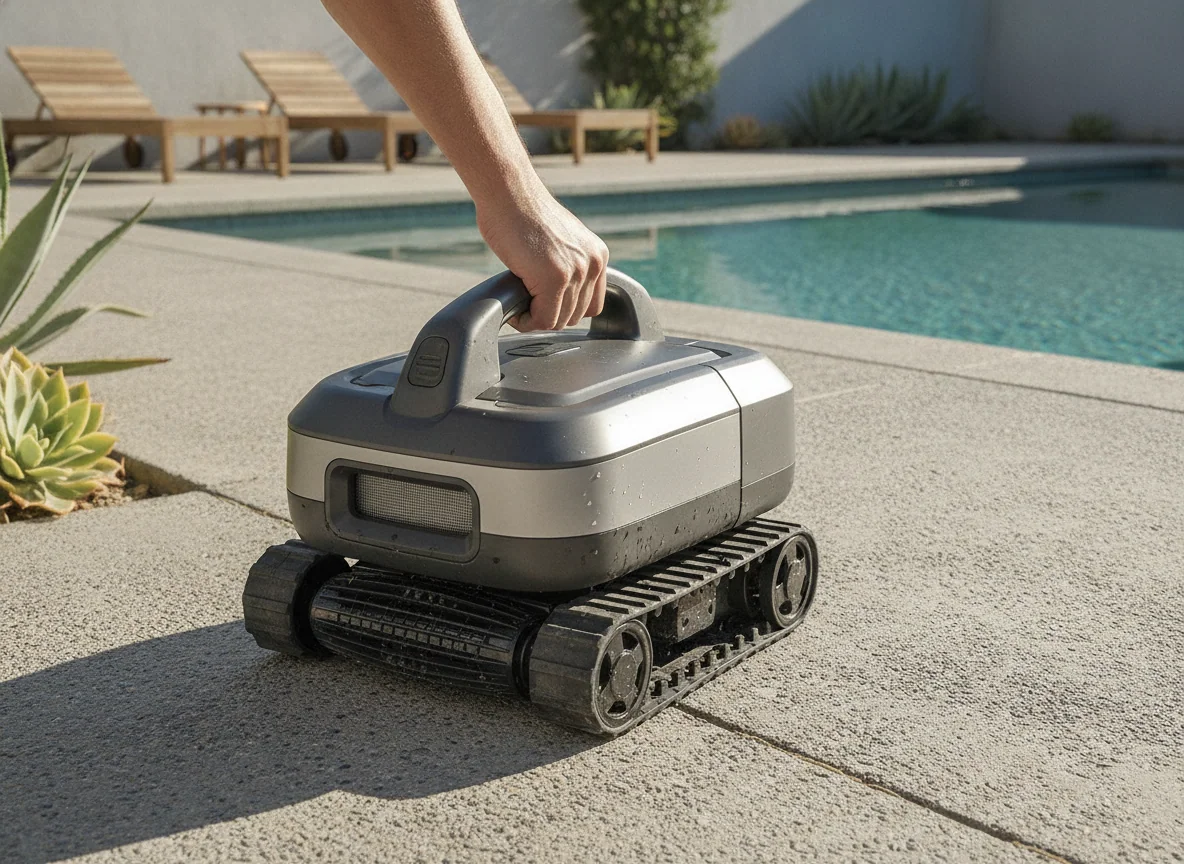
2. WYBOT A1 — The A1 is the narrow choice for a flat above-ground pool that only needs its floor swept.
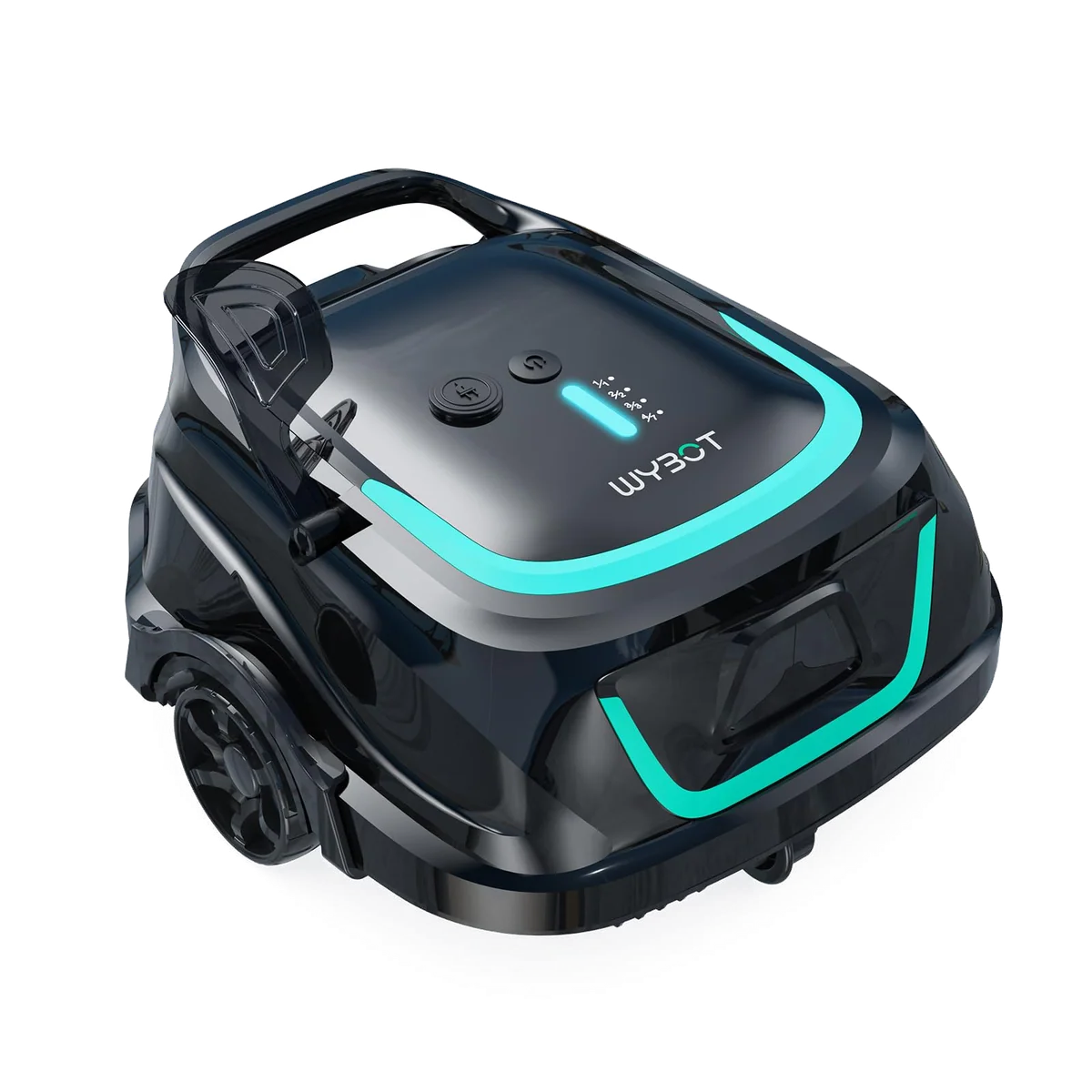
Its light cordless body and foam-backed 180-micron filter can remove useful amounts of loose sediment without a hose, cable, or app.
It cannot scrub or climb walls, and random travel can miss debris, stall on wrinkles, or turn an uneven floor into a rescue exercise.
The A1 succeeds when the assignment stays small. It drives across the floor, vacuums loose material, and attempts to stop near an edge when the cycle ends or the battery becomes low. The exact listing rates this revision for up to 130 minutes and excludes meaningful wrinkles and slopes over 15 degrees.
Its dual-layer filter is a better idea than a bare coarse basket, particularly for loose fine sediment. The missing brush is the harder boundary. Dirt resting on the floor can be collected when the machine crosses it, but algae or grime attached to the surface still needs agitation.
Exact-model owner reports divide between effective floor cleaning and units that stop, sit idle, or shut off during a crossing. That sample is too small for a failure rate, yet the agreement between the critical accounts is enough to make the first cycles a compatibility and reliability test.
What earns its place
- The simple cordless body is easy to deploy when the pool floor is flat and unobstructed.
- The secondary foam layer is useful for loose fine material that reaches the intake.
- Floor-only operation can be enough for routine maintenance in a smooth round or rectangular pool.
Strengths
- The cordless body avoids a floating power cable, hose setup, and tangles.
- The dual-layer filter is useful for loose fine sediment that reaches the inlet.
- The light body is easier to lower and retrieve than many full-size corded robots.
- Filter rinsing is straightforward once the housing is aligned correctly.
Limitations
- Random travel can repeat routes while leaving other parts of the floor untouched.
- The lack of an active brush leaves attached algae and grime behind.
- Wrinkles, slopes, drains, ladders, and floor transitions can stop or trap it.
- Owners report early shutdowns, charging failures, broken clips, and other durability problems.
- It cannot clean walls or the waterline.
What narrows the fit
- There is no active brush for attached algae or grime.
- There is no wall, step, or waterline cleaning.
- Slopes, drains, ladders, liner wrinkles, and uneven sections can defeat its simple movement.
3. WYBOT B1 — The B1 is a light full-pool experiment for buyers protected by an easy return policy.
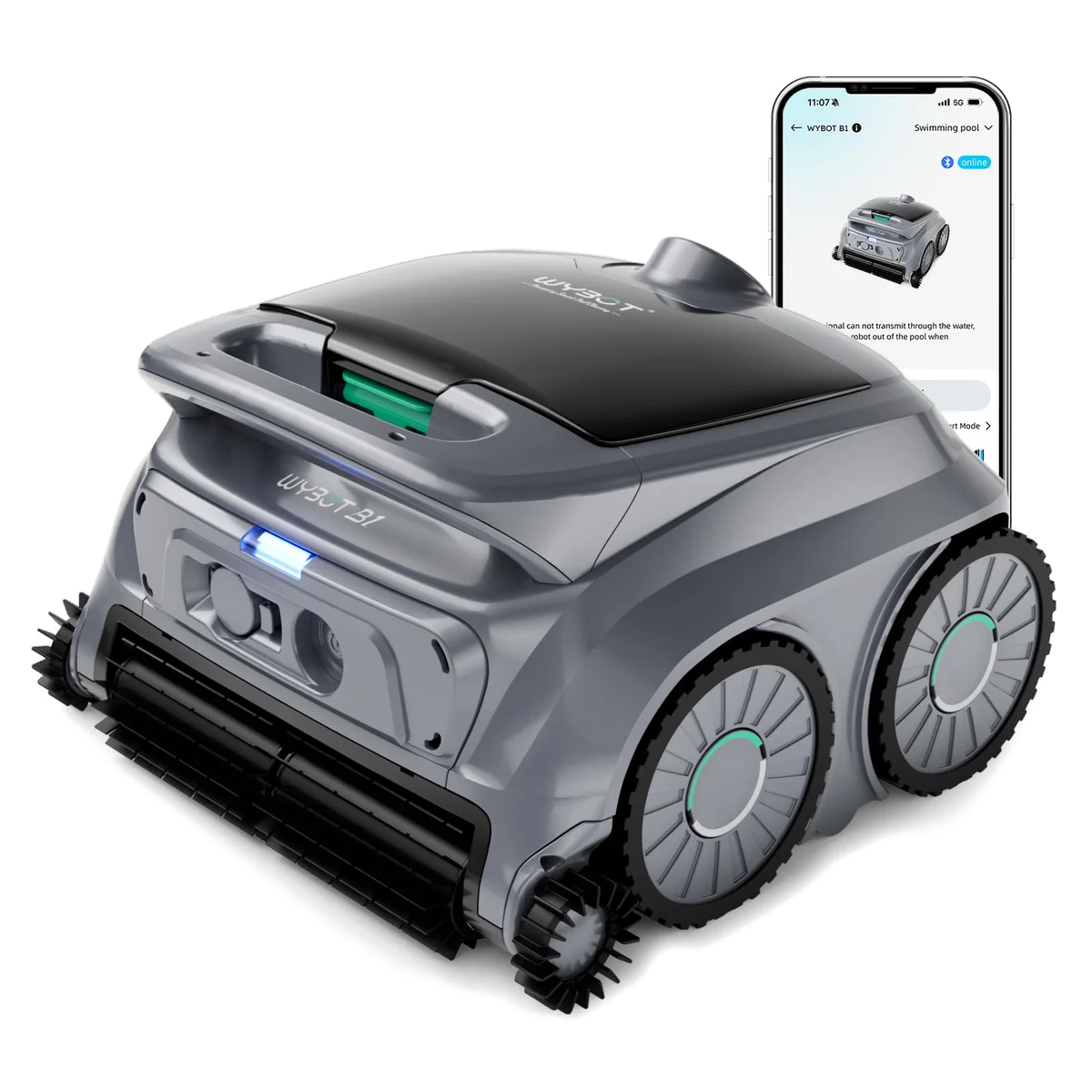
It can collect ordinary debris, climb straightforward walls, reach the waterline, and cross some raised obstacles without bringing a cable into the pool.
Coverage can become repetitive around slopes, steps, and corners, while the coarse basket, awkward hood latch, and early failure reports make ownership harder to recommend.
The B1 is more capable than the A1 in a literal sense. It attempts the floor, walls, and waterline, and exact owners report useful pickup of leaves, bugs, sand, rocks, and ordinary dirt. They also describe contradictory navigation, with some machines covering a pool convincingly and others spending much of a cycle in one corner or becoming stranded on steps.
The app does not rescue that uncertainty. Treat it as a setup interface for modes and preferences before immersion, not as a live underwater remote. The basket is also nominally 180 microns without the C2 Vision’s ultra-fine insert, which makes the B1 a weak choice for persistent silt, dead algae, or floor-polishing work.
The most serious exact-model report describes a unit that cleaned well before failing after two months, followed by an owner teardown that found water around internal electrical areas. One teardown cannot prove a model-wide sealing defect, but it is serious enough that retailer protection belongs in the buying decision rather than in the small print.
What works
- The relatively light cordless chassis is easier to handle than many full-size wall-climbing robots.
- Visible debris pickup can be effective in a small pool with ordinary transitions.
- Wall reach and edge parking are real capabilities when the pool geometry cooperates.
Strengths
- At roughly 14 pounds dry, the B1 is relatively easy to carry for a robot that attempts full-pool cleaning.
- Cordless operation removes cable drag, tangles, and the need to position a transformer near the pool.
- Direct evidence supports useful pickup of leaves, bugs, sand, pebbles, and ordinary settled dirt.
- It can climb vertical walls, reach the waterline, cross a raised drain, and park near an edge.
Limitations
- Coverage can become repetitive or incomplete in pools with slopes, steps, shelves, or awkward corners.
- The 180-micron basket lacks the ultra-fine secondary filtration needed for serious silt or water-polishing work.
- The app-dependent mode selection, unlabeled controls, and absence of a weekly timer limit the “smart” claim.
- The hood latch is awkward enough to turn routine basket cleaning into a daily annoyance.
- A direct two-month failure and recurring WYBOT support complaints make the easy-return policy part of the product.
What gets old
- Steps, shelves, slopes, and awkward corners can consume runtime without producing complete coverage.
- The hood release can make routine basket access unnecessarily difficult.
- Exact reviews include short runtime, lost wall climbing, debris loss during retrieval, and an early electrical failure.
4. WYBOT C1 — The C1 is the conventional full-pool option for a simple layout and a buyer willing to carry the ownership risk.
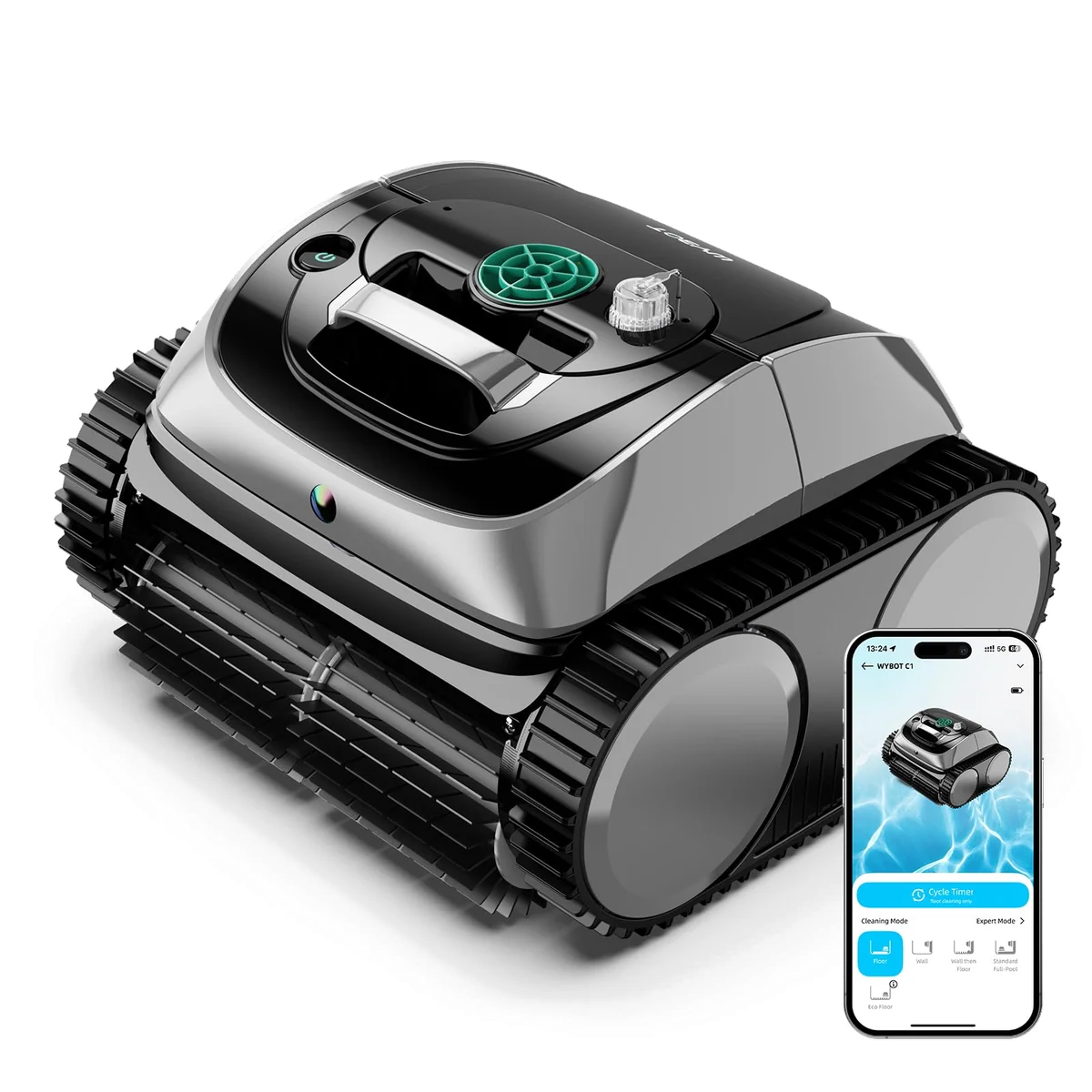
Its strongest case is competent floor cleaning with useful wall and waterline coverage, a top-access filter, and enough claimed runtime for a substantial uncomplicated pool.
Steps and shelves remain conditional, one charge may not finish a complicated pool, and the exact revision lacks enough history to settle durability.
The C1 promises the most familiar whole-pool formula here: a gyroscope-guided route, dual brushes, a 180-micron filter, and modes for floor, walls, waterline, and steps. WYBOT rates the exact listing for up to 160 minutes on a four-hour charge, but the same record contains both a roughly two-and-a-half-hour owner result and an owner whose pool could not be finished on one charge.
Cleaning is the favorable half of the story. Exact owners report pickup of fine sand and large leaves, while filter access is straightforward. The harder questions concern broad shelves, angled steps, benches, route repetition, and what happens when a missed area needs another long cycle after the battery is empty.
The app should be understood before purchase. One exact owner needed a 2.4 GHz network and stronger signal during setup, while no retained exact-model account establishes dependable live communication after submersion. Configure the cleaner while it is accessible, then expect the physical routine of retrieval, rinsing, drying, and charging.
What works
- Open-floor cleaning and routine leaf pickup receive encouraging exact-model reports.
- Wall and waterline modes make it more useful than a floor-only sweeper.
- The top-access filter and cordless setup keep ordinary cycle handling simple.
Strengths
- Open floors and routine maintenance debris are its strongest cleaning case.
- Wall and waterline cleaning can be convincing in pools with simple continuous surfaces.
- The top-access filter and cordless form make an ordinary cleaning cycle easy to manage.
- Exact-product reports support pickup of sand and at least some large leaves.
Limitations
- Steps, shelves, benches, and awkward shallow transitions can derail coverage.
- The advertised runtime may not finish a large or complicated pool on one charge.
- The app appears more useful before launch than while the cleaner is underwater.
- Earlier C1 reports raise credible concerns about electrical or battery failures and difficult support.
What remains unsettled
- The 160-minute maximum does not guarantee complete coverage in a large or complicated pool.
- Step, shelf, bench, and shallow-transition performance depends heavily on geometry.
- The exact review set is too small to answer long-term battery and electronics questions confidently.
Our #1 Pick: WYBOT C2 Vision
Check Price on AmazonWe ranked the cleaning result before the feature count
Four questions decided this order: what debris the machine can actually retain, which pool surfaces it can cover with reasonable consistency, how much handling follows every cycle, and how much confidence the ownership record deserves. A long runtime claim cannot rescue poor routing, and an app does not compensate for a filter that lets the target debris pass through.
Exact listings establish what each current ASIN promises, while retained exact-model reviews show where those promises meet real pool geometry. WYBOT lists the A1 as a floor-focused machine with dual-layer filtration and up to 130 minutes of runtime; it lists the C1 for floor, walls, waterline, and steps with up to 160 minutes; and it gives the C2 Vision eight cleaning modes, dual filtration, and camera-assisted routing. Those are maximums and feature claims, not guarantees that one cycle will cover every surface.
Pool shape received more weight than advertised square footage. Steps, tanning ledges, slopes, liner wrinkles, contrasting fittings, and tight corners repeatedly change the result, even when the pool sits comfortably inside a stated area limit. A simpler cleaner in a compatible pool can save more work than a more ambitious machine that repeatedly strands itself or overlooks the same section.
| Model | Best-supported job | Cleaning reach | Main reason to hesitate |
|---|---|---|---|
| C2 Vision | Fine sediment, dust, pollen, sand, and visible debris pockets | Floor, walls, and waterline, with several selectable routes | The camera can misread stains, color changes, drains, and complicated shallow architecture. |
| A1 | Loose dirt, bugs, sand, and light debris on a smooth floor | Floor only | Random travel, no active scrubbing brush, and sensitivity to wrinkles or slopes narrow its usefulness. |
| B1 | Ordinary visible debris in a small, straightforward pool | Floor, walls, and waterline | Uneven coverage, coarse filtration, an awkward basket latch, and reliability concerns weaken the proposition. |
| C1 | Routine floor debris with useful wall cleaning in a simple pool | Floor, walls, and waterline, with conditional step coverage | Complicated geometry, underwater connectivity limits, and an unsettled durability record keep it from being carefree. |
We did not turn a handful of owner reports into invented failure percentages. The exact C1 record contains only four retained reviews, while the other models also have limited text samples relative to their rating totals. That means the page can identify repeated risks and model-specific failures, but it cannot tell you that a particular percentage of units will fail.
The pool chooses the model before the feature list does
Start with the surface that must be cleaned
If only a flat floor needs frequent loose-debris pickup, the A1 is the least complicated answer. If walls and the waterline matter, remove it from consideration immediately. The B1, C1, and C2 Vision can physically reach more surfaces, but steps and shallow ledges remain conditional rather than assured.
None of these machines should be mistaken for a dependable stair specialist. A robot needs enough water over its body to maintain traction and propulsion, and the angle between floor, riser, tread, bench, or tanning ledge can interrupt its route. Readers whose pool design revolves around those features should use the site’s guide to cleaners for steps, ledges, and shallow shelves rather than choosing from brand loyalty.
Match the filter to the debris, not the suction headline
Coarse leaves and visible dirt ask for intake width and basket capacity. Fine sand, silt, pollen, and dead algae ask for filtration tight enough to retain what the robot picks up. The C2 Vision has the clearest advantage on that second job because its 10-micron insert is materially finer than the 180-micron baskets specified across the lineup.
That insert is not an excuse to run a leaf-packed pool through the finest filter first. Remove or collect the bulky material, then use the tighter layer for what remains. For a broader explanation of why debris type changes the result, read what robotic pool cleaners can pick up.
Decide whether cordless handling is actually easier for you
Cordless eliminates a floating power cable, tangles, and transformer placement beside the pool. It adds a different routine: lift the wet cleaner, drain it, open and rinse the filter, dry the charging area, recharge the battery, and lower the robot again for the next substantial run. That trade is excellent for some decks and surprisingly repetitive for others.
App scheduling does not make a cordless robot self-replenishing. A scheduled machine can divide the charge already inside it, but it cannot climb out, rinse itself, connect its charger, or begin another full battery cycle. The site’s corded versus cordless comparison is the better next step if repeat automation matters more than a cable-free water surface.
Treat app control as preflight configuration
Bluetooth and Wi-Fi features are useful for selecting modes, pool settings, routes, and firmware updates while the cleaner is accessible. They should not be valued as live underwater steering unless the exact product demonstrates another communication method. For these models, configure first and submerge second.
This is normal signal behavior, not necessarily a defective app. It becomes a purchasing problem only when the interface or marketing encourages the buyer to expect real-time submerged control. The guide to how pool-cleaner apps communicate underwater explains that boundary in detail.
Use the return window as the first pool-fit test
- Confirm that the exact charger, manual, retrieval hook, filter pieces, and charging-port cover are present before the cleaner enters the pool.
- Run the mode you expect to use most and record whether the battery completes a meaningful cycle.
- Watch the cleaner at the drain, shallow transition, steps, ledges, corners, slopes, and liner seams.
- Check whether it repeatedly cleans one route while leaving another section untouched.
- Retrieve it from its stopping point and decide whether the wet lifting weight is manageable.
- Open, empty, rinse, reinstall, and latch the filter to expose any daily handling irritation.
- Test app pairing and mode transfer from the place where the cleaner will normally be configured.
- Do not let an intermittent stoppage or charging fault drift beyond the seller’s return deadline.
A pool robot can be technically functional and still be wrong for a particular pool. Returning a machine that cannot navigate the actual geometry is not impatience; it is the correct response to a compatibility failure that another hour of marketing copy will not fix.
Final call
The C2 Vision is the best WYBOT in this group because it combines credible whole-pool cleaning with filtration the cheaper models cannot match. Buy it for the fine filter and configurable cleaning modes, then regard the camera as a conditional bonus.
Skip the C2 Vision if stains, contrasting fittings, multicolored finishes, broad ledges, or upper steps define the pool. Skip the whole lineup if the purchase must deliver proven long-term reliability or unattended repeat cleaning. WYBOT’s strongest machine can remove a great deal of dirt, but it cannot remove the owner from the charging and retrieval loop.
Frequently Asked Questions
Which WYBOT pool cleaner is best overall?
The C2 Vision is the best overall choice here because its 10-micron insert gives it the strongest fine-debris performance, provided the pool has a visually consistent finish.
Should I buy the C1 or the C2 Vision?
Choose the C2 Vision for ultra-fine filtration and targeted debris hunting, but choose the simpler C1 proposition when color changes would confuse the camera and the extra vision features have little value, as explained in the full C1 and C2 Vision comparison .
Is the A1 enough for an above-ground pool?
The A1 can suit a flat, obstacle-light above-ground pool that only needs loose floor debris collected, but it cannot scrub, climb walls, or overcome substantial wrinkles and slopes.
Can WYBOT apps control these robots underwater?
Treat the apps as pre-submersion setup tools because the supplied evidence does not establish reliable live underwater steering for these models.
Can any of these cleaners remove floating leaves?
No, these are submerged vacuums rather than surface skimmers, so floating leaves still require the pool’s skimmer, a net, or a dedicated robotic skimmer.
Can I use one WYBOT charger with another WYBOT model?
Do not assume charger interchangeability because voltage, connector, polarity, and battery-management requirements must match the exact model.
Where should I get the correct WYBOT manual?
Use the manual supplied for the exact model and ASIN or obtain an exact-model copy from the seller or manufacturer rather than following instructions for another A1, B1, C1, C2, Osprey, or S-series revision.
Can a WYBOT stay in the pool between cleaning cycles?
Plan to retrieve, drain, rinse, dry, and charge the cleaner after its run rather than treating a cordless WYBOT as a permanent in-pool appliance.
How should I choose between the A1 and B1?
Choose the A1 only for simple floor sweeping and consider the B1 only when wall reach is worth accepting its less convincing coverage and ownership record, with the differences detailed in the A1 and B1 comparison .
Our Top Pick
The WYBOT C2 Vision earns the top spot. The C2 Vision is the WYBOT to buy for fine debris and a visually simple pool.