The Aiper Scuba S3 Earns a Qualified Yes for Simple Pools
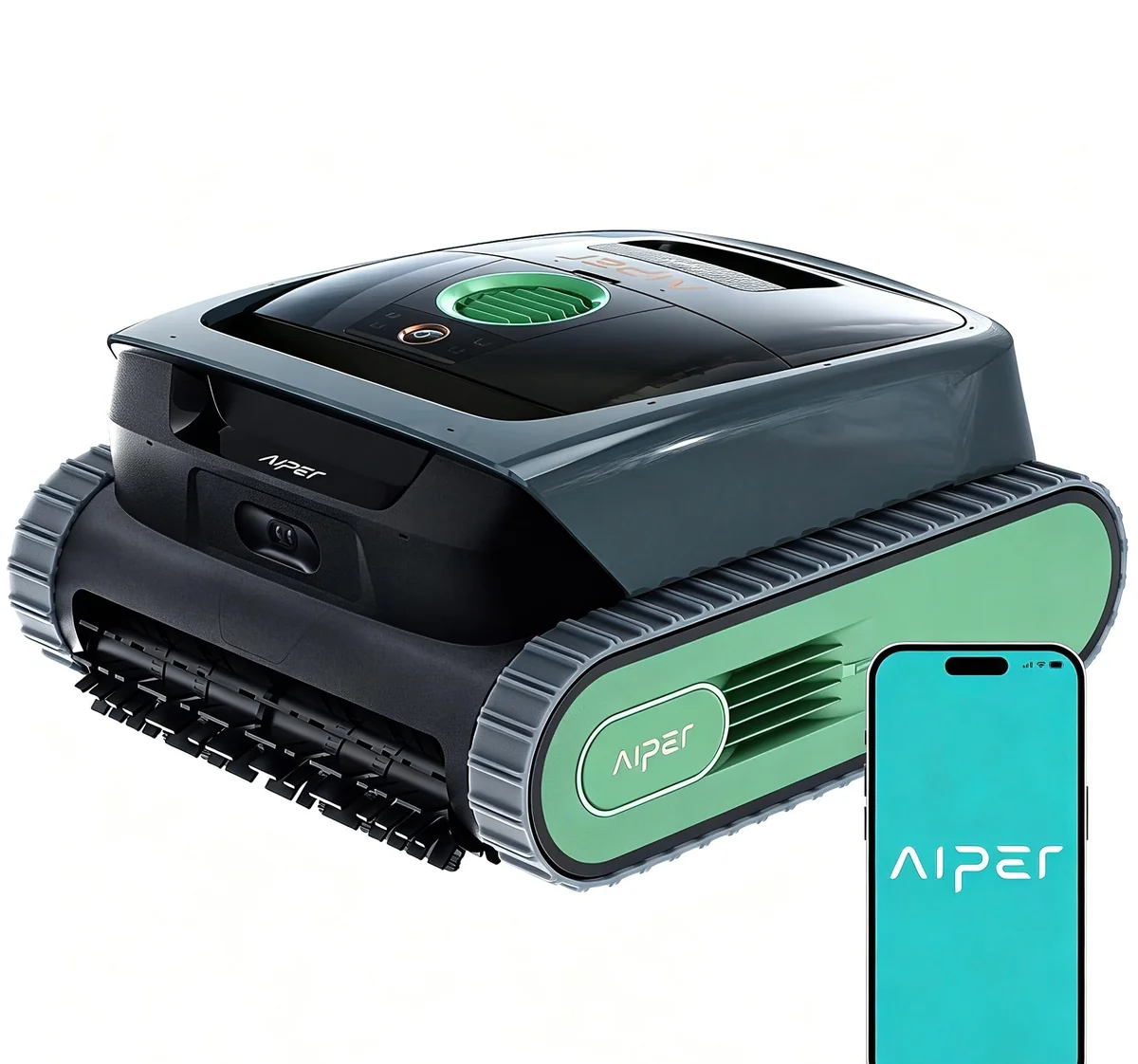
This is a qualified buy for owners of uncomplicated pools who prize cord-free floor cleaning, not for buyers who need flawless steps, underwater app control, or proven multi-season reliability.
The final call
The S3-style Aiper Scuba is worth considering because its central promise survives scrutiny: it can remove a large share of routine floor debris without a hose or cable, and its ultrafine insert can be genuinely useful after the leaf load is gone. The qualification is substantial. Complex geometry exposes coverage gaps, the app stops being a controller underwater, and the exact-owner record already contains battery and cord failures without enough multi-season history to show how common they are.
Buy it for an open, maintainable pool when cordless handling solves a real problem and occasional manual touch-ups are acceptable. Walk away if the listing still cannot confirm the S3 identity, if prominent drains or shallow features repeatedly trap the machine, or if dependable scheduled cleaning matters more than keeping a cord off the deck. For a broader view of alternatives, our cordless pool-cleaner guide compares machines built around the same convenience without pretending that every battery robot carries the same compromises.
The first problem is knowing what is in the box
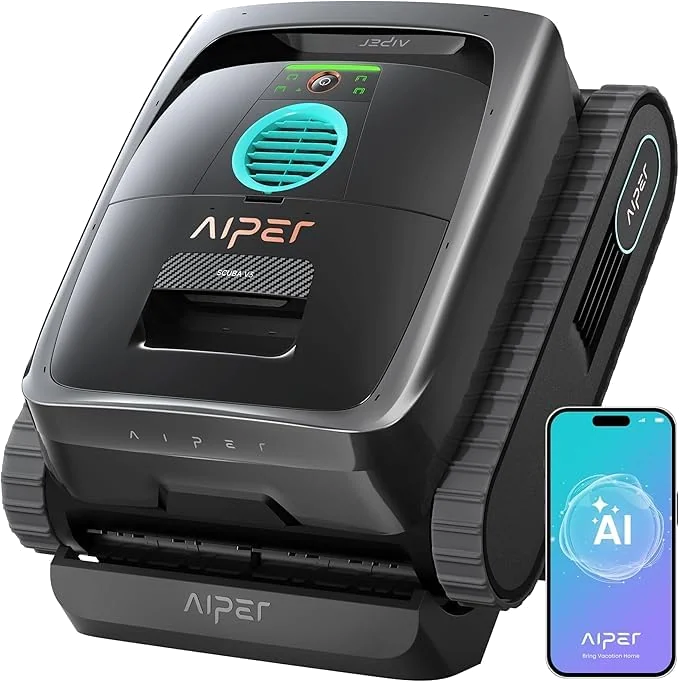
Amazon calls this exact product the “Aiper Scuba Robotic Pool Cleaner, Green,” with ASIN B0GGQZSV9K, but the captured listing never identifies an S3 model number or supplies a proper specification sheet. One retained owner explicitly calls the cleaner a Scuba S3, and the reported ultrafine insert, long runtime, wall and waterline modes, and app behavior resemble the newer S3-style machine. That makes S3 the strongest identification available, not a fact the listing itself settles.
This ambiguity matters because “Aiper Scuba” covers machines with sharply different jobs. Some siblings clean only flat floors for roughly one cycle, while newer models climb walls, travel along the waterline, and use more elaborate navigation. Advice for an S1, SE, 800, N1, or V3 should not be pasted onto this product merely because the shells and names look related.
Key Specifications
The battery, app, and mapping need translation
Plan around one full cleaning cycle
Healthy-unit reports cluster around three hours rather than a dependable four-hour maximum. Two exact owners report more than 180 minutes, while a supplied S3 reviewer measured 189 minutes in a complete cycle. Another owner noticed the cleaner slowing after roughly an hour, and the retained sample also includes a unit whose battery performance deteriorated over its first few uses.
That spread makes a single runtime number misleading. A reasonably healthy machine appears able to complete a substantial maintenance pass, but pool shape, selected mode, debris load, battery condition, and repeated climbing all affect what the owner actually gets. Claims around 240 minutes should be read as mode-dependent ceilings, not the normal result of a full floor, wall, and waterline cycle.
The app works before the dive, not during it
Set the mode or pattern before lowering the cleaner into the pool because its Wi-Fi connection disappears underwater. The onboard button still gives access to the basic auto, floor, wall, and waterline modes, so the app is not required for an ordinary run. An exact owner found the app rudimentary, received no useful notifications, and wanted a coverage report that was not provided.
“Smart navigation” therefore means patterned movement and sensor-based decisions, not a Roomba-style map that proves every square foot was visited. One owner thought the machine had a mind of its own, and another watched it repeat the same region of a curved bowl. Judge the floor after a cycle rather than trusting the label.
Automatic cleaning still leaves an ownership loop
The machine automates the underwater pass, but someone must retrieve it, let the water drain, empty and rinse the basket, clean the separate fine insert when used, dry the charging area, and recharge the battery. Missed corners or steps remain a manual job. That is dramatically less work than assembling hoses and operating a pump vacuum, but it is not hands-off daily pool care.
Retrieval also deserves a trial run. The cleaner may finish somewhere awkward, and an owner who misses its reachable position can struggle to find the hook point in cloudy deep water. Test where it tends to stop before assuming every cycle will end at the convenient side of the pool.
Strengths & Limitations
Strengths
- Fine debris and ordinary leaves are the strongest parts of the exact-owner record.
- Floor cleaning can replace much of the hose and pole-vacuum routine.
- Basic cleaning modes can be selected on the machine without opening the app.
- Wall and waterline modes add useful coverage in pools with straightforward geometry.
Limitations
- The generic Amazon title does not confirm that B0GGQZSV9K is the S3.
- Curved bowls, corners, steps, ledges, and main drains can defeat or redirect it.
- Wi-Fi drops underwater, so mid-cycle app changes are unavailable.
- The exact-owner sample includes an early cord failure and rapid battery deterioration.
- Long-term durability remains unproven for this exact listing.
It finds dirt more reliably than it finds every part of the pool
The cleaning result is the convincing part of this review. Exact owners report baskets full of leaves, dirt, grime, algae residue, and very fine particles. One freeform-pool owner described a change from a neglected mess to almost spotless within a week, while another said the first full-charge run collected a remarkable amount of material. Even the owner who returned the cleaner for battery trouble praised its microparticle pickup.
The floor is its safest assignment. Owners describe dependable routine pickup there, and one runs floor mode on weekday mornings while reserving the walls and waterline for occasional cycles. A Grecian-style pool produced only small missed areas, but a curved deep-end bowl made the cleaner repeat the same wall section while debris remained in curved corners. The machine can climb, but climbing capability is not the same as complete wall coverage.
Pool geometry writes the real route plan
Steps and tight corners still need manual attention. A main drain can hold the cleaner until someone nudges it, and a detailed S3 demonstration found that approach angle determined whether the tracks could maintain contact on ledges and transitions. Direct contact with a drain could interrupt the route, while a corner could leave the cleaner without useful traction until it reversed.
| Job | Reasonable expectation |
|---|---|
| Open floor | The most dependable coverage, especially for settled leaves, dirt, and routine debris. |
| Straight walls | Useful climbing and scrubbing, though individual sections may still be missed. |
| Waterline | Horizontal cleaning is supported, but corners and transitions can interrupt a pass. |
| Steps and ledges | Success depends on width, angle, and whether both tracks can maintain contact. |
| Main drains | Test them early because the cleaner may cross, hesitate, divert, or become stuck. |
Fine debris needs a two-pass strategy
The included ultrafine insert is not merely a brochure feature. Owners credit it with catching microparticles, algae residue, and other fine material. For a leaf-heavy pool, the smarter routine is to run the larger basket without the insert first, empty it, then reinstall the fine filter for the dustier second pass. That preserves capacity and reduces the chance that leaf load chokes the finer media.
Do not turn that praise into a promise that the robot polishes pool water. A quantified comparison of related Aiper S1 and V3 models found that secondary fine media could still allow sand or silt back into the water column, although that test did not include this S3-style listing. The fair conclusion is that the insert improves fine-particle capture, not that it replaces circulation, filtration, or a careful vacuum-to-waste cleanup.
A green pool is beyond its brief. Chemistry, filtration, brushing, and sometimes waste vacuuming must solve the outbreak first; the robot can then collect settled dead algae and remaining debris during recovery. One exact owner states that limitation plainly.
Cordless convenience is the product, not a free bonus
The reason to choose this Aiper is simple: no power cable, suction hose, booster connection, or pump setup follows it into the water. That matters around fences, across busy decks, and for owners who find conventional vacuuming physically punishing. The trade is equally simple: the cable disappears from the pool and reappears as charging, retrieval, battery aging, and the inability to communicate with the cleaner underwater.
Its value therefore depends more on routine than on a feature count. It makes sense for an owner who can drop it into a reasonably open pool, let it concentrate on the floor, rinse it afterward, and touch up a few difficult features. It makes much less sense for someone buying the word “automatic” in hopes of eliminating observation, charging, and manual corner work.
S3, V3, or a corded Dolphin
The newer Aiper V3 adds camera-based debris targeting and a charging dock, while the S3 is positioned as the simpler way to get the core floor, wall, and waterline hardware without paying for camera-guided hunting. Buyers deciding whether targeted debris detection is worth the added complexity can use our Aiper Scuba V3 and S3 comparison.
Dolphin is not automatically better at every job. In a systematic test that covered an Aiper S1 rather than this S3, the Aiper posted stronger wall coverage than the tested Dolphin while the Dolphin retained fine silt more effectively. That result argues against choosing by logo alone. If continuous power and avoiding battery logistics matter more than a cord-free deck, start with our guide to corded and cordless pool robots and then examine the Dolphin Nautilus CC review.
Within Aiper’s own range, the safest next step is the Aiper model guide, especially if the seller cannot resolve the identity of B0GGQZSV9K. A lower model name is not a harmless substitution when floor-only cleaners and wall-climbing machines share the same broad Scuba branding.
The cleaning is proven sooner than the hardware
The exact-owner record is reassuring about short-term debris pickup and much weaker about durability. One cord reportedly failed after three days and led to a delayed refund, while another cleaner showed rapidly declining battery usefulness over its first few outings and was returned. Several positive reviewers had owned their machines for only a short period, and one explicitly reserved judgment on longevity.
Reports about other Scuba generations cannot diagnose this S3-style unit, but they show why the early faults deserve weight. S1 and N1 owner discussions range from dependable year-long use to dead-on-arrival machines, failures after several months, repeated returns, unavailable parts, and support cases that stalled after polite responses. Other owners did receive replacements or refunds, so the record supports uncertainty rather than a claim that every Aiper fails.
Smart Pool Bots would treat the return window as a test period. Run every mode, check the curved wall, steps, ledges, and drains, compare early-cycle and late-cycle movement, confirm a complete charge, and retain the packaging until those checks are finished. A machine that cannot navigate the pool or hold useful battery performance when new is unlikely to become a better fit after the easy return period closes.
Care cannot cure a defect, but it can reduce avoidable strain
A long-term S1 owner describes a disciplined routine of removing the cleaner, rinsing the basket and body, letting the parts dry, drying the charge-port area, and then charging. Those are sibling-model practices rather than an S3 manual, but they are sensible habits for a cordless machine exposed to treated water. They do not excuse a three-day cable failure or a defective battery.
The unanswered question is not whether the cleaner can make an impressive first basket. It can. The unanswered question is how many seasons the battery, charging hardware, seals, and electronics will keep delivering that result, and the available record is too young and too polarized for confidence.
Sources (3)
- Amazon listings and customer reviews — Aiper Scuba S3
- Owner reports across r/PoolPros, r/pools threads
- Owner and reviewer video, 4 channels